A vial of white powder labeled 5 mg, a 30 mL bottle of bacteriostatic water, and a box of insulin syringes. Here is the answer: add 2.5 mL of bacteriostatic water to a 5 mg tesamorelin vial, run the stream down the glass wall, roll the vial gently until the solution is clear, and refrigerate it. That ratio gives 2 mg/mL, so 1 mg is 50 units on a U-100 syringe and 2 mg is a full 100 units.
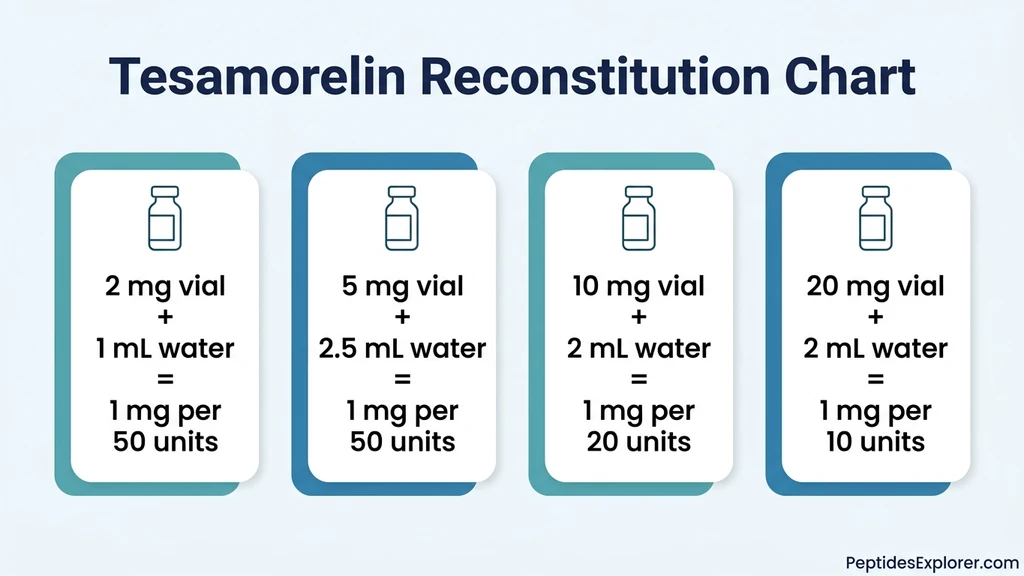
| Vial | Bac water | Concentration | 1 mg draw | 2 mg draw |
|---|---|---|---|---|
| 2 mg | 1 mL | 2 mg/mL | 50 units | 100 units |
| 5 mg | 2.5 mL | 2 mg/mL | 50 units | 100 units |
| 10 mg | 2 mL | 5 mg/mL | 20 units | 40 units |
| 20 mg | 2 mL | 10 mg/mL | 10 units | 20 units |
This page covers mixing, drawing, and storing only. Which dose to draw and how long to run it belongs to the tesamorelin dosage chart. The compound itself, a GHRH analog with one narrow FDA approval, is profiled in the tesamorelin peptide overview.
Get your custom peptide protocol:
- Tailored to your body and goals
- Precise dosing and cycle length
- Safe stacking combinations
- Backed by peer-reviewed studies
- Ready in under 2 minutes
What You Need Before You Open the Vial
Lay everything out first. Reconstitution goes wrong when you are hunting for a swab with a needle already in the stopper.
- Lyophilized tesamorelin vial (2, 5, 10, or 20 mg)
- Bacteriostatic water, 0.9% benzyl alcohol, in a 30 mL bottle
- One 3 mL syringe with an 18 to 22 gauge needle, for the water
- U-100 insulin syringes, 29 to 31 gauge, 0.5 mL or 1 mL
- Alcohol swabs, a fine marker, and a sharps container
The water choice decides how long the vial lives. Bacteriostatic water carries 0.9% benzyl alcohol, a preservative that suppresses microbial growth across the repeated stopper punctures of a multi-dose vial (Meyer et al., J Pharm Sci, 2007, PMID 17722087). Sterile water has none, which is why the single-dose Egrifta SV kit ships sterile water and the weekly-mix Egrifta WR kit ships bacteriostatic water.
The full comparison is in the bacteriostatic vs sterile water guide, sourcing in where to buy bacteriostatic water, and the "reconstitution solution" labeling confusion in the reconstitution solution comparison.
Tesamorelin Reconstitution, Step by Step
The whole procedure takes five minutes. The slow part is the water going in.
- 1.Warm and clean. Let the vial and the water bottle reach room temperature. Wash your hands.
- 2.Swab both stoppers. Separate alcohol swabs for the peptide vial and the water bottle. Let them dry for 10 seconds.
- 3.Draw the water. Pull 2.5 mL (for a 5 mg vial) into the 3 mL syringe. Not an insulin syringe: 2.5 mL is two and a half refills of 100 units, and every refill is a chance to lose count.
- 4.Aim at the glass. Push the needle through the stopper at an angle so the tip rests against the inside wall. Press the plunger over 30 to 60 seconds.
- 5.Roll, never shake. The Egrifta label says to roll the vial gently between your hands for about 30 seconds and never shake it. Mechanical stress drives peptides to aggregate in solution (Manning et al., Pharm Res, 2010, PMID 20143256), and aggregated peptide is peptide you cannot use.
- 6.Inspect. Clear, colorless, nothing floating. That is the label's own acceptance test.
- 7.Label the vial. Date, concentration in mg/mL, and the unit count for your draw. Ten seconds that prevent every mistake in the scenarios below.
- 8.Store. A research vial goes in the refrigerator at 2 to 8 degrees C, upright, away from light. A prescription Egrifta vial follows its own label, which says the opposite; the storage section explains why.
The generic technique, including what to do when a cake refuses to dissolve, is in the peptide reconstitution walkthrough. The same rolling, aiming, and labeling steps carry over to the CJC-1295 and ipamorelin reconstitution guide, only at microgram concentrations. What happens after mixing is in the peptide injection guide.
Why the Water, Not the Vial, Sets Your Units
Think of a powdered drink mix. One packet stirred into a small glass makes a strong drink; the same packet stirred into a pitcher makes a weak one. The sugar never changed, but each sip carries a different amount.
Literally stated: the milligrams of tesamorelin in the vial are fixed. The water you add sets the concentration in mg/mL, and the concentration sets how many units deliver your draw. Two people with identical 5 mg vials inject different volumes for the same draw if one added 1 mL and the other added 2.5 mL. Convert any draw at any concentration with the peptide unit converter.
Water Volumes and Unit Math for 2, 5, 10, and 20 mg Vials
Two lines of arithmetic run every row of this table. Concentration in mg/mL = mg in the vial divided by mL of water. Units on a U-100 syringe = (draw in mg divided by concentration in mg/mL) times 100.
Worked once: a 10 mg vial plus 2 mL of water is 10 divided by 2, or 5 mg/mL. A 2 mg draw is 2 divided by 5, or 0.4 mL, which is 40 units.
| Vial | Bac water | Concentration | 1 mg draw | 2 mg draw |
|---|---|---|---|---|
| 2 mg | 0.5 mL | 4 mg/mL | 25 units | 50 units |
| 2 mg | 1 mL | 2 mg/mL | 50 units | 100 units |
| 5 mg | 1 mL | 5 mg/mL | 20 units | 40 units |
| 5 mg | 2.5 mL | 2 mg/mL | 50 units | 100 units |
| 10 mg | 1 mL | 10 mg/mL | 10 units | 20 units |
| 10 mg | 2 mL | 5 mg/mL | 20 units | 40 units |
| 10 mg | 5 mL | 2 mg/mL | 50 units | 100 units |
| 20 mg | 2 mL | 10 mg/mL | 10 units | 20 units |
| 20 mg | 4 mL | 5 mg/mL | 20 units | 40 units |
Pick the row that lands your draw between 20 and 50 units: large enough to read accurately, small enough for a 0.5 mL syringe. A 100-unit draw fills a 1 mL syringe to the very top, where the last mark is hardest to read; a 10-unit draw is so small that one tick of error is a 10% dose error.
One capacity note: 10 mg plus 5 mL, or 20 mg plus 4 mL, only works if the glass holds that much, and many research vials are 3 mL. Check your own vial with the peptide reconstitution calculator before the water goes in.
How to Read a U-100 Syringe for a Tesamorelin Draw
A U-100 insulin syringe holds 100 units per mL, so 1 unit is 0.01 mL. The 0.3 mL syringe marks every half unit, the 0.5 mL syringe every unit, and the 1 mL syringe every 2 units.
Match the syringe to the draw. At 2 mg/mL, a 2 mg draw is 100 units, the entire barrel of a 1 mL syringe with the plunger on the last line. At 5 mg/mL, the same draw is 40 units, mid-barrel on a 0.5 mL syringe with every unit marked. The second setup is easier to read and easier to repeat.
Read the leading edge of the black plunger tip, not the rubber dome, at eye level. Tap the barrel with a fingernail to raise air bubbles, push them out, and re-draw to the line. A U-40 syringe or a tuberculin syringe marked in mL breaks every number on this page; U-100 only.
What the Egrifta Label Says, and Where Research Vials Differ
Tesamorelin is the FDA-approved GHRH analog sold as Egrifta, approved for one use: reducing excess abdominal fat in adults with HIV-associated lipodystrophy. In the phase 3 program, visceral fat fell about 15 to 18% over 26 weeks against placebo (Falutz et al., N Engl J Med, 2007, PMID 18057338; Falutz et al., J Clin Endocrinol Metab, 2010, PMID 20554713), and a later trial showed reductions in liver fat as well (Stanley et al., JAMA, 2014, PMID 25038357). Every other use is off-label or research use, a distinction covered in is tesamorelin FDA approved.
Two prescription formulations exist, and their labels are the only tesamorelin mixing instructions backed by stability data.
Egrifta SV (2 mg vial). Mix with 0.5 mL of Sterile Water for Injection for 2 mg per 0.5 mL. Roll gently for 30 seconds, never shake, use immediately, and discard any unused solution; the label says never to store, freeze, or refrigerate the mixed vial. The powder carries histidine, mannitol, polysorbate 20, and sucrose alongside the peptide (Egrifta SV prescribing information).
Egrifta WR (11.6 mg vial). Mix with 1.3 mL of Bacteriostatic Water for Injection for 8 mg/mL. One vial gives 7 daily doses of 1.28 mg (0.16 mL), which the label describes as exposure similar to 2 mg of the original 1 mg/vial formulation. Store the mixed vial at 20 to 25 degrees C, out of light, never refrigerated or frozen, and discard it 7 days after mixing; the water bottle is discarded 28 days after first use (Egrifta WR prescribing information).
A research vial does not inherit those rules. Egrifta's 7-day room-temperature window was earned with stability testing on that exact excipient blend in that exact vial. A research vial arrives with no excipient list and no stability file, so the conservative default is the refrigerator and a shorter clock. The same logic applies to the analogs compared in tesamorelin vs CJC-1295 and tesamorelin vs sermorelin vs ipamorelin.
Storage After Mixing: Label Rules vs Community Practice
Peptides in solution degrade through hydrolysis, deamidation, oxidation, and aggregation, and those reactions run faster as temperature rises (Manning et al., Pharm Res, 2010, PMID 20143256). The clock starts the moment water touches powder.
| Product | Diluent | After mixing | Window |
|---|---|---|---|
| Egrifta SV, 2 mg | 0.5 mL sterile water | Use immediately, never refrigerate | Single use |
| Egrifta WR, 11.6 mg | 1.3 mL bacteriostatic water | 20 to 25 degrees C, dark, no refrigerator | 7 days per label |
| Research vial, 2 to 20 mg | Bacteriostatic water | 2 to 8 degrees C, dark, upright | 14 to 28 days, community practice |
Be honest about what each number is. The label's 7 days is a tested claim. The community's 14 to 28 days refrigerated is convention; no published stability study covers research-grade tesamorelin in bacteriostatic water, so treat 14 days as the safe end and 28 as the outer limit for a vial that stayed cold and clear. Peptide-by-peptide timelines are in the reconstituted shelf-life guide.
Size the vial to the window; a 20 mg vial that outlives its clock is wasted peptide, not a bargain. Never freeze a mixed vial, never leave it on the counter overnight, and never top up a nearly empty vial with fresh water to stretch the last doses.
The water bottle has its own rules: refrigeration optional, per does bacteriostatic water need to be refrigerated, but the 28-day discard after first puncture is firm, per the bacteriostatic water shelf-life guide. Unmixed research powder stays refrigerated and dark; the broader rules are in how to store peptides.
Signs of a Bad Vial
The label's acceptance test is clear, colorless, and free of particles. Anything else fails.
- Cloudy or hazy after 10 minutes of gentle rolling. Aggregated peptide, not undissolved powder.
- Floating particles, strands, or a film on the glass. Do not filter and inject; discard.
- Any color. Tesamorelin solution is colorless. Yellow or tan means degradation or contamination.
- A cake that will not dissolve. Water jetted onto the powder clumps it; let the vial stand upright for 10 minutes and roll again. Still solid after that, the vial is suspect.
- Powder that arrived wet, shrunken, or discolored. Lyophilized tesamorelin is a white to off-white cake.
- Rubber flecks in the solution. Coring from a steep needle angle. Enter at 45 degrees with the bevel up, then straighten.
- Past the window, or warm overnight. No visual check rescues a vial that sat at room temperature for 12 hours.
When a vial fails, photograph it, note the lot number, and contact the supplier. Do not inject it to "see."
Three Quantified Mistakes
Half the water, double the dose. You planned 2.5 mL into a 5 mg vial but the syringe held 1.25 mL. The vial is now 4 mg/mL, and your 100-unit draw delivers 4 mg instead of 2 mg, a silent 2x overdose every day until the vial empties. The adverse events that separated tesamorelin from placebo in the pooled trials, injection-site reactions, joint pain, and fluid retention, scale with exposure (Falutz et al., J Clin Endocrinol Metab, 2010, PMID 20554713). Fix: read the 3 mL barrel before the water goes in, and write the real concentration on the vial.
New vial, old units. You finished a 2 mg vial mixed at 1 mL (2 mg/mL), where 2 mg was 100 units. The next vial is 10 mg with 2 mL (5 mg/mL). The habitual 100-unit draw now delivers 5 mg, two and a half times your draw, and the vial is gone in two days. Fix: recalculate units every time you mix, never from memory.
Copying the Egrifta SV ratio. Half a milliliter into a 10 mg research vial makes 20 mg/mL, where 2 mg is a 10-unit draw and every tick of misreading is 10% of the dose. Fix: the 0.5 mL ratio belongs to a 2 mg single-use vial; scale water to the vial you hold.
Sterile water on a multi-week vial. A research vial gets punctured daily for 2 to 4 weeks. Without benzyl alcohol, every puncture is a contamination opportunity with nothing pushing back (Meyer et al., J Pharm Sci, 2007, PMID 17722087). Egrifta SV can afford sterile water because the vial dies after one draw; yours cannot. Fix: bacteriostatic water for any vial that outlives one use.
Frequently Asked Questions
How much bacteriostatic water do you add to a 5 mg tesamorelin vial?
2.5 mL is the standard volume, giving 2 mg/mL: 1 mg is 50 units and 2 mg is 100 units on a U-100 syringe. Adding 1 mL instead gives 5 mg/mL, where 2 mg is 40 units. Check any other volume with the peptide reconstitution tool.
How many units is 2 mg of tesamorelin?
It depends only on concentration. At 2 mg/mL, 2 mg is 100 units; at 5 mg/mL it is 40 units; at 10 mg/mL it is 20 units; at the Egrifta SV ratio of 4 mg/mL it is 50 units. Convert any draw with the peptide unit converter.
Can you use sterile water to reconstitute tesamorelin?
Only for a vial you empty in one draw, which is exactly how the single-dose Egrifta SV uses it. A research vial punctured daily for 2 to 4 weeks needs the 0.9% benzyl alcohol in bacteriostatic water. The bacteriostatic vs sterile water guide covers the difference.
Should reconstituted tesamorelin be refrigerated?
For a research vial, yes: 2 to 8 degrees C, dark, upright. For prescription Egrifta, no; the label says to store the mixed WR vial at 20 to 25 degrees C and never refrigerate it, because its excipient blend was stability-tested that way. The reconstituted shelf-life guide explains both cases.
How long does reconstituted tesamorelin last?
The Egrifta WR label allows 7 days at room temperature after mixing with bacteriostatic water. Community practice for refrigerated research vials is 14 to 28 days, a convention rather than tested data. Discard cloudy or colored solution at any age, per how to store peptides.
Can you shake a tesamorelin vial to dissolve the powder?
No. The Egrifta label says to roll the vial gently between your hands for about 30 seconds and never shake it, and mechanical stress makes peptides aggregate (PMID 20143256). Powder that resists gentle rolling usually got hit by a direct water stream; the peptide reconstitution walkthrough covers the fix.
What does the Egrifta label say about mixing tesamorelin?
Egrifta SV: 2 mg vial plus 0.5 mL sterile water, roll 30 seconds, use immediately, discard the rest. Egrifta WR: 11.6 mg vial plus 1.3 mL bacteriostatic water for 8 mg/mL, 7 daily doses of 0.16 mL, discard 7 days after mixing. Its approval status is covered in is tesamorelin FDA approved.
How do you know if a tesamorelin vial has gone bad?
A good solution is clear and colorless with no particles, the label's own acceptance test. Cloudiness after 10 minutes of rolling, floating strands, yellow tint, or a cake that will not dissolve all mean discard. Water quality matters too; see does bacteriostatic water need to be refrigerated.
The Bottom Line
2.5 mL of bacteriostatic water into a 5 mg vial gives 2 mg/mL: 50 units per milligram. Aim at the glass, roll for 30 seconds, confirm it is clear and colorless, label it, and refrigerate.
The principle: the vial fixes the milligrams, the water fixes the concentration, and the label you write is the only record of it. Egrifta's 7-day room-temperature rule belongs to Egrifta's formulation; a research vial earns nothing but the refrigerator and a shorter clock.
Check every setup with the peptide reconstitution calculator before the water goes in, and read the tesamorelin peptide overview for the compound behind the vial. Tesamorelin is FDA-approved only for HIV-associated abdominal fat; every other use is research use, and this content is educational, not medical advice. More guides at PeptidesExplorer.
Related Articles
Tesamorelin Peptide: Uses, Evidence, Risks
Tesamorelin peptide explained: a GHRH analogue FDA-approved as Egrifta for HIV lipodystrophy. What it does to visceral fat, IGF-1, and who should avoid it.
How to Reconstitute CJC-1295 and Ipamorelin (Unit Math)
Reconstitute CJC-1295 and ipamorelin: 2 mL bacteriostatic water per 5 mg vial = 25 mcg per unit. Water volumes, unit tables, blend rules, storage.
How to Reconstitute MOTS-c: Step-by-Step
How to reconstitute MOTS-c step by step. Mixing table for 5mg and 10mg vials, syringe unit math, storage shelf life, and the reconstitution mistakes to avoid.
Tesamorelin vs Ipamorelin: Key Differences
Tesamorelin vs ipamorelin: GHRH analog vs ghrelin mimetic. Fat loss data, dosing, side effects, cost, and stacking protocols. PubMed-cited guide.