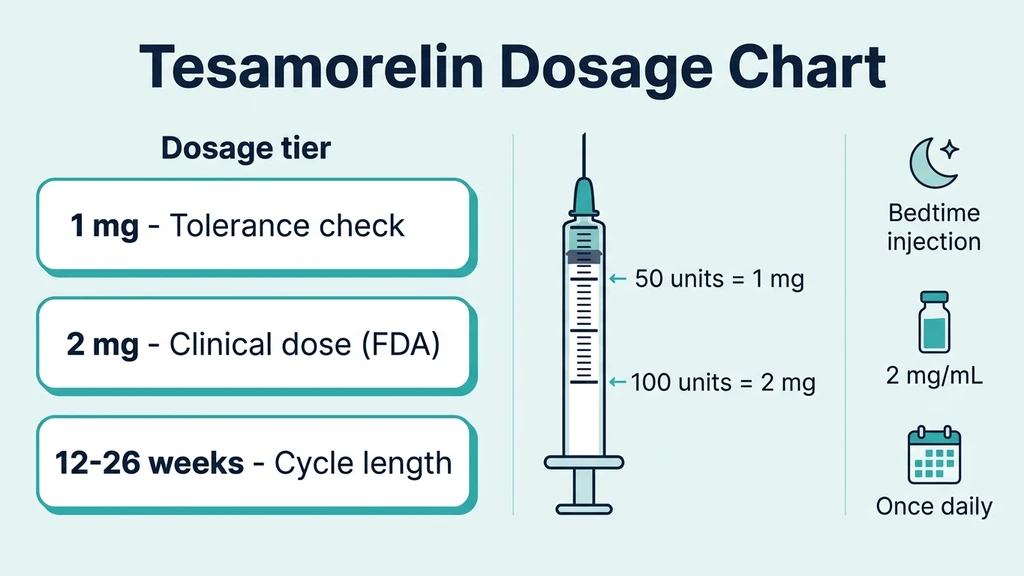
You have a tesamorelin vial in one hand and an insulin syringe in the other, and every source quotes a different number. Here is the anchor: the FDA-approved clinical dose is 2 mg injected subcutaneously once daily, the dose used in the Egrifta trials for HIV-associated lipodystrophy. Research protocols typically run 1 to 2 mg per day for 8 to 16 weeks. Everything else, including the syringe units, depends on how you reconstitute.
| Protocol | Daily dose | Schedule | Typical duration |
|---|---|---|---|
| Conservative start | 1 mg | Once daily | Weeks 1-2, then reassess |
| Standard research | 2 mg | Once daily | 8-16 weeks |
| FDA clinical (Egrifta, HIV lipodystrophy) | 2 mg | Once daily | Continuous, reassessed |
| Egrifta SV (concentrated formulation) | 1.4 mg | Once daily | Continuous, reassessed |
| Egrifta WR (weekly-reconstitution formulation) | 1.28 mg | Once daily | Continuous, reassessed |
This page is the all-purpose chart for tesamorelin: dosing tiers, reconstitution math, timing, titration, and cycle length. It replaces the generic peptide dosage chart for this one compound. Tesamorelin outside a prescription is a research chemical, so treat every number here as education, not medical advice.
Get your custom peptide protocol:
- Tailored to your body and goals
- Precise dosing and cycle length
- Safe stacking combinations
- Backed by peer-reviewed studies
- Ready in under 2 minutes
How Tesamorelin Dosing Works
Tesamorelin is a growth hormone-releasing hormone (GHRH) analog. It does not put growth hormone into your body. It signals your pituitary to release more of its own, in the same pulsatile rhythm it already uses.
Think of a furnace on a thermostat. Injecting synthetic HGH is like running a space heater at full blast all night: constant heat, no feedback, no off switch. Tesamorelin turns the thermostat up instead, so your own furnace burns hotter during its normal cycles and still shuts off when the room warms. Literally: tesamorelin amplifies your natural GH pulses while IGF-1 feedback keeps the axis regulated, which is why dosing stays fixed instead of climbing.
That mechanism explains the flat dose. In the pivotal trial, 2 mg daily raised IGF-1 and cut visceral adipose tissue by roughly 15% over 26 weeks in patients with HIV-associated central fat accumulation (Falutz et al., N Engl J Med, 2007, PMID 18057338). More was not tested as better; 2 mg was simply the dose that moved fat without breaking the feedback loop. It also explains why tesamorelin is dosed daily while HGH itself follows different rules, and why it behaves differently from the GHRP class covered in the tesamorelin vs sermorelin vs ipamorelin comparison.
Tesamorelin Dosage Chart by Goal
One sentence of context first: only the HIV lipodystrophy dose is FDA-validated, and every other tier below is extrapolated from it by researchers and clinics.
| Goal or context | Daily dose | Weekly total | Schedule | Duration | Evidence level |
|---|---|---|---|---|---|
| Tolerance check (any goal) | 1 mg | 7 mg | Once daily | 1-2 weeks | Extrapolated |
| HIV lipodystrophy (Egrifta) | 2 mg | 14 mg | Once daily | Continuous | FDA-approved |
| Visceral fat research | 2 mg | 14 mg | Once daily | 12-26 weeks | Phase 3 trials |
| General fat loss research | 1-2 mg | 7-14 mg | Once daily | 8-16 weeks | Extrapolated |
| Liver fat (NAFLD) research | 2 mg | 14 mg | Once daily | 6-12 months | RCT in HIV |
| Sleep and recovery research | 1 mg | 7 mg | Once daily, evening | 8-12 weeks | Anecdotal |
| 5-on-2-off pattern | 1-2 mg | 5-10 mg | Weekdays only | 8-16 weeks | Anecdotal |
The visceral fat numbers are the best documented. Across two pooled phase 3 trials, 2 mg daily reduced visceral adipose tissue by about 15-18% versus placebo over 26 weeks, and the fat returned after discontinuation (Falutz et al., J Clin Endocrinol Metab, 2010, PMID 20554713). A separate randomized trial found tesamorelin also reduced liver fat (Stanley et al., JAMA, 2014, PMID 25038357), later confirmed over 12 months in a dedicated NAFLD trial (Stanley et al., Lancet HIV, 2019, PMID 31611038).
If your only goal is body composition, the fat-loss-specific protocols, stacking options, and week-by-week expectations live in the dedicated tesamorelin dosage for fat loss guide. The regulatory picture, including what the approval does and does not cover, is in is tesamorelin FDA approved.
Reconstitution and Injection Math
Research tesamorelin ships as lyophilized powder, usually in 2 mg, 5 mg, or 10 mg vials. Your syringe units depend entirely on how much bacteriostatic water you add. The peptide amount is fixed; the water only sets the concentration.
| Vial size | Water added | Concentration | 1 mg dose | 2 mg dose |
|---|---|---|---|---|
| 2 mg | 1 mL | 2 mg/mL | 50 units | 100 units |
| 5 mg | 2.5 mL | 2 mg/mL | 50 units | 100 units |
| 5 mg | 1 mL | 5 mg/mL | 20 units | 40 units |
| 10 mg | 2 mL | 5 mg/mL | 20 units | 40 units |
| 10 mg | 1 mL | 10 mg/mL | 10 units | 20 units |
Walk through one row so the logic sticks. A 5 mg vial plus 2.5 mL of water gives 5 mg / 2.5 mL = 2 mg per mL. On a U-100 insulin syringe, 1 mL equals 100 units, so a 2 mg dose is a full 100 units and a 1 mg dose is 50 units. Add only 1 mL instead and the same vial becomes 5 mg/mL, so 2 mg shrinks to 40 units.
Write the concentration on the vial with a marker the moment you reconstitute. Full technique, from swabbing the stopper to aiming the water stream down the glass wall, is in the how to reconstitute peptides guide. To check your own numbers, run them through the peptide reconstitution calculator or convert any dose with the peptide unit converter.
Timing and Cycle Length
Inject tesamorelin once daily, and pick a consistent slot. Two timings dominate real protocols: the Egrifta label pattern of a fixed daily time into abdominal fat, and the research habit of injecting 30 to 60 minutes before bed on an empty stomach.
The bedtime logic is physiological. Your largest natural GH pulse arrives during the first hours of deep sleep, and a GHRH analog amplifies pulses that are already firing. Food works against you here because elevated insulin and free fatty acids blunt GH release, so keep 2 to 3 hours between your last meal and the injection.
Cycle length depends on the goal. Visceral fat changes need patience: measurable reduction took 26 weeks in the phase 3 trials, and stopping reversed it, with visceral fat returning toward baseline during the off-treatment extension (Falutz et al., 2010, PMID 20554713). Liver fat needed 12 months to show its full effect (Stanley et al., Lancet HIV, 2019, PMID 31611038).
A practical research pattern is 12 weeks on, then 4 or more weeks off while you evaluate waist measurements and bloodwork. Tesamorelin's half-life is short, roughly 26 to 38 minutes, so the drug clears within hours even though its downstream IGF-1 effects persist for days; you can model this decay with the peptide half-life tracker. Between injections, keep the reconstituted vial refrigerated and follow the peptide storage guide, because a degraded vial quietly turns a 2 mg dose into an unknown one.
Titration and Common Mistakes
Tesamorelin needs no GLP-1 style titration ladder. The clinical dose starts at 2 mg on day one. Many researchers still run 1 mg for the first 1 to 2 weeks as a tolerance check for water retention, joint aches, and injection-site reactions, then step up to 2 mg. That is the entire ramp.
The expensive errors are concentration errors, not titration errors.
Mistake 1: carrying old syringe units to a new concentration. You finish a 5 mg vial mixed with 2.5 mL (2 mg/mL), where your 2 mg dose was 100 units. The next vial gets only 1 mL of water, making 5 mg/mL. Draw your usual 100 units and you inject 5 mg, 2.5 times the clinical dose, with the fluid retention, joint pain, and glucose spikes that scale with it. Fix: recalculate units every single time you reconstitute.
Mistake 2: dosing a 10 mg vial like a 2 mg vial. A 10 mg vial with 1 mL of water is 10 mg/mL. The habitual 100-unit draw now delivers 10 mg, five times the studied dose, in one injection. Fix: write mg/mL on the vial label before the first draw.
Mistake 3: ignoring glucose. Tesamorelin raised IGF-1 and nudged glucose measures in trials (Falutz et al., 2007, PMID 18057338), which matters if you are insulin resistant. Fix: baseline fasting glucose and IGF-1, then recheck at week 8 to 12, as outlined in the peptide safety guide.
Mistake 4: quitting at week 4 and calling it a failure. Visceral fat moved over 26 weeks in the trials, not four. If daily 2 mg injections do not fit your budget or patience, compare longer-acting alternatives in the tesamorelin vs ipamorelin breakdown instead of doubling the dose.
Frequently Asked Questions
What is the standard tesamorelin dosage?
The FDA-approved dose is 2 mg injected subcutaneously once daily, the dose that cut visceral fat by 15-18% over 26 weeks in phase 3 trials. Research protocols run 1 to 2 mg daily. Fat-loss-specific variations are covered in the tesamorelin dosage for fat loss guide.
How many units is 2 mg of tesamorelin?
It depends on concentration. At 2 mg/mL (a 5 mg vial with 2.5 mL of water), 2 mg is 100 units on a U-100 insulin syringe. At 5 mg/mL, it is 40 units. Verify your own mix with the peptide reconstitution calculator before every new vial.
When is the best time to inject tesamorelin?
Most protocols inject 30 to 60 minutes before bed on an empty stomach, keeping 2 to 3 hours after the last meal, because your largest natural GH pulse fires during early deep sleep. A fixed morning slot also works if evenings are unreliable. Mechanism details are in the tesamorelin peptide overview.
How long should a tesamorelin cycle last?
Plan for 12 weeks minimum, because visceral fat reduction took 26 weeks to fully develop in clinical trials and reversed after stopping. A common research pattern is 12-16 weeks on, then 4 or more weeks off with bloodwork. Compare other GH peptide cycle lengths in the peptide dosage chart.
Does tesamorelin require titration?
No formal titration exists; the clinical dose starts at 2 mg on day one. Many researchers still run 1 mg daily for 1-2 weeks to screen for water retention and joint aches before stepping up. That cautious ramp mirrors how is tesamorelin FDA approved describes the label: one dose, no escalation schedule.
How much water do I add to a 5 mg tesamorelin vial?
Add 2.5 mL of bacteriostatic water for a clean 2 mg/mL concentration, making a 2 mg dose exactly 100 units and a 1 mg dose 50 units. Adding 1 mL gives 5 mg/mL, so 2 mg becomes 40 units. Step-by-step technique is in the how to reconstitute peptides guide.
Can I stack tesamorelin with other GH peptides?
Researchers commonly pair tesamorelin, a GHRH analog, with a GHRP like ipamorelin because the two amplify GH release through different receptors. Typical add-on doses run 200-300 mcg of ipamorelin daily. Compare synergy, cost, and evidence in the tesamorelin vs CJC-1295 comparison before combining anything.
The Bottom Line
The tesamorelin dosage chart reduces to one anchor number: 2 mg subcutaneously once daily, the FDA-validated dose behind every meaningful trial result, with 1 mg serving as the tolerance-check tier and 8 to 26 weeks as the realistic window for visible change. Your syringe units are a separate question that only your reconstitution answers, so recalculate them with every new vial.
The principle underneath: tesamorelin amplifies your own GH pulses, so the right dose is the one the feedback loop was studied at, not the biggest one your vial allows.
Check your math with the peptide reconstitution calculator, then browse the full library of evidence-based dosage guides at PeptidesExplorer.com.
Related Articles
Tesamorelin Dosage for Fat Loss
Tesamorelin dosage guide for fat loss. FDA-approved 2 mg/day protocol, visceral fat reduction data, cycling strategies, and GH peptide comparisons.
Ipamorelin Dosage: Solo Protocols, Timing & Unit Math
Ipamorelin dosage: 200-300 mcg subcutaneous, 1-3x daily, bedtime fasted. Charts by goal and weight, saturation dose, reconstitution units, safety data.
Sermorelin Dosage Chart by Goal & Weight
Sermorelin dosage chart: 200-500 mcg nightly before bed. Doses by goal and body weight, unit conversions for every vial size, timing, and titration.
CJC-1295 Dosage: Complete Protocol Guide
CJC-1295 dosage guide: DAC and no-DAC protocols. Dosing by goal (anti-aging, fat loss, muscle, sleep), ipamorelin stacking, and injection timing.