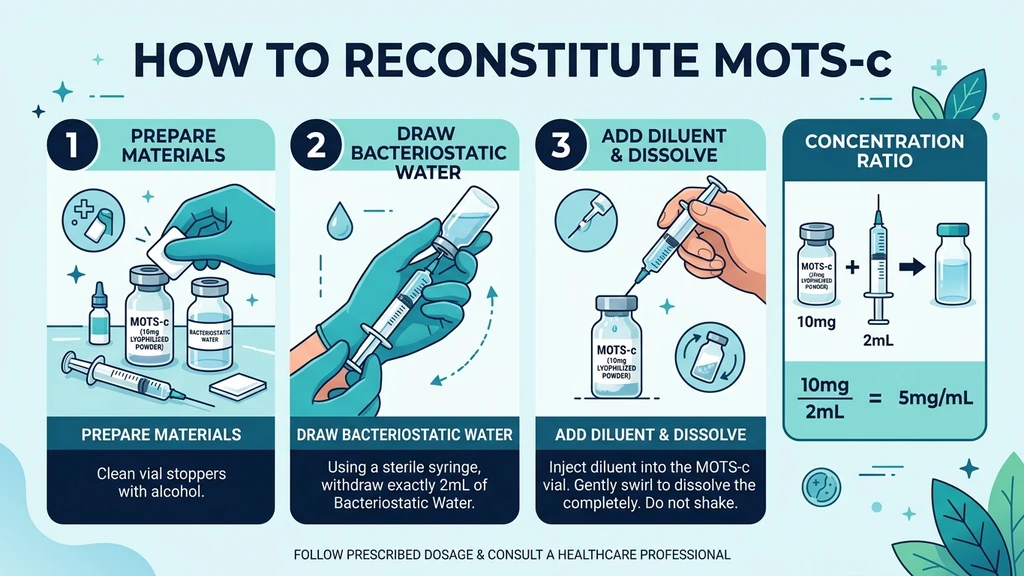
To reconstitute MOTS-c, add bacteriostatic water to the lyophilized vial. A standard 10mg MOTS-c vial plus 2mL of bacteriostatic water gives a concentration of 5mg/mL. Swab the cap, draw the water, run the stream down the inside wall of the vial, and swirl gently until the powder dissolves. The whole process takes under five minutes and needs no shaking.
The volume of water you add does not change the total drug. It only changes how concentrated each unit on your syringe is. Below are mixing tables for 5mg and 10mg vials, the syringe math, storage shelf life, and the five mistakes that waste a vial.
*This article is for research and educational purposes only. It is not medical advice. Consult a healthcare provider before acting on any information here.*
Get your custom peptide protocol:
- Tailored to your body and goals
- Precise dosing and cycle length
- Safe stacking combinations
- Backed by peer-reviewed studies
- Ready in under 2 minutes
What You Need and the Direct Answer
Gather these supplies before you open anything:
- MOTS-c lyophilized vial (commonly 5mg or 10mg)
- Bacteriostatic water (0.9% benzyl alcohol)
- A 3mL syringe with a draw needle for the water
- Insulin syringes (U-100, 29 to 31 gauge) for dosing
- Alcohol swabs and a flat, clean surface
The direct answer: a 10mg MOTS-c vial reconstituted with 2mL of bacteriostatic water yields 5mg/mL, so 1 insulin unit (0.01mL) holds 0.05mg, or 50mcg. Adjust the water volume to set your preferred concentration. More water makes a more dilute solution that is easier to dose in small increments; less water makes a concentrated solution that uses fewer units per injection.
Use the Reconstitution Calculator for any vial size and water combination not listed below.
Quick Mixing Table
These are the resulting concentrations for the two most common MOTS-c vial sizes at 1mL, 2mL, and 3mL of bacteriostatic water.
| Vial size | BAC water added | Concentration | Per insulin unit (0.01mL) |
|---|---|---|---|
| 5mg | 1mL | 5mg/mL | 50mcg |
| 5mg | 2mL | 2.5mg/mL | 25mcg |
| 5mg | 3mL | 1.67mg/mL | ~16.7mcg |
| 10mg | 1mL | 10mg/mL | 100mcg |
| 10mg | 2mL | 5mg/mL | 50mcg |
| 10mg | 3mL | 3.33mg/mL | ~33.3mcg |
For the 10mg MOTS-c reconstitution, 2mL of water is the common default because 5mg/mL lands at round numbers on an insulin syringe. To confirm your target dose, see the MOTS-c dosage guide.
Step-by-Step Reconstitution
The technique matters more than speed. MOTS-c is a peptide, and rough handling shears the molecule.
- 1.Wash your hands and clean a flat surface. Let both vials reach room temperature if they were refrigerated.
- 2.Swab both rubber stoppers with an alcohol swab. Wipe the MOTS-c vial cap and the bacteriostatic water cap, then let them air dry.
- 3.Draw the bacteriostatic water. Using a 3mL syringe, pull your chosen volume (1mL, 2mL, or 3mL) of bacteriostatic water into the syringe.
- 4.Insert the needle into the MOTS-c vial at an angle so the tip rests against the inside glass wall. Push slowly and let the water run down the wall. Do not blast it directly onto the powder pellet.
- 5.Remove the needle and swirl, do not shake. Roll the vial gently between your fingers or swirl it in a slow circle. Set it down and wait. The powder usually dissolves within one to two minutes.
- 6.Inspect the solution. A correctly reconstituted MOTS-c vial is clear and colorless with no floating particles. Do not use a cloudy or particulate solution.
The pressure inside the vial rises as you add liquid. To avoid spraying, let the vacuum or pressure equalize before withdrawing the needle. For storing the finished vial, see how to store peptides.
Concentration Math: Setting Your Dose in Units
The water volume you add is the single variable that decides how many insulin units equal one dose. Total MOTS-c stays fixed, so concentration is just milligrams divided by milliliters.
Worked example. You have a 10mg vial and add 2mL of bacteriostatic water. Concentration is 10mg / 2mL = 5mg/mL, which equals 5,000mcg per mL. A U-100 insulin syringe holds 100 units per mL, so each unit carries 5,000 / 100 = 50mcg.
If your target dose is 250mcg, divide 250 by 50 to get 5 units. Draw to the 5-unit mark. If your target is 500mcg, that is 10 units.
The same logic scales to any setup. Concentration per unit (mcg) = (vial mg × 1000) / (mL of water × 100). Plug your numbers into the Reconstitution Calculator to avoid arithmetic errors, and cross-check against the MOTS-c dosage protocol PDF for a printable reference. Once you confirm units, the where to inject MOTS-c guide covers site rotation.
Storage After Mixing and Shelf Life
Once reconstituted, MOTS-c is far less stable than the dry powder. The lyophilized vial can sit in a freezer for many months, but the liquid form has a short clock.
- Refrigerate the reconstituted vial at 2 to 8°C. The kitchen fridge door is too warm; place it on a shelf inside.
- Use within 28 to 30 days. The 0.9% benzyl alcohol in bacteriostatic water inhibits bacterial growth for roughly four weeks (USP standard), which sets the practical shelf life (Meyer et al., 2009).
- Do not freeze the reconstituted solution. Freeze-thaw cycles damage peptide structure, and repeated cycling is a known driver of peptide degradation in solution (Manning et al., 2010).
- Keep it out of light and date the vial when you first puncture it.
If you used plain sterile water instead of bacteriostatic water, the window collapses to about 24 hours because there is no preservative. The full breakdown is in how long do reconstituted peptides last. For cycle planning around that shelf life, see MOTS-c cycle length.
Common Reconstitution Mistakes
Most ruined vials trace back to five errors. Each one is avoidable.
Shaking the vial. Vigorous shaking creates foam and shears the peptide, lowering potency. Swirl gently instead, and wait for the powder to dissolve on its own.
Using the wrong water. Saline can interact with some peptides, and tap or distilled water is not sterile. Use bacteriostatic water for multi-dose vials. If a supplier ships "reconstitution solution," confirm what it contains, because reconstitution solution is not always the same as bacteriostatic water.
Overfilling the vial. Adding 3mL to a tiny vial can exceed its volume and force liquid back out the needle. Match your water volume to the vial size in the table above.
Blasting water onto the powder. A hard stream directed at the pellet can denature the peptide. Run the water down the glass wall instead.
Skipping the alcohol swab. Both stoppers must be wiped before each puncture to keep the solution clean. For a deeper sterile-technique comparison, see bacteriostatic water vs sterile water.
Frequently Asked Questions
How much bac water for MOTS-c 10mg?
Most users add 2mL of bacteriostatic water to a 10mg MOTS-c vial, which gives 5mg/mL and clean numbers on an insulin syringe. You can use 1mL for a more concentrated 10mg/mL solution. See the mixing table above or the MOTS-c dosage guide.
Can I use sterile water instead of bacteriostatic water for MOTS-c?
You can, but sterile water has no preservative, so the reconstituted vial must be used within about 24 hours. Bacteriostatic water lasts 28 to 30 days refrigerated. The full comparison is in bacteriostatic water vs sterile water.
How long does reconstituted MOTS-c last?
Reconstituted with bacteriostatic water and refrigerated at 2 to 8°C, MOTS-c stays usable for roughly 28 to 30 days. Do not freeze the liquid. For storage detail across peptides, read how long do reconstituted peptides last.
Should I shake the vial to dissolve MOTS-c faster?
No. Shaking foams the solution and can shear the peptide, lowering potency. Swirl gently and let the powder dissolve over one to two minutes. The how to store peptides guide covers handling that preserves stability.
What concentration does MOTS-c reconstitute to?
Concentration equals vial milligrams divided by milliliters of water. A 5mg vial in 1mL is 5mg/mL; a 10mg vial in 2mL is also 5mg/mL. Use the Reconstitution Calculator to set yours precisely.
How many units on an insulin syringe is one MOTS-c dose?
At 5mg/mL, each U-100 unit holds 50mcg, so a 250mcg dose is 5 units. Divide your target dose by the mcg-per-unit value. The MOTS-c dosage protocol PDF lists common conversions for reference.
Where do I inject MOTS-c after reconstitution?
MOTS-c is typically given subcutaneously into the abdominal fat, rotating sites to avoid irritation. Confirm your protocol with a healthcare provider. The where to inject MOTS-c guide covers technique and site rotation.
The Bottom Line
Reconstituting MOTS-c is simple once the concentration math is clear. Add bacteriostatic water down the vial wall, swirl gently, refrigerate, and use within roughly a month. The water volume sets your per-unit dose, not the total drug, so choose it to make your target dose land on round syringe marks.
Treat every step as research preparation and confirm any protocol with a qualified healthcare provider before use. To check the MOTS-c profile and run your own vial-and-water numbers, explore the tools and guides at PeptidesExplorer.com.
Helpful Tools
Related Articles
How to Reconstitute Cagrilintide (5 mg, 10 mg)
How to reconstitute cagrilintide: bacteriostatic water for 5 mg and 10 mg vials, mg to units on a U-100 syringe, fridge storage and the 28-day clock.
How to Reconstitute Tesamorelin: Water Volumes & Units
How to reconstitute tesamorelin: bacteriostatic water volumes for 2, 5, 10 and 20 mg vials, U-100 unit math, mixing steps, storage window, and bad-vial signs.
How to Reconstitute CJC-1295 and Ipamorelin (Unit Math)
Reconstitute CJC-1295 and ipamorelin: 2 mL bacteriostatic water per 5 mg vial = 25 mcg per unit. Water volumes, unit tables, blend rules, storage.
MOTS-c Before and After: Results & Timeline
See realistic MOTS-c before and after results, a week-by-week timeline, what the research shows, and the factors that decide whether you respond.