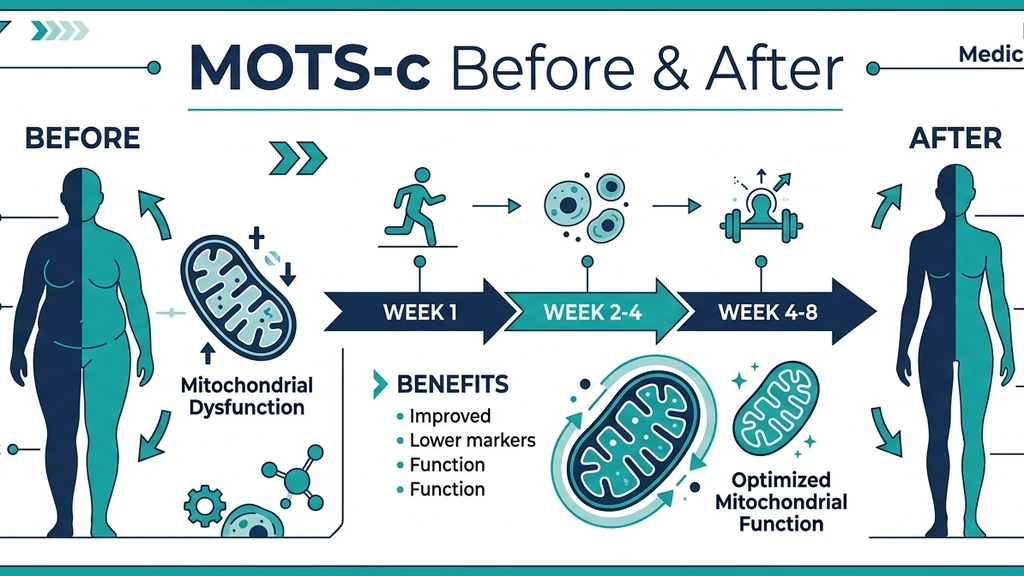
You start a MOTS-c protocol on a Monday and check the mirror the next morning expecting a transformation. Nothing has changed. That is normal. In controlled research, MOTS-c shifts energy and metabolic markers within the first 1 to 2 weeks, while visible body composition changes (the actual "before and after") tend to appear over 6 to 12 weeks and depend heavily on training and diet. MOTS-c is a 16-amino-acid mitochondrial peptide studied in research settings, not an approved drug, so frame any expectations as experimental. This guide maps a realistic timeline, separates the science from the photos, and explains what changes your results. Always consult a qualified healthcare provider before using any peptide.
Get your custom peptide protocol:
- Tailored to your body and goals
- Precise dosing and cycle length
- Safe stacking combinations
- Backed by peer-reviewed studies
- Ready in under 2 minutes
What MOTS-c Actually Does
MOTS-c is a 16-amino-acid peptide encoded inside your mitochondria that activates AMPK, the cellular fuel sensor that tells muscle to burn glucose and fat for energy (Lee et al., 2015). Think of your mitochondria as the engine room of every cell. MOTS-c is the engineer who walks in and switches the engines from idling to working, pulling sugar out of the blood and into muscle.
In the foundational study, MOTS-c treatment prevented diet-induced obesity and reversed age-dependent muscle insulin resistance in mice (Lee et al., 2015, Cell Metabolism, PMID 25738459). The peptide inhibits the folate cycle, triggers AMPK, and increases the muscle glucose transporter GLUT4.
A later study showed MOTS-c is also exercise-induced: levels rise sharply in muscle and blood during physical activity, and treated older mice nearly doubled their running capacity (Reynolds et al., 2021, Nature Communications). This is why people frame MOTS-c as an "exercise mimetic" rather than a fat-melting shortcut. For the full mechanism, see the MOTS-c peptide profile and the broader guide on peptides for energy.
MOTS-c Before and After: A Realistic Week-by-Week Timeline
Most users report energy and recovery changes within 2 weeks, while measurable fat loss and waist changes cluster around weeks 6 to 12 of a consistent protocol. The peptide has a short half-life, so effects build with repeated dosing rather than a single injection (track decay with the Peptide Half-Life Tracker).
The table below reflects commonly reported anecdotal patterns layered on the research timeline. Individual responses vary widely, and none of this is guaranteed.
| Timeframe | What people typically report | What is actually measurable |
|---|---|---|
| Days 1 to 7 | Subtle energy lift, fewer afternoon crashes | Often nothing visible; AMPK activation begins |
| Weeks 1 to 2 | Better workout endurance, faster recovery | Possible improvement in fasting glucose |
| Weeks 3 to 4 | Reduced cravings, clothes fit slightly looser | Small waist or weight changes (0.5 to 2 kg) |
| Weeks 6 to 8 | Visible recomposition, leaner midsection | Measurable fat loss with diet and training |
| Weeks 9 to 12 | The "after" photo most people share | Body composition shift, improved markers |
Dosing and cycle length drive this curve. Review the MOTS-c dosage guide and cycle length guide before you start, and use the peptide dosage chart as a reference.
What the Research Shows vs the Anecdotal Photos
Human MOTS-c research is early and small, so before and after photos online run far ahead of the published evidence. The strongest human data comes from a 2022 study showing MOTS-c rises in skeletal muscle after long-term physical activity and improves acute exercise performance after a single dose (Hyatt et al., 2022, Physiological Reports, PMC9270643).
The dramatic body-recomposition findings come from rodents. In mice, MOTS-c improved insulin sensitivity and prevented obesity (Lee et al., 2015) and boosted running capacity in aged animals (Reynolds et al., 2021). Mouse metabolism does not transfer one-to-one to humans, and injected doses in people are not standardized.
The honest read: MOTS-c has credible mechanistic support for energy, glucose handling, and exercise capacity, but large controlled human weight-loss trials do not yet exist. A lean "after" photo usually reflects the diet and training run alongside the peptide, not the peptide alone. Treat marketing transformations as anecdotes, and read the peptides before and after results guide for how to interpret them.
Factors That Change Your Results
Your MOTS-c results depend on four levers more than the peptide brand: dose, cycle length, training, and injection timing. Get these wrong and the "before and after" gap stays flat.
Dose and cycle length
Researchers and clinicians typically discuss MOTS-c in the 5 to 10 mg per week range, often split across 2 to 3 injections, run for 4 to 8 week cycles. Underdosing produces the flat-mirror disappointment; chasing high doses raises side-effect risk without proven extra benefit. Map your protocol with the MOTS-c dosage guide and plan the duration with the cycle length guide.
Training and diet
MOTS-c amplifies what exercise already does, so results scale with how hard you train. In the human data, the peptide rose with physical activity and improved performance (Hyatt et al., 2022). A caloric deficit plus resistance training is what produces the visible recomposition; the peptide nudges the metabolism in the right direction.
Fasted timing and storage
Because MOTS-c works through AMPK and glucose uptake, many protocols time injections in a fasted state or before training to align with the exercise response. Degraded peptide also flattens results, so follow proper reconstitution and storage steps, and know where to inject MOTS-c.
What Before and After Photos Really Capture
A MOTS-c before and after photo captures three separate things that get blurred into one: fat loss, energy and performance, and metabolic markers. Only one of those shows up in a picture.
Fat loss is visual but slow, and it is driven mostly by the deficit and training underneath the protocol. Energy and recovery are the changes users feel first, usually within 2 weeks, but they never appear in a static image. Metabolic markers like fasting glucose and insulin sensitivity are arguably the most meaningful endpoint in the research, yet they are invisible without a blood test.
This mismatch is why expectations go wrong. Someone feels great by week 2, sees no mirror change, and quits before the 6 to 12 week window where body composition actually shifts. Judge MOTS-c by a combination of how you feel, a tape measure at the waist, the scale, and ideally bloodwork, not by a single photo.
Common Mistakes and Unrealistic Expectations
The most common MOTS-c mistake is expecting a single injection to do the work of a diet and a training block. The peptide is a metabolic amplifier, not a substitute for effort.
Frequent errors that flatten results:
- Quitting at week 2 because the mirror has not changed, before the recomposition window opens.
- Underdosing or erratic dosing, which keeps AMPK activation inconsistent. Anchor it with the dosage protocol.
- Skipping training, then blaming the peptide when the photo looks the same.
- Ignoring side effects like injection-site irritation or fatigue instead of reviewing the MOTS-c side effects guide.
- Buying degraded or mishandled peptide, which fails the safety basics in the peptide safety guide.
MOTS-c is studied in research settings and is not an approved therapy. Set milestones at weeks 2, 6, and 12, measure objectively, and talk to a qualified healthcare provider before and during any protocol.
Frequently Asked Questions
How long does it take to see results from MOTS-c?
Most people notice energy and recovery changes within 1 to 2 weeks, while visible body composition (the actual before and after) usually shows up over 6 to 12 weeks of consistent use with training. The peptide builds with repeated dosing, so check the MOTS-c dosage guide before you start.
Is the fat loss from MOTS-c permanent?
Fat loss is driven mostly by the diet and training run alongside MOTS-c, so it persists only if those habits do. The peptide amplifies a metabolic response rather than rewriting your set point. Plan cycles deliberately using the cycle length guide and keep training after you stop.
Are MOTS-c before and after photos realistic?
Most dramatic transformations reflect a caloric deficit and resistance training, not the peptide alone, and many are marketing anecdotes. Human research is early and small. Read the peptides before and after results guide to interpret photos honestly and set grounded expectations.
Can you get results from MOTS-c without exercise?
MOTS-c is exercise-induced and works largely by amplifying the body response to training (Reynolds et al., 2021), so results are far weaker without it. You may still feel energy or glucose changes, but visible recomposition needs effort. See peptides for energy for context.
When do MOTS-c results plateau?
Many users see the steepest progress in weeks 6 to 12, after which gains slow as the body adapts. This is why protocols run in 4 to 8 week cycles rather than continuously. Plan timing and rest periods with the MOTS-c cycle length guide.
What dose of MOTS-c do people use for results?
Discussions commonly center on 5 to 10 mg per week, split across 2 to 3 injections over a 4 to 8 week cycle, though no human dose is officially established. Underdosing is a frequent reason for flat results. Map a protocol with the MOTS-c dosage guide.
Does the time of day I inject MOTS-c change results?
Because MOTS-c works through AMPK and glucose uptake, many protocols time it in a fasted state or before training to align with the exercise response. Proper handling matters too, so follow the reconstitution and storage steps to avoid degraded peptide.
Is MOTS-c safe to use for results?
MOTS-c is studied in research settings and is not an approved drug, so long-term human safety data is limited. Reported issues are usually mild, like injection-site irritation. Review the MOTS-c side effects guide and consult a qualified healthcare provider before starting.
The Bottom Line
MOTS-c before and after results follow a predictable arc: energy and recovery within 1 to 2 weeks, then visible body composition over 6 to 12 weeks, with the size of the change set by your dose, training, and diet rather than the vial itself. The research supports MOTS-c as a metabolic and exercise amplifier (Lee et al., 2015; Reynolds et al., 2021; Hyatt et al., 2022), but large human weight-loss trials do not yet exist, so treat photos as anecdotes and measure your own progress objectively. MOTS-c is an experimental peptide, not an approved therapy, and a qualified healthcare provider should guide any protocol. Plan your costs with the Peptide Cost Calculator, then explore evidence-based peptide guides at PeptidesExplorer.com to research smarter.
Helpful Tools
Related Articles
How to Reconstitute Cagrilintide (5 mg, 10 mg)
How to reconstitute cagrilintide: bacteriostatic water for 5 mg and 10 mg vials, mg to units on a U-100 syringe, fridge storage and the 28-day clock.
Where to Inject MOTS-c: Best Sites & Technique
Where to inject MOTS-c: best subcutaneous sites (abdomen, thigh, love handles), needle gauge, step-by-step technique, and rotation to avoid bruising.
How to Reconstitute MOTS-c: Step-by-Step
How to reconstitute MOTS-c step by step. Mixing table for 5mg and 10mg vials, syringe unit math, storage shelf life, and the reconstitution mistakes to avoid.
IGF-1 LR3 Results: What to Expect by Week
IGF-1 LR3 results week by week: pumps, recovery, lean mass, and what before-and-after photos really show. Evidence vs bro-science, safety, and dosing.