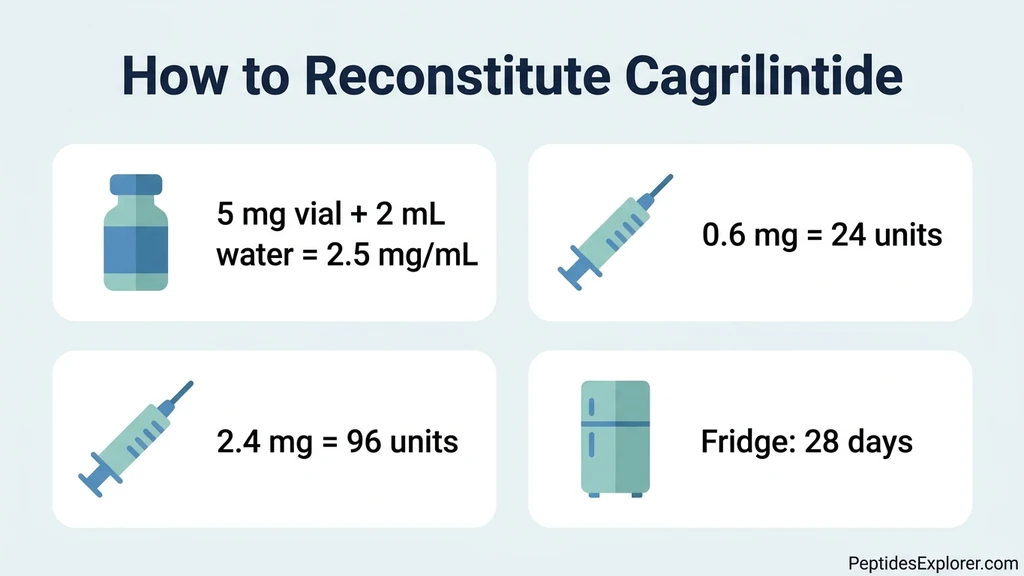
A 5 mg vial of white cake, a 30 mL bottle of bacteriostatic water, and a question about how much of one goes into the other. Here is the answer: add 2 mL of bacteriostatic water to a 5 mg cagrilintide vial, or 2 mL to a 10 mg vial, run the stream down the glass wall, roll the vial until the solution is clear, and refrigerate it. The 5 mg vial comes out at 2.5 mg/mL, where every unit on a U-100 syringe holds 25 mcg; the 10 mg vial comes out at 5 mg/mL, 50 mcg per unit.
| Vial | Bac water | Concentration | Per unit | 0.6 mg draw | 2.4 mg draw |
|---|---|---|---|---|---|
| 5 mg | 2 mL | 2.5 mg/mL | 25 mcg | 24 units | 96 units |
| 5 mg | 1 mL | 5 mg/mL | 50 mcg | 12 units | 48 units |
| 10 mg | 2 mL | 5 mg/mL | 50 mcg | 12 units | 48 units |
| 10 mg | 4 mL | 2.5 mg/mL | 25 mcg | 24 units | 96 units |
This page covers mixing, drawing, storing, and troubleshooting only. The milligram amounts in the tables are the 0.3 to 2.4 mg steps from the phase 2 trial, used as worked examples; which step to use and when to climb belongs to the cagrilintide dosage guide. The compound itself is profiled in what is cagrilintide, its pairing with tirzepatide in the cagrilintide and tirzepatide guide, and the Novo Nordisk co-formulation in the CagriSema dosing guide.
Get your custom peptide protocol:
- Tailored to your body and goals
- Precise dosing and cycle length
- Safe stacking combinations
- Backed by peer-reviewed studies
- Ready in under 2 minutes
What You Need Before You Open the Vial
Lay everything out first. The mistakes in the scenarios below happen when a needle is already in the stopper and the water volume is still a guess.
- Lyophilized cagrilintide vial, 5 mg or 10 mg
- Bacteriostatic water, 0.9% benzyl alcohol, 30 mL bottle
- One 3 mL syringe with an 18 to 22 gauge needle for the water
- U-100 insulin syringes, 29 to 31 gauge, 0.5 mL or 1 mL
- Alcohol swabs, a fine permanent marker, a sharps container
The water choice sets how long the vial lives. Bacteriostatic water carries 0.9% benzyl alcohol, a preservative that suppresses microbial growth across the repeated stopper punctures of a multi-dose vial (Meyer et al., J Pharm Sci, 2007, PMID 17722087). A once-weekly peptide means a 5 mg vial gets punctured over 4 to 8 weeks, and plain sterile water has nothing pushing back during that time.
The full comparison is in bacteriostatic water vs sterile water, sourcing in where to buy bacteriostatic water, and the "reconstitution solution" labeling trap in is reconstitution solution the same as bacteriostatic water. Use water only. Saline, acetic acid, and anything else a supplier ships unlabeled stays in the box unless the certificate of analysis names it as the intended diluent.
Cagrilintide Reconstitution, Step by Step
The whole procedure takes five minutes. The slow parts are the water going in and the cake dissolving, and both are slower for cagrilintide than for a small unmodified peptide.
- 1.Warm and clean. Let the vial and the water bottle reach room temperature for 15 minutes. A cold vial pulls condensation onto the stopper. Wash your hands.
- 2.Swab both stoppers. One swab for the cagrilintide vial, a fresh one for the water bottle. Let them dry for 10 seconds.
- 3.Draw the water. Pull 2 mL into the 3 mL syringe. Read the barrel at eye level before the needle leaves the water bottle.
- 4.Aim at the glass. Push the needle through the stopper at an angle so the tip rests against the inside wall. Press the plunger over 30 to 60 seconds. The water sheets down the glass and floods the cake from below.
- 5.Roll, never shake. Hold the vial between your palms and roll it for 30 seconds. Set it down for 2 minutes. Roll again. A lipidated peptide can take 5 to 10 minutes to go fully clear; the stability section explains why.
- 6.Inspect. Hold the vial against a white wall and then against a dark one. Clear, colorless, nothing floating, no persistent foam ring.
- 7.Label the vial. Date mixed, concentration in mg/mL, and the unit count for your draw, in marker, on the glass. Ten seconds that prevent every mistake on this page.
- 8.Refrigerate. 2 to 8 degrees C, upright, in the body of the fridge, away from the door and the light.
If the cake sat at the bottom and the water hit it directly, it clumps. Stand the vial upright for 10 minutes and roll again before deciding anything. The same rolling and aiming technique carries over to the retatrutide reconstitution guide and the tirzepatide reconstitution guide, which cover the two compounds most often mixed in the same week.
Water Volumes and Unit Math for 5 mg and 10 mg Vials
Think of a drink mix packet. One packet stirred into a small glass makes a strong drink; the same packet stirred into a pitcher makes a weak one. The powder never changed, but every sip carries a different amount.
Literally stated: the milligrams of cagrilintide in the vial are fixed. The water you add sets the concentration in mg/mL, and the concentration sets how many units deliver any given draw. Two lines of arithmetic run every row below. Concentration in mg/mL equals mg in the vial divided by mL of water. Units on a U-100 syringe equal the draw in mg, divided by the concentration in mg/mL, times 100.
Worked once: 5 mg plus 2 mL is 5 divided by 2, or 2.5 mg/mL, which is 2,500 mcg/mL. A U-100 syringe holds 100 units per mL, so one unit carries 25 mcg. A 0.6 mg draw is 600 mcg divided by 25 mcg, or 24 units.
| Vial | Bac water | Concentration | Per unit | 0.3 mg | 0.6 mg | 1.2 mg | 2.4 mg |
|---|---|---|---|---|---|---|---|
| 5 mg | 1 mL | 5 mg/mL | 50 mcg | 6 units | 12 units | 24 units | 48 units |
| 5 mg | 2 mL | 2.5 mg/mL | 25 mcg | 12 units | 24 units | 48 units | 96 units |
| 5 mg | 2.5 mL | 2 mg/mL | 20 mcg | 15 units | 30 units | 60 units | 120 units |
| 10 mg | 2 mL | 5 mg/mL | 50 mcg | 6 units | 12 units | 24 units | 48 units |
| 10 mg | 3 mL | 3.33 mg/mL | 33.3 mcg | 9 units | 18 units | 36 units | 72 units |
| 10 mg | 4 mL | 2.5 mg/mL | 25 mcg | 12 units | 24 units | 48 units | 96 units |
Pick the row that lands your draw between 10 and 60 units. A 6-unit draw is so small that one tick of misreading is a 17% error; a 120-unit draw means two syringes and a second chance to lose count. For the low 0.3 and 0.6 mg steps, 2.5 mg/mL is the better choice; for 1.2 mg and above, 5 mg/mL keeps the draw mid-barrel.
Two capacity notes. The 10 mg plus 4 mL row only works if the glass holds 4 mL, and many research vials are 3 mL. And a 5 mg vial at 2.4 mg per draw holds only two draws, so a 10 mg vial is the sensible size once you are past 1.2 mg. Check any setup with the peptide reconstitution calculator before the water goes in, and convert an odd draw with the peptide unit converter.
Reading the syringe matters as much as the math. A U-100 syringe holds 100 units per mL, so 1 unit is 0.01 mL. The 0.3 mL syringe marks every half unit, the 0.5 mL every unit, the 1 mL every 2 units. Read the leading edge of the black plunger tip at eye level, tap the barrel with a fingernail to raise bubbles, push them out, and re-draw to the line. A U-40 syringe or a tuberculin syringe marked in mL breaks every number on this page.
Storage Before and After Mixing: Fridge Temperatures and the 28-Day Clock
Peptides in solution degrade through hydrolysis, deamidation, oxidation, and aggregation, and every one of those reactions runs faster as temperature rises (Manning et al., Pharm Res, 2010, PMID 20143256). The clock starts the moment water touches powder.
| State | Temperature | Light | Window |
|---|---|---|---|
| Lyophilized, sealed | 2 to 8 degrees C, or a freezer for months | Dark | Supplier expiry |
| Reconstituted, bacteriostatic water | 2 to 8 degrees C, upright | Dark | 28 days outer limit |
| Reconstituted, sterile water | 2 to 8 degrees C | Dark | 24 hours |
| Bacteriostatic water bottle, opened | Room temperature or fridge | Dark | 28 days after first puncture |
Be honest about what the 28 days is. The number is the multi-dose vial convention in US pharmacy practice, built on the preservative in the water, and no published stability study covers research-grade cagrilintide in bacteriostatic water. The benzyl alcohol holds the microbial side of the problem for about four weeks; the chemical side, whether the peptide itself is intact on day 28, is untested. Treat 28 as the limit for a vial that stayed cold and clear, and size the vial so it empties before then. The 10 mg vial at two draws per month is exactly the wrong size at 0.3 mg; it is the right size at 2.4 mg.
Once-weekly dosing makes the arithmetic unusual. A 5 mg vial at 0.6 mg per week lasts 8 weeks of doses, but the clock says 4. Either accept that half the vial is discarded on day 28, or mix a 5 mg vial for a 4-week block and buy the next one accordingly. Peptide-by-peptide timelines are in how long reconstituted peptides last, and the storage rules for the sealed powder in how to store peptides.
Never freeze a mixed vial, never leave it on the counter overnight, and never top up a nearly empty vial with fresh water to stretch the last dose. The water bottle has its own rules: refrigeration optional, per does bacteriostatic water need to be refrigerated, but the 28-day discard after first puncture is firm, per how long bacteriostatic water lasts.
Why Cagrilintide Hates Shaking and Freezing
Cagrilintide is an analogue of amylin, and amylin's defining chemical problem is that it clumps. The native hormone has a high propensity to form amyloid fibrils, which is what made a long-acting analogue so hard to build; cagrilintide is the stabilized, lipidated version that came out of that effort (Kruse et al., J Med Chem, 2021, PMID 34288673). The same amyloid behavior is the basis of islet amyloid in type 2 diabetes (Westermark et al., Physiol Rev, 2011, PMID 21742788).
Stabilized means resistant, not immune. The engineering buys the molecule a half-life of 159 to 195 hours in plasma, with peak levels 24 to 72 hours after injection (Enebo et al., Lancet, 2021, PMID 33894838), in a formulation Novo Nordisk designed for it. A research vial in bacteriostatic water has no such formulation, so the physical stresses that drive aggregation fall on your handling instead.
Two stresses matter at the kitchen table. Agitation creates an air-water interface, and a lipidated peptide, with a fatty acid chain on one end, behaves like a surfactant: it crowds that interface, unfolds, and sticks to itself. Freezing creates an ice-water interface and concentrates the peptide, salts, and preservative into the last pockets of liquid. Both are documented routes to aggregation for peptide and protein drugs (Manning et al., Pharm Res, 2010, PMID 20143256).
Aggregated cagrilintide is cagrilintide you cannot dose. Some of it stays in the vial as haze, some passes into the syringe as particles, and your real draw becomes an unknown fraction of the number on the label. That is why the step-by-step says roll, why the storage table says never freeze the solution, and why the foam ring in step 6 is a warning sign and not a cosmetic one.
Cloudy Vial Troubleshooting
A fresh cagrilintide solution should be clear and colorless. Work through the signs in order; the first two are fixable, the rest are not.
- Hazy at 2 minutes, with visible cake at the bottom. Undissolved, not aggregated. Stand the vial upright for 10 minutes, roll for 30 seconds, and look again. Lipidated peptides dissolve slower than small ones.
- A foam layer after rolling. You rolled too hard or tipped the vial end over end. Set it down for 10 minutes. If the foam collapses and the liquid under it is clear, it is usable; if a milky layer remains, it is not.
- Still cloudy at 15 minutes, no cake visible. Aggregated peptide in suspension. Do not filter it, do not inject it, do not warm it in your hands to "help."
- Floating strands, flecks, or a film on the glass. Aggregate or stopper coring. Discard.
- Any color. Yellow or tan means degradation or contamination. Discard.
- Clear on day 1, hazy on day 10. The solution degraded in the fridge, usually from a warm spell, a door-shelf location, or light. Discard and store the next one deeper in the fridge.
- Powder that arrived wet, shrunken, or stuck to the glass. The cold chain failed before you opened the box. Photograph it, record the lot number, and contact the supplier.
Needle angle causes more "particles" than the peptide does. Enter the stopper at 45 degrees with the bevel up, then straighten; a steep jab cores a rubber fleck into the solution that looks exactly like aggregate. The same cold-chain and inspection rules apply to the tesamorelin reconstitution guide, where a cloudy vial fails the label's own acceptance test.
Mixing Cagrilintide With Semaglutide or Retatrutide in One Syringe
Three things are known, and one thing is not. Known: cagrilintide and semaglutide can be given in the same session. In the phase 1b trial, co-administration did not change semaglutide's exposure or elimination, and cagrilintide's own exposure rose in proportion to its dose (Enebo et al., Lancet, 2021, PMID 33894838). Known: the pairing works clinically. In REDEFINE 1, cagrilintide plus semaglutide produced a 20.4% weight reduction at 68 weeks against 3.0% for placebo (Garvey et al., N Engl J Med, 2025, PMID 40544433), and in the type 2 diabetes phase 2 trial the combination outperformed either drug alone, 15.6% against 5.1% and 8.1% (Frias et al., Lancet, 2023, PMID 37364590).
Known, and the one that matters here: those trials used pharmaceutical formulations developed for the pair. CagriSema is a fixed-dose combination whose formulation chemistry, the buffer, the pH, the excipients that let a lipidated amylin analogue and a lipidated GLP-1 analogue coexist in one solution, belongs to its developer and is not something a research vial inherits.
Not known: whether two research vials drawn into one insulin syringe stay chemically intact for the minutes they share a barrel, or the days they would share a vial if you pre-mixed. No published stability data exists for a home blend of cagrilintide with semaglutide, and none at all for cagrilintide with retatrutide, which has no co-administration trial in humans.
The practical rule follows from that gap. Draw each compound from its own vial into its own syringe and inject them in the same session at sites at least 5 cm apart, or on opposite sides of the abdomen, using the rotation map in the GLP-1 injection sites guide. Never pre-mix two vials into one, and never draw one compound through a syringe that already holds the other. Two needles cost a few cents; a cloudy syringe of two expensive peptides costs both.
Three Quantified Mistakes
Half the water, double the dose. You planned 2 mL into a 5 mg vial, but the 3 mL syringe held 1 mL. The vial is now 5 mg/mL, and the 24-unit draw you labeled as 0.6 mg delivers 1.2 mg, a silent 2x overdose every week until the vial empties. In the phase 2 trial, gastrointestinal events rose with dose, 41% to 63% across the 0.3 to 4.5 mg groups against 32% on placebo, with nausea at 20% to 47% against 18% (Lau et al., Lancet, 2021, PMID 34798060). Fix: read the 3 mL barrel before the water goes in, and write the concentration you actually made on the glass.
New vial, old units. You finished a 5 mg vial mixed at 2 mL, where 1.2 mg was 48 units. The next vial is 10 mg, also at 2 mL. The habitual 48-unit draw now delivers 2.4 mg, double the draw and two steps up the 0.3, 0.6, 1.2, 2.4 ladder in a single week. Fix: recalculate units every time you mix, never from memory, and never from the previous vial's label.
Shaking the cloudy vial clear. The cake dissolved slowly, you shook it for 20 seconds, and it went hazy instead of clear. The haze is aggregate, the peptide left in solution is an unknown fraction of 5 mg, and a 48-unit draw now delivers somewhere between 0 and 1.2 mg. Fix: roll for 30 seconds, wait 2 minutes, roll again, and give a lipidated peptide the 10 minutes it needs.
Sterile water on a once-weekly vial. A 5 mg vial at 0.6 mg per week gets punctured eight times over eight weeks. Without benzyl alcohol, every puncture is a contamination opportunity with nothing pushing back (Meyer et al., J Pharm Sci, 2007, PMID 17722087). Fix: bacteriostatic water for any vial that outlives one draw, and a 28-day discard date on the glass.
Frequently Asked Questions
How much bacteriostatic water do you add to a 5 mg cagrilintide vial?
2 mL is the practical default, giving 2.5 mg/mL: 25 mcg per unit, so 0.6 mg is 24 units and 1.2 mg is 48 units on a U-100 syringe. Adding 1 mL instead gives 5 mg/mL, where 1.2 mg is 24 units. Check any other volume with the peptide reconstitution calculator.
How much bacteriostatic water for a 10 mg cagrilintide vial?
2 mL gives 5 mg/mL, 50 mcg per unit, so 0.6 mg is 12 units and 2.4 mg is 48 units. 4 mL matches the 5 mg vial at 2.5 mg/mL, but only if the glass holds 4 mL; most research vials hold 3 mL, where 3 mL gives 3.33 mg/mL. Convert odd draws with the peptide unit converter.
How many units is 0.6 mg of cagrilintide?
It depends only on concentration. At 2.5 mg/mL, 0.6 mg is 24 units; at 5 mg/mL it is 12 units; at 2 mg/mL it is 30 units; at 3.33 mg/mL it is 18 units. Units equal the draw in mg divided by mg/mL, times 100. The cagrilintide profile covers the trial dose range those steps come from.
How long is cagrilintide good for after reconstitution?
Up to 28 days refrigerated at 2 to 8 degrees C in bacteriostatic water, a convention built on the preservative rather than on a published cagrilintide stability study. In sterile water the window is about 24 hours. Discard any cloudy, colored, or particle-bearing vial at any age; the reconstituted peptide shelf-life guide has the full comparison.
Can you shake a cagrilintide vial to dissolve the powder?
No. Cagrilintide is a lipidated amylin analogue, and amylin has a high propensity to form fibrils (PMID 34288673). Shaking creates an air-water interface where the peptide aggregates, turning the solution hazy and the dose unknown. Roll for 30 seconds, wait 2 minutes, roll again. The how to store peptides guide covers the handling that keeps it intact.
Why is my cagrilintide cloudy after reconstitution?
Two causes. Undissolved cake, with powder visible at the bottom and haze that clears within 10 minutes of standing and gentle rolling, is normal for a lipidated peptide. Haze that persists at 15 minutes with no cake visible is aggregated peptide, usually from shaking, a direct water jet, or a freeze; discard it. The bacteriostatic vs sterile water guide covers the diluent side.
Can you mix cagrilintide and semaglutide in the same syringe?
Nothing published supports it. The trials co-administered the two in pharmaceutical formulations, and CagriSema is a fixed-dose combination with proprietary chemistry; no stability data exists for two research vials sharing one syringe. Draw each into its own syringe and inject at sites 5 cm apart. Site rotation is in the GLP-1 injection sites guide.
Can you freeze reconstituted cagrilintide?
No. Freezing concentrates the peptide into the last liquid pockets and exposes it to an ice-water interface, both documented drivers of aggregation (PMID 20143256). The sealed lyophilized vial tolerates a freezer; the mixed solution does not. Keep it at 2 to 8 degrees C in the body of the fridge, as described in the retatrutide reconstitution guide.
The Bottom Line
2 mL of bacteriostatic water into a 5 mg cagrilintide vial gives 2.5 mg/mL, 25 mcg per unit; 2 mL into a 10 mg vial gives 5 mg/mL, 50 mcg per unit. Aim at the glass, roll for 30 seconds, give it 10 minutes to clear, label it, and refrigerate.
The principle: the vial fixes the milligrams, the water fixes the concentration, and the handling decides whether the peptide stays in solution. Cagrilintide is an amylin analogue engineered against fibrils, and shaking or freezing is how you undo that engineering at home.
Cagrilintide is an investigational compound with no FDA approval, and no published study covers research vials in bacteriostatic water or home blends with semaglutide or retatrutide; the windows here are conventions, stated as such. Run every setup through the peptide reconstitution calculator before the water goes in, and find the rest of the cluster at PeptidesExplorer. Educational content, not medical advice.
Related Articles
How to Reconstitute Tesamorelin: Water Volumes & Units
How to reconstitute tesamorelin: bacteriostatic water volumes for 2, 5, 10 and 20 mg vials, U-100 unit math, mixing steps, storage window, and bad-vial signs.
How to Reconstitute CJC-1295 and Ipamorelin (Unit Math)
Reconstitute CJC-1295 and ipamorelin: 2 mL bacteriostatic water per 5 mg vial = 25 mcg per unit. Water volumes, unit tables, blend rules, storage.
How to Reconstitute MOTS-c: Step-by-Step
How to reconstitute MOTS-c step by step. Mixing table for 5mg and 10mg vials, syringe unit math, storage shelf life, and the reconstitution mistakes to avoid.
How to Reconstitute Retatrutide
How to reconstitute retatrutide step by step for 5mg, 10mg, and 20mg vials. Concentration tables, BAC water volumes, syringe units per dose, and storage guide.