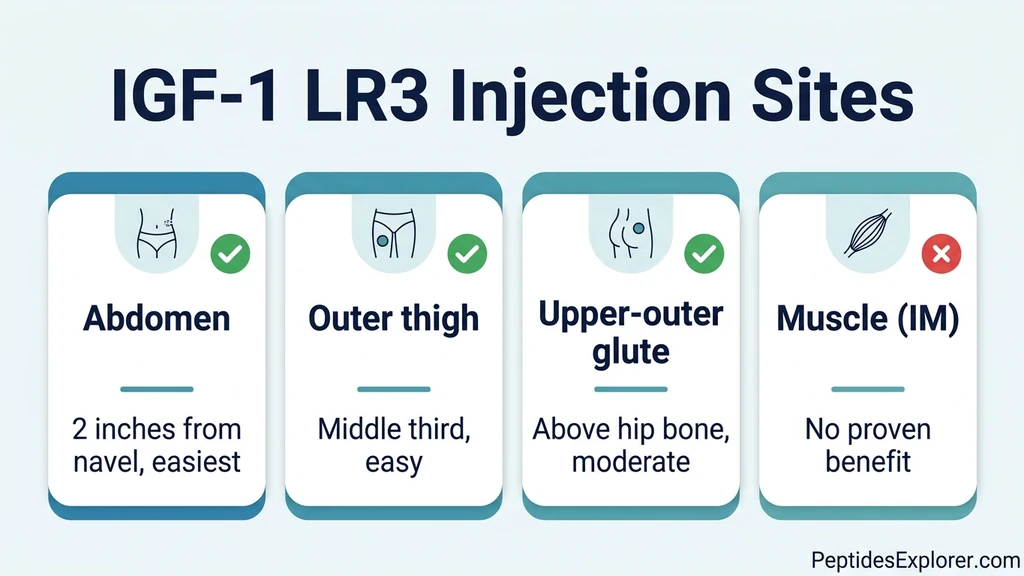
The syringe is loaded, your training session is done, and half the forum threads say "bilateral into the muscle you just trained." Here is the answer: inject IGF-1 LR3 subcutaneously into belly fat, 2 inches from the navel, with a 29 to 31 gauge insulin syringe, and rotate to the outer thigh and upper-outer glute. The compound circulates for 20 to 30 hours and acts on your whole body, so the needle's location does not decide which muscle grows.
| Site | Landmark | Route | Self-injection ease | Role |
|---|---|---|---|---|
| Abdomen | 2+ inches from navel, above or beside it | Subcutaneous | Easiest | Default, most consistent uptake |
| Outer thigh | Middle third, front-outer quadrant | Subcutaneous | Easy | Rotation partner |
| Upper-outer glute / flank | Above the hip bone, toward the side | Subcutaneous | Moderate, mirror helps | Extra rotation room |
| Trained muscle (IM) | Bicep, delt, quad belly | Intramuscular | Hard, more bleeding | No proven benefit, higher hypoglycemia swing |
This page covers sites, depth, needle choice and rotation only. For how much to draw and how long to run it, the IGF-1 LR3 dosage protocol is the reference. The compound itself is profiled on the IGF-1 LR3 page.
Get your custom peptide protocol:
- Tailored to your body and goals
- Precise dosing and cycle length
- Safe stacking combinations
- Backed by peer-reviewed studies
- Ready in under 2 minutes
Subcutaneous or Intramuscular: What the Pharmacology Decides
Think of a drop of food coloring in a bathtub. Pour it at the tap end or the drain end, and an hour later the water is one uniform tint. IGF-1 LR3 is that dye, and your bloodstream is the tub.
Literally stated: IGF-1 LR3 is IGF-1 with a 13-amino-acid N-terminal extension and an arginine swapped in at position 3. Those two edits cut its binding to IGF-binding proteins, which is why it outperforms native IGF-1 in cell assays that secrete those proteins (Francis et al., J Mol Endocrinol, 1992, PMID 1378742). Unbound, it stays active in circulation for 20 to 30 hours instead of minutes.
A 20 to 30 hour molecule does not stay where you put it. Whatever tissue the needle enters, the peptide reaches every IGF-1 receptor in the body within hours. In diabetic rats, the systemically dosed potent variants restored growth across the whole animal (Tomas et al., Biochem J, 1993, PMID 7683875).
So choose the route for absorption speed, comfort and safety; targeting is off the table. Subcutaneous fat is the route the peptide injection guide teaches for every research peptide, and it is the default here.
The Bilateral Site-Growth Myth
The myth has a real paper behind it. Adams and McCue infused IGF-1 directly into one rat shin muscle through a catheter on an implanted osmotic mini-pump, at doses too low to act systemically. The infused muscle came out about 9% heavier than the opposite leg, with more protein and more DNA (Adams et al., J Appl Physiol, 1998, PMID 9572822).
Read the method. That was continuous, slow infusion of native IGF-1, held inside one muscle for two weeks, at a dose that never reached the rest of the body. A bolus of long-acting LR3 pushed into a bicep is the opposite design: delivered in seconds, from a molecule engineered to escape binding and travel. It is in general circulation before you have capped the needle.
Say it plainly: no human study has measured whether injecting IGF-1 LR3 into a specific muscle grows that muscle more than the other side. None exists. The IGF-1 LR3 results guide explains why the early bilateral fullness people report is mostly fluid and glycogen, and the peptides for muscle growth guide covers what whole-body IGF-1 signaling can do without a target.
Site-by-Site Walkthrough
Every subcutaneous site targets the same layer: the fat between skin and muscle. Pinch a fold, insert at 45 degrees, push the plunger over 5 to 10 seconds, count to 5, withdraw.
Abdomen
Stay at least 2 inches from the navel in every direction and away from the waistband line. The ring of tissue around the navel is denser and more vascular, which means more bruising and less predictable uptake.
The abdomen earns its default status on consistency. In insulin studies, abdominal fat absorbed at a stable rate while the thigh varied sharply with depth and activity (Frid et al., Diabetes Care, 1988, PMID 3276476). For a peptide that lowers blood sugar, predictable beats fast.
Outer Thigh
Use the middle third of the front-outer thigh, seated, with the muscle relaxed. Lean legs carry thin fat here, so pinch a real fold and keep the angle at 45 degrees.
On a lean quad, a 5/16 inch needle at 90 degrees with no pinch is an intramuscular injection whether you meant it or not. Skip the thigh on days you train legs.
Upper-Outer Glute and Flank
The flank above the hip bone and the upper-outer quadrant of the glute give most people a generous fold and double the rotation real estate. Use a mirror the first few times.
If you still want an intramuscular site after reading the pharmacology, the glute and deltoid are the conventional ones. The BPC-157 injection site guide walks through the landmarking for both.
A Rotation Map That Keeps Absorption Stable
Two insulin findings sit in tension. First, repeated sticks in one spot build lipohypertrophy, a rubbery lump that absorbs erratically: in 430 insulin users, 64.4% had lumps, and 98% of those with lumps rotated poorly or not at all, against 5% among correct rotators (Blanco et al., Diabetes Metab, 2013, PMID 23886784).
Second, hopping between body regions raises day-to-day variability. Type 1 diabetics who rotated among arms, abdomen and thighs had a plasma glucose standard deviation of 3.7 mmol/L, versus 2.7 mmol/L when every injection stayed in the abdomen (Bantle et al., JAMA, 1990, PMID 2179591).
The reconciliation: rotate within a region, and change regions rarely. Spread daily sticks across a grid on the abdomen, at least 1 inch apart, and move to the thigh or glute only for a planned block of days.
| Day | Site |
|---|---|
| 1 | Left abdomen, upper |
| 2 | Right abdomen, upper |
| 3 | Left abdomen, lower |
| 4 | Right abdomen, lower |
| 5 | Left flank |
| 6 | Right flank |
| 7 | Back to day 1, 1 inch from the last mark |
Retire any zone that feels firm or rubbery for several weeks. The complete peptide injection guide applies the same grid logic to every peptide.
Needle Gauge, Length and Angle
Subcutaneous: a 29 to 31 gauge insulin syringe with a 5/16 inch (8 mm) needle, 45 degrees with a pinch, or 90 degrees where the fat layer is thick.
Intramuscular, if chosen: a 25 gauge, 1 inch needle at 90 degrees, and aspirate before pushing.
Depth changes speed. In insulin users, an accidental intramuscular landing in the thigh absorbed at least 50% faster than the neighboring fat, with a half-clearance time of 123 minutes versus more than 180; in the abdomen, muscle and fat absorbed at the same rate (Frid et al., Diabetes Care, 1988, PMID 3276476). Insulin is the analogy here; no LR3 route-comparison data exists.
Reconstitute with bacteriostatic water so the vial survives daily draws; the bacteriostatic vs sterile water guide explains why. Mixing technique lives in the reconstitution walkthrough, and the peptide reconstitution calculator converts your vial and water volume into units on the syringe.
Post-Workout Timing and Why It Changes the Site
Many users inject after training, and exercise changes how a site behaves.
The number: after an intramuscular thigh injection followed by 40 minutes of cycling, insulin absorption jumped from 0.46 to 1.17% per minute, a 2.5-fold increase, while subcutaneous thigh absorption barely moved. Plasma glucose fell about 2 mmol/L further after the intramuscular stick (Frid et al., Diabetes Care, 1990, PMID 2190773). Muscle blood flow rose fivefold with exercise; fat blood flow did not.
Scenario one: quad injection on leg day. You push IGF-1 LR3 intramuscularly into a quad, then squat. Muscle blood flow is up fivefold, absorption runs at 2.5 times the resting rate, and a glucose-lowering compound dumps into circulation at once. That is the shaky, sweating, foggy 20 minutes people call "the LR3 crash." Fix: abdomen, subcutaneous, after the session, carbohydrate on hand.
Hypoglycemia at the Needle
IGF-1 lowers blood sugar the same way insulin does, at about 6% of insulin's potency molecule for molecule. In eight healthy adults, an intravenous bolus of 100 mcg/kg drove blood glucose to 1.98 mmol/L (36 mg/dL) at 30 minutes, matching insulin, with 80% of circulating IGF-1 free of carrier proteins (Guler et al., N Engl J Med, 1987, PMID 3299085). That free fraction is the mechanism, and LR3 is engineered to stay free.
So the injection moment is the risk moment. Have 30 to 50 g of fast carbohydrate within reach before the needle goes in, never inject fasted and then train, and know the sequence: shakiness, sweating, racing heart, confusion. Below 3.9 mmol/L (70 mg/dL), treat it.
Scenario two: the lump. A month of same-spot abdominal sticks builds lipohypertrophy. Uptake from that tissue is erratic: 39.1% of people with lumps had unexplained hypoglycemia versus 5.9% without (Blanco et al., Diabetes Metab, 2013, PMID 23886784). One day the lump releases nothing, the next it releases two days' worth. Fix: the rotation grid, and a fresh needle every time.
Never stack IGF-1 LR3 with insulin or other glucose-lowering compounds; the peptide stacking guide separates studied pairings from folklore. Check your draw volume with the IGF-1 LR3 dosage calculator.
Site Reactions: Normal vs Not
A small red bump, mild soreness, or a coin-sized bruise is normal and fades within 1 to 3 days. Redness that spreads after day one, warmth, growing swelling, pus, or fever means possible infection and needs a clinician rather than another injection.
To keep reactions small: let the alcohol dry, warm the syringe in your hand for a minute, inject slowly, and do not rub the site. Keep the vial cold between draws; the reconstituted shelf-life guide gives the limits.
Mistakes That Actually Cost You
Chasing bilateral growth. Two intramuscular sticks a day, more bleeding, more scar tissue, no measured advantage. Fix: one subcutaneous abdominal injection.
Intramuscular into a muscle you are about to train. Absorption 2.5 times faster, glucose roughly 2 mmol/L lower (Frid 1990). Fix: abdomen on training days, always.
Same-spot loyalty. 98% of lipohypertrophy cases trace to poor rotation (Blanco 2013), and the lump then makes your blood sugar unpredictable. Fix: the seven-day grid, 1 inch between marks.
No carbohydrate in the room. Hypoglycemia arrives in 15 to 30 minutes. Fix: juice or glucose tablets on the counter before you uncap the needle.
Frequently Asked Questions
Where is the best place to inject IGF-1 LR3?
Subcutaneous belly fat, at least 2 inches from the navel, with a 29 to 31 gauge insulin syringe. Abdominal fat absorbs at the most predictable rate, which matters for a compound that lowers blood sugar. Rotate to the outer thigh or flank in planned blocks; the peptide injection guide covers landmarking.
Should IGF-1 LR3 be injected intramuscularly or subcutaneously?
Subcutaneously. IGF-1 LR3 circulates for 20 to 30 hours and reaches every muscle regardless of route, so intramuscular injection adds pain and bleeding without a proven benefit. In insulin studies, muscle absorbed up to 50% faster than fat (PMID 3276476), which only raises the hypoglycemia swing. The IGF-1 LR3 profile explains the half-life.
Does injecting IGF-1 LR3 into a muscle make that muscle grow?
No human data supports it. The rat study behind the idea infused native IGF-1 continuously into one muscle for two weeks at a dose too low to circulate, producing 9% more mass (PMID 9572822). A bolus of long-acting LR3 leaves the muscle within hours. The IGF-1 LR3 results guide covers what the fullness people notice really is.
Can I inject IGF-1 LR3 into the muscle I just trained?
Avoid it. Exercise raised muscle blood flow fivefold and increased intramuscular insulin absorption 2.5-fold, dropping glucose about 2 mmol/L further than a subcutaneous stick (PMID 2190773). With a glucose-lowering peptide, that is the fastest route to a crash. Use the abdomen after training, per the complete injection guide.
What needle size do you use for IGF-1 LR3?
A 29 to 31 gauge insulin syringe with a 5/16 inch (8 mm) needle for subcutaneous injection, inserted at 45 degrees with a pinched fold. A 0.3 or 0.5 mL barrel reads small volumes more precisely. Convert your vial concentration into syringe units with the peptide reconstitution calculator.
How often should I rotate IGF-1 LR3 injection sites?
Every injection, at least 1 inch from the last mark, but stay within one region for stretches of days. Poor rotation explained 98% of lipohypertrophy cases in 430 insulin users (PMID 23886784), while hopping between regions raised glucose variability (PMID 2179591). Rotation grids are illustrated in the BPC-157 injection site guide.
Why do I feel shaky after injecting IGF-1 LR3?
IGF-1 lowers blood glucose the way insulin does, at roughly 6% of insulin potency per molecule; a bolus in healthy adults dropped glucose to 1.98 mmol/L within 30 minutes (PMID 3299085). Shakiness, sweating and confusion mean hypoglycemia: take 30 to 50 g of fast carbohydrate. Which pairings raise that risk is covered in the peptide stacking guide.
The Bottom Line
Belly fat, 2 inches off the navel, 29 to 31 gauge, 45 degrees, rotate within the region, carbohydrate on the counter. That is the whole site technique for IGF-1 LR3.
The principle: a 20 to 30 hour molecule that escapes its binding proteins goes everywhere, so the site is a safety and comfort decision, never a targeting one. Protect the tissue and your blood sugar; the signal reaches the muscle wherever the needle went.
For how much to draw and how long to run it, read the IGF-1 LR3 dosage protocol, and check your units with the IGF-1 LR3 dosage calculator. IGF-1 LR3 is a research compound, not an FDA-approved therapy; this content is educational, not medical advice. More guides at PeptidesExplorer.
Related Articles
Where to Inject CJC-1295 and Ipamorelin: Sites & Rotation
Where to inject CJC-1295 and ipamorelin: abdomen 2 inches from the navel, thigh, love handles. Site table, rotation map, timing, and welt fixes.
When to Take IGF-1 LR3: Best Time & Fed vs Fasted
When to take IGF-1 LR3: post-workout with carbs on training days, morning with breakfast on rest days, never fasted. Half-life, spacing from GH peptides, FAQ.
GLP-1 Injection Sites: The 3 Approved Spots
GLP-1 injection sites: abdomen, front thigh, back of upper arm. What the Ozempic, Wegovy, Mounjaro and Zepbound labels say, plus a rotation plan that works.
Where to Inject MOTS-c: Best Sites & Technique
Where to inject MOTS-c: best subcutaneous sites (abdomen, thigh, love handles), needle gauge, step-by-step technique, and rotation to avoid bruising.