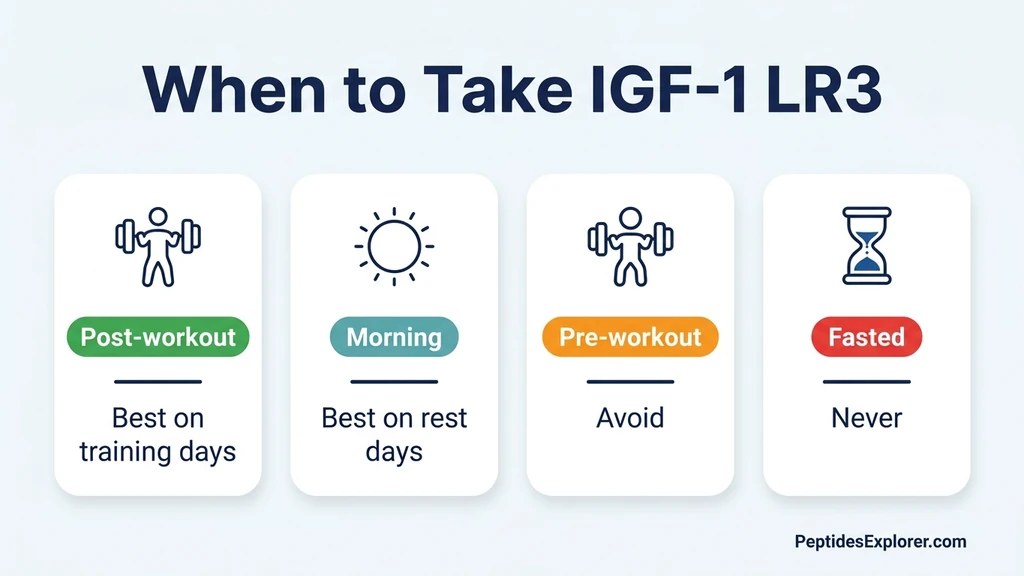
Your gym bag is packed, the IGF-1 LR3 vial is in the fridge, and the protocol sheet only says "once daily." Here is the answer: inject IGF-1 LR3 within 30 to 60 minutes after training, then eat a meal with carbohydrates inside the hour. On rest days, inject in the morning with breakfast. Never inject with no food planned, because IGF-1 lowers blood glucose.
| Timing window | Training days | Rest days | Food rule |
|---|---|---|---|
| Post-workout (30 to 60 min after the last set) | Best | Not applicable | Carb and protein meal within 60 min |
| Morning with breakfast | Acceptable | Best | Eat within 30 min of the injection |
| Pre-workout | Avoid | Not applicable | Glucose drops during the session |
| Before bed | Only after a slow-carb meal | Only after a slow-carb meal | Highest risk of an unnoticed low |
| Fully fasted (no food for hours either side) | Never | Never | No exception |
The number that settles most of the debate: IGF-1 LR3 is quoted at a 20 to 30 hour half-life, so one injection covers the whole day and the clock matters less than the plate. Amounts per injection, cycle length and stacking doses live on the IGF-1 LR3 dosage protocol page; the week-by-week timeline sits on the IGF-1 LR3 results page. This page covers timing only.
Get your custom peptide protocol:
- Tailored to your body and goals
- Precise dosing and cycle length
- Safe stacking combinations
- Backed by peer-reviewed studies
- Ready in under 2 minutes
Why the Half-Life Settles Most of the Timing Debate
Think of native IGF-1 as a text message and LR3 as a letter pinned to a noticeboard. The text is read within minutes and gone. The letter stays up all day. Literally stated: native IGF-1 is captured within minutes by six binding proteins, while the arginine swap at position 3 and the 13-amino-acid extension on LR3 weaken that capture, so LR3 stays active far longer.
The original characterization makes the point cleanly. Long [Arg3]-IGF-I stimulated protein and DNA synthesis in rat myoblasts more potently than IGF-1 itself, and the advantage came from escaping binding proteins rather than tighter receptor binding: in cells that secrete no binding proteins, LR3 was less potent than IGF-1 (Francis et al., J Mol Endocrinol, 1992, PMID 1378742).
For your clock, that means post-workout, morning and bedtime injections all pour into the same 20 to 30 hour tail. You cannot miss the training stimulus by an hour. Timing decides where the first hours of peak activity land, and whether food is in your system when they do.
One honesty flag. No human pharmacokinetic study of IGF-1 LR3 exists. The human numbers we have are for native rhIGF-1: injected subcutaneously into healthy volunteers, it peaked after about 7 hours, showed a half-life near 20 hours, and was 100% bioavailable (Grahnén et al., Acta Paediatr Suppl, 1993, PMID 8219484). That figure is shaped by binding proteins LR3 mostly avoids, so treat the 20 to 30 hour LR3 number as an estimate. The peptide half-life tracker lets you model both assumptions and see how little the curve moves.
The Four Timing Options, Ranked
Four windows get argued about. Two are good, one is conditional, one is a bad idea.
Post-Workout: The Default on Training Days
Resistance training raises mixed muscle protein synthesis by 112% at 3 hours, and it is still 65% above resting at 24 hours (Phillips et al., Am J Physiol, 1997, PMID 9252485). Injecting 30 to 60 minutes after the last set puts LR3's first hours in the steepest part of that curve, and the meal you are about to eat covers the glucose drop. Two problems solved with one act.
The window is wider than the forums claim. A review of nutrient timing concluded that the post-exercise anabolic window stretches well past 60 minutes and that pre- and post-exercise feeding produce similar adaptations (Aragon and Schoenfeld, J Int Soc Sports Nutr, 2013, PMID 23360586). Post-workout wins on convenience and safety, not on a stopwatch.
Morning: The Default on Rest Days
A morning injection lands right after your first meal, when glucose is rising and you are awake to notice a wobble. It also keeps the injection at the clock position most peptide routines already use, the same reason morning is the default in the BPC-157 timing guide. Morning works on training days too if you lift in the evening and would rather not inject late.
Pre-Workout: Skip It
Injecting before training stacks two glucose-lowering events: IGF-1 receptor signalling pulls glucose into muscle, and the session burns through glycogen at the same time. Add a fasted session and you have built a hypoglycemia experiment with a barbell overhead. The only argument for pre-workout is the pump, which is subjective and unmeasured.
Before Bed: Conditional
Bedtime appeals because growth hormone pulses in the first 90 minutes of deep sleep. LR3 does not care. It acts directly on IGF-1 receptors and bypasses the pituitary, so there is no pulse to line up with, a distinction the MK-677 vs ipamorelin comparison explains from the secretagogue side.
The real objection is that you are asleep during the hours a low would show. If you choose bedtime, the last meal must include slow carbohydrates and a glucose meter is not optional for the first few nights.
Fed vs Fasted: Why "Never Fully Fasted" Is the Rule
The hypoglycemia evidence is human and unambiguous. In eight healthy adults, an intravenous injection of rhIGF-1 at 100 mcg/kg dropped blood glucose to 1.98 mmol/L (36 mg/dL) within 30 minutes, nearly identical to insulin at 0.15 IU/kg; on a molar basis IGF-1 was 6% as potent as insulin, and 80% of the circulating peptide was free of binding proteins (Guler et al., N Engl J Med, 1987, PMID 3299085). That was native IGF-1 pushed in fast. LR3 goes in slower under the skin, but it is designed to stay free of binding proteins, the exact state that produced the crash.
The rule that follows: eat within 30 to 60 minutes of every injection, and make sure the meal contains carbohydrates and protein. Coffee is not food. A protein shake with no carbs is half a meal.
Scenario 1: fasted morning cardio. You skip breakfast, inject at 6:30, and ride the bike for 40 minutes. Liver glycogen is already low from the overnight fast, and LR3 is moving glucose into muscle on top of that. By minute 25 you are sweating cold, your hands shake, and your vision narrows: the signature of a glucose reading in the 50s or lower. Fix: eat first, or move the injection to after the session, with breakfast.
Scenario 2: bedtime injection after a low-carb dinner. Chicken and greens at 7 pm, injection at 11 pm. If LR3 mirrors the roughly 7 hour peak of subcutaneous rhIGF-1, peak activity arrives between 3 and 6 am, while you are asleep and cannot respond. Fix: 30 to 50 g of slow carbohydrates with the last meal and a glucose check at bedtime, or move the injection to morning. Keep fast-acting glucose on the nightstand either way.
Training Days vs Rest Days
Skipping rest days throws away half the benefit. Muscle protein synthesis remains 34% elevated 48 hours after a single session (Phillips et al., PMID 9252485), and the autocrine and paracrine IGF-1 produced inside loaded muscle keeps driving satellite cell activation and fibre remodelling between sessions, not only during them (Adams, J Appl Physiol, 2002, PMID 12183514). A rest-day injection lands in that repair window, and with a 20 to 30 hour tail it overlaps yesterday's dose anyway.
| Day | Injection window | Meal rule |
|---|---|---|
| Lifting day, morning session | Within 60 min after the session | Post-workout meal with carbs |
| Lifting day, evening session | Post-workout, or morning if you avoid late injections | Dinner with slow carbs if injecting late |
| Rest day | Morning, with breakfast | Eat within 30 min |
| Cardio-only day | After the session, never before | Post-cardio meal with carbs |
| Missed injection | Take it with your next meal; do not double up | Same rule |
Consistency matters more than the exact hour. A schedule that swings from 7 am one day to 11 pm the next stacks two injections inside 16 hours and then leaves a 32 hour gap, so the peaks bunch and the troughs stretch. Hold the same clock position, give or take two hours. The training side of the equation is covered in peptides for muscle growth.
Spacing From Insulin and GH Secretagogues
Insulin. IGF-1 LR3 and exogenous insulin share a glucose-lowering effect, and IGF-1 cross-reacts weakly with the insulin receptor. Injecting both inside the same window doubles the signal that produced a 36 mg/dL reading in the NEJM volunteers. If you are on prescribed insulin for any reason, IGF-1 LR3 timing is a conversation with your prescriber, full stop.
GH secretagogues. Ipamorelin, CJC-1295 and MK-677 raise growth hormone from the pituitary, which raises your own IGF-1 downstream. They do not compete with LR3 for a time slot, but stacking a GH pulse and an LR3 peak in the same hour concentrates the glucose effect and makes side effects harder to attribute. The common arrangement is LR3 post-workout and the secretagogue before bed, several hours apart; oral MK-677 goes with the evening meal.
The stack logic is laid out in the peptide stacking guide, and the peptide stack calculator lays the injection times out on one timeline so you can see the overlaps before you commit to them.
How Long IGF-1 LR3 Stays in Your System
Five half-lives clear roughly 97% of a drug. At 20 to 30 hours per half-life, that is 100 to 150 hours: IGF-1 LR3 is effectively gone 4 to 6 days after the last injection. At 24 hours it is still near half strength, which is why once-daily dosing works at all.
The flip side is accumulation. When the dosing interval equals the half-life, steady state sits at about twice the single-dose exposure and arrives in 4 to 5 days. Side effects that were absent on day 1 and appear on day 4 are usually this curve, not a bad vial.
On how long 1 mg lasts: at the daily amounts on the IGF-1 LR3 dosage protocol page (20 to 50 mcg), a 1 mg vial covers 20 to 50 injections, so 3 to 7 weeks of daily use. In practice the limiter is often the reconstituted vial, which degrades in the fridge on the timeline in the reconstituted peptide shelf-life guide. Run your vial size and reconstitution volume through the IGF-1 LR3 dosage calculator before you mix.
Timing Mistakes That Cost You
Injecting fasted "to keep it clean." An empty stomach adds no absorption benefit to a subcutaneous peptide; it only removes the glucose buffer. This is the mistake behind most shaky, sweaty mornings reported with LR3. Fix: food within the hour, every time.
Moving the window every day. With a 20 to 30 hour tail, a floating schedule stacks peaks on some days and leaves gaps on others. Fix: post-workout on training days, morning on rest days, held for the full run.
Pre-workout "for the pump." Glucose falls during the session, the session itself pulls glucose, and the only payoff is a feeling. Fix: inject after, eat, train again tomorrow.
Sharing a window with a GH secretagogue or insulin. Two glucose-lowering signals in the same hour, and no way to tell which one caused the side effect. Fix: LR3 post-workout, secretagogue before bed, insulin only with a prescriber. The best time to take tirzepatide guide applies the same spacing logic to a GLP-1 agonist, and the KPV morning or night guide applies it to an anti-inflammatory peptide.
Frequently Asked Questions
What is the best time to take IGF-1 LR3?
Within 30 to 60 minutes after training on lifting days, followed by a meal with carbohydrates inside the hour. On rest days, inject in the morning with breakfast. Because the quoted half-life is 20 to 30 hours, either window covers the full day. The IGF-1 LR3 profile covers the compound itself.
Should I take IGF-1 LR3 before or after a workout?
After. Injecting before training combines IGF-1 driven glucose uptake with the glycogen drain of the session, which is how people end up shaky mid-set. Post-workout injection lands where muscle protein synthesis is elevated 112% at 3 hours (PMID 9252485) and the post-training meal covers the glucose drop. See peptides for muscle growth for the training context.
Can you take IGF-1 LR3 on an empty stomach?
Not without a meal planned within the hour. IGF-1 lowers blood glucose: 100 mcg/kg intravenously dropped healthy adults to 1.98 mmol/L (36 mg/dL) in 30 minutes (PMID 3299085). Subcutaneous LR3 acts slower, but the direction is the same. Eat carbohydrates and protein within 30 to 60 minutes; the peptide safety guide covers what to keep on hand.
Do you take IGF-1 LR3 on rest days?
Yes, in the morning with breakfast. Muscle protein synthesis stays 34% elevated 48 hours after a session (PMID 9252485), so rest days are repair days, and the 20 to 30 hour tail means a rest-day injection overlaps the previous one anyway. Model the overlap with the peptide half-life tracker.
How long does IGF-1 LR3 stay in your system?
About 4 to 6 days after the last injection, using the 20 to 30 hour half-life estimate and the five-half-life rule for clearance. No human pharmacokinetic study of LR3 exists; the closest human data is native rhIGF-1 with a half-life near 20 hours (PMID 8219484). The IGF-1 LR3 results page covers how long effects take to show.
How long will 1 mg of IGF-1 LR3 last?
At the daily amounts listed in the IGF-1 LR3 dosage protocol (20 to 50 mcg per day), a 1 mg vial covers 20 to 50 injections, roughly 3 to 7 weeks of once-daily use. The reconstituted vial often expires before the peptide runs out, so plan the dilution around the run length, not the vial.
Can I take IGF-1 LR3 at the same time as ipamorelin or MK-677?
Space them by several hours. The usual arrangement is LR3 post-workout and ipamorelin or MK-677 before bed. Secretagogues raise your own IGF-1 through growth hormone, and putting that pulse in the same hour as an LR3 peak concentrates the glucose effect. Lay the times out with the peptide stack calculator.
The Bottom Line
Post-workout with a carbohydrate meal on training days, morning with breakfast on rest days, never fully fasted, and several hours away from any GH secretagogue or insulin. That is the whole timing protocol for IGF-1 LR3.
The principle: with a 20 to 30 hour tail, the clock is the secondary variable and the plate is the primary one, because the one human risk that is well documented for IGF-1 is hypoglycemia, and food is the control.
Check your vial math with the IGF-1 LR3 dosage calculator, take the amounts from the IGF-1 LR3 dosage protocol, and browse the rest of the library at PeptidesExplorer. IGF-1 LR3 is a research compound, not FDA-approved for any human use; this content is educational, not medical advice.
Related Articles
IGF-1 LR3 Results: What to Expect by Week
IGF-1 LR3 results week by week: pumps, recovery, lean mass, and what before-and-after photos really show. Evidence vs bro-science, safety, and dosing.
Where to Inject IGF-1 LR3: Sites, SubQ vs IM, Rotation
Where to inject IGF-1 LR3: abdomen, thigh or glute, subcutaneous, 29-31G needle. Why site-specific growth is a myth, a rotation map, and the hypoglycemia rule.
Peptides for Bodybuilding (2026)
Best peptides for bodybuilding: BPC-157, TB-500, MK-677, CJC-1295/Ipamorelin, HGH Fragment 176-191. Dosages and stacking protocols.
BPC-157 for Muscle Growth: Research
Does BPC-157 build muscle? Review of PubMed studies on muscle repair, healing mechanisms, dosage protocols, and how BPC-157 compares to TB-500 for recovery.