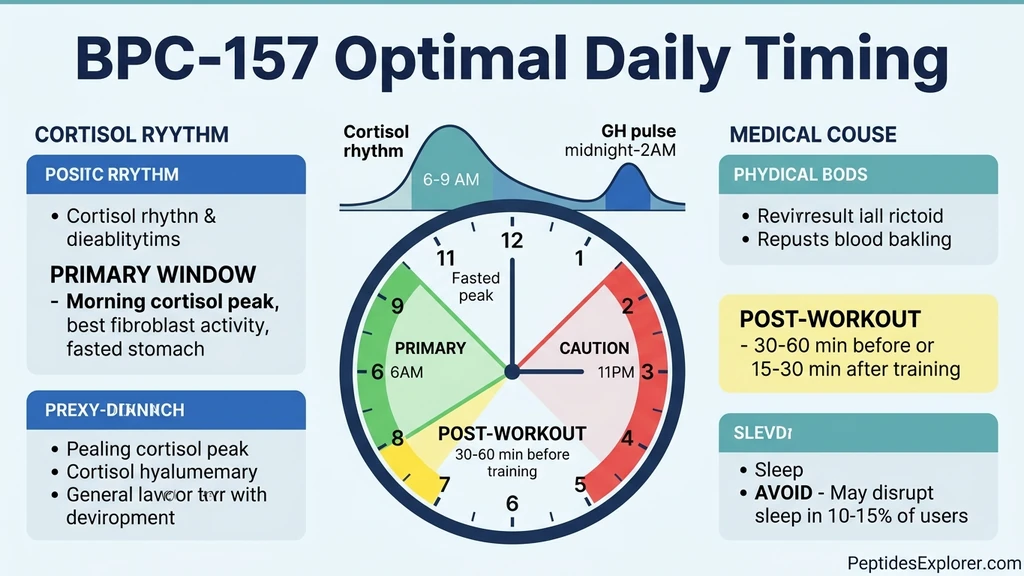
You have a reconstituted vial of BPC-157, your syringe is ready, and your alarm is set. But for what time? Inject BPC-157 in the morning, 20 to 30 minutes before breakfast, on an empty stomach. Morning dosing between 6 AM and 9 AM aligns with your body's peak cortisol and growth factor activity, avoids the sleep disruption that 10 to 15% of evening users report, and gives the peptide a clean metabolic environment for absorption.
| Timing Factor | Optimal Window | Why |
|---|---|---|
| Time of day | 6 AM to 9 AM | Aligns with cortisol peak and circadian repair signaling |
| Food timing | 20 to 30 min before breakfast | Fasted state reduces competing blood flow to the gut |
| Exercise timing | 30 to 60 min before or 15 to 30 min after training | Pre-workout primes repair; post-workout catches the inflammatory window |
| Injury phase | Start within 48 to 72 hours of acute injury | Earlier intervention = faster VEGF upregulation |
| TB-500 stack | Same morning session, separate syringe | Simplifies compliance; no pharmacokinetic conflict |
| Cycle start | Day 1 of recovery protocol | No loading period required |
| Cycle end | After 4 to 8 weeks; reassess before extending | Rest 2 to 4 weeks to resensitize receptors |
This guide covers timing only. If you need dosing amounts, injection technique, or route selection, see how to take BPC-157. For personalized volume calculations, use the BPC-157 dosage calculator.
BPC-157 is not FDA-approved for any medical use. All timing recommendations reflect preclinical research and clinical practice observations. Consult a licensed healthcare provider before using any peptide.
Get your custom peptide protocol:
- Tailored to your body and goals
- Precise dosing and cycle length
- Safe stacking combinations
- Backed by peer-reviewed studies
- Ready in under 2 minutes
Morning vs. Evening: What the Biology Says
BPC-157 has a plasma half-life under 30 minutes after intramuscular administration, with peak concentration (Tmax) reached within 3 minutes of injection and plasma levels returning to baseline within 24 hours (Xu et al., Front Pharmacol, 2022). That rapid clearance means the peptide's direct signaling window is short. The downstream repair cascades it triggers (VEGF upregulation, fibroblast migration, nitric oxide modulation) persist for hours, but the initial signal fires fast.
This pharmacokinetic profile makes timing relevant. You want that signal to land when your body's repair infrastructure is most active.
The Case for Morning Injection
Your body runs tissue repair on a circadian schedule. Cortisol peaks between 6 AM and 9 AM, priming the inflammatory response that initiates healing. Fibroblasts, the cells responsible for collagen deposition and wound closure, exhibit circadian rhythms that favor daytime activity. A 2017 study in Science Translational Medicine found that wounds sustained during the active phase healed approximately 60% faster than those occurring during the rest phase, driven by circadian actin dynamics in fibroblasts (Hoyle et al., Sci Transl Med, 2017).
BPC-157 activates fibroblasts through the FAK-paxillin pathway (Chang et al., Life Sci, 2011). Delivering that activation signal when fibroblasts are already primed for migration and collagen synthesis creates a synergy that evening injection misses.
There is also the dopamine factor. BPC-157 modulates the dopaminergic system (Sikiric et al., J Physiol Paris, 1999). Approximately 10 to 15% of users report mild sleep disruption from evening injections, ranging from delayed sleep onset to lighter sleep quality. Morning injection eliminates this risk entirely.
When Evening Injection Makes Sense
Growth hormone secretion peaks during the first 90 minutes of deep sleep (Van Cauter et al., Sleep, 1996). GH drives collagen synthesis in tendons and skeletal muscle (Doessing et al., J Physiol, 2010). Some practitioners theorize that evening BPC-157 injection pairs the peptide's VEGF upregulation with the overnight GH pulse, creating a dual stimulus for tissue repair during sleep.
No published study has tested this hypothesis directly. The reasoning is pharmacologically sound but unproven. If you tolerate evening injection without sleep disruption, you may capture this theoretical benefit. If your sleep quality drops even slightly, the trade-off is not worth it. Poor sleep raises cortisol, suppresses GH secretion, and shifts the body toward a proteolytic (tissue-breaking) state (Dattilo et al., Med Hypotheses, 2011). One disrupted night undoes what the peptide gained.
Verdict: Morning injection is the safer, evidence-supported default. Switch to evening only if you sleep well through it and want to test the GH-synergy hypothesis.
Fasted vs. Fed: Does Food Matter?
For injectable BPC-157, food timing has a minor effect. For oral BPC-157, it matters significantly.
Injectable BPC-157 and Meal Timing
Subcutaneous injection bypasses the gastrointestinal tract entirely. The peptide enters the bloodstream through capillaries in subcutaneous fat, and food in your stomach does not alter this absorption pathway.
That said, a fasted state offers one indirect advantage. After eating, blood flow shifts toward the digestive organs (the postprandial splanchnic response), reducing perfusion to peripheral tissues including your injection site. Injecting 20 to 30 minutes before breakfast ensures blood flow is not diverted to digestion during the critical first few minutes of peptide absorption.
This is an optimization, not a requirement. If you forget and inject after breakfast, the difference is marginal. Consistency matters more than perfection.
Oral BPC-157 and Meal Timing
Oral BPC-157 must pass through the stomach and intestinal lining. Food in the stomach buffers gastric acid, dilutes the peptide, and slows gastric emptying. These factors reduce the peptide's contact time with the intestinal epithelium and lower absorption efficiency.
| Oral Timing | Absorption | Best For |
|---|---|---|
| 30 min before food (empty stomach) | Highest | Gut healing: IBS, ulcers, intestinal permeability |
| With food | Reduced by 30 to 40% | Not recommended |
| 2 hours after food | Moderate | Acceptable if morning fasting is impractical |
For gut-specific conditions, fasted dosing is not optional. The peptide needs direct contact with the GI lining. Swallowing BPC-157 alongside a meal buries it in a bolus of food that shields the damaged mucosa from the peptide's direct action.
For detailed oral administration protocols, see the BPC-157 oral guide.
Before or After Exercise: The Training Window
Exercise creates tissue damage. BPC-157 repairs tissue damage. The question is whether you prime the repair system before training or catch the inflammatory response after it.
Pre-Workout Injection (30 to 60 Minutes Before Training)
Injecting BPC-157 before exercise delivers the VEGF and nitric oxide signaling cascade before the tissue stress occurs. Given BPC-157's rapid Tmax (peak plasma concentration within minutes), the downstream repair pathways are already activated when microdamage begins.
Advantages: - VEGF is upregulated before exercise-induced microtears occur, theoretically reducing the severity of damage - Nitric oxide modulation may improve blood flow during training - Fibroblasts at the injury site are already primed when the repair signal arrives
Best for: Athletes training through minor injuries who want to protect healing tissue during the session. Also useful for chronic tendinopathy where daily training stresses a partially healed tendon.
Post-Workout Injection (15 to 30 Minutes After Training)
Exercise triggers an acute inflammatory response within minutes of completing a session. Neutrophils and macrophages flood the damaged tissue, clearing debris and releasing cytokines that signal repair. Injecting BPC-157 during this window delivers the peptide's anti-inflammatory and pro-angiogenic signals directly into an environment already mobilized for healing.
Advantages: - Catches the peak of exercise-induced inflammation - Blood flow to muscles remains elevated for 30 to 60 minutes post-training, improving peptide distribution - Aligns with the body's natural repair sequence: damage first, then repair signals
Best for: Athletes using BPC-157 primarily for recovery between sessions rather than protecting a specific injury during training.
| Timing | Scenario | Inject |
|---|---|---|
| Healing a specific injury while training | Pre-workout | 30 to 60 min before |
| General recovery between sessions | Post-workout | 15 to 30 min after |
| Rest day (no training) | Morning routine | With your standard morning dose |
| Twice-daily protocol | Split | Morning (fasted) + post-workout (afternoon) |
Avoid injecting during training or immediately after (within 10 minutes). Heart rate and blood flow are maximal, which accelerates peptide clearance from the injection site before local absorption occurs. Let your heart rate return below 100 bpm before injecting.
Injury Phase Timing: When to Start BPC-157
Tissue healing follows three overlapping phases: inflammation (days 1 to 5), proliferation (days 5 to 21), and remodeling (day 21 onward). BPC-157 acts on all three, but the timing of your first injection determines which phase benefits most.
Acute Injury (0 to 72 Hours Post-Injury)
Starting BPC-157 within 48 to 72 hours of an acute injury catches the tail end of the inflammatory phase and the beginning of proliferation. This is the optimal window. BPC-157 modulates (not suppresses) inflammation through the nitric oxide system (Sikiric et al., Curr Pharm Des, 2018), keeping the inflammatory response functional while preventing it from becoming excessive and damaging.
Early VEGF upregulation means new blood vessels begin forming at the injury site sooner. In animal models, BPC-157 administration during the acute phase produced measurable improvements in angiogenesis and fibroblast migration within 72 hours of treatment (Hsieh et al., Int Wound J, 2017).
Protocol for acute injury: - Start BPC-157 as soon as swelling and acute pain allow injection near the site - Begin at 250mcg once daily for days 1 to 3 - Increase to 500mcg daily from day 4 onward if tolerated - Inject near the injury for maximum local concentration
Subacute Injury (1 to 3 Weeks Post-Injury)
The proliferative phase is when collagen deposition peaks, granulation tissue forms, and the structural scaffold of the repaired tissue takes shape. BPC-157 enhances all of these processes. Starting during weeks 1 to 3 is still effective, though you miss the chance to modulate the initial inflammatory response.
Protocol for subacute injury: - Start at 500mcg daily (the assessment window is less critical at this stage) - Consider twice-daily dosing (250mcg morning + 250mcg afternoon) for more consistent signaling - Continue for a full 6 to 8 week cycle
Chronic Injury (4+ Weeks, Failed Conservative Treatment)
Chronic tendinopathy, non-healing sprains, and lingering post-surgical stiffness benefit from BPC-157, but the timeline is longer. Chronic injuries lack the active inflammatory milieu that BPC-157 works with during acute healing. The peptide must restart repair processes that have stalled.
Protocol for chronic injury: - Start at 500mcg daily; consider 500mcg twice daily for the first 2 weeks - Plan for a full 8-week cycle minimum - Stack with TB-500 for systemic repair support - Reassess at week 8; a second cycle after a 2 to 4 week break is common for chronic conditions
| Injury Phase | Start Timing | Initial Dose | Cycle Length | Expected First Results |
|---|---|---|---|---|
| Acute (0 to 72 hours) | ASAP | 250mcg/day, then 500mcg | 4 to 6 weeks | 7 to 14 days |
| Subacute (1 to 3 weeks) | When ready | 500mcg/day | 6 to 8 weeks | 14 to 21 days |
| Chronic (4+ weeks) | Any time | 500mcg 1 to 2x/day | 8 weeks minimum | 21 to 28 days |
| Post-surgical | 1 to 2 weeks post-op | 250mcg, then 500mcg | 6 to 8 weeks | 14 to 21 days |
For post-surgical use, wait until the surgical wound has closed and your surgeon confirms it is safe to inject near the site. Starting 1 to 2 weeks post-operation is the most common clinical approach. For pre-surgical use (prehabilitation), some practitioners start BPC-157 one week before surgery to upregulate VEGF and prime the tissue for faster post-operative healing. No published study validates this protocol, but the pharmacological reasoning is consistent with BPC-157's mechanism.
Stacking Schedule: BPC-157 with TB-500 and GHK-Cu
BPC-157 + TB-500 Daily Schedule
BPC-157 targets localized repair through VEGF and fibroblast activation. TB-500 (Thymosin Beta-4) drives systemic repair through actin regulation and cell migration. The two peptides work through entirely different pathways, so there is no pharmacokinetic conflict when taken together.
| Time | BPC-157 | TB-500 | Notes |
|---|---|---|---|
| 6:30 AM (fasted) | 500mcg subQ near injury | 2.5mg subQ (abdomen) on injection days | Separate syringes, separate sites |
| TB-500 injection days | Daily | Mon/Thu or Mon/Wed/Fri | 5 to 10mg total per week during loading |
| TB-500 non-injection days | Daily | Off | BPC-157 continues every day |
| After week 4 | Continue daily | Reduce to 2.5mg 1 to 2x/week | TB-500 maintenance phase |
Key timing rules: - Inject both during the same morning session to simplify compliance - Use separate syringes and separate injection sites (BPC-157 near the injury, TB-500 in the abdomen or opposite thigh) - Both cycles should start on the same day and run for the same duration (4 to 8 weeks) - Take the same 2 to 4 week rest period for both peptides simultaneously
For complete stacking doses and protocols, see the BPC-157 + TB-500 dosage guide and the peptide stacking guide. Use the peptide stack calculator to plan your protocol.
Adding GHK-Cu as a Third Component
GHK-Cu is a copper-binding tripeptide that stimulates collagen synthesis, attracts immune cells to injury sites, and has antioxidant properties. Adding it to a BPC-157/TB-500 stack creates three distinct repair signals: localized angiogenesis (BPC-157), systemic cell migration (TB-500), and collagen remodeling (GHK-Cu).
Timing with the triple stack: - Morning: BPC-157 (500mcg) + TB-500 (on scheduled days) + GHK-Cu (200 to 600mcg) - All three can be injected during the same session - Each requires its own syringe - GHK-Cu can be injected subcutaneously at the same site as BPC-157 (near the injury) since both target local tissue, but offset the injection points by 1 to 2 cm
For the full triple-stack protocol, see the GHK-Cu, BPC-157, and TB-500 blend guide.
Cycle Timing: When to Start, How Long, When to Stop
BPC-157 does not require a loading phase, a taper, or a post-cycle therapy. But the cycle structure still matters for long-term effectiveness.
Cycle Structure by Goal
| Goal | Cycle Length | Rest Period | Second Cycle? |
|---|---|---|---|
| Mild injury (tendonitis, strain) | 4 weeks | 2 weeks | Usually not needed |
| Moderate injury (partial tear) | 6 to 8 weeks | 2 to 4 weeks | If pain or dysfunction remains |
| Severe injury (full tear, post-surgical) | 8 weeks | 4 weeks | Common; reassess at week 8 |
| Chronic tendinopathy | 8 weeks | 4 weeks | Often 2 to 3 cycles total |
| Gut healing (IBS, leaky gut) | 4 to 8 weeks (oral) | 2 to 4 weeks | Based on symptom resolution |
| General recovery (athletes) | 4 weeks | 4 weeks | Run cyclically during season |
The rest period is not optional. BPC-157 modulates dopamine D2 receptors and interacts with the serotonergic system (Sikiric et al., Curr Pharm Des, 2018). Continuous use beyond 8 to 12 weeks risks receptor downregulation, where those receptors become less responsive and the peptide's effects diminish. The 2 to 4 week break allows receptors to resensitize.
Signs You Can Stop Early
Not every injury requires a full 8-week cycle. Watch for these markers:
- Pain at the injury site has resolved for 5 or more consecutive days. Transient pain-free days do not count. Wait for a sustained window.
- Full range of motion has returned with no compensatory movement patterns.
- You can perform your sport or activity at pre-injury intensity without guarding or hesitation.
- The warmth sensation at the injection site has faded. During active healing, many users notice mild warmth near the injury (a sign of BPC-157's angiogenic activity). When this sensation disappears, the peptide may have completed its primary vascular work.
If these criteria are met at week 4, you can stop. Running the full 8 weeks "just in case" wastes peptide and extends your time before the next available cycle if a new injury occurs.
Signs You Need a Longer Cycle or Second Run
- Pain improves but does not resolve by week 6.
- Range of motion plateaus below pre-injury levels.
- Imaging (ultrasound, MRI) shows ongoing structural deficits.
- The injury is chronic (more than 3 months old before starting BPC-157).
In these cases, complete the 8-week cycle, rest for 4 weeks, and begin a second cycle. Second cycles often produce faster results because the first cycle built the vascular and cellular infrastructure that the second cycle continues to strengthen. For chronic tendinopathy, 2 to 3 cycles over 6 to 9 months is a common clinical pattern.
Circadian Rhythm and Tissue Repair: The Science
Your cells do not repair at a constant rate throughout the day. Research in chronobiology reveals clear 24-hour rhythms in wound healing that BPC-157 timing can leverage.
Daytime Fibroblast Activity
Fibroblasts are the workhorses of tissue repair. They migrate to injury sites, deposit collagen, and build the structural matrix that becomes healed tissue. A landmark study published in Science Translational Medicine demonstrated that fibroblasts exhibit circadian rhythms in actin-dependent processes, including cell migration and adhesion (Hoyle et al., Sci Transl Med, 2017).
The practical finding: skin wounds incurred during the active (daytime) phase showed increased fibroblast invasion and healed approximately 60% faster than nighttime wounds. The clock genes BMAL1 and PER2 regulate these rhythms at the cellular level.
BPC-157 activates fibroblast migration through the FAK-paxillin signaling pathway. Injecting during peak fibroblast activity (morning to midday) delivers the activation signal when the cells are most capable of responding. Think of it as calling workers to a construction site during their shift rather than leaving a message overnight.
Nighttime Collagen Synthesis
Collagen synthesis follows its own circadian pattern. Research published in Nature Cell Biology identified that procollagen synthesis peaks during the rest phase (nighttime in humans), while collagen fibril assembly occurs during the active phase (Pickard et al., Nat Cell Biol, 2019). Growth hormone, which stimulates collagen synthesis in tendons and skeletal muscle (Doessing et al., J Physiol, 2010), surges during the first 90 minutes of deep sleep.
This creates an interesting timing consideration. BPC-157's VEGF and fibroblast signals fire during the day. The collagen those fibroblasts produce assembles overnight. The peptide sets up the infrastructure; sleep builds the structure. This is why sleep quality during a BPC-157 cycle is as important as the injection itself. Seven hours of uninterrupted sleep may contribute more to healing than an extra 250mcg of peptide.
Common Timing Mistakes
These errors do not cause harm, but they reduce the effectiveness of your protocol. Each one is easy to fix.
Four Mistakes That Slow Your Recovery
Mistake 1: Injecting at random times each day. BPC-157's direct signaling window is short (plasma half-life under 30 minutes). Injecting at 7 AM one day, 3 PM the next, and 10 PM the day after scatters the repair signal across different circadian phases. Your fibroblasts receive activation at different points in their 24-hour cycle each day. Pick a time. Stick to it within a 1-hour window.
Mistake 2: Injecting immediately after a heavy meal. A large meal diverts blood flow to the splanchnic circulation for 2 to 3 hours. Injecting subcutaneously during this window means reduced perfusion at the injection site and slower peptide absorption into systemic circulation. The clinical difference is small, but over a 4 to 8 week cycle, small inefficiencies compound.
Mistake 3: Evening injection despite sleep disruption. Some users continue evening dosing because they read that nighttime aligns with GH secretion. If evening BPC-157 costs you even 30 minutes of sleep onset delay, the net effect is negative. Sleep loss suppresses GH, raises cortisol, and favors protein degradation over synthesis (Dattilo et al., Med Hypotheses, 2011). The theoretical GH synergy cannot overcome the documented harm of poor sleep.
Mistake 4: Waiting weeks after injury to start. The inflammatory phase (days 1 to 5) is when BPC-157's modulatory effects on nitric oxide and inflammation have the greatest impact. Starting at week 3 or 4 means you missed the window where the peptide could have shaped the inflammatory response. BPC-157 still works during proliferation and remodeling, but earlier is better for acute injuries.
Twice-Daily Dosing: How to Split the Schedule
Twice-daily BPC-157 (250mcg in the morning + 250mcg in the afternoon, or 500mcg + 500mcg for severe injuries) doubles the number of signaling events per day. Here is how to time the split.
| Protocol | Morning Dose | Afternoon Dose | Total Daily |
|---|---|---|---|
| Standard split | 250mcg at 7 AM (fasted) | 250mcg at 1 to 3 PM | 500mcg |
| Aggressive split (severe injury) | 500mcg at 7 AM (fasted) | 500mcg at 1 to 3 PM | 1000mcg |
| Training day split | 250mcg at 7 AM (fasted) | 250mcg post-workout | 500mcg |
Rules for twice-daily timing: - Space injections at least 6 hours apart. BPC-157's downstream signaling persists for hours; stacking two doses 2 hours apart provides no additional benefit. - Keep the second dose before 3 PM to avoid any risk of dopaminergic interference with sleep. - If you train in the morning, shift the first dose to post-workout and move the second dose to early afternoon. - Rotate injection sites between morning and afternoon doses, even if both target the area near your injury. Offset by 1 to 2 cm.
Twice-daily dosing is most valuable during the first 2 to 3 weeks of a cycle, when the inflammatory and early proliferative phases demand the most repair signaling. After week 3, many practitioners drop to once-daily dosing for the remainder of the cycle.
Danger Scenarios: When Timing Goes Wrong
Timing errors with BPC-157 rarely cause direct harm. The peptide has shown no lethal dose across 36 animal studies and no adverse events at 10mg and 20mg intravenous doses in humans (Staresinic et al., 2025; Kang et al., 2025). But poor timing wastes peptide and delays recovery.
Scenario 1: Evening injection causes insomnia. You inject 500mcg at 9 PM. BPC-157's dopaminergic modulation delays your sleep onset by 45 minutes. Over a 4-week cycle, that is 21 hours of lost sleep. Growth hormone secretion during deep sleep drops. Cortisol rises. Your body shifts from anabolic (tissue-building) to catabolic (tissue-breaking). The peptide helped repair tissue during the day, but the sleep loss erased part of the overnight consolidation. Net result: slower healing than if you had injected the same dose at 7 AM.
Scenario 2: Starting BPC-157 four weeks after an ACL sprain. The inflammatory phase ended at day 5. The proliferative phase is winding down. You missed the window where BPC-157 could have modulated inflammation, accelerated early angiogenesis, and directed fibroblast migration during peak activity. The peptide still works during the remodeling phase, but you may need 8 weeks instead of 4 to reach the same outcome. For a knee injury this significant, stacking with TB-500 compensates somewhat by adding systemic repair signaling.
Scenario 3: Injecting immediately post-workout with heart rate at 160 bpm. Elevated cardiac output means rapid blood flow through subcutaneous tissue. The peptide is swept into systemic circulation before it can establish meaningful local concentration at the injection site. You get systemic exposure but lose the localized benefit that makes near-injury injection valuable. Wait 15 to 30 minutes. Let your heart rate drop below 100 bpm.
Frequently Asked Questions
What is the best time of day to inject BPC-157?
Morning between 6 AM and 9 AM, on an empty stomach. This aligns with peak circadian fibroblast activity, avoids the 10 to 15% risk of sleep disruption from evening injection, and ensures peripheral blood flow is not diverted to digestion. If using twice-daily dosing, inject the second dose before 3 PM.
Should I take BPC-157 before or after a workout?
Both work, for different reasons. Pre-workout (30 to 60 minutes before) primes the VEGF repair cascade before tissue stress occurs, which is ideal if you are training through an injury. Post-workout (15 to 30 minutes after, once heart rate drops below 100 bpm) catches the acute inflammatory window. For general recovery, post-workout is the more common choice.
Can I take BPC-157 with food?
Injectable BPC-157 is not affected by food in any meaningful way. Injecting fasted offers a minor advantage in peripheral blood flow. Oral BPC-157 should be taken on an empty stomach, 30 minutes before food, to maximize direct contact with the GI lining. Taking oral BPC-157 with a meal reduces absorption by an estimated 30 to 40%.
How soon after an injury should I start BPC-157?
Within 48 to 72 hours is optimal for acute injuries. This catches the inflammatory phase, where BPC-157 modulates the nitric oxide system and begins VEGF upregulation. Starting during weeks 1 to 3 is still effective for the proliferative phase. Chronic injuries (4 or more weeks old) respond to BPC-157 but typically require a full 8-week cycle and may benefit from stacking with TB-500.
How long should a BPC-157 cycle last?
Four weeks for mild injuries (tendonitis, strains). Six to 8 weeks for moderate injuries (partial tears, chronic tendinopathy). Eight weeks for severe or post-surgical injuries. Always follow with a 2 to 4 week rest period to resensitize dopamine D2 receptors and other targets. If healing is incomplete, run a second cycle after the break.
Can I take BPC-157 and TB-500 at the same time of day?
Yes. Inject both during the same morning session using separate syringes and separate injection sites. BPC-157 goes near the injury; TB-500 goes subcutaneously in the abdomen or opposite thigh. The two peptides work through different pathways (VEGF/FAK-paxillin vs. actin regulation) and have no pharmacokinetic conflict when administered simultaneously.
Does BPC-157 work better in the morning because of cortisol?
Cortisol peaks between 6 AM and 9 AM and primes the inflammatory machinery that initiates tissue repair. Fibroblasts, the cells BPC-157 activates through FAK-paxillin signaling, also exhibit peak migration activity during daytime hours. Research shows daytime wounds heal 60% faster than nighttime wounds due to circadian fibroblast dynamics (Hoyle et al., 2017). Morning injection aligns BPC-157's signal with this biological window.
What happens if I miss my usual injection time?
Inject as soon as you remember, as long as it is before 3 PM. If you remember after 3 PM and are concerned about sleep disruption, skip to the next morning. One shifted dose in a 4 to 8 week cycle has no measurable impact. Do not double the next dose to compensate. Consistency across weeks matters more than precision on any single day.
The Bottom Line
The optimal BPC-157 timing protocol is straightforward: inject in the morning (6 AM to 9 AM), fasted, at a consistent time each day. Start within 48 to 72 hours of an acute injury. Run your cycle for 4 to 8 weeks depending on severity, rest for 2 to 4 weeks, and reassess.
Timing alone will not make or break your results. Consistent daily injection, proper storage, adequate sleep (7 or more hours), and allowing the full cycle duration to complete are the factors that separate successful protocols from abandoned ones. But when you layer circadian-optimized timing on top of those fundamentals, you align BPC-157's signaling with your body's peak repair capacity.
Use the BPC-157 dosage calculator to convert your dose into exact syringe units. For the complete administration guide covering routes, dosing amounts, injection technique, and reconstitution, see how to take BPC-157. For stacking protocols, see the peptide stacking guide and the BPC-157 vs. TB-500 comparison.
Related Articles
Where to Inject IGF-1 LR3: Sites, SubQ vs IM, Rotation
Where to inject IGF-1 LR3: abdomen, thigh or glute, subcutaneous, 29-31G needle. Why site-specific growth is a myth, a rotation map, and the hypoglycemia rule.
When to Take IGF-1 LR3: Best Time & Fed vs Fasted
When to take IGF-1 LR3: post-workout with carbs on training days, morning with breakfast on rest days, never fasted. Half-life, spacing from GH peptides, FAQ.
Where to Inject BPC-157 for Back Pain: Lower Back Sites
Where to inject BPC-157 for lower back pain, herniated disc, sciatica and SI joint pain: abdomen vs paraspinal sites, landmarks, zones to avoid, red flags.
Best Time to Take Retatrutide: Morning or Night?
Best time to take retatrutide: any hour, same weekday. Evening blunts nausea, morning suits diarrhea. Missed-dose rule, day switching, food, travel, alcohol.