You injected your weekly tirzepatide dose two days ago and now every meal feels like a negotiation. Your appetite is gone, your stomach protests at the sight of fried food, and you worry that eating 900 calories of crackers and broth is wrecking your muscle mass. The fix is structured eating: 1.2-1.5 g protein per kilogram of body weight daily, spread across 4-6 small meals of 300-400 calories each, built around lean protein, complex carbohydrates, and cooked vegetables. This approach minimizes GI side effects, preserves lean mass, and keeps weight loss on track.
SURMOUNT-1 documented that 26-40% of total weight lost on tirzepatide came from lean tissue rather than fat (Jastreboff et al., NEJM 2022). A 2024 review confirmed that protein intakes above 1.2 g/kg/day combined with resistance training reduced lean mass loss by up to 50% compared to unstructured diets (Neeland et al., Diabetes Obes Metab 2024).
| Quick Reference | Details |
|---|---|
| Daily protein target | 1.2-1.5 g per kg body weight (e.g., 96-120 g for an 80 kg person) |
| Meal frequency | 4-6 small meals, 300-400 calories each |
| Best protein sources | Chicken breast, fish, eggs, Greek yogurt, cottage cheese, tofu |
| Foods to avoid | Fried foods, high-fat meals, carbonated drinks, raw cruciferous vegetables |
| Daily fiber | 25-30 g from cooked vegetables, oats, and berries |
| Daily water | 2.5-3.5 L (85-120 oz), more during GI symptoms |
| Meal timing on injection day | Light meals for 24 hours post-injection; avoid large or fatty meals |
| Calorie range | 1,200-1,600 cal/day (adjust for body size and activity) |
For dosing protocols, see our tirzepatide dosage chart. For side effect management, see our guides on tirzepatide and diarrhea and tirzepatide and constipation.
Get your custom peptide protocol:
- Tailored to your body and goals
- Precise dosing and cycle length
- Safe stacking combinations
- Backed by peer-reviewed studies
- Ready in under 2 minutes
Why Diet Matters More on Tirzepatide Than Off It
Think of your daily food intake like a budget that just got cut in half. Before tirzepatide, you might have eaten 2,200 calories without thinking. Now your appetite allows 1,200-1,600. Every calorie carries more weight. Spend them on chicken thighs and roasted sweet potatoes, and you preserve muscle, fuel your brain, and keep your gut calm. Spend them on white bread and gummy bears, and you lose muscle, crash by 2 PM, and trigger nausea.
Tirzepatide activates both GLP-1 and GIP receptors, slowing gastric emptying by 30-40% and reducing appetite through central satiety signaling (Frias et al., Lancet 2021). The reduced food volume means three things. First, protein intake drops unless you prioritize it at every meal. Second, micronutrient gaps open for iron, B12, vitamin D, calcium, and thiamine. Third, the wrong food textures and fat loads amplify GI side effects that are already elevated by the drug itself.
A 2025 joint advisory from the American Society for Nutrition and the Obesity Society found that patients on GLP-1 agonists who followed structured nutrition plans lost the same total weight but retained 40-50% more lean mass than those who ate ad libitum (PMC, 2025). The drug handles appetite suppression. Your job is making the smaller intake count.
Foods to Eat vs Foods to Avoid
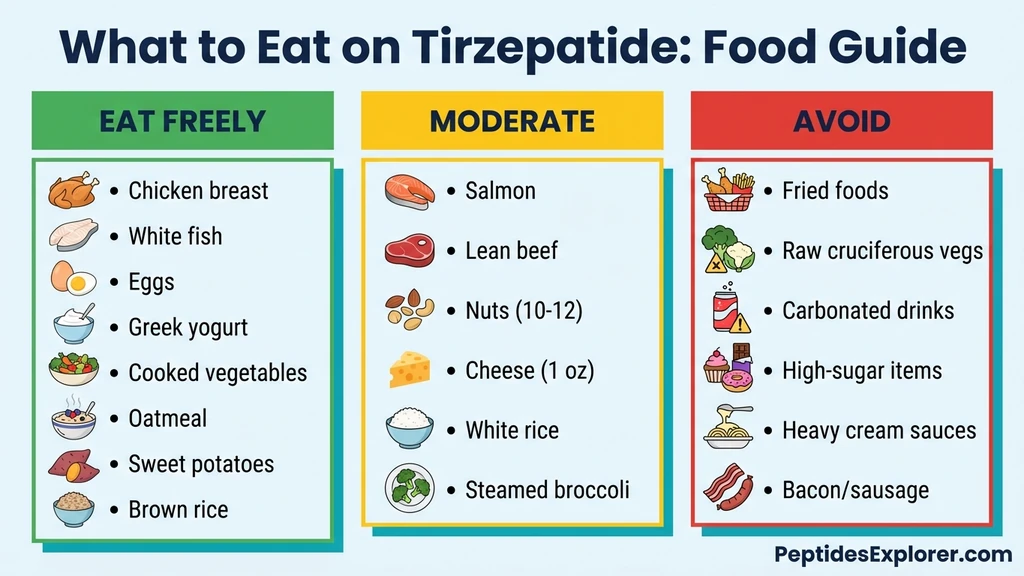
The table below separates foods into three categories based on how they interact with tirzepatide's GI effects and your nutritional needs. Green foods support muscle preservation and minimize side effects. Yellow foods are fine in moderation but can trigger symptoms in sensitive individuals. Red foods reliably worsen nausea, bloating, or diarrhea.
| Category | Foods to Eat (Green) | Eat in Moderation (Yellow) | Foods to Avoid (Red) |
|---|---|---|---|
| Protein | Chicken breast, turkey, white fish, eggs, Greek yogurt, cottage cheese, tofu, lentils | Salmon, lean beef, pork tenderloin, protein shakes | Fatty cuts of red meat, bacon, sausage, fried chicken |
| Carbs | Oatmeal, sweet potatoes, brown rice, quinoa, whole wheat bread | White rice, regular pasta, bananas | Donuts, pastries, sugary cereals, white bread |
| Vegetables | Zucchini, spinach (cooked), carrots, green beans, bell peppers | Broccoli (steamed), cauliflower (roasted) | Raw broccoli, raw cabbage, raw onions, raw Brussels sprouts |
| Fats | Olive oil (small amounts), avocado (quarter portions), almonds (10-12) | Peanut butter (1 tbsp), cheese (1 oz) | Fried foods, heavy cream sauces, butter-heavy dishes |
| Drinks | Water, herbal tea, ginger tea, electrolyte drinks | Black coffee (1 cup), diluted fruit juice | Carbonated drinks, alcohol, energy drinks, milkshakes |
| Fruit | Berries, melon, applesauce, peeled apples | Oranges, grapes, pineapple | Dried fruit (concentrated sugar), fruit juice (large portions) |
Two patterns explain this table. First, fat is the strongest trigger for nausea on tirzepatide. High-fat meals stimulate cholecystokinin (CCK) release, which compounds the delayed gastric emptying already caused by GLP-1 activation. The stomach holds food longer while bile acids churn. The result is nausea that peaks 30-90 minutes after eating. A meal with 15 g of fat clears the stomach 40% faster than one with 40 g of fat in tirzepatide users (Nauck et al., 2021).
Second, raw cruciferous vegetables produce gas through bacterial fermentation in the colon. Tirzepatide slows transit, giving bacteria more time to ferment. Cooking breaks down the raffinose and cellulose fibers responsible for gas production by 60-70%. Steamed broccoli rarely causes problems. Raw broccoli in a salad often does.
Protein Targets to Prevent Muscle Loss
Muscle loss is the hidden cost of GLP-1 weight loss. The SURMOUNT-1 trial showed that 26-40% of weight lost on tirzepatide was lean tissue rather than fat (Jastreboff et al., 2022). For someone who loses 50 pounds, that means 13-20 pounds of muscle gone. Adequate protein intake is the first line of defense.
How Much Protein You Need
The current evidence points to 1.2-1.5 g of protein per kilogram of body weight per day for people on GLP-1 agonists. A 2024 review in Diabetes, Obesity and Metabolism found this range, combined with resistance training, preserved the most lean mass during pharmacological weight loss (Neeland et al., 2024). A 2025 case series documented patients on tirzepatide who consumed 1.6-2.3 g/kg relative to fat-free mass and maintained or even gained lean tissue during treatment (Tinsley & Nadolsky, 2025).
| Body Weight | Daily Protein Target (1.2 g/kg) | Daily Protein Target (1.5 g/kg) | Per Meal (5 meals) |
|---|---|---|---|
| 60 kg (132 lb) | 72 g | 90 g | 14-18 g |
| 70 kg (154 lb) | 84 g | 105 g | 17-21 g |
| 80 kg (176 lb) | 96 g | 120 g | 19-24 g |
| 90 kg (198 lb) | 108 g | 135 g | 22-27 g |
| 100 kg (220 lb) | 120 g | 150 g | 24-30 g |
| 110 kg (242 lb) | 132 g | 165 g | 26-33 g |
Use current body weight for the calculation, not goal weight. As you lose weight, recalculate every 10 kg (22 lb) lost.
Protein Distribution Matters
Eating 120 g of protein is not the same as eating it well. Muscle protein synthesis (MPS) peaks at 25-40 g of protein per meal, then plateaus. A single 60 g protein dinner wastes half its muscle-building potential compared to three 40 g servings spread across the day.
Distribute protein across 4-5 eating occasions. Each meal or snack should contain 20-35 g of protein. Leucine content matters: animal proteins (chicken, eggs, dairy, fish) contain 8-10% leucine, which triggers MPS most effectively. Plant proteins (legumes, tofu, tempeh) contain 6-7% leucine, so you need about 20% more volume to match the stimulus. A study on protein timing during caloric restriction found that evenly distributed intake preserved 15% more lean mass than the same total protein consumed primarily at dinner (Mamerow et al., J Nutr 2014).
High-Protein Foods That Are GI-Friendly
Not all protein sources sit well on tirzepatide. A 12 oz ribeye steak delivers 70 g of protein but also 50 g of fat. Your stomach will punish you for it. The best protein sources combine high protein density with low fat content and easy digestibility.
| Food | Protein (per serving) | Fat | GI Tolerance |
|---|---|---|---|
| Chicken breast (4 oz, grilled) | 35 g | 4 g | Excellent |
| Egg whites (4 large) | 14 g | 0 g | Excellent |
| Greek yogurt, nonfat (1 cup) | 20 g | 0 g | Good |
| Cottage cheese, low-fat (1 cup) | 28 g | 3 g | Good |
| White fish, cod (4 oz, baked) | 26 g | 1 g | Excellent |
| Shrimp (4 oz) | 24 g | 1 g | Good |
| Tofu, firm (5 oz) | 18 g | 8 g | Good |
| Lentils (1 cup, cooked) | 18 g | 1 g | Moderate (gas risk) |
| Whey protein isolate (1 scoop) | 25 g | 1 g | Good (avoid if lactose-sensitive) |
| Bone broth (1 cup) | 10 g | 0 g | Excellent |
Protein shakes are useful when appetite is minimal. Blend whey isolate with water or almond milk rather than whole milk. Add a banana for potassium. Keep fat under 5 g per shake. Sip slowly over 20-30 minutes rather than gulping, as rapid stomach distension triggers nausea.
Meal Timing Around Injection Day
Tirzepatide's GI effects peak 24-72 hours after injection. The drug's half-life is approximately 5 days, but the initial surge of GLP-1 and GIP receptor stimulation is strongest in the first 48 hours (Coskun et al., Mol Metab 2018). Strategic meal timing around your injection day reduces nausea, bloating, and diarrhea.
| Timing | Meal Strategy |
|---|---|
| Day before injection | Normal eating. Ensure adequate protein and hydration. Have your larger meals here. |
| Injection day (0-6 hours post) | Light meal 1-2 hours before injecting. After injection, stick to bland, low-fat foods: broth, crackers, plain chicken, rice. |
| Day 1 post-injection | Smallest meals of the week. 4-6 mini-meals of 200-300 calories each. Prioritize protein and cooked vegetables. Avoid raw salads and fried foods. |
| Day 2 post-injection | GI effects begin easing. Gradually increase meal size. Still avoid high-fat foods. |
| Days 3-7 | Normal structured eating resumes. Follow the standard 4-6 meals, 300-400 calories each, with 20-30 g protein per meal. |
Evening injection timing helps. Injecting at night means peak GI effects occur while you sleep. A retrospective analysis found that evening administration reduced reported nausea by up to 20% compared to morning injection. If nausea still hits hard on day 1, ginger tea (1-2 cups, steeped from fresh ginger root for 10 minutes) and vitamin B6 (25 mg twice daily) both reduce GLP-1-related nausea with minimal side effects. For a deeper look at timing, see our guide on the best time to take tirzepatide.
GI-Friendly Foods for Each Side Effect
Tirzepatide produces different GI symptoms in different people. The right foods depend on which symptom you face. Eating for nausea is the opposite of eating for constipation in some ways, so identifying your primary issue matters.
Foods for Nausea (Affects 20-24% of Users)
Nausea on tirzepatide comes from delayed gastric emptying. Food sits in the stomach longer than the brain expects. The fix is small-volume, low-fat, easy-to-digest meals that clear the stomach quickly.
Eat: Plain crackers, dry toast, white rice, bananas, applesauce, broth-based soups, boiled chicken, plain oatmeal, ginger (tea, chews, or 250 mg capsules 2-3 times daily). Cold foods often sit better than hot foods because they produce fewer aromatic compounds that trigger nausea receptors.
Avoid: Large meals (anything over 400 calories in one sitting), greasy or fried foods, strong-smelling foods (garlic, onions, fish), heavy cream sauces, carbonated beverages, and lying down within 30 minutes of eating.
Practical tip: Eat before you feel hungry. On tirzepatide, waiting for hunger signals often means waiting too long. Set alarms for meals every 3-4 hours. Skipping meals allows stomach acid to accumulate on an empty, slow-moving stomach, which worsens nausea. For related side effects, see does tirzepatide make you tired.
Foods for Constipation (Affects 6-12% of Users)
Constipation on tirzepatide results from slowed transit through the entire GI tract. Stool sits in the colon too long, and the colon absorbs too much water. The fix is fiber, fluid, and movement.
Eat: Cooked vegetables (zucchini, spinach, green beans), oatmeal, ground flaxseed (2 tbsp daily, mixed into yogurt or oatmeal), prunes or prune juice (4-6 prunes or 4 oz juice daily), chia seeds (1 tbsp soaked in water for 15 minutes), kiwifruit (2 per day; a randomized trial found kiwifruit increased bowel frequency by 1.5 movements per week in constipated adults).
Avoid: Cheese in large amounts, white bread, processed snacks, and bananas (they firm stool, which helps diarrhea but worsens constipation).
Critical pairing: Fiber without water makes constipation worse. Every additional 10 g of fiber requires at least 500 mL (17 oz) of extra water. Target 25-30 g of fiber from food sources alongside 2.5-3.5 L of total fluid daily.
Foods for Diarrhea (Affects 12-17% of Users)
Diarrhea on tirzepatide comes from increased intestinal fluid secretion and bile acid malabsorption. The fix is the opposite of constipation management: reduce fiber, add binding foods, and replace lost electrolytes.
Eat: White rice, bananas, applesauce, plain toast (the BRAT diet), boiled potatoes, chicken breast, bone broth, oatmeal (soluble fiber absorbs excess water), and electrolyte drinks (look for 40-80 mEq/L sodium, 20-30 mEq/L potassium).
Avoid: Raw vegetables, salads, high-fiber cereals, nuts in large quantities, caffeine (stimulates colonic motility), alcohol, artificial sweeteners (sorbitol and mannitol pull water into the intestine), and spicy foods.
Timing: Diarrhea typically peaks during weeks 2-4 at each new dose level. Follow the BRAT-style diet during these windows, then gradually reintroduce normal foods as stools firm. If diarrhea persists beyond 6 weeks at a stable dose, discuss bile acid sequestrants with your prescriber.
Foods for Bloating and Gas
Bloating is the most common complaint on tirzepatide, affecting 15-20% of users across trials. Slow gastric emptying means food ferments longer in the stomach and small intestine, producing gas.
Eat: Cooked vegetables (cooking reduces fermentable fiber by 60-70%), lean proteins (produce minimal gas), rice (the only grain that does not produce gas during digestion), fennel tea, peppermint tea (relaxes intestinal smooth muscle).
Avoid: Raw cruciferous vegetables (broccoli, cauliflower, cabbage, Brussels sprouts), beans and lentils in large portions, carbonated beverages (add gas directly), chewing gum (causes air swallowing), and eating too fast (also causes air swallowing).
Practical tip: Eat slowly. Set a 20-minute minimum per meal. Put your fork down between bites. Chew each bite 15-20 times. This reduces air swallowing and pre-digests food in the mouth, easing the burden on a slower stomach.
Sample Meal Plans (1,200-1,600 Calorie Range)
These meal plans prioritize protein, minimize GI triggers, and hit 1,200-1,600 calories depending on body size and activity. Adjust portions up or down based on your weight and hunger levels. The protein target assumes an 80 kg (176 lb) person aiming for 1.2-1.5 g/kg/day (96-120 g).
Plan A: 1,200 Calories / 100 g Protein (Injection Day or Low-Appetite Days)
This plan works for the 24-48 hours after your injection when appetite and GI tolerance are lowest.
| Meal | Food | Calories | Protein |
|---|---|---|---|
| Breakfast (8 AM) | 1 cup nonfat Greek yogurt + 1/2 cup blueberries | 170 | 20 g |
| Snack (10:30 AM) | 1 scoop whey isolate in water + 1/2 banana | 160 | 27 g |
| Lunch (1 PM) | 4 oz grilled chicken breast + 1 cup steamed green beans + 1/2 cup white rice | 320 | 36 g |
| Snack (4 PM) | 1/2 cup low-fat cottage cheese + 5 crackers | 150 | 14 g |
| Dinner (7 PM) | 4 oz baked cod + 1 cup steamed zucchini + 1/2 sweet potato | 280 | 28 g |
| Evening (optional) | 1 cup bone broth | 40 | 10 g |
| Total | 1,120-1,160 | ~135 g |
This plan exceeds the minimum protein target while keeping fat under 25 g total. The low fat content reduces nausea risk. Bone broth in the evening provides additional collagen protein and soothes the GI tract.
Plan B: 1,400 Calories / 115 g Protein (Standard Days)
Use this plan on days 3-7 of your injection cycle when appetite is moderate and GI symptoms are manageable.
| Meal | Food | Calories | Protein |
|---|---|---|---|
| Breakfast (8 AM) | 2 whole eggs + 2 egg whites scrambled + 1 slice whole wheat toast | 270 | 26 g |
| Snack (10:30 AM) | 1 cup nonfat Greek yogurt + 10 almonds | 200 | 22 g |
| Lunch (1 PM) | 4 oz turkey breast + mixed greens salad + 1/2 avocado + balsamic vinegar | 350 | 32 g |
| Snack (4 PM) | 1 scoop whey isolate in almond milk | 140 | 25 g |
| Dinner (7 PM) | 5 oz grilled salmon + 1 cup roasted broccoli + 1/2 cup quinoa | 420 | 38 g |
| Total | ~1,380 | ~143 g |
This plan introduces healthy fats (avocado, salmon, almonds) on days when your stomach tolerates them. If nausea flares, swap the salmon for white fish and drop the avocado.
Plan C: 1,600 Calories / 130 g Protein (Active or Higher-Weight Days)
For people who exercise regularly or weigh above 90 kg, this plan provides more fuel without overloading the stomach.
| Meal | Food | Calories | Protein |
|---|---|---|---|
| Breakfast (7:30 AM) | 1 cup oatmeal + 1 scoop whey protein + 1/2 cup berries | 340 | 33 g |
| Snack (10 AM) | 1/2 cup cottage cheese + 1 small apple (sliced) | 180 | 15 g |
| Lunch (12:30 PM) | 5 oz grilled chicken + 1 cup brown rice + 1 cup steamed spinach + 1 tsp olive oil | 450 | 40 g |
| Snack (3:30 PM) | 2 hard-boiled eggs + 5 whole grain crackers | 210 | 14 g |
| Dinner (6:30 PM) | 4 oz shrimp stir-fry with bell peppers, carrots, snap peas + 1/2 cup white rice + 1 tsp sesame oil | 380 | 28 g |
| Evening | 1 cup bone broth | 40 | 10 g |
| Total | ~1,600 | ~140 g |
Stir-frying with minimal oil (1 tsp) keeps fat low while adding flavor. Avoid heavy stir-fry sauces (teriyaki, peanut sauce), which contain hidden sugar and fat. Use soy sauce, ginger, and garlic instead.
Hydration Protocol
Tirzepatide suppresses thirst alongside hunger. Many users do not notice they are drinking half their usual fluid intake until headaches, constipation, or dark urine appear. Dehydration compounds every GI side effect and increases the risk of acute kidney injury, which occurred in 0.2-0.4% of GLP-1 agonist users in post-marketing surveillance (Faillie et al., Diabetes Care 2017).
| Hydration Target | Amount |
|---|---|
| Baseline daily water | 2.5-3.0 L (85-100 oz) for women; 3.0-3.5 L (100-120 oz) for men |
| During diarrhea episodes | Add 500 mL-1 L (17-34 oz) of oral rehydration solution (ORS) per day |
| During constipation | Add 500 mL (17 oz) above baseline |
| Exercise days | Add 500 mL per 30 minutes of exercise |
| Hot climate | Add 500 mL-1 L above baseline |
What counts as fluid: Water, herbal tea, broth, electrolyte drinks, diluted juice. Coffee counts toward fluid intake but has mild diuretic effects above 3 cups per day.
What does not help: Carbonated water triggers bloating and gas. Alcohol dehydrates and worsens nausea. Energy drinks combine caffeine, carbonation, and sugar, a triple trigger.
Practical system: Fill a 1 L bottle in the morning. Finish it by noon. Fill again. Finish by dinner. Fill a third time and sip through the evening. This simple habit hits 3 L without tracking ounces. If your urine is pale yellow, you are hydrated. Dark amber or brown means drink more immediately.
Electrolytes during GI symptoms: Standard water is not enough when you are losing fluid through diarrhea or vomiting. Add an oral rehydration solution containing sodium (40-80 mEq/L), potassium (20-30 mEq/L), and a small amount of glucose. Pharmacy-grade options (Pedialyte, DripDrop, WHO ORS formula) outperform sports drinks, which contain too much sugar and too little sodium. For a detailed approach to managing fluid loss from diarrhea, see our guide on tirzepatide and diarrhea.
Micronutrient Gaps and Supplements
Reduced food intake creates predictable nutrient deficiencies. A 2025 retrospective study found that adults on GLP-1 agonists for 6+ months had significantly lower levels of iron, vitamin B12, vitamin D, calcium, and thiamine compared to matched controls (ScienceDirect, 2025). These gaps do not announce themselves with obvious symptoms until they are advanced.
| Nutrient | Risk Factor on Tirzepatide | Signs of Deficiency | Food Sources | Supplement if Needed |
|---|---|---|---|---|
| Iron | Reduced red meat intake, reduced absorption | Fatigue, pale skin, brittle nails | Spinach, lentils, fortified cereals | 18-27 mg/day (with vitamin C for absorption) |
| Vitamin B12 | Reduced animal protein intake | Fatigue, numbness/tingling, brain fog | Eggs, fish, dairy, nutritional yeast | 500-1,000 mcg/day sublingual |
| Vitamin D | General insufficiency worsened by caloric restriction | Bone pain, muscle weakness, low mood | Fatty fish, fortified dairy, sunlight | 2,000-4,000 IU/day |
| Calcium | Reduced dairy intake, reduced absorption | Bone loss accelerates during weight loss | Greek yogurt, cottage cheese, fortified almond milk | 500-1,000 mg/day (split into 2 doses) |
| Magnesium | Lost through diarrhea, reduced dietary intake | Muscle cramps, constipation, poor sleep | Pumpkin seeds, spinach, dark chocolate | 200-400 mg glycinate at bedtime |
| Thiamine (B1) | Reduced carbohydrate and grain intake | Fatigue, confusion, nerve damage | Whole grains, pork, legumes | 50-100 mg/day if deficient |
A daily multivitamin covers the basics. For people experiencing hair loss on tirzepatide, additional zinc (30 mg/day), biotin (5,000 mcg/day), and iron (if ferritin is below 30 ng/mL) support hair follicle cycling. Get baseline blood work (CBC, iron panel, B12, vitamin D, metabolic panel) before starting tirzepatide and repeat at 3 and 6 months.
Common Nutrition Mistakes on Tirzepatide
These four mistakes account for most diet-related problems on tirzepatide. Each has a specific consequence and a specific fix.
Mistake 1: Eating too little protein. Consuming under 60 g of protein per day while losing 1-2 pounds per week guarantees muscle loss. SURMOUNT-1 showed 26-40% of weight lost was lean tissue in participants without structured nutrition. The fix: track protein for the first 2 weeks using a food diary or app. Once you build the habit of 20-30 g per meal, tracking becomes unnecessary.
Mistake 2: Skipping meals entirely. Some users eat nothing on injection day because their appetite vanishes. This causes blood sugar swings, crashes energy, and allows stomach acid to irritate an empty, slow-moving stomach (worsening nausea). The fix: eat by the clock, not by hunger. Set 4-5 alarms. Even 200 calories of Greek yogurt and crackers is better than zero.
Mistake 3: Drinking calories. A 20 oz smoothie from a chain restaurant contains 400-600 calories, 60-80 g of sugar, and minimal protein. It also passes through the stomach faster than solid food, bypassing the satiety signals tirzepatide relies on. The fix: if you drink a protein shake, make it yourself with whey isolate, water or almond milk, and fruit. Keep it under 200 calories and above 25 g protein.
Mistake 4: Eating a large fatty dinner. After restricting all day, some users compensate with a 700-calorie high-fat meal in the evening. This overwhelms a stomach that has been moving slowly all day. Nausea, bloating, and acid reflux follow. The fix: keep dinner at 300-450 calories with less than 15 g of fat. Move the larger eating window to midday when gastric motility is highest.
Resistance Training and Protein Synergy
Protein alone is not enough. The 2025 joint advisory from four major nutrition and obesity organizations was explicit: increased protein intake is likely inadequate to preserve muscle mass in the absence of structured resistance training (PMC, 2025).
A 2025 case series of patients on semaglutide and tirzepatide who combined high protein intake (1.6-2.3 g/kg fat-free mass) with resistance training 3-5 days per week achieved striking results. Fat mass dropped 46.9-61.6%. Lean tissue changes ranged from -6.9% to +5.8%, meaning some patients actually gained muscle while losing significant body fat (Tinsley & Nadolsky, 2025).
The practical minimum: 2-3 sessions per week of resistance training targeting all major muscle groups. Each session should include compound movements (squats, deadlifts, rows, presses) for 3-4 sets of 8-12 repetitions. Consume 25-35 g of protein within 2 hours of training. This combination creates the stimulus (training) and the building blocks (protein) that prevent the muscle loss tirzepatide would otherwise accelerate.
For exercise around injection day, schedule your hardest training sessions on days 4-7 of your cycle when GI symptoms are lowest. Light walking (20-30 minutes) on days 1-2 post-injection is fine and may actually reduce nausea by promoting gastric motility. For dosing around your training schedule, use our tirzepatide dosage calculator.
Frequently Asked Questions
How much protein should I eat per day on tirzepatide?
Aim for 1.2-1.5 g of protein per kilogram of body weight daily. For an 80 kg (176 lb) person, that means 96-120 g per day, split across 4-5 meals of 20-30 g each. A 2024 review found this range, combined with resistance training, reduced lean mass loss by up to 50% compared to unstructured eating during GLP-1-assisted weight loss.
What foods should I avoid on tirzepatide?
Fried and high-fat foods are the top triggers for nausea. Avoid fatty cuts of meat, heavy cream sauces, pastries, carbonated drinks, alcohol, and raw cruciferous vegetables (broccoli, cabbage, Brussels sprouts). Fat slows gastric emptying further, and raw cruciferous vegetables produce gas that compounds bloating from already-delayed digestion.
Can I eat normally on tirzepatide injection day?
Not ideally. GI side effects peak 24-72 hours after injection. On injection day and the day after, stick to smaller meals (200-300 calories each), prioritize bland and low-fat foods, and avoid raw vegetables. Eat a normal meal 1-2 hours before injecting. Evening injection timing reduces nausea by up to 20% because peak effects occur during sleep.
How many calories should I eat on tirzepatide?
Most users naturally fall into a 1,200-1,600 calorie range due to appetite suppression. Do not intentionally eat below 1,200 calories, as this increases muscle loss and micronutrient deficiency risk. Focus on protein quality (1.2-1.5 g/kg/day) rather than calorie counting. If you consistently eat under 1,000 calories, discuss with your prescriber.
How much water should I drink on tirzepatide?
Target 2.5-3.0 L (85-100 oz) daily for women and 3.0-3.5 L (100-120 oz) for men. Add 500 mL-1 L during diarrhea episodes or exercise. Tirzepatide suppresses thirst alongside hunger, so drink by schedule rather than by thirst. Pale yellow urine confirms adequate hydration. Dark amber means drink more immediately.
Does tirzepatide cause nutrient deficiencies?
Yes. Reduced food intake creates gaps in iron, vitamin B12, vitamin D, calcium, and thiamine. A 2025 study found significantly lower levels of these nutrients in adults on GLP-1 agonists for 6+ months. A daily multivitamin covers the basics. Get blood work (CBC, iron panel, B12, vitamin D) before starting and at 3 and 6 months.
What should I eat if tirzepatide makes me nauseous?
Bland, low-fat, small-volume foods: plain crackers, dry toast, white rice, bananas, applesauce, broth-based soups, and boiled chicken. Cold foods often sit better than hot foods. Ginger tea or ginger supplements (250 mg, 2-3 times daily) reduce GLP-1-related nausea. Eat every 3-4 hours by the clock, even if appetite is absent, to prevent acid buildup.
Can I drink alcohol on tirzepatide?
Alcohol is best avoided or limited to 1-2 drinks per week maximum. It dehydrates (worsening constipation and kidney risk), irritates the GI lining (worsening nausea and diarrhea), provides empty calories that displace protein, and impairs blood sugar control. For a full breakdown, see our guide on drinking alcohol on tirzepatide.
The Bottom Line
What to eat on tirzepatide reduces to three priorities: protein first (1.2-1.5 g/kg/day), fat low (under 15 g per meal), and hydration constant (2.5-3.5 L daily). Build every meal around a lean protein source, add cooked vegetables or complex carbs, and keep portions small enough that your slowed stomach can process them without protest.
The meal plans above provide a starting framework. Adjust based on your GI symptoms: BRAT-style foods during diarrhea episodes, higher fiber and fluid during constipation, bland and cold foods during nausea peaks. Track protein intake for the first 2 weeks to build the habit, then let the pattern carry itself.
Pair your nutrition plan with resistance training 2-3 times per week. Protein without the training stimulus preserves some muscle, but the combination is where the evidence is strongest. Patients who did both retained 40-50% more lean mass than those on tirzepatide alone.
Use our tirzepatide dosage calculator to plan a gradual titration that minimizes GI disruption while you dial in your diet. For dosing details, see our tirzepatide dosage chart in units.
Related tirzepatide articles: - Does Tirzepatide Cause Diarrhea? — managing the most common GI side effect - Does Tirzepatide Cause Constipation? — fiber, fluid, and motility strategies - Does Tirzepatide Make You Tired? — fatigue from nutritional depletion - Does Tirzepatide Cause Hair Loss? — nutrient deficiency and hair shedding - Best Time to Take Tirzepatide — injection timing for fewer side effects - Can You Drink Alcohol on Tirzepatide? — alcohol and GI interaction - Tirzepatide Before and After — real results with proper nutrition - Why Am I Not Losing Weight on Tirzepatide? — troubleshooting stalls - Tirzepatide Maintenance Dose After Weight Loss — long-term dosing strategy
Explore all peptide profiles and tools at PeptidesExplorer.
Related Articles
Cheapest Tirzepatide: Every Route Priced (2026)
The cheapest tirzepatide in 2026: manufacturer self-pay vials from $299/month, $25 insured copays, true cost per milligram, and why compounded copies ended.
Does Tirzepatide Expire? Shelf Life
Tirzepatide expires in 24-36 months as powder and 28 days once reconstituted. Learn storage temps, degradation signs, and potency loss timelines.
How to Reconstitute Tirzepatide
How to reconstitute tirzepatide step by step for 5mg, 10mg, 15mg, and 30mg vials. Concentration tables, BAC water volumes, syringe units, and storage guide.
Does Compounded Tirzepatide Work? Real Data
Does compounded tirzepatide work? Review SURMOUNT data, salt form differences (base, acetate, sodium), potency gaps, and FDA status in 2026.