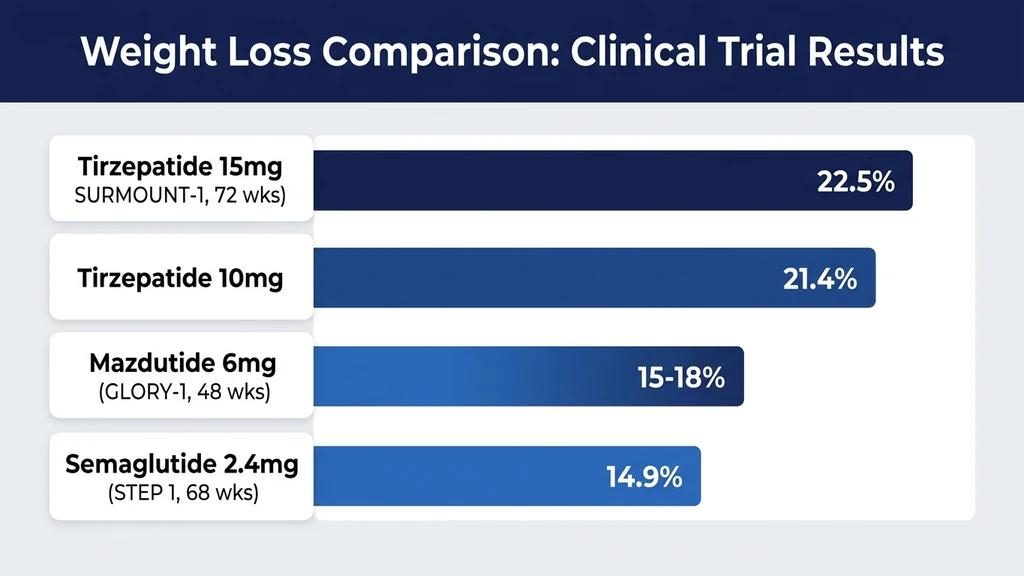
You are weighing the next generation of weight loss drugs against the current gold standard. Mazdutide (IBI362) and tirzepatide target different receptor pairs to achieve weight loss. Tirzepatide activates GLP-1 and GIP receptors, producing up to 22.5% weight loss at 72 weeks (SURMOUNT-1). Mazdutide activates GLP-1 and glucagon receptors, achieving 18.6 to 20.1% weight loss at 48 to 60 weeks (GLORY-1 and GLORY-2). Tirzepatide is FDA-approved and globally available. Mazdutide is approved only in China by the NMPA as of June 2025 (Mazdutide: First Approval, 2025).
| Feature | Tirzepatide | Mazdutide |
|---|---|---|
| Receptors | GIP + GLP-1 | GLP-1 + Glucagon |
| Developer | Eli Lilly | Innovent Biologics (co-developed with Eli Lilly) |
| Brand names | Mounjaro, Zepbound | Xinermei |
| Max weight loss | 22.5% at 72 weeks (15 mg) | 20.1% at 60 weeks (9 mg) |
| Trial program | SURMOUNT (obesity), SURPASS (T2D) | GLORY (obesity), DREAMS (T2D) |
| Approval status | FDA-approved (US, EU, UK) | NMPA-approved (China only) |
| Dosing | 2.5 to 15 mg weekly | 3 to 9 mg weekly |
| Administration | Subcutaneous injection | Subcutaneous injection |
For tirzepatide dosing, use our tirzepatide dosage calculator. For tirzepatide results, see our tirzepatide before and after guide.
Not FDA-approved for use outside labeled indications. Consult a healthcare provider before starting any weight loss medication.
Get your custom peptide protocol:
- Tailored to your body and goals
- Precise dosing and cycle length
- Safe stacking combinations
- Backed by peer-reviewed studies
- Ready in under 2 minutes
How Each Drug Works: The Receptor Difference
Both drugs are dual-receptor agonists, meaning they activate two hormone receptor pathways simultaneously. The specific receptors they target determine their metabolic effects.
Tirzepatide: GLP-1 + GIP (The Twincretin)
Tirzepatide is a 39-amino acid peptide that activates both GLP-1 and GIP receptors. The GLP-1 component suppresses appetite and slows gastric emptying. The GIP component enhances insulin sensitivity and optimizes adipose tissue function.
Think of these two pathways as a volume dial and a sensitivity dial on a radio. GLP-1 turns down the hunger volume. GIP adjusts how efficiently your body processes the metabolic signal. Together, they produce greater weight loss than either receptor alone (Jastreboff et al., NEJM, 2022). Eli Lilly coined the term "twincretin" for this dual mechanism. Tirzepatide was the first approved drug to combine GIP and GLP-1 agonism in a single molecule.
Mazdutide: GLP-1 + Glucagon (The Metabolic Accelerator)
Mazdutide activates GLP-1 and glucagon receptors. The GLP-1 component provides the same appetite suppression as tirzepatide. The glucagon component adds a distinct metabolic effect: it increases hepatic energy expenditure, promotes fat oxidation, and clears liver fat directly.
Glucagon is the hormone your body releases during fasting to mobilize stored energy. Activating the glucagon receptor pharmacologically mimics this fasting signal. Your body burns more calories at rest (thermogenesis) and clears fat from the liver more efficiently (Nature Communications, 2023).
Why the Receptor Difference Matters Clinically
GIP enhances insulin sensitivity and appetite regulation. Glucagon enhances energy expenditure and liver fat clearance. Tirzepatide wins on appetite suppression and insulin sensitization. Mazdutide may win on metabolic rate and hepatic steatosis.
For patients whose primary concern is maximum weight loss and blood sugar control, tirzepatide's GIP pathway delivers proven, FDA-approved results. For patients with significant liver fat (NAFLD/MASH), mazdutide's glucagon pathway offers a targeted mechanism that GIP does not share. Compare this to the similar glucagon mechanism in survodutide vs tirzepatide.
Clinical Trial Results Compared
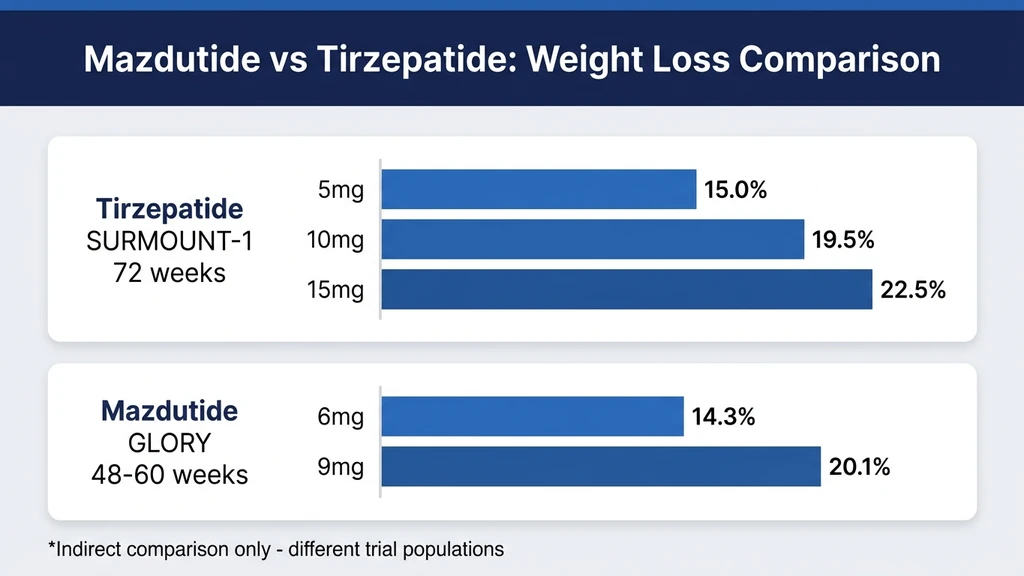
Comparing trial data across different programs requires caution. Patient populations, trial durations, and endpoints differ. These numbers offer directional guidance, not head-to-head equivalence.
Tirzepatide: SURMOUNT Program
SURMOUNT-1 enrolled 2,539 adults with obesity (BMI 30+) or overweight (BMI 27+) with at least one comorbidity. Participants received tirzepatide 5, 10, or 15 mg weekly for 72 weeks (Jastreboff et al., NEJM, 2022).
| Dose | Weight Loss (72 wk) | Participants Losing 20%+ |
|---|---|---|
| 5 mg | 15.0% | 27% |
| 10 mg | 19.5% | 46% |
| 15 mg | 22.5% | 56% |
| Placebo | 3.1% | 1.5% |
SURMOUNT-5, the head-to-head against semaglutide, confirmed tirzepatide's superiority: 20.2% versus 13.7% weight loss at 72 weeks (NEJM, 2025).
Mazdutide: GLORY Program
GLORY-1 enrolled 610 Chinese adults with obesity. Mazdutide 6 mg produced 14.3% weight loss at 48 weeks (NEJM, 2025). GLORY-2, testing the higher 9 mg dose, showed 20.1% weight loss at 60 weeks, with the weight loss curve still declining at trial end (not yet plateaued).
| Trial | Dose | Weight Loss | Duration | Participants |
|---|---|---|---|---|
| GLORY-1 | 6 mg | 14.3% | 48 weeks | 610 |
| GLORY-2 | 9 mg | 20.1% | 60 weeks | Not yet published |
| Phase 2 | 3/4.5/6 mg | Up to 11.7% | 24 weeks | 240 |
The 9 mg supplementary NMPA application was accepted in November 2025 (Mazdutide: First Approval, 2025). A pooled meta-analysis in non-diabetic adults confirmed these weight loss figures (PubMed, 2025).
DREAMS-3: Mazdutide vs Semaglutide Head-to-Head
DREAMS-3 enrolled 349 participants with type 2 diabetes and obesity. Mazdutide 6 mg achieved 10.3% weight loss versus semaglutide 1 mg at 6.0% at the same timepoint (PubMed, 2025). HbA1c reduction was comparable: 2.03% versus 1.84%.
Mazdutide outperformed semaglutide on weight loss in a diabetic population. No head-to-head trial between mazdutide and tirzepatide exists yet, though one is planned for moderate-to-severe obesity.
Side Effects Comparison
GI side effects are the dominant concern for both drugs. The key difference is in discontinuation rates.
| Parameter | Tirzepatide (SURMOUNT-1) | Mazdutide (GLORY-1) |
|---|---|---|
| Nausea | 24 to 31% | 20 to 30% (estimated) |
| Diarrhea | 17 to 23% | 15 to 25% (estimated) |
| Vomiting | 5 to 12% | 5 to 10% (estimated) |
| Discontinuation for AEs | 4.3 to 7.1% | 0.5 to 1.5% |
Mazdutide's strikingly low discontinuation rate (0.5 to 1.5%) in GLORY-1 stands out. Whether this reflects genuinely better tolerability or differences in patient populations and reporting standards between the Chinese GLORY and Western SURMOUNT cohorts remains unclear.
Glucagon receptor activation carries a theoretical risk of hyperglycemia. In practice, the GLP-1 component counterbalances this effect, and blood sugar increases have not been a significant concern in mazdutide trials (Phase 1b, 2022). For comprehensive tirzepatide side effect data, see our tirzepatide long-term side effects review.
Availability and Approval Status
This is the most important practical distinction between the two drugs in 2026.
Tirzepatide: Global Availability
Tirzepatide has been FDA-approved since May 2022 (Mounjaro for type 2 diabetes) and November 2023 (Zepbound for obesity). Available in the United States, European Union, United Kingdom, Japan, and many other countries. Generic compound versions are available through 503A and 503B pharmacies in the US. For information on compound formulations, see our guide on compound tirzepatide safety.
Mazdutide: China Only
The NMPA (China's National Medical Products Administration, equivalent to the FDA) approved mazdutide for obesity in June 2025 and for type 2 diabetes in September 2025. The brand name is Xinermei. A supplementary application for the 9 mg dose was accepted in November 2025.
No FDA submission has been announced. Innovent Biologics developed mazdutide in partnership with Eli Lilly, which creates a commercial conflict of interest. Eli Lilly manufactures tirzepatide, a direct competitor in the US market. The commercial incentive to bring a competing product to Western markets is limited. Mazdutide may remain China-exclusive for the foreseeable future.
Cost and Access
Tirzepatide's US list price runs approximately $1,000 to $1,200 per month for brand-name Mounjaro or Zepbound. Insurance coverage is inconsistent. Compound tirzepatide from specialty pharmacies costs significantly less ($200 to $500 per month), though availability faces ongoing regulatory scrutiny.
Mazdutide's pricing in China is expected to be significantly lower, consistent with the Chinese pharmaceutical market. However, it is not available through any legal channel in Western markets. No research-grade mazdutide is available from US or European suppliers. If you can access tirzepatide today, that is your accessible dual-agonist option.
The Glucagon Advantage: What Mazdutide Offers That Tirzepatide Cannot
Glucagon receptor activation produces metabolic effects that GIP receptor activation does not.
Energy expenditure increase. Glucagon stimulates thermogenesis in the liver and brown adipose tissue. Your body burns more calories at rest. Tirzepatide reduces caloric intake. Mazdutide reduces caloric intake and increases caloric output simultaneously.
Direct liver fat clearance. Glucagon increases hepatic fat oxidation, the process by which the liver burns its own fat stores. In patients with NAFLD or MASH, this mechanism targets the organ most at risk. Tirzepatide reduces liver fat indirectly through weight loss (approximately 55% reduction). Mazdutide reduces liver fat through both weight loss and direct hepatic action.
Potential MASH benefit. Mazdutide's dual mechanism positions it as a candidate for MASH treatment, similar to survodutide (another GLP-1/glucagon agonist with dedicated Phase 3 MASH trials). No MASH-specific trial for mazdutide has been announced, but the pharmacological rationale is strong based on the glucagon receptor's hepatic effects.
Who Should Care About Mazdutide?
Today, mazdutide is relevant to four groups.
Patients with liver fat concerns. If NAFLD or MASH is your primary condition alongside obesity, the glucagon receptor pathway offers targeted liver benefits that GIP does not provide. You cannot access mazdutide yet in Western markets, but understanding the mechanism prepares you for GLP-1/glucagon drugs that will reach Western markets (including survodutide).
Pipeline watchers. Mazdutide's GLORY-2 data (20.1% weight loss at 9 mg) signals that GLP-1/glucagon drugs are approaching GIP/GLP-1 drugs in efficacy while offering distinct metabolic benefits. The obesity drug market is diversifying beyond the tirzepatide/semaglutide duopoly.
Researchers studying glucagon receptor agonism. The GLORY and DREAMS trial data expand the clinical evidence base for glucagon co-agonism in metabolic disease.
Patients in China or with access to Asian healthcare systems. Mazdutide is commercially available under the brand name Xinermei. For other GLP-1 comparisons, see our orforglipron vs tirzepatide analysis and our retatrutide vs tirzepatide comparison.
Frequently Asked Questions
Is mazdutide better than tirzepatide for weight loss?
Not based on current data. Tirzepatide produces 22.5% weight loss at 72 weeks (SURMOUNT-1, 15 mg). Mazdutide produces 20.1% at 60 weeks (GLORY-2, 9 mg) with the curve still declining at trial end. The gap may narrow with longer mazdutide trials, but direct head-to-head data does not exist. Trial population differences (Chinese vs Western cohorts) also complicate comparison. For current treatment options, see our tirzepatide before and after results.
Can I get mazdutide in the US?
No. Mazdutide is approved only in China (NMPA, June 2025). No FDA submission has been announced. Eli Lilly co-developed both mazdutide and tirzepatide, creating limited commercial incentive to bring a competing product to the US market. No legitimate supplier offers mazdutide in Western markets. Tirzepatide remains the only accessible dual-agonist option in the United States.
What is the difference between GIP and glucagon agonism?
GIP (glucose-dependent insulinotropic polypeptide) receptor activation enhances insulin sensitivity and adipose tissue function, primarily supporting appetite regulation and glucose control. Glucagon receptor activation increases hepatic energy expenditure, promotes fat oxidation, and clears liver fat directly. Tirzepatide uses GIP. Mazdutide uses glucagon. Both pair their secondary receptor with GLP-1 for appetite suppression.
Will mazdutide ever be FDA-approved?
Uncertain. The main barrier is commercial, not scientific. Eli Lilly co-developed mazdutide with Innovent Biologics and simultaneously manufactures tirzepatide. Bringing a competitor to its own blockbuster drug to the US market makes limited business sense. Unless Innovent pursues an independent FDA filing or a strategic partnership emerges, US approval may not occur. Monitor pipeline developments for updates.
How does mazdutide compare to semaglutide?
In the DREAMS-3 head-to-head trial (349 participants with T2D), mazdutide 6 mg produced 10.3% weight loss versus 6.0% for semaglutide 1 mg (PubMed, 2025). HbA1c reduction was similar (2.03% vs 1.84%). Mazdutide outperformed semaglutide on weight loss in a diabetic population. No comparison exists in a non-diabetic obesity population.
Is mazdutide the same as survodutide?
No. Both are GLP-1/glucagon dual agonists, but they are different molecules from different companies. Mazdutide (IBI362) is developed by Innovent Biologics and Eli Lilly, approved in China. Survodutide (BI 456906) is developed by Boehringer Ingelheim and Zealand Pharma, in Phase 3 globally with dedicated MASH trials. They target the same receptor pair but differ in pharmacokinetics, tolerability, and development strategy. See our survodutide vs tirzepatide comparison.
The Bottom Line
Tirzepatide is the proven choice today: FDA-approved, globally available, and backed by 72-week data showing 22.5% weight loss. Mazdutide shows strong potential, with 20.1% weight loss at 60 weeks and a glucagon-driven metabolic pathway that directly targets liver fat and energy expenditure.
The practical reality: if you live outside China, tirzepatide is your only accessible option. Mazdutide's relevance to Western patients lies in what it signals about the future. GLP-1/glucagon drugs are approaching GIP/GLP-1 efficacy while offering distinct liver and metabolic benefits that GIP-based drugs cannot match.
Use our tirzepatide dosage calculator to plan your current treatment. For the oral GLP-1 alternative, see our orforglipron vs tirzepatide comparison. For another GLP-1/glucagon drug in global development, review our survodutide vs tirzepatide analysis. For switching from semaglutide, see our switching guide.
Helpful Tools
Related Articles
Orforglipron vs Tirzepatide: Pill vs Shot
Orforglipron vs tirzepatide: 12.4% weight loss for the oral GLP-1 pill vs 22.5% for tirzepatide. ATTAIN-1 NEJM data and switching results.
Retatrutide vs Tirzepatide Compared
Retatrutide vs tirzepatide compared: 28.7% vs 22.5% weight loss, triple vs dual agonist mechanism, side effects, dosing, cost, and FDA status.
Does Compounded Tirzepatide Work? Real Data
Does compounded tirzepatide work? Review SURMOUNT data, salt form differences (base, acetate, sodium), potency gaps, and FDA status in 2026.
Tirzepatide: How Long to Work?
Tirzepatide reduces appetite within the first week, produces measurable weight loss by week 4, and delivers significant results by weeks 12-16.