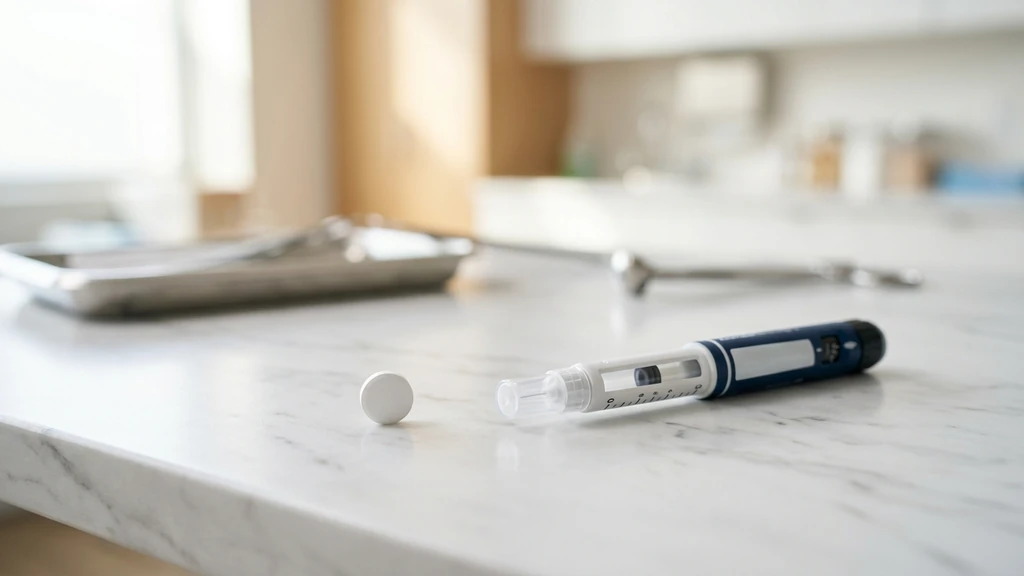
You want GLP-1 therapy but hate needles. Orforglipron is the first oral nonpeptide GLP-1 receptor agonist, producing 12.4% weight loss at 72 weeks in Phase 3 (ATTAIN-1). Tirzepatide, a dual GIP/GLP-1 injectable, produces 22.5% weight loss at 72 weeks (SURMOUNT-1). Both come from Eli Lilly. The tradeoff is clear: orforglipron eliminates needles; tirzepatide delivers nearly double the weight loss. Orforglipron's FDA PDUFA date is April 10, 2026 (NEJM, 2025; Jastreboff et al., NEJM, 2022).
| Feature | Orforglipron | Tirzepatide |
|---|---|---|
| Type | Oral nonpeptide small molecule | Injectable peptide |
| Receptors | GLP-1 only | GIP + GLP-1 |
| Administration | Daily pill (any time, with or without food) | Weekly subcutaneous injection |
| Max weight loss (Phase 3) | 12.4% at 72 weeks (ATTAIN-1) | 22.5% at 72 weeks (SURMOUNT-1) |
| Half-life | 29 to 49 hours | ~5 days (120 hours) |
| FDA status | PDUFA April 10, 2026 | Approved (Mounjaro 2022, Zepbound 2023) |
| Developer | Eli Lilly | Eli Lilly |
| Storage | Room temperature | Refrigerated (pen) or cold chain (compound) |
| Estimated cost | Expected lower than tirzepatide | ~$1,000 to $1,200/month |
For current tirzepatide dosing, use our tirzepatide dosage calculator. Not FDA-approved outside labeled indications. Consult a healthcare provider before starting any GLP-1 therapy.
Get your custom peptide protocol:
- Tailored to your body and goals
- Precise dosing and cycle length
- Safe stacking combinations
- Backed by peer-reviewed studies
- Ready in under 2 minutes
How Each Drug Works
Orforglipron and tirzepatide activate different receptor combinations using fundamentally different molecular structures. These structural differences explain every clinical outcome that follows.
Orforglipron: A Nonpeptide Small Molecule GLP-1 Agonist
Orforglipron is not a peptide. It is a synthetic small molecule that activates the GLP-1 receptor through a mechanism called biased signaling. Traditional GLP-1 peptides (semaglutide, liraglutide, and the GLP-1 portion of tirzepatide) are chains of amino acids that stomach acid destroys within minutes. Orforglipron survives the stomach because it is not made of amino acids.
Think of the difference like a key and a lockpick. A peptide GLP-1 agonist is a custom-cut key that fits the receptor lock precisely but dissolves in acid. Orforglipron is a lockpick that opens the same lock but is made of steel. It works through a slightly different binding mechanism (biased signaling), but it survives conditions that destroy peptide keys.
The half-life of 29 to 49 hours requires daily dosing, compared to tirzepatide's 5-day half-life that allows weekly injection. Orforglipron targets only the GLP-1 receptor. It does not activate GIP (NEJM, 2023).
Tirzepatide: A Dual GIP/GLP-1 Peptide
Tirzepatide is a 39-amino acid peptide that activates both GIP and GLP-1 receptors. The dual mechanism produces stronger appetite suppression and greater insulin sensitization than GLP-1 alone. Its 5-day half-life (enabled by a fatty acid chain that binds albumin in the bloodstream) allows weekly injection.
As a peptide, tirzepatide cannot survive oral administration. Stomach acid and digestive enzymes break it apart within minutes. Injection delivers it directly into subcutaneous tissue, bypassing the GI degradation problem. For injection site guidance, see our best injection sites guide and our how to inject tirzepatide walkthrough.
Why Orforglipron Can Be a Pill When GLP-1 Peptides Cannot
Oral semaglutide (Rybelsus) exists, but it is a peptide packed with an absorption enhancer (SNAC) that must be taken on an empty stomach with minimal water. Only 0.4 to 1% of the dose actually absorbs. The rest is destroyed by gastric acid.
Orforglipron avoids this problem entirely. Its nonpeptide structure resists proteolytic degradation. It absorbs readily from the small intestine without food timing restrictions. Take it at any time, with or without a meal. This makes orforglipron the first truly convenient oral GLP-1 therapy.
Weight Loss: Clinical Trial Data Compared
The efficacy gap is the central question in this comparison. Tirzepatide produces substantially more weight loss. The question is whether orforglipron's convenience justifies the lower efficacy ceiling.
Orforglipron: ATTAIN Trials
ATTAIN-1 enrolled adults with obesity (BMI 30+) or overweight (BMI 27+) with comorbidities. Results at 72 weeks (NEJM, 2025):
| Dose | Weight Loss (72 wk) |
|---|---|
| 6 mg | 8.6% |
| 12 mg | 9.4% |
| 36 mg | 12.4% |
| Placebo | 0.9% |
ATTAIN-2 tested orforglipron in adults with type 2 diabetes and obesity. The 36 mg dose produced 10.5% weight loss at 72 weeks (Lancet, 2025). Lower weight loss in diabetic populations is consistent across all GLP-1 drugs.
The Phase 2 trial showed up to 14.7% weight loss at 36 weeks with higher doses (NEJM, 2023). Phase 3 results at 12.4% are lower, which is common when larger, more diverse populations are enrolled.
Tirzepatide: SURMOUNT Trials
SURMOUNT-1 results at 72 weeks (Jastreboff et al., NEJM, 2022):
| Dose | Weight Loss (72 wk) |
|---|---|
| 5 mg | 15.0% |
| 10 mg | 19.5% |
| 15 mg | 22.5% |
| Placebo | 3.1% |
SURMOUNT-5, the head-to-head against semaglutide, showed 20.2% versus 13.7% weight loss at 72 weeks (NEJM, 2025). Tirzepatide's lowest dose (5 mg, 15.0%) produces more weight loss than orforglipron's highest approved dose (36 mg, 12.4%).
The Efficacy Gap Explained
Three factors drive the 10-percentage-point gap between orforglipron (12.4%) and tirzepatide (22.5%).
Single vs dual receptor. Orforglipron activates only GLP-1. Tirzepatide activates both GIP and GLP-1. The additional GIP pathway enhances insulin sensitivity and adipose tissue regulation in ways that GLP-1 alone cannot replicate.
Oral vs injectable bioavailability. Even though orforglipron absorbs well for a small molecule, injectable tirzepatide delivers drug directly into subcutaneous tissue with approximately 80% bioavailability. Oral drugs face intestinal metabolism, hepatic first-pass effects, and variable absorption.
Daily peaks vs sustained weekly levels. Tirzepatide's 5-day half-life maintains relatively stable plasma levels across the week. Orforglipron's 29 to 49-hour half-life creates daily peak-and-trough cycles that may reduce the sustained receptor activation needed for maximum appetite suppression.
The Switching Question: ATTAIN-MAINTAIN Results
Eli Lilly's ATTAIN-MAINTAIN study tested a sequential treatment model: start with tirzepatide for aggressive weight loss, then switch to oral orforglipron for maintenance (Eli Lilly Press Release).
Participants who switched from tirzepatide to orforglipron regained approximately 5.7 pounds over the maintenance period. Those switched to placebo regained approximately 20 pounds. Orforglipron preserved the vast majority of tirzepatide-induced weight loss without continued injections.
This creates a compelling sequential treatment pathway: use tirzepatide for 6 to 12 months to reach your target weight (leveraging its superior 22.5% efficacy), then transition to the orforglipron pill for long-term maintenance. The injectable phase handles the loss. The oral maintenance phase handles preservation indefinitely.
This approach is not yet FDA-approved as a formal treatment protocol. If orforglipron gains approval in April 2026, prescribers will likely begin implementing this sequential strategy. For background on switching between GLP-1 agents, see our switching from semaglutide guide.
Side Effects Comparison
Both drugs share the GLP-1-driven GI side effect profile: nausea, diarrhea, vomiting, and constipation. The discontinuation rates tell the tolerability story.
| Parameter | Orforglipron (ATTAIN-1) | Tirzepatide (SURMOUNT-1) |
|---|---|---|
| Nausea | 30 to 40% | 24 to 31% |
| Diarrhea | 15 to 25% | 17 to 23% |
| Vomiting | 10 to 20% | 5 to 12% |
| Constipation | 10 to 15% | 6 to 17% |
| Discontinuation for AEs | 5.3 to 10.3% | 4.3 to 7.1% |
Orforglipron has a slightly higher discontinuation rate (5.3 to 10.3% vs 4.3 to 7.1%). Daily oral dosing means GI symptoms are renewed each day. Tirzepatide's weekly injection concentrates symptoms into a predictable 24 to 48-hour window after injection, then fades.
Neither drug has shown serious safety signals beyond expected GLP-1 class effects (gallbladder events, theoretical pancreatitis risk). For detailed tirzepatide safety data, see our tirzepatide long-term side effects review.
The Practical Reality: Daily Pill vs Weekly Injection
Efficacy data tells half the story. The other half is how the drug fits into your daily life and adherence patterns.
Convenience and Adherence
Orforglipron: One pill daily. No needles, no refrigeration, no injection technique to learn. Take it at any time, with or without food. Ideal for travel: pack pills in a carry-on without cooler bags or insulated pouches.
Tirzepatide: One injection weekly. Requires a refrigerator (brand pen) or cold chain (compound vial). Requires learning injection technique, managing needles, rotating sites, and disposing of sharps properly.
An estimated 20 to 25% of patients decline injectable GLP-1 drugs because of needle aversion. Orforglipron opens the GLP-1 category to millions of new users who would not otherwise try it. For tirzepatide injection technique, see our best injection sites guide.
Missed Dose Implications
Orforglipron's 29 to 49-hour half-life means plasma levels drop significantly within 2 days of a missed dose. Missing a single day reduces drug exposure noticeably. Missing 2 to 3 consecutive days eliminates most therapeutic effect.
Tirzepatide's 5-day half-life provides a much wider margin. Missing your weekly injection by 1 to 2 days leaves substantial circulating drug. Even a 3-day delay still maintains partial receptor activation.
If you tend to miss daily medications, tirzepatide's weekly schedule is more forgiving. If you are consistent with daily habits but resist injections, orforglipron fits your adherence pattern better.
Storage Requirements
Orforglipron is a room-temperature pill. Store it in a medicine cabinet. No cold chain required. No insulated bags during travel. No worrying about medication viability in hot climates.
Tirzepatide pens (Mounjaro, Zepbound) require refrigeration at 36 to 46 degrees F. They can remain at room temperature (up to 86 degrees F) for up to 21 days. Compound tirzepatide vials require refrigeration with shorter stability windows. For storage guidance, see our article on how long does tirzepatide last in the fridge.
FDA Status and Availability
Orforglipron: The FDA granted Priority Review, shortening the review timeline from 10 to 6 months. The PDUFA (Prescription Drug User Fee Act) target action date is April 10, 2026. If approved, commercial availability is expected in the second half of 2026. The drug is not currently available by any legal route. No pharmacy carries it before FDA approval.
Tirzepatide: FDA-approved since May 2022 (Mounjaro for type 2 diabetes) and November 2023 (Zepbound for chronic weight management). Available at pharmacies nationwide. Compound versions available from 503A and 503B pharmacies.
If you need GLP-1 therapy today, tirzepatide is available now. Orforglipron's approval is expected but not guaranteed. For information on tirzepatide pill form, note that tirzepatide itself cannot be made into a pill due to its peptide structure.
Cost and Access
Tirzepatide: Brand-name Mounjaro and Zepbound list at approximately $1,000 to $1,200 per month. Insurance coverage varies widely. Compound tirzepatide from specialty pharmacies runs $200 to $500 per month but faces ongoing regulatory scrutiny.
Orforglipron: Eli Lilly has signaled that oral GLP-1 drugs will be priced below injectables. Oral manufacturing is simpler: standard pills versus pre-filled auto-injector pens. Industry analysts estimate orforglipron could launch at $500 to $800 per month, though pricing is not yet confirmed.
Insurance coverage for oral medications typically follows standard pharmacy benefit structures without specialty pharmacy requirements, which tends to favor broader coverage. Generic timelines differ: tirzepatide's peptide complexity and patent portfolio protect it through the early 2030s. Orforglipron's small molecule structure is theoretically more accessible for generic development, but patent protection will likely delay generics for a comparable period.
Who Should Choose Which?
The choice depends on your priorities, not just the numbers.
Choose Orforglipron If (Once Available)
You have needle phobia or a strong preference against injections. Your weight loss goal is moderate (10 to 15% of body weight). You value daily routine simplicity over weekly injection management. You travel frequently and need room-temperature, hassle-free medication. You want a potentially lower-cost oral option. You want to avoid injection site reactions, bruising, and rotation schedules.
Choose Tirzepatide If
You need maximum weight loss (15% or more of body weight). You prefer weekly dosing over a daily pill. You are comfortable with subcutaneous injections. You want the dual GIP/GLP-1 mechanism for enhanced insulin sensitivity. You want a drug with 72 weeks of proven Phase 3 data and established post-marketing experience. You need a drug available right now. See our tirzepatide before and after results for real-world outcomes.
Can You Use Both? The Sequential Approach
The ATTAIN-MAINTAIN data supports a sequential treatment model. Aggressive weight loss with tirzepatide (6 to 12 months to reach target), then transition to oral orforglipron for maintenance. This combines tirzepatide's superior efficacy for the loss phase with orforglipron's needle-free convenience for the years-long maintenance phase.
Concurrent use (taking both simultaneously) is not supported by any clinical data. Both drugs target the GLP-1 receptor, so combining them would amplify GI side effects without proportional efficacy gains. They are not designed for combination therapy.
If orforglipron is approved in April 2026, the sequential approach becomes a practical option by mid to late 2026. Discuss this strategy with your prescriber. For other pipeline options in the comparison, see mazdutide vs tirzepatide, survodutide vs tirzepatide, and retatrutide vs tirzepatide.
Frequently Asked Questions
Is orforglipron as effective as tirzepatide?
No. Orforglipron produces 12.4% weight loss at 72 weeks (ATTAIN-1, 36 mg) versus tirzepatide's 22.5% (SURMOUNT-1, 15 mg). The gap is driven by orforglipron's single GLP-1 receptor target versus tirzepatide's dual GIP/GLP-1 mechanism, plus differences in oral versus injectable bioavailability. Tirzepatide's lowest dose (5 mg, 15.0%) outperforms orforglipron's highest dose.
When will orforglipron be available?
The FDA PDUFA target action date is April 10, 2026. If approved, commercial availability is expected in the second half of 2026. The FDA granted Priority Review (6-month timeline). Approval is not guaranteed. Orforglipron is not currently available through any legal channel. For a currently available option, see our tirzepatide dosage calculator.
Can you take orforglipron instead of tirzepatide?
Once approved, yes. Both target weight loss through GLP-1 receptor activation. The tradeoff is efficacy versus convenience: tirzepatide produces 22.5% weight loss (injectable, weekly) while orforglipron produces 12.4% (oral, daily). Switching from tirzepatide to orforglipron for maintenance is supported by ATTAIN-MAINTAIN data showing only 5.7 pounds of regain versus 20 pounds on placebo.
Is orforglipron a GLP-1?
Yes, orforglipron is a GLP-1 receptor agonist. It is a nonpeptide small molecule that activates the same receptor as semaglutide and the GLP-1 component of tirzepatide. The critical difference: orforglipron is not a peptide. Its synthetic small-molecule structure survives stomach acid, enabling oral administration. It is the first nonpeptide GLP-1 agonist to complete Phase 3 trials (NEJM, 2025).
Will orforglipron be cheaper than tirzepatide?
Likely yes. Eli Lilly has indicated oral GLP-1 drugs will be priced below injectables. Oral manufacturing is simpler than pre-filled auto-injector pens. Industry estimates suggest $500 to $800 per month versus tirzepatide's $1,000 to $1,200. Insurance coverage for oral medications also tends to be more favorable than for injectable specialty drugs. Pricing is not yet confirmed for the US market.
Can you switch from tirzepatide to orforglipron?
The ATTAIN-MAINTAIN study tested this exact scenario. Participants who switched from tirzepatide to orforglipron regained only 5.7 pounds, versus 20 pounds for those switched to placebo. This supports a sequential approach: aggressive weight loss with tirzepatide, then maintenance with oral orforglipron. The protocol is not yet FDA-approved as a formal treatment pathway.
Does orforglipron have the same side effects as tirzepatide?
Similar GI side effects (nausea, diarrhea, vomiting) because both activate GLP-1 receptors. Orforglipron's discontinuation rate is slightly higher (5.3 to 10.3% vs 4.3 to 7.1%), possibly because daily dosing renews GI symptoms each day. Tirzepatide concentrates symptoms into a 24 to 48-hour window after injection. Orforglipron has no injection site reactions, bruising, or rotation-related concerns.
The Bottom Line
Orforglipron and tirzepatide represent two complementary approaches from the same company. Tirzepatide delivers superior weight loss (22.5% vs 12.4%) through dual GIP/GLP-1 receptor activation via weekly injection. Orforglipron offers a needle-free daily pill with GLP-1-only activation and a lower but meaningful efficacy profile.
The ATTAIN-MAINTAIN switching data suggests the strongest use case for orforglipron may be as a maintenance drug after tirzepatide-driven weight loss. If the FDA approves orforglipron by April 2026, this sequential approach could become a standard treatment model: inject for the loss phase, swallow a pill for the maintenance phase.
Use our tirzepatide dosage calculator to plan your current treatment. For other comparisons in the obesity drug pipeline, see mazdutide vs tirzepatide and survodutide vs tirzepatide. For real-world results data, visit our tirzepatide before and after page.
Helpful Tools
Related Articles
Mazdutide vs Tirzepatide: Which Dual Agonist Wins?
Mazdutide vs tirzepatide: 20.1% weight loss (GLORY-2) vs 22.5% (SURMOUNT-1). GLP-1/glucagon vs GIP/GLP-1 mechanisms and 2026 availability.
Retatrutide vs Tirzepatide Compared
Retatrutide vs tirzepatide compared: 28.7% vs 22.5% weight loss, triple vs dual agonist mechanism, side effects, dosing, cost, and FDA status.
Does Oral Tirzepatide Work? The Facts
Oral tirzepatide is not FDA-approved. Why peptide pills face absorption barriers, sublingual drops vs injections, and oral GLP-1 alternatives in 2026.
Retatrutide Availability & Timeline
Retatrutide is expected to receive FDA approval in mid-2027 with pharmacy availability in late 2027. Full timeline and Phase 3 trial status.