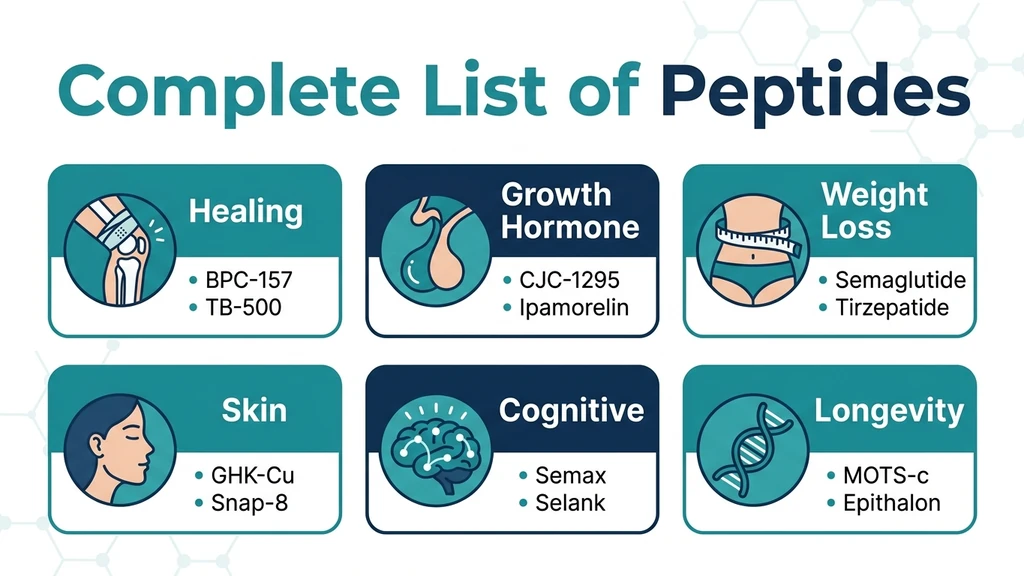
You typed a peptide name into a search bar, got forty results, and still cannot tell which compound does what. Here is the map. Research peptides sort into seven working categories: healing and recovery, growth hormone and muscle, weight loss and metabolism, skin and cosmetic, cognitive and sleep, sexual health, and longevity. More than 80 peptide drugs have reached global markets, with roughly 150 more in clinical development (Wang et al., Signal Transduct Target Ther, 2022, PMID 35165272).
| Category | What it targets | Best-known examples |
|---|---|---|
| Healing and recovery | Tissue repair, inflammation | BPC-157, TB-500, KPV |
| Growth hormone and muscle | GH release, muscle growth | CJC-1295, ipamorelin, MK-677 |
| Weight loss and metabolism | Appetite, fat oxidation | Semaglutide, tirzepatide, retatrutide |
| Skin and cosmetic | Collagen, pigmentation, wrinkles | GHK-Cu, Snap-8, melanotan |
| Cognitive and sleep | Focus, anxiety, sleep depth | Semax, selank, DSIP |
| Sexual health | Libido, hormonal signaling | PT-141, kisspeptin, gonadorelin |
| Longevity and mitochondrial | Cellular energy, aging markers | MOTS-c, NAD+, epithalon |
Each section below lists the peptides in that category, what each one does, and where to read the full guide. Every compound here is a research chemical unless it carries FDA approval, so treat dosing discussions as educational and talk to a qualified provider before touching a vial.
Get your custom peptide protocol:
- Tailored to your body and goals
- Precise dosing and cycle length
- Safe stacking combinations
- Backed by peer-reviewed studies
- Ready in under 2 minutes
How Peptides Are Classified
A peptide is a short chain of amino acids, usually 2 to 50 links long. Think of amino acids as an alphabet of 20 letters: string a few together and you get a word, and each word tells one specific cell receptor to do one specific job. That receptor match is how peptides get sorted into categories.
BPC-157 speaks to tissue-repair pathways, so it files under healing. Semaglutide speaks to the GLP-1 receptor that controls appetite, so it files under weight loss. The category tells you the receptor system, which tells you the effect.
Size separates peptides from their neighbors. Insulin sits at the top of the range with 51 amino acids, while full proteins run into the hundreds. Peptide drug development has accelerated sharply since 2000, driven largely by the GLP-1 class (Muttenthaler et al., Nat Rev Drug Discov, 2021, PMID 33536635). If you are new to all of this, start with the getting started with peptides guide and the peptide safety guide before picking a category.
Healing and Recovery Peptides
Healing peptides accelerate tissue repair by boosting blood vessel growth, cell migration, or immune signaling at the injury site. This is the category most people enter through, usually chasing a tendon that will not heal. The peptides for healing overview and the best peptides for tendon repair guide cover selection in depth.
| Peptide | What it does | Full guide |
|---|---|---|
| BPC-157 | Gut and soft-tissue repair via blood vessel growth | BPC-157 profile |
| TB-500 | Cell migration for muscle, tendon, and ligament repair | TB-500 profile |
| KPV | Anti-inflammatory tripeptide for gut and skin conditions | KPV profile |
| Thymosin alpha-1 | Immune modulation, studied in infections and oncology | Thymosin alpha-1 profile |
| LL-37 | Antimicrobial peptide, innate immune defense | LL-37 profile |
BPC-157 and TB-500 are the flagship pair here and are often run together. Read the BPC-157 vs TB-500 comparison to understand who does what, and the combined dosage guide if you plan to stack them.
Growth Hormone and Muscle Peptides
These peptides raise your own growth hormone output instead of injecting synthetic HGH, which is why the HGH vs peptides comparison matters before you choose. Two subtypes exist: GHRH analogs that tell the pituitary when to release, and GHRPs that amplify how much comes out. The peptides for muscle growth guide ranks them by goal.
| Peptide | What it does | Full guide |
|---|---|---|
| Sermorelin | Mild GHRH analog, common clinical starting point | Sermorelin profile |
| CJC-1295 | Longer-acting GHRH analog, steady GH elevation | CJC-1295 profile |
| Ipamorelin | Selective GHRP with minimal hunger or cortisol effect | Ipamorelin profile |
| Tesamorelin | FDA-approved GHRH analog, targets visceral fat | Tesamorelin guide |
| GHRP-6 | Strong GH pulse with pronounced hunger stimulation | GHRP-6 profile |
| Hexarelin | Most potent GHRP, faster receptor desensitization | Hexarelin profile |
| MK-677 | Oral GH secretagogue, technically not a peptide | MK-677 profile |
| IGF-1 LR3 | Long-acting IGF-1 analog, direct anabolic signal | IGF-1 LR3 profile |
| Follistatin-344 | Myostatin inhibitor studied for muscle growth | Follistatin-344 dosage guide |
The most common pairing is CJC-1295 with ipamorelin, which combines both subtypes in one protocol. The CJC-1295 and ipamorelin benefits guide explains the synergy.
Weight Loss and Metabolic Peptides
This is the largest category by prescription volume, anchored by the GLP-1 receptor agonists that reshaped obesity medicine. The best peptides for weight loss guide compares every option, and the retatrutide vs tirzepatide breakdown covers the head-to-head most readers ask about.
| Peptide | What it does | Full guide |
|---|---|---|
| Semaglutide | GLP-1 agonist, FDA-approved (Ozempic, Wegovy) | Semaglutide profile |
| Tirzepatide | Dual GIP/GLP-1 agonist, FDA-approved (Mounjaro, Zepbound) | Tirzepatide profile |
| Retatrutide | Triple agonist in phase 3 trials, up to 24% weight loss | Retatrutide profile |
| Cagrilintide | Amylin analog, often paired with semaglutide | Cagrilintide profile |
| AOD-9604 | HGH fragment studied for fat metabolism | AOD-9604 profile |
| HGH Fragment 176-191 | Lipolytic fragment without full GH effects | HGH Fragment profile |
| 5-Amino-1MQ | Oral NNMT inhibitor studied for fat cell metabolism | 5-Amino-1MQ profile |
Semaglutide and tirzepatide carry full FDA approval, which puts them in a different safety tier from everything else on this page. The rest remain research compounds with thinner human data.
Skin and Cosmetic Peptides
Cosmetic peptides work through collagen synthesis, pigmentation signaling, or muscle-contraction blocking, and several apply topically instead of by injection. The peptides for skin overview explains which format fits which goal.
| Peptide | What it does | Full guide |
|---|---|---|
| GHK-Cu | Copper peptide, collagen production and skin remodeling | GHK-Cu profile |
| Snap-8 | Topical wrinkle reducer, blocks expression-line contractions | Snap-8 guide |
| Melanotan 1 | Tanning peptide, more selective and milder profile | Melanotan 1 vs 2 comparison |
| Melanotan 2 | Stronger tanning peptide with libido side effects | Melanotan 2 profile |
| Glutathione | Antioxidant tripeptide used for skin brightening | Glutathione guide |
GHK-Cu dominates this category and earns its reputation: the GHK-Cu benefits guide covers the evidence for skin, hair, and wound repair. Melanotan compounds carry real risk, including nausea and unregulated pigment changes, so read the comparison before considering either.
Cognitive, Mood, and Sleep Peptides
Most peptides in this category came out of Russian research programs and act on brain-derived neurotrophic factor, GABA signaling, or sleep architecture. Evidence quality varies widely here, which the peptides for cognitive function guide addresses head-on.
| Peptide | What it does | Full guide |
|---|---|---|
| Semax | Nootropic studied for focus, memory, and BDNF | Semax profile |
| Selank | Anxiolytic peptide without sedation or dependence | Selank profile |
| DSIP | Delta sleep-inducing peptide for sleep depth | DSIP profile |
Semax and selank are usually taken as nasal sprays, which makes them the rare needle-free entries on this page. For the broader toolkits, see peptides for anxiety and peptides for sleep, and check the DSIP dosage guide before experimenting with sleep timing.
Sexual Health and Hormonal Peptides
These peptides act on brain receptors or the hypothalamic axis rather than on blood flow, which separates them mechanically from drugs like sildenafil. The peptides for libido guide maps the options by symptom.
| Peptide | What it does | Full guide |
|---|---|---|
| PT-141 | Melanocortin agonist for libido, FDA-approved as Vyleesi | PT-141 profile |
| Kisspeptin | Upstream trigger of the reproductive hormone axis | Kisspeptin profile |
| Gonadorelin | GnRH analog, preserves natural testosterone signaling | Gonadorelin profile |
| Oxytocin | Bonding and intimacy hormone, studied intranasally | Oxytocin profile |
| HCG | Hormone analog that maintains testicular function | HCG guide |
PT-141 works in roughly 60% of users and needs 45 minutes to 2 hours of lead time, detailed in the PT-141 dosage guide. Men optimizing hormones should also read the best peptides for testosterone guide, since kisspeptin, gonadorelin, and HCG each solve a different part of that puzzle.
Longevity, Mitochondrial, and Bioregulator Peptides
Longevity peptides target the machinery of aging itself: mitochondrial output, NAD+ levels, and telomere maintenance. Human evidence is the thinnest of any category on this page, a caveat the bioregulator peptides guide treats seriously.
| Peptide | What it does | Full guide |
|---|---|---|
| MOTS-c | Mitochondrial peptide, exercise mimetic, AMPK activator | MOTS-c profile |
| Humanin | Mitochondrial peptide studied for cellular protection | Humanin guide |
| SS-31 | Targets cardiolipin to restore mitochondrial function | SS-31 guide |
| NAD+ | Coenzyme injection for cellular energy metabolism | NAD+ profile |
| Epithalon | Telomerase-activating tetrapeptide from pineal research | Epithalon profile |
| Thymalin | Thymus bioregulator studied for immune aging | Thymalin guide |
| Pinealon | Brain bioregulator tripeptide for cognitive aging | Pinealon guide |
MOTS-c is the standout for anyone who trains, since it rises naturally during exercise and amplifies the metabolic response. If daytime fatigue is the complaint rather than aging as such, start with the peptides for energy guide instead.
How to Read a Peptide Label
Every research peptide vial shows the same three facts: peptide name, total milligrams of lyophilized powder, and purity percentage. The number that trips people up is the milligrams, because a vial labeled 5 mg contains 5 mg of dry powder and zero liquid. You add bacteriostatic water yourself, and the amount you add sets the concentration of every dose you draw.
Add 2 mL of water to a 5 mg vial and you get 2.5 mg/mL. Add 1 mL and the same vial doubles to 5 mg/mL, so identical syringe markings now deliver twice the dose. Run your exact numbers through the peptide reconstitution calculator and convert syringe markings with the peptide unit converter before the first injection.
Three supporting reads close the loop: the how to reconstitute peptides walkthrough for mixing technique, the bacteriostatic vs sterile water comparison for choosing the right diluent, and the peptide storage guide because reconstituted peptides degrade within weeks even refrigerated. The peptide dosage chart collects typical research doses for every compound listed above.
Frequently Asked Questions
How many peptides are there in total?
Over 7,000 naturally occurring peptides have been identified, more than 80 peptide drugs hold regulatory approval worldwide, and roughly 150 sit in clinical trials (Lau and Dunn, Bioorg Med Chem, 2018, PMID 28720325). The research community focuses on the 30 to 40 compounds covered in the getting started with peptides guide.
What is the best peptide for beginners?
BPC-157 is the most common first peptide because it has a wide dosing range, mild side effects, and the largest body of user experience. Read the BPC-157 profile for the evidence, and work through the peptide safety guide before you order anything.
Which peptides are FDA-approved?
From this list: semaglutide, tirzepatide, tesamorelin, and PT-141 (as Vyleesi) carry FDA approval, and insulin is technically a peptide too. Everything else is sold as a research chemical without approved human use. The are peptides legal guide explains what that distinction means for buyers.
Which peptides work best for weight loss?
Tirzepatide leads the approved options with average weight loss around 20% at the top dose, followed by semaglutide near 15%. Retatrutide reached 24% in phase 2 trials but remains unapproved. The best peptides for weight loss guide compares all seven metabolic peptides.
Do all peptides require injection?
No. Semax and selank are nasal sprays, MK-677 and 5-Amino-1MQ are oral, GHK-Cu and Snap-8 work topically, and BPC-157 survives the stomach in oral form. Injection still delivers the highest bioavailability for most compounds, as the oral vs injection comparison shows with numbers.
Can you stack peptides from different categories?
Yes, and most experienced users do: a healing peptide alongside a GH peptide is the classic combination. Check compatibility with the peptide interaction checker, then build doses and timing with the peptide stack calculator so two compounds never share one syringe by guesswork.
How much do peptides cost per month?
Research peptides run roughly $30 to $150 per month for compounds like BPC-157 or ipamorelin, while GLP-1 drugs range from $200 compounded to over $1,000 branded. The peptide cost breakdown itemizes each category, and the peptide cost calculator prices your exact protocol.
Are peptides the same as steroids?
No. Peptides signal your body to adjust its own hormone output, while anabolic steroids replace hormones directly at supraphysiological doses. That difference shapes side effects, legality, and recovery after stopping. The peptides vs steroids comparison walks through the mechanisms and the drug-testing implications.
The Bottom Line
Every research peptide worth knowing sorts into one of seven categories: healing, growth hormone, weight loss, skin, cognitive, sexual health, or longevity, and the category tells you the receptor system before you read a single study. Match the category to your goal first, then drill into the individual profile linked in the tables above.
Pick the compound with the deepest evidence for your specific problem and ignore the one with the loudest marketing.
Bookmark this page as your index, check doses against the peptide dosage chart, and explore the full library of profiles, calculators, and guides at PeptidesExplorer.com.
Related Articles
Where to Inject IGF-1 LR3: Sites, SubQ vs IM, Rotation
Where to inject IGF-1 LR3: abdomen, thigh or glute, subcutaneous, 29-31G needle. Why site-specific growth is a myth, a rotation map, and the hypoglycemia rule.
When to Take IGF-1 LR3: Best Time & Fed vs Fasted
When to take IGF-1 LR3: post-workout with carbs on training days, morning with breakfast on rest days, never fasted. Half-life, spacing from GH peptides, FAQ.
How to Reconstitute Tesamorelin: Water Volumes & Units
How to reconstitute tesamorelin: bacteriostatic water volumes for 2, 5, 10 and 20 mg vials, U-100 unit math, mixing steps, storage window, and bad-vial signs.
How to Reconstitute CJC-1295 and Ipamorelin (Unit Math)
Reconstitute CJC-1295 and ipamorelin: 2 mL bacteriostatic water per 5 mg vial = 25 mcg per unit. Water volumes, unit tables, blend rules, storage.