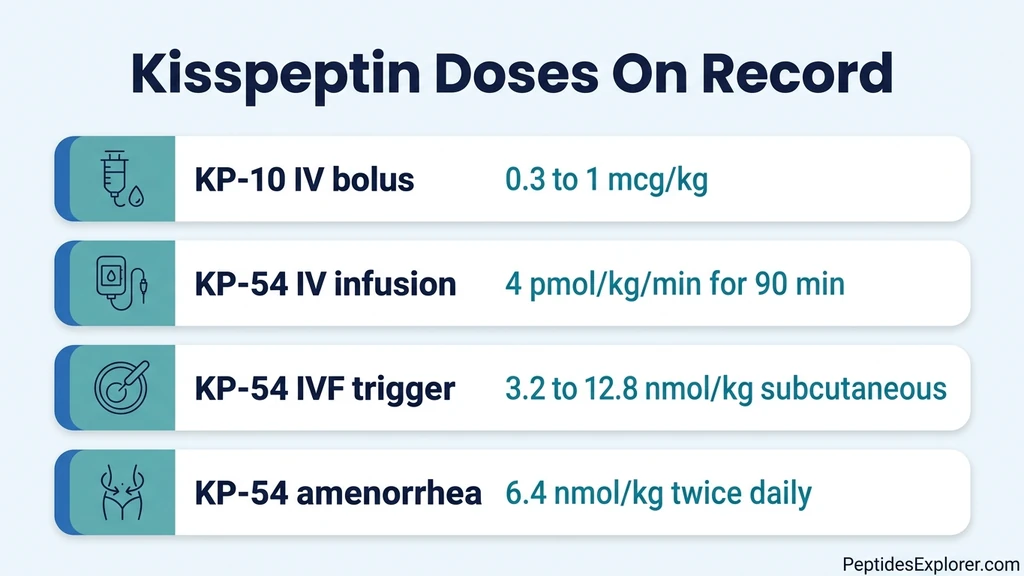
You have a vial labeled kisspeptin-10 and a forum post quoting a dose in nmol/kg. Here is the honest answer: every kisspeptin dose in the human literature is weight-based and was given under monitoring, most of it intravenously. Kisspeptin-10 was tested at 0.01 to 3 mcg/kg IV bolus, kisspeptin-54 at 6.4 nmol/kg subcutaneous or 3.2 to 12.8 nmol/kg as a single IVF trigger. No trial has ever established a self-administered protocol.
| Population | Form | Dose on record | Route | Schedule studied |
|---|---|---|---|---|
| Healthy men | KP-54 | 4 pmol/kg/min, 90 min | IV infusion | Single session |
| Healthy men | KP-10 | 0.01 to 3 mcg/kg (peak at 1) | IV bolus | Single dose |
| Men, low testosterone + T2D | KP-10 | 0.3 mcg/kg bolus, or 4 mcg/kg/h for 11 h | IV | Single session |
| Women, IVF trigger | KP-54 | 3.2 to 12.8 nmol/kg | Subcutaneous | One injection, once |
| Women, hypothalamic amenorrhea | KP-54 | 6.4 nmol/kg | Subcutaneous | Twice daily or twice weekly |
The compound behind those numbers is covered in the kisspeptin peptide overview, and the receptor biology sits on the kisspeptin profile. What follows is the dosing record itself: what was given, to whom, and what it did.
Get your custom peptide protocol:
- Tailored to your body and goals
- Precise dosing and cycle length
- Safe stacking combinations
- Backed by peer-reviewed studies
- Ready in under 2 minutes
Why Kisspeptin Doses Are Written in nmol/kg Instead of mcg
Two molecules share the name. Kisspeptin-54 is the full-length circulating form, roughly 5,857 daltons. Kisspeptin-10 is its ten-amino-acid active tail, roughly 1,302 daltons, about a quarter of the mass for the same receptor activity.
That mass gap is why the literature dosed in moles rather than micrograms. One nanomole of KP-54 weighs 5.86 mcg; one nanomole of KP-10 weighs 1.30 mcg. Quote a dose in "mcg" without naming the form and you have said nothing useful.
The half-lives diverge just as sharply. KP-54 clears with a plasma half-life near 28 minutes in men (Dhillo et al., J Clin Endocrinol Metab, 2005, PMID 16174713), while KP-10 clears in a few minutes, which is why the KP-10 studies used infusion pumps rather than injections.
The conversion, since it is arithmetic rather than a medical claim: mcg = nmol/kg x body weight in kg x 5.86 for KP-54, or x 1.30 for KP-10. Cross-compound reference numbers live on the peptide dosage chart.
Kisspeptin Dosage for Men: What the Trials Actually Gave
The first human male study used kisspeptin-54 as a 90-minute intravenous infusion at 4 pmol/kg per minute in six healthy volunteers. Mean 90-minute LH rose from 4.2 to 10.8 U/L, FSH from 3.2 to 3.9 U/L, and 180-minute testosterone from 21.7 to 24.9 nmol/L (Dhillo et al., J Clin Endocrinol Metab, 2005, PMID 16174713). Total exposure across that infusion works out to about 0.36 nmol/kg, near 170 mcg for an 80 kg man.
Kisspeptin-10 was then mapped across a full dose range. Intravenous boluses from 0.01 to 3 mcg/kg produced a dose-dependent LH rise that peaked at 1 mcg/kg, taking LH from 4.1 to 12.4 IU/L within 30 minutes. The 3 mcg/kg dose produced a smaller response than 1 mcg/kg, and a 22.5-hour infusion at 4 mcg/kg/h raised testosterone from 16.6 to 24.0 nmol/L (George et al., J Clin Endocrinol Metab, 2011, PMID 21632807).
Read that ceiling carefully. Tripling the dose from 1 to 3 mcg/kg lowered the LH response rather than raising it.
The closest thing to a clinical testosterone application came from five men with type 2 diabetes and low testosterone. A 0.3 mcg/kg IV bolus raised LH from 4.7 to 10.7 IU/L, and an 11-hour infusion at 4 mcg/kg/h raised testosterone from 8.5 to 11.4 nmol/L, about 245 to 329 ng/dL (George et al., Clin Endocrinol (Oxf), 2013, PMID 23153270). Eleven hours of intravenous peptide bought roughly 84 ng/dL, and it ended when the drip ended.
For men reading this with a restart or testosterone goal, that is the whole yield on record. Compounds with take-home dosing precedent are covered in best peptides for testosterone, and the pulsatile GnRH approach used clinically to maintain testicular function is gonadorelin.
Kisspeptin Dosage for Women: The Single-Trigger Evidence
Women have the strongest kisspeptin dosing data of anyone, and it is all single-dose. In 53 women undergoing IVF, one subcutaneous injection of kisspeptin-54 at 1.6, 3.2, 6.4, or 12.8 nmol/kg triggered egg maturation, with 92% reaching embryo transfer and a 23% clinical pregnancy rate (Jayasena et al., J Clin Invest, 2014, PMID 25036713).
A 60-woman phase 2 trial then tested the same approach in women at high risk of ovarian hyperstimulation syndrome. Oocyte maturation occurred in 95% of women across 3.2 to 12.8 nmol/kg, live birth rate per transfer was 45%, and no woman developed moderate, severe, or critical OHSS (Abbara et al., J Clin Endocrinol Metab, 2015, PMID 26192876). At 9.6 nmol/kg, a 70 kg woman receives about 3.9 mg of KP-54 in one injection.
That absent OHSS signal is the entire clinical case for kisspeptin over a conventional trigger, and it is why the comparison with hCG as a trigger keeps appearing in fertility literature. One injection, one supervised cycle, one retrieval 36 hours later.
Kisspeptin is not approved by the FDA for fertility, ovulation induction, or any other use in either sex. The IVF work sits at phase 2.
Frequency, Timing, and Cycle Length: Where the Data Breaks
This is the section that decides everything else. Ten women with hypothalamic amenorrhea received kisspeptin-54 at 6.4 nmol/kg subcutaneously, twice daily, for two weeks. Day 1 produced a mean maximal LH increment of 24.0 IU/L. The identical injection on day 14 produced 2.5 IU/L, and the FSH increment fell from 9.1 to 0.5 IU/L (Jayasena et al., J Clin Endocrinol Metab, 2009, PMID 19820030).
Run the arithmetic. The LH response kept 10% of its size, a 90% loss. The FSH response kept 5%, a 95% loss. Two weeks of twice-daily dosing converted an active compound into an inert injection.
Spacing the doses helped without solving it. Twice-weekly kisspeptin-54 over 8 weeks produced only partial desensitization and still raised reproductive hormones against saline, while twice-daily dosing produced complete tolerance (Jayasena et al., Clin Pharmacol Ther, 2010, PMID 20980998). The receptor reads pulses, so exposure time matters more than dose size, and lowering the dose does not restore the response.
One week of twice-daily KP-54 in healthy cycling women did not abolish menstrual cyclicity and shortened mean cycle length from 28.6 to 26.8 days (Jayasena et al., J Clin Endocrinol Metab, 2013, PMID 24030945).
Anyone quoting a kisspeptin cycle length in weeks is extrapolating past every trial on record. The longest repeated schedule ever published is 8 weeks of twice-weekly KP-54 in a hospital setting, and its central finding was partial loss of response. Compare a compound where a durable schedule does exist, such as sermorelin and testosterone.
Reconstitution Units for the Doses in the Literature
If you are converting a trial dose to syringe units, the volumes are unforgiving. KP-10 doses are tiny and KP-54 doses are large, and the same dilution cannot serve both.
Assume an 80 kg body. A 1 mcg/kg KP-10 dose is 80 mcg. A 6.4 nmol/kg KP-54 dose is 37.5 mcg/kg, or 3.0 mg.
| Form and vial | Bac water | Concentration | Study dose (80 kg) | Units on U-100 |
|---|---|---|---|---|
| KP-10, 5 mg | 5 mL | 1 mg/mL | 24 mcg (0.3 mcg/kg) | 2.4 units |
| KP-10, 5 mg | 5 mL | 1 mg/mL | 80 mcg (1 mcg/kg) | 8 units |
| KP-10, 5 mg | 2 mL | 2.5 mg/mL | 80 mcg (1 mcg/kg) | 3.2 units |
| KP-54, 10 mg | 2 mL | 5 mg/mL | 3.0 mg (6.4 nmol/kg) | 60 units |
| KP-54, 10 mg | 2 mL | 5 mg/mL | 4.5 mg (9.6 nmol/kg) | 90 units |
The KP-10 rows are the problem. At 2.5 mg/mL, a 1 mcg/kg dose is 3.2 units, a mark you cannot read accurately on a standard insulin syringe, and a one-unit misdraw moves the dose by more than 30%. Diluting to 1 mg/mL puts the same dose at 8 units, which is at least measurable.
The KP-54 rows carry the opposite problem: a 9.6 nmol/kg dose fills nearly a full syringe and consumes almost half a 10 mg vial in one draw. Use bacteriostatic water rather than sterile water for any vial punctured more than once, follow the reconstitution walkthrough, and check your vial against the peptide reconstitution calculator and the peptide unit converter.
Doing this math correctly does not make the resulting injection a validated protocol. It makes it a correctly measured dose of something nobody has studied on that schedule.
Side Effects and the Quality of the Evidence
Reported effects in the trials were mild. Injection-site discomfort, transient flushing or warmth, headache, and occasional nausea. The IVF trials reported no moderate, severe, or critical OHSS across 60 women (PMID 26192876), and the 8-week twice-weekly study reported no adverse effects.
That record comes with three limits. Sample sizes were small, often 4 to 10 people per arm. Exposure was short, with the longest repeated schedule running 8 weeks. And every dose was a sterile, weight-adjusted preparation given with serial blood sampling.
The predictable downstream effect in men is aromatization. Kisspeptin raises your own LH and therefore your own testosterone, which converts to estradiol at your normal rate. Any honest monitoring plan includes LH, FSH, total testosterone, and estradiol, drawn at trough rather than 45 minutes after a dose.
Hormone-sensitive cancers are a hard contraindication in both sexes, since the mechanism is raising sex hormone output. Pregnancy is another. The broader framework is in the peptide safety guide, and the compounds people compare kisspeptin against sit in peptides for libido.
Four Dosing Mistakes With Real Numbers Attached
Using a KP-54 number with a KP-10 vial. Take 6.4 nmol/kg from the amenorrhea study and apply it to KP-10 at 80 kg and you get 666 mcg, more than eight times the 1 mcg/kg dose where the LH response peaked in men, and well past the 3 mcg/kg point where the response shrank. Name the form before you touch the math.
Dosing daily to "keep levels up." Twice-daily KP-54 for 14 days cut the LH response by 90% and the FSH response by 95% (PMID 19820030). Frequent dosing is the fastest route to no response at all, and you will not see it happen without an LH assay.
Judging the result from a post-injection blood draw. LH swings two to three fold across a normal morning by itself, and a 30-minute spike after a dose measures a receptor firing rather than a durable change. Testosterone in the 11-hour infusion study moved 84 ng/dL and returned to baseline afterward (PMID 23153270). Draw at trough, on a separate morning, twice.
Treating a research vial like a clinical preparation. Every dose cited here was sterile, weight-adjusted and monitored, with an ethics committee behind the dose range. A gray-market vial has none of that. Injection basics are in the how to inject peptides guide, storage timelines in the reconstituted shelf-life guide.
Frequently Asked Questions
What is the kisspeptin dosage for men in studies?
Kisspeptin-10 was given as IV boluses of 0.01 to 3 mcg/kg, with the LH response peaking at 1 mcg/kg, and as infusions of 1.5 to 4 mcg/kg per hour. Kisspeptin-54 was infused at 4 pmol/kg/min for 90 minutes. All were monitored intravenous doses. See the kisspeptin profile.
What is the kisspeptin dosage for women?
A single subcutaneous kisspeptin-54 injection of 3.2 to 12.8 nmol/kg triggered oocyte maturation in 95% of IVF patients (PMID 26192876). For a 70 kg woman, 9.6 nmol/kg is about 3.9 mg. Repeated dosing was studied at 6.4 nmol/kg. Trigger comparisons are in the hCG peptide guide.
How do I convert kisspeptin nmol/kg into mcg?
Multiply nmol/kg by body weight, then by 5.86 for kisspeptin-54 or 1.30 for kisspeptin-10, since those are the molecular masses in mcg per nanomole. At 80 kg, 6.4 nmol/kg of KP-54 is 3.0 mg. Convert to syringe units with the peptide unit converter.
How often can kisspeptin be dosed before it stops working?
Twice daily for two weeks cut the LH response by 90% and FSH by 95% (PMID 19820030). Twice weekly over 8 weeks caused only partial desensitization. The receptor responds to pulses, so exposure time matters more than dose size. Pulsatile dosing precedent exists instead for gonadorelin.
Is kisspeptin-10 dosed the same as kisspeptin-54?
No. KP-10 weighs about 1,302 daltons against 5,857 for KP-54, so the same nmol/kg figure is roughly a quarter of the mass. KP-10 also clears in minutes, which is why its studies used infusions. Cross-compound numbers sit on the peptide dosage chart.
Can kisspeptin be used to restart testosterone after suppression?
No trial has tested that. The closest data is an 11-hour IV infusion in men with type 2 diabetes that raised testosterone by about 84 ng/dL and stopped when the infusion stopped (PMID 23153270). For compounds with restart precedent, see best peptides for testosterone.
What are the side effects at these doses?
Trials reported injection-site discomfort, flushing, headache, and occasional nausea, with no OHSS across 60 IVF patients. Sample sizes were 4 to 10 per arm and exposure rarely exceeded 8 weeks. Rising testosterone also raises estradiol in men. Read the peptide safety guide first.
Is kisspeptin approved for any of these uses?
No. Kisspeptin is not FDA-approved for fertility, testosterone stimulation, or any other indication in either sex. The IVF trigger work sits at phase 2, and everything else is early clinical research. Compare with a compound that has take-home dosing data in PT-141 for men.
The Bottom Line
The kisspeptin dosage record is short and specific. Kisspeptin-10 at 0.01 to 3 mcg/kg intravenously in men, peaking at 1 mcg/kg. Kisspeptin-54 at 4 pmol/kg/min by infusion, or 3.2 to 12.8 nmol/kg as a single subcutaneous IVF trigger in women, or 6.4 nmol/kg repeated.
The principle underneath those numbers is that the receptor answers pulses and goes quiet under steady exposure. Two weeks of twice-daily dosing cost 90% of the LH response, which is why no published schedule extends past 8 weeks and why no one can honestly hand you a cycle length.
Run any dose you are converting through the peptide reconstitution calculator, and read the kisspeptin profile for the receptor biology behind the arithmetic. Kisspeptin is an early-stage research compound rather than an approved therapy, and this page is educational, not medical advice. For more dosage references and calculators, explore PeptidesExplorer.
Related Articles
Kisspeptin Peptide: What the Human Evidence Shows
Kisspeptin peptide sits upstream of GnRH and drives LH, FSH, and testosterone. Human trial doses, kisspeptin-10 vs 54, and the desensitization risk.
Ipamorelin Dosage: Solo Protocols, Timing & Unit Math
Ipamorelin dosage: 200-300 mcg subcutaneous, 1-3x daily, bedtime fasted. Charts by goal and weight, saturation dose, reconstitution units, safety data.
Epitalon Dosage: Khavinson Protocol, Cycles & Unit Math
Epitalon dosage: 5-10 mg/day subcutaneous for 10-20 days, 1-2 courses per year. Khavinson protocol, reconstitution units for 10-50 mg vials, evidence review.
HGH Fragment 176-191 Dosage: What Research Supports
HGH Fragment 176-191 dosage: 250-500 mcg/day subcutaneous, fasted, 8-12 week cycles. Unit math for 2 mg and 5 mg vials, rodent vs human evidence, safety.