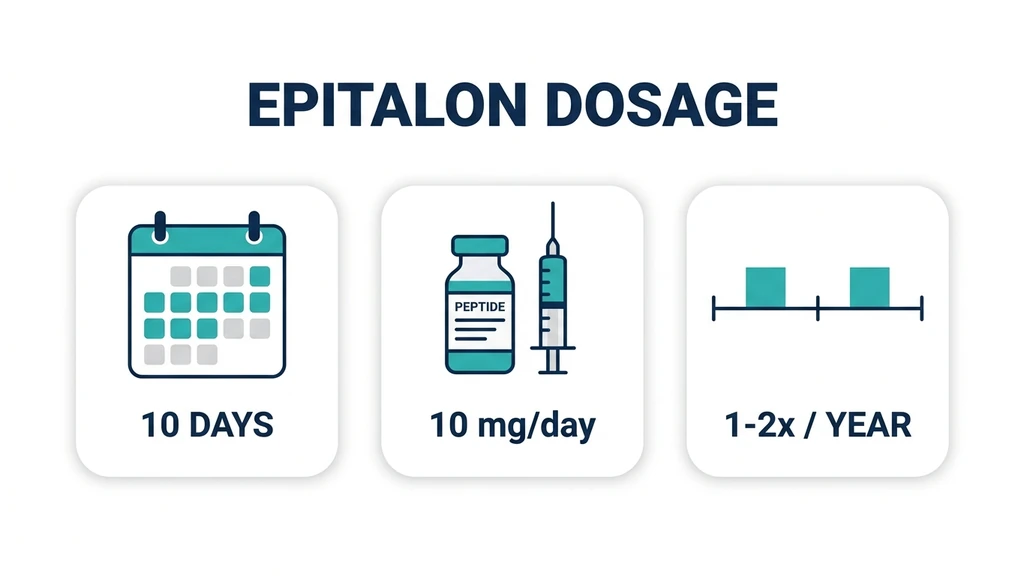
You have a vial of Epitalon and a dozen conflicting protocol charts. Here is the answer: research-derived Epitalon protocols use 5 to 10 mg per day, injected subcutaneously for 10 to 20 days per course, repeated 1 to 2 times per year with 4 to 6 months between courses. The classic Khavinson protocol is 10 mg per day for 10 days: 100 mg total per cycle.
| Protocol | Daily dose | Duration | Frequency | Total per cycle |
|---|---|---|---|---|
| Khavinson-style intensive | 10 mg SubQ | 10 days | 1-2x/year | 100 mg |
| Standard 20-day | 5 mg SubQ | 20 days | 1-2x/year | 100 mg |
| Conservative first cycle | 5 mg SubQ | 10 days | 2x/year | 50 mg |
| Every-other-day variant | 10 mg SubQ | 20 days, 10 doses | 1-2x/year | 100 mg |
One honesty flag before the details: the human outcome data behind these numbers comes from epithalamin, the pineal extract that preceded synthetic Epitalon. The dosing is extrapolated, and this guide says so wherever it matters. For every other compound's numbers, the peptide dosage chart is the reference.
Get your custom peptide protocol:
- Tailored to your body and goals
- Precise dosing and cycle length
- Safe stacking combinations
- Backed by peer-reviewed studies
- Ready in under 2 minutes
Where These Numbers Come From: Epithalamin vs Epitalon
The lineage runs in one direction. In the 1980s, Russian clinics tested epithalamin, an extract of bovine pineal gland. Vladimir Khavinson's group later isolated the active fragment and synthesized it as the tetrapeptide Ala-Glu-Asp-Gly: Epitalon.
Think of telomeres as the plastic tips on shoelaces. Every cell division frays them a little, and when the tips wear through, the lace stops working. Telomerase is the machine that re-caps the ends. Literally stated: in cultured human somatic cells, Epitalon induced telomerase activity and elongated telomeres (Khavinson et al., Bull Exp Biol Med, 2003, PMID 12937682). That is in vitro evidence, not a human trial.
The second mechanism is the one you can feel. Epithalamin restored the circadian rhythm of pineal melatonin production in elderly people (Korkushko et al., Bull Exp Biol Med, 2004, PMID 15452611), which is why users report deeper sleep and vivid dreams within days. The sleep angle connects to the broader peptides for sleep landscape.
The mortality data is epithalamin, full stop. In 266 people over 60 followed for 6 to 8 years, epithalamin courses were associated with a 1.6 to 1.8-fold mortality reduction, and the combination with thymalin reached 4.1-fold (Khavinson et al., Neuro Endocrinol Lett, 2003, PMID 14523363). Those cohorts were prospective, not randomized double-blind, and thymalin itself is covered in the thymalin overview.
The Khavinson Protocol, Step by Step
The intensive course is simple: 10 mg subcutaneous, once per day, in the evening, for 10 consecutive days. Rotate abdominal injection sites daily and keep the schedule unbroken.
Evening injection follows the melatonin logic. Epithalamin's measured effect was restoring the nocturnal melatonin peak, so dosing before bed works with the rhythm you are trying to rebuild. No controlled morning-versus-evening comparison exists; this is mechanism-based practice, not trial data.
Course spacing matters more than course size. In the 15-year follow-up study, 39 coronary patients received 6 epithalamin courses spread over 3 years, against 40 controls on basic therapy alone. The treated group showed decelerated cardiovascular aging, normalized melatonin rhythm, and significantly lower mortality (Korkushko et al., Bull Exp Biol Med, 2011, PMID 22451889). That is two courses per year, not continuous use. The effects persisted between courses, which is the whole argument for cycling.
Reconstitution Math: 10, 20, and 50 mg Vials
Epitalon doses are large by peptide standards: milligrams, not micrograms. That changes the math and the shopping list.
The formula, once: units on a U-100 syringe = (dose in mg divided by concentration in mg/mL) times 100.
| Vial | Bac water | Concentration | 5 mg dose | 10 mg dose |
|---|---|---|---|---|
| 10 mg | 1 mL | 10 mg/mL | 50 units | 100 units (full syringe) |
| 10 mg | 2 mL | 5 mg/mL | 100 units | 2 x 100 units |
| 20 mg | 2 mL | 10 mg/mL | 50 units | 100 units |
| 50 mg | 2.5 mL | 20 mg/mL | 25 units | 50 units |
Plan the full course before buying. A 10-day intensive protocol consumes 100 mg, so a single 10 mg vial covers one day. Larger vials at higher concentration keep each injection inside one syringe: at 5 mg/mL, a 10 mg dose is 2 full mL and two sticks, while at 20 mg/mL it is a comfortable 50 units.
Use bacteriostatic water for any vial that lasts more than one draw; the bacteriostatic vs sterile water guide explains why. Technique is in the reconstitution walkthrough, storage timelines in the reconstituted shelf-life guide, and every ratio here can be checked with the peptide reconstitution calculator.
Quantified Mistake Scenarios
The 10x concentration error. You memorized "50 units = 5 mg" from a 10 mg/mL mix, then reconstituted the next 50 mg vial in 1 mL. That vial is 50 mg/mL, and the same 50 units now deliver 25 mg, five times your dose and a quarter of your course supply in one shot. No acute toxicity has been reported at study doses, but you are in uncharted territory with an empty wallet. Fix: write mg/mL on every vial the minute you mix it.
The mcg reflex. Users arriving from BPC-157 or bioregulator dosing think in micrograms. Epitalon runs 5,000 to 10,000 mcg per dose. Draw a BPC-sized 250 mcg and you under-dose by 20 to 40x, feel nothing, and conclude the peptide failed. Fix: Epitalon is dosed in mg; check the unit twice.
Continuous year-round use. The published courses are 10 to 20 days with months between. Daily use across a full year has no supporting evidence, triples the cost past $1,000, and abandons the protocol that generated the data. Fix: cycle, then stop, then wait.
The syringe that cannot hold the dose. At 5 mg/mL, 10 mg is 2 mL: two complete U-100 syringes per injection. Fix: reconstitute at 10 mg/mL or higher, verified with the unit converter.
Side Effects and the Evidence Gap
Reported side effects are mild: injection-site redness, transient drowsiness, vivid dreams, occasional headache. The dream effect is consistent with the measured melatonin restoration. Published courses report no serious adverse events, with the caveat that pharmacovigilance in those studies was limited by modern standards.
The cancer question cuts both ways. Telomerase activation sounds like a tumor risk on paper. The animal data points the other direction: in female SHR mice dosed lifelong, Epitalon left mean lifespan unchanged, extended maximum lifespan by 12.3%, and reduced leukemia incidence 6-fold, with no rise in total tumor incidence (Anisimov et al., Biogerontology, 2003, PMID 14501183). Active cancer remains a hard contraindication regardless; that decision belongs to an oncologist.
Now the paragraph competitors skip: nearly all of this evidence comes from one research lineage, the St. Petersburg group around Khavinson, Anisimov, and Korkushko. The human studies were not blinded or randomized to modern standards, and independent replication is thin. An independent 2025 review summarizes the promise and the gaps from outside that network (Araj et al., Int J Mol Sci, 2025, PMID 40141333). Dose accordingly: conservative, cycled, and with expectations calibrated to the evidence.
Common Mistakes Recap
Buying 10 mg vials for a 100 mg cycle and running out on day 3. Skipping the 4 to 6 month spacing between courses. Injecting in the morning against the melatonin rationale.
Shaking the vial instead of swirling. Judging results by feel beyond sleep quality, when the claimed telomere effects are silent by nature. Trusting outlier low-dose charts circulating online, including the 2 mg/day version, which matches no published course.
The full protocol context for Epitalon lives on its profile page, and the mixing fundamentals are in the reconstitution walkthrough.
Frequently Asked Questions
What is the Khavinson protocol for Epitalon?
10 mg subcutaneous per day for 10 consecutive days, run 1 to 2 times per year with 4 to 6 months between courses. That is 100 mg per cycle. The Epitalon profile covers the compound behind the protocol.
How many units is 5 mg of Epitalon?
At 10 mg/mL (a 10 mg vial with 1 mL of bacteriostatic water), 5 mg is 50 units on a U-100 insulin syringe. Other dilutions change the number, so run your setup through the peptide reconstitution calculator first.
How often should you cycle Epitalon?
1 to 2 courses per year, spaced 4 to 6 months apart. The 15-year follow-up cohort used 6 epithalamin courses over 3 years (PMID 22451889), and effects persisted between courses. Storage between cycles is covered in the reconstituted shelf-life guide.
Should Epitalon be injected morning or night?
Evening. Epithalamin restored the nocturnal melatonin rhythm in elderly patients (PMID 15452611), so dosing before bed works with that mechanism. No controlled comparison exists. The sleep connection is explored in peptides for sleep.
Can you take Epitalon orally or as a nasal spray?
Injection is the only route used in the published research. Peptides degrade in the digestive tract, and no bioavailability data supports oral or nasal Epitalon dosing. Subcutaneous injection technique is covered in the reconstitution walkthrough.
Is Epitalon the same as epithalamin?
No. Epithalamin is the pineal gland extract used in the human mortality studies; Epitalon is the synthetic four-amino-acid fragment (AEDG) derived from it. Community protocols extrapolate epithalamin results to Epitalon, an assumption worth knowing you are making.
Does Epitalon increase cancer risk?
The animal data shows the opposite for leukemia: a 6-fold reduction in lifelong-dosed mice with no rise in total tumors (PMID 14501183). Human long-term safety data is limited, and active cancer remains a contraindication. Broader context sits in the bioregulator peptides guide.
The Bottom Line
5 to 10 mg per day, 10 to 20 days per course, 1 to 2 courses per year. The Khavinson protocol is 10 mg for 10 days, evenings, then months of nothing.
The principle: Epitalon is a course you complete, not a supplement you maintain. The published results came from spaced cycles, and the spacing is part of the dose.
Check your vial math with the peptide reconstitution calculator before day one, and read the Epitalon profile for the full compound picture. Epitalon is a research compound, not an FDA-approved therapy; this content is educational, not medical advice.
Related Articles
Ipamorelin Dosage: Solo Protocols, Timing & Unit Math
Ipamorelin dosage: 200-300 mcg subcutaneous, 1-3x daily, bedtime fasted. Charts by goal and weight, saturation dose, reconstitution units, safety data.
HGH Fragment 176-191 Dosage: What Research Supports
HGH Fragment 176-191 dosage: 250-500 mcg/day subcutaneous, fasted, 8-12 week cycles. Unit math for 2 mg and 5 mg vials, rodent vs human evidence, safety.
Tesamorelin Dosage Chart: Clinical Doses
Full tesamorelin dosage chart: the 2 mg/day clinical dose, research tiers, reconstitution math in syringe units, timing, titration, and cycle length.
Sermorelin Dosage Chart by Goal & Weight
Sermorelin dosage chart: 200-500 mcg nightly before bed. Doses by goal and body weight, unit conversions for every vial size, timing, and titration.