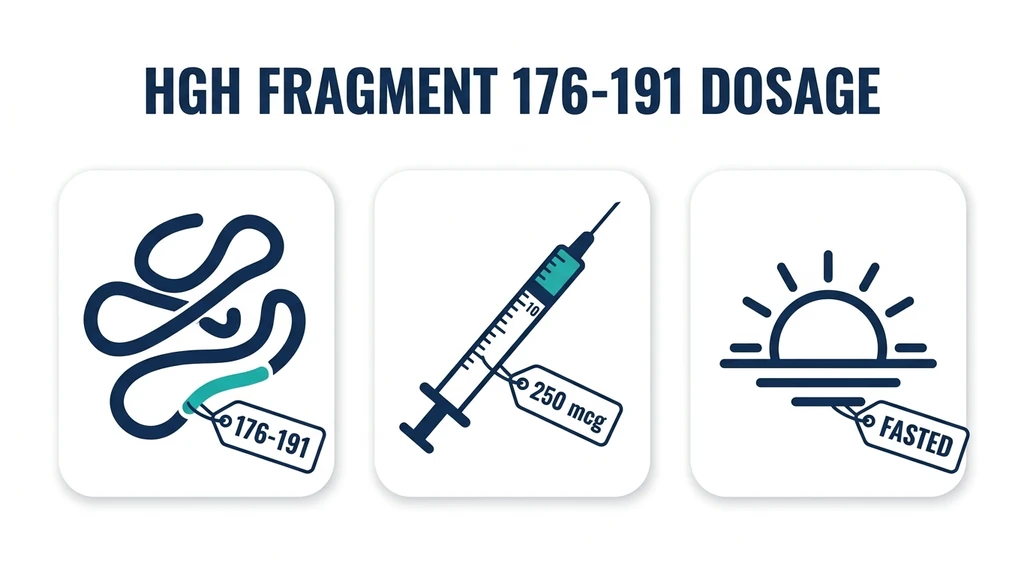
You have a vial of HGH Frag, a bag of insulin syringes, and five forum tabs that disagree with each other. Here is the answer: the commonly used protocol is 250 to 500 mcg per day subcutaneous, split into 1 or 2 fasted injections, for 8 to 12 weeks. And here is what no vendor page says in the first paragraph: that range comes from community practice and rodent-study extrapolation. No human trial has ever dosed the unmodified fragment.
| Experience | Dose | Frequency | Timing | Cycle |
|---|---|---|---|---|
| Beginner | 250 mcg | 1x/day | Morning, fasted | 6-8 weeks |
| Standard | 250 mcg | 2x/day | AM fasted + PM, 3h after food | 8-12 weeks |
| Advanced | 500 mcg | 1-2x/day | AM fasted or pre-cardio | 8-12 weeks, then 4-6 off |
Skip the arithmetic if you want: the HGH Fragment dosing tool converts any vial and water combination into syringe units. The full compound background lives on the HGH Fragment 176-191 profile.
Get your custom peptide protocol:
- Tailored to your body and goals
- Precise dosing and cycle length
- Safe stacking combinations
- Backed by peer-reviewed studies
- Ready in under 2 minutes
What HGH Fragment 176-191 Is, and the AOD-9604 Connection
Growth hormone is a Swiss Army knife: growth signaling, IGF-1 release, blood sugar effects, and fat mobilization all fold out of one molecule. Fragment 176-191 is one blade snapped off the knife. Literally stated: it is the C-terminal region of hGH associated with lipolytic activity, isolated from the growth and glucose machinery.
Almost all published data concerns AOD-9604, the same fragment stabilized with an added tyrosine, or related analogs. In obese Zucker rats, oral AOD-9604 at 500 mcg per kg for 19 days cut body-weight gain by more than half and raised adipose lipolytic activity, without the insulin-sensitivity damage intact hGH causes (Ng et al., Horm Res, 2000, PMID 11146367).
Run the honesty math on that number. Rat-equivalent dosing for a 90 kg human would be 45,000 mcg per day. The community protocol is 250 to 500 mcg total. Whatever the gray-market dose does, it is not a scaled replica of the studies that made the fragment famous.
One mechanistic correction worth carrying: the lipolytic effect is not directly mediated through the beta-3 adrenergic receptor. In beta3-knockout mice, AOD-9604 still reduced weight and fat over 14 days (Heffernan et al., Endocrinology, 2001, PMID 11713213). The molecule has also been studied far from fat loss: intra-articular AOD-9604 improved cartilage regeneration in a rabbit osteoarthritis model (Kwon et al., Ann Clin Lab Sci, 2015, PMID 26275694). Researched molecule, yes. Human fat-loss dosing data, no. The sibling compound's numbers live in the AOD-9604 dosage and side effects guide.
Why Every Protocol Says Fasted
Insulin suppresses lipolysis. The fragment's one job is mobilizing stored fat, and a fed-state injection sends it to work against your own insulin. The rodent work that found fat oxidation gains ran without hyperglycemia or reduced insulin secretion (Heffernan et al., Int J Obes, 2001, PMID 11673763), but the practical rule stands: keep insulin low around the injection.
The rules in practice: inject in the morning before food and wait 30 to 60 minutes to eat. For a second dose, stay at least 3 hours after the last meal. Black coffee and water are fine.
Pre-cardio dosing is popular and mechanistically plausible: mobilized fatty acids plus activity that burns them. Direct evidence for the combination is zero, so file it under optimization folklore rather than protocol. The commonly reported half-life of 15 to 30 minutes has no primary source either; treat the fragment as a short-burst compound and let timing, not total micrograms, carry the protocol.
Reconstitution Math: 2 mg and 5 mg Vials
One formula converts everything: dose in mcg divided by concentration in mcg/mL, times 100, equals units on a U-100 insulin syringe.
| Vial | Bac water | Concentration | 250 mcg | 500 mcg |
|---|---|---|---|---|
| 5 mg | 2 mL | 2,500 mcg/mL | 10 units | 20 units |
| 5 mg | 2.5 mL | 2,000 mcg/mL | 12.5 units | 25 units |
| 2 mg | 1 mL | 2,000 mcg/mL | 12.5 units | 25 units |
| 2 mg | 0.8 mL | 2,500 mcg/mL | 10 units | 20 units |
Watch the 12.5-unit trap. Most insulin syringes have no half-unit marks, so a 12.5-unit dose becomes a guess twice a day. Choose water volumes that land on clean numbers: 0.8 mL into a 2 mg vial, or 2 mL into a 5 mg vial, puts 250 mcg at exactly 10 units.
Mixing technique is the same as every lyophilized peptide, covered in the reconstitution walkthrough. Run your own vial through the HGH Fragment dosing tool or the peptide reconstitution calculator before the first draw.
What Could Actually Go Wrong
The mL/units misread. Drawing 0.5 mL of a 2,500 mcg/mL solution delivers 1,250 mcg, a 5x dose in one pin. The barrel reads 50 units, and 50 does not look alarming next to 10 unless you check. Fix: compute units once, write them on the vial label, and read the barrel every time.
The concentrated-vial trap. Reconstituting 5 mg with only 0.5 mL creates 10,000 mcg/mL. Your habitual 10-unit draw now delivers 1,000 mcg, quadruple the intended dose, every injection until the vial empties. Fix: standardize one water volume across cycles.
Stacking fasts on fasts. Extended fasting, fasted cardio, and a lipolytic peptide in the same morning produces lightheadedness and hypoglycemia-like symptoms in a predictable minority of users, more so alongside other glucose-affecting compounds. Fix: introduce one variable at a time.
Be clear about what the safety record is: no acute human toxicity has been documented, and no human trial has looked. "Nobody has documented harm" and "safe" are different sentences.
Side Effects, the Evidence Gap, and Who Should Skip It
Reported side effects are anecdotal and mild: injection-site redness, headache, transient fatigue, occasional lightheadedness. The rodent data adds what the fragment did not do over 14 to 19 days: no hyperglycemia, no reduced insulin secretion, no competition for the hGH receptor (Heffernan et al., Int J Obes, 2001, PMID 11673763). Those are short rodent findings, not human safety data.
The evidence gap, stated flat: the fragment has no approved use anywhere. The human program that existed used oral AOD-9604 at roughly 1 mg per day, was reported only in non-indexed company-adjacent publications, and was shelved for weight loss. The oral analog work extends to related fragments; even the human-tissue lipolysis signal comes from adipose samples in vitro (Heffernan et al., Am J Physiol Endocrinol Metab, 2000, PMID 10950816, studying the analog AOD-9401). Long-term human safety is unknown.
Skip it entirely if pregnant or breastfeeding, with active cancer, with type 1 diabetes (the fasting requirement is the conflict), or with an eating-disorder history. Tested athletes have a specific trap: the fragment is WADA-prohibited, and while AOD-9604 does not trip the hGH isoform immunoassay used in doping control (Orlovius et al., Drug Test Anal, 2013, PMID 24124033), dedicated peptide screens detect it. The wider testing picture is in do peptides show up on drug tests.
Common Mistakes
- 1.Dosing after meals. The single most common way to waste the vial. Keep the fast.
- 2.Judging results at week 2. The community protocol assumes 8 to 12 weeks inside a calorie deficit. The fragment mobilizes fat; it does not create the deficit.
- 3.Treating it as a diet replacement. Every rodent result happened alongside controlled feeding.
- 4.Confusing Frag dosing with AOD-9604 oral dosing. The human AOD-9604 trials used about 1 mg orally; community Frag protocols are 250 to 500 mcg subcutaneous. Different compound form, different route, different numbers, detailed in the AOD-9604 guide.
- 5.Believing spot-reduction injection myths. Injection site changes comfort, not where fat leaves.
- 6.Buying unverified vials. Gray-market quality variance is the largest uncontrolled variable in any protocol; the peptide dosage chart only helps if the vial contains what the label claims.
Frequently Asked Questions
How many units is 250 mcg of HGH Fragment 176-191?
10 units at 2,500 mcg/mL (a 5 mg vial with 2 mL of bacteriostatic water). The number depends entirely on your reconstitution volume, so run your setup through the HGH Fragment dosing tool before drawing.
Do I have to inject HGH Frag fasted?
Yes, if you want the mechanism working for you. Insulin suppresses lipolysis, the fragment’s only documented action. Inject in the morning before food and wait 30 to 60 minutes to eat, per the protocol on the HGH Fragment 176-191 profile.
Can I take HGH Frag before cardio?
You can, and the logic of mobilized fatty acids plus activity is plausible, but no study has tested the combination. Treat pre-cardio timing as folklore layered on the fasted rule, not as protocol. Mixing basics are in the reconstitution walkthrough.
How long should an HGH Fragment cycle last?
8 to 12 weeks, followed by 4 to 6 weeks off, per community convention. No human trial defines a cycle length. Expect nothing measurable before week 4 inside a calorie deficit, and compare protocols on the peptide dosage chart.
Is HGH Frag dosing the same as AOD-9604 dosing?
No. The human AOD-9604 program used about 1 mg per day orally; community Frag protocols run 250 to 500 mcg subcutaneous. Same parent fragment, different form and route. The AOD-9604 dosage guide covers the oral compound.
Will HGH Fragment 176-191 show up on a drug test?
It is WADA-prohibited. AOD-9604 does not affect the standard hGH isoform immunoassay (Orlovius 2013, PMID 24124033), but dedicated peptide screens detect the fragment directly. Details in do peptides show up on drug tests.
Does HGH Frag affect blood sugar or IGF-1?
Rodent studies found no hyperglycemia, no reduced insulin secretion, and no hGH-receptor binding over 14 to 19 days (PMID 11673763). No human study has confirmed any of it. Monitor fasting glucose anyway if you run cycles, as the HGH Fragment profile recommends.
The Bottom Line
250 to 500 mcg per day, fasted, subcutaneous, 8 to 12 weeks. That is the community protocol, and community is the precise word: the rodent studies that made this fragment famous used doses two orders of magnitude higher per kilogram.
The principle: with an unstudied dose, execution is everything you control. The fast, the clean unit math, and the deficit do the work the peptide is credited with.
Convert your vial with the HGH Fragment dosing tool and read the HGH Fragment 176-191 profile for the full compound picture. HGH Fragment 176-191 is a research compound, not an FDA-approved therapy; this content is educational, not medical advice.
Related Articles
CJC-1295 Dosage: Complete Protocol Guide
CJC-1295 dosage guide: DAC and no-DAC protocols. Dosing by goal (anti-aging, fat loss, muscle, sleep), ipamorelin stacking, and injection timing.
5-Amino-1MQ Dosage: Protocols, Cycling, and Safety
5-Amino-1MQ dosage guide: 50-150 mg/day oral protocols, NNMT inhibition mechanism, cycle length, stacking options, and PubMed-cited research.
Tesamorelin Dosage for Fat Loss
Tesamorelin dosage guide for fat loss. FDA-approved 2 mg/day protocol, visceral fat reduction data, cycling strategies, and GH peptide comparisons.
Ipamorelin Dosage: Solo Protocols, Timing & Unit Math
Ipamorelin dosage: 200-300 mcg subcutaneous, 1-3x daily, bedtime fasted. Charts by goal and weight, saturation dose, reconstitution units, safety data.