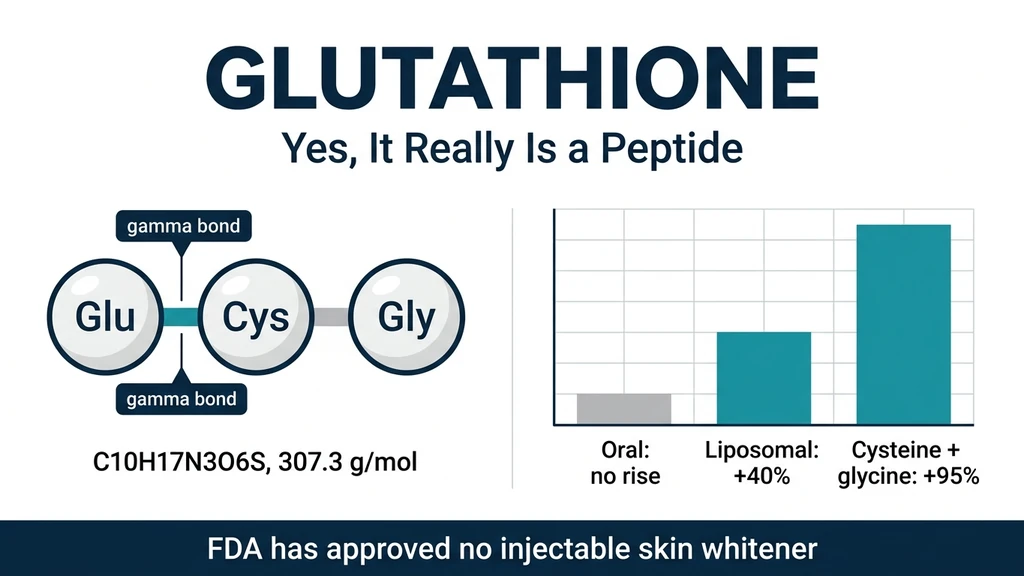
You are holding a bottle of glutathione capsules, and the label says "peptide." Yes, glutathione is a peptide. It is a tripeptide built from glutamate, cysteine and glycine, and it is one of the few supplements sold under that word where the chemistry is honest. It works as an antioxidant and redox buffer. Signalling peptides like BPC-157 bind receptors; glutathione donates electrons. Swallowing it barely raises your blood levels.
| Quick Reference | Detail |
|---|---|
| Is glutathione a peptide? | Yes, a tripeptide (3 amino acids) |
| Amino acids | Glutamate, cysteine, glycine |
| Unusual feature | Gamma-glutamyl bond, not the standard alpha bond |
| Formula / mass | C10H17N3O6S, 307.33 g/mol (PubChem CID 124886) |
| What it does | Antioxidant and redox buffer |
| Does it signal receptors? | No |
| Oral bioavailability | Poor; hydrolysed in gut and liver |
| Best-evidenced way to raise it | Cysteine precursors such as NAC |
| IV for skin lightening | Not FDA-approved; documented harms |
The word "peptide" describes the bond geometry. It says nothing about the job. Reading it on a label tells you how the molecule is stitched together and nothing about whether it will do anything for your skin, your energy, or your liver. For the wider picture, see what peptides do for skin.
Get your custom peptide protocol:
- Tailored to your body and goals
- Precise dosing and cycle length
- Safe stacking combinations
- Backed by peer-reviewed studies
- Ready in under 2 minutes
Yes, Glutathione Is a Peptide. Here Is the Structure.
A peptide is a chain of amino acids joined by amide bonds. Glutathione has three amino acids joined by two such bonds, which makes it a tripeptide by any definition a biochemist would accept.
The full name is gamma-glutamyl-cysteinyl-glycine. Glutamate sits at one end, cysteine in the middle, glycine at the far end. Cysteine carries the reactive sulfur atom (the thiol, written SH) that does all the chemical work.
The gamma is where glutathione stops behaving like an ordinary peptide. In a normal peptide bond, the amino acid donates its alpha-carboxyl, the one attached to the same carbon as the amine group. Glutamate here donates its side-chain carboxyl instead, five carbons down. PubChem records the IUPAC name as (2S)-2-amino-5-[[(2R)-1-(carboxymethylamino)-1-oxo-3-sulfanylpropan-2-yl]amino]-5-oxopentanoic acid (PubChem CID 124886), and that "5-oxo" position is the gamma-carboxyl doing the linking, with the alpha-carboxyl left free as an acid.
That single structural quirk has a consequence. Ordinary peptidases recognise alpha linkages and slice them. They do not recognise the gamma bond, so glutathione survives inside cells for hours rather than seconds. One enzyme does cleave it: gamma-glutamyl transferase, which sits on the surface of intestinal and liver cells. Witschi's group attributed the negligible systemic availability of swallowed glutathione to exactly that enzyme (Witschi et al., Eur J Clin Pharmacol, 1992, PMID 1362956).
Compare this to two molecules the supplement market keeps miscategorising. NAD+ is a dinucleotide, no amino acids in it. SLU-PP-332 is a small synthetic organic compound. Neither is a peptide. Glutathione is the rare case where the label is chemically correct.
The Sponge That Gets Wrung Out and Reused
Picture a kitchen sponge. It soaks up a spill, you wring it out over the sink, and it goes back to the counter ready for the next spill. The sponge is never consumed. It cycles between soaked and wrung, and what limits you is how fast you can wring it, not how many sponges you own.
Glutathione cycles the same way. In its reduced form (GSH), the cysteine thiol donates an electron to a reactive oxygen species and neutralises it. Two spent GSH molecules bond together into oxidised glutathione (GSSG). An enzyme called glutathione reductase then strips the bond, spends NADPH, and hands you back two fresh GSH. The literal statement: glutathione is a recyclable redox buffer, and the ratio of GSH to GSSG is the readout of how oxidatively stressed a cell is.
Healthy cells hold that ratio heavily toward the reduced side and maintain glutathione at millimolar concentrations inside the cytosol. Witschi measured basal plasma glutathione at only 6.2 micromol per litre in healthy volunteers. Blood carries a trace. Cells hold the reservoir, and glutathione synthesis is a two-step ATP-dependent reaction whose rate is capped by how much cysteine is available (Forman et al., Mol Aspects Med, 2009, PMID 18796312).
That last clause is the whole strategy. If cysteine is the bottleneck, the sensible intervention is to deliver cysteine, and glutathione is a poor cysteine delivery vehicle because the gut takes it apart before it reaches the bloodstream intact.
Being a Peptide Tells You Almost Nothing About What It Does
Most peptides sold in this space are signalling molecules. They bind a receptor, flip a switch, and a cell changes behaviour. GHK-Cu upregulates collagen genes in fibroblasts. BPC-157 modulates growth factor expression in healing tissue. Their function lives in their shape, which is why a single amino acid substitution can kill the effect.
Glutathione binds no receptor as its primary act. Its function lives in one sulfur atom. Strip away the glutamate and the glycine and you still have a thiol that donates electrons; the two flanking amino acids exist mainly to protect the cysteine from being oxidised or degraded on its own.
So a reader who learns that glutathione is a peptide has learned a fact about bond geometry. They have not learned that it heals tendons, or grows hair, or lightens skin. Those claims each need their own evidence, and they mostly do not have it. If you are new to the category, GHK-Cu benefits shows what a well-evidenced signalling peptide's data actually looks like by comparison.
Danger Scenario 1: Paying for Oral Glutathione That Never Arrives
Here is the mistake. You buy 500 mg oral glutathione capsules, take two daily, and expect your plasma glutathione to climb the way a vitamin C level would.
Witschi gave seven healthy volunteers 0.15 mmol per kilogram of oral glutathione, roughly 3.5 grams for a 75 kg adult, which is seven of those 500 mg capsules in one sitting. Over the following 270 minutes, plasma glutathione, cysteine and glutamate showed no significant rise from a baseline of 6.2, 8.3 and 54 micromol per litre. The conclusion was that systemic availability is negligible in humans (Witschi et al., Eur J Clin Pharmacol, 1992, PMID 1362956).
Allen and Bradley then ran the realistic consumer protocol. Forty healthy adults, 500 mg twice daily, four weeks, randomised and placebo-controlled. No significant change in urinary F2-isoprostanes, no change in 8-hydroxy-2'-deoxyguanosine, no change in erythrocyte glutathione status (Allen & Bradley, J Altern Complement Med, 2011, PMID 21875351).
Run the arithmetic on that protocol. One gram a day for 28 days is 28 grams of glutathione, 56 capsules, and at typical retail pricing between 30 and 60 dollars. The measured return on every oxidative stress biomarker the trial tracked was zero.
The honest complication is duration. Richie's six-month trial at 250 mg and 1,000 mg daily did move body stores: erythrocyte glutathione rose about 17 percent on the low dose, plasma and erythrocyte glutathione rose 30 to 35 percent on the high dose, and buccal cell glutathione climbed 260 percent (Richie et al., Eur J Nutr, 2015, PMID 24791752). Six months at 1,000 mg daily is 180 grams of powder and several hundred dollars for a 30 percent shift in a marker no one has tied to a clinical outcome.
The fix: stop paying for acute plasma effects that trials say do not exist. If you want a six-month, several-hundred-dollar experiment in raising body stores, price it honestly against everything else in your cabinet first. See how much peptides cost.
Danger Scenario 2: IV Glutathione for Skin Lightening
Clinics across the United States, Southeast Asia and the Gulf sell intravenous glutathione drips marketed for brighter or lighter skin. A typical package runs 10 sessions at 150 to 250 dollars each, so 1,500 to 2,500 dollars, often at 600 to 1,200 mg per infusion once or twice weekly.
The US Food and Drug Administration has approved no injectable drug for skin whitening or lightening. Its consumer update calls these products unapproved new drugs, warns they may contain unknown harmful ingredients or contaminants, and notes that improper injection can transmit disease and cause serious injury (FDA, Injectable Skin Lightening and Skin Bleaching Products May Be Unsafe).
The Philippine Food and Drug Administration went further in a May 2011 advisory, and the adverse events it catalogued are specific: Stevens-Johnson syndrome and toxic epidermal necrolysis, thyroid dysfunction, renal dysfunction, severe abdominal pain, air embolism, and potentially fatal sepsis from unsterile administration. Stevens-Johnson syndrome and toxic epidermal necrolysis involve the epidermis detaching in sheets. Both are dermatologic emergencies managed in burn units.
What are you buying that risk for? Sonthalia's review of the field concluded that clinical evidence for intravenous glutathione as a skin lightener rests on "a single study with a dubious study design" and apparently flawed analysis (Sonthalia et al., Dermatol Pract Concept, 2018, PMID 29445569). Two thousand dollars, one weak trial, and a documented pathway to a burn-unit admission.
This site does not publish an intravenous glutathione protocol, and no reputable source should. Intravenous administration of an unapproved compound for a cosmetic indication sits at the far end of the risk spectrum. Read are peptides legal and the peptide safety guide before any clinic takes your card.
The fix: if hyperpigmentation is the actual problem, that is a dermatology consultation, not an infusion suite.
How to Read a Glutathione Product Label
Four words on a bottle carry almost all the information, and most buyers skim past them.
Reduced glutathione (GSH). The active form, the one with the free thiol. Sometimes printed as "L-glutathione reduced" or under the branded ingredient name Setria. This is what the Witschi, Allen and Richie trials used orally.
Oxidised glutathione (GSSG). Two glutathione molecules already bonded through their sulfurs, meaning the thiols are spent. Your cells can reduce it back, but paying premium prices for the spent form makes no sense. If a label says only "glutathione" with no "reduced," ask the manufacturer which one is in the capsule.
Liposomal. Glutathione wrapped in phospholipid vesicles to survive the gut. Sinha's pilot found 40 percent higher whole blood glutathione, 25 percent higher in erythrocytes and 28 percent higher in plasma after two weeks at 500 to 1,000 mg daily, with natural killer cell cytotoxicity up as much as 400 percent (Sinha et al., Eur J Clin Nutr, 2018, PMID 28853742). Read the fine print: twelve subjects, one month, and the authors disclosed research funding from the company that makes the product. Encouraging at pilot scale. Nowhere near established.
Sublingual. Dissolved under the tongue to bypass first-pass gut and liver metabolism. Schmitt's three-week crossover in 20 people with metabolic syndrome found the sublingual form raised total and reduced plasma glutathione and improved the GSH/GSSG ratio (p=0.003) where standard oral glutathione did not (Schmitt et al., Redox Biol, 2015, PMID 26262996). Twenty subjects gives a signal. It does not settle the question.
Then there is what a serum or plasma glutathione number means when a wellness clinic hands you one. Almost all body glutathione sits inside cells at millimolar concentration; plasma carries single-digit micromolar. A plasma reading is a spillover measurement, several orders of magnitude removed from the intracellular pool that actually matters, and it moves with sample handling, fasting state and how fast the tube reached the lab. A single plasma glutathione value is close to uninterpretable on its own. What researchers track instead is the GSH/GSSG ratio in a controlled specimen.
When you compare vendors, apply the same scrutiny you would to any research chemical purchase. See where to buy peptides in 2026.
NAC: The Better-Evidenced Route
Cysteine limits glutathione synthesis. Free cysteine is unstable in solution and mildly toxic at high intakes, so the practical donor is N-acetylcysteine (NAC), a cysteine molecule with an acetyl group protecting the amine.
Sekhar's group tested the precursor logic directly. Elderly subjects with depleted red cell glutathione received cysteine and glycine supplementation for two weeks. Red cell glutathione concentration rose 94.6 percent, the fractional synthesis rate rose 78.8 percent, and plasma oxidative stress markers and F2-isoprostanes fell (Sekhar et al., Am J Clin Nutr, 2011, PMID 21795440). Roughly a doubling of the intracellular pool, from a substrate that survives digestion.
Set that beside 3.5 grams of oral glutathione producing no significant plasma change in 270 minutes. Feeding the factory beats shipping the finished product through an enzyme that exists specifically to dismantle it.
NAC is not free of consequences. It carries a sulfurous smell, can cause nausea and gastrointestinal upset, and interacts with nitrates and some anticoagulant regimens. It is also the standard hospital antidote for paracetamol overdose, precisely because it restores hepatic glutathione, which is about as strong a proof of mechanism as this field offers. Review peptide therapy side effects and talk to a clinician if you take other medication.
One more honest note on the immune claims. Both Richie and Sinha reported large increases in natural killer cell cytotoxicity, which is why glutathione appears in immune-support marketing. Those were small trials with surrogate endpoints and no infection outcomes. For where the immune evidence is stronger, see peptides for the immune system.
Every Route, Every Form: The Reference Table
One row per delivery route, with what the trial actually measured rather than what the marketing claims.
| Route / form | Bioavailability evidence | What the trial measured | Verdict |
|---|---|---|---|
| Oral GSH, single dose | Witschi 1992, n=7, 0.15 mmol/kg (~3.5 g) | Plasma GSH, cysteine, glutamate over 270 min | No significant rise. Systemic availability negligible |
| Oral GSH, 4 weeks | Allen & Bradley 2011, n=40, 500 mg twice daily | Urinary F2-isoprostanes, 8-OHdG, erythrocyte GSH | No significant change in any biomarker |
| Oral GSH, 6 months | Richie 2015, 250 or 1,000 mg daily | Erythrocyte, plasma and buccal cell GSH | Body stores rose 17% (low) to 30-35% (high); buccal +260% |
| Liposomal GSH, 1 month | Sinha 2018, n=12, 500 or 1,000 mg daily | Whole blood, RBC, plasma, PBMC GSH; NK cytotoxicity | +40% whole blood; industry-funded pilot, tiny sample |
| Sublingual GSH, 3 weeks | Schmitt 2015, n=20, crossover | Plasma total/reduced GSH, GSH/GSSG ratio, vitamin E | Beat oral GSH on GSH/GSSG ratio (p=0.003); small sample |
| Oxidised GSSG, oral | No human bioavailability trial | Nothing | Thiol already spent. No reason to buy it |
| Cysteine precursor (NAC / cysteine + glycine) | Sekhar 2011, elderly subjects, 2 weeks | Red cell GSH concentration and synthesis rate | +94.6% GSH, +78.8% synthesis rate. Best-evidenced route |
| IV GSH, cosmetic skin lightening | Sonthalia 2018 review | One trial, "dubious study design" | Not FDA-approved. SJS/TEN, renal and thyroid dysfunction, air embolism reported |
| IV GSH, clinical indications | Approved in some countries for hepatic disorders, chemotherapy toxicity | Varies | Prescriber's decision, not a wellness purchase |
Nothing in this table describes an injection protocol, and nothing here should be read as one. Dosing decisions belong to a clinician who has seen your labs.
Four Common Mistakes
Mistake 1: Assuming "peptide" implies "signalling peptide." Glutathione shares a bond type with BPC-157 and shares nothing else. A shopper who reasons "peptides heal tissue, glutathione is a peptide, therefore glutathione heals tissue" has made a category error. The fix: judge every compound on its own trial data.
Mistake 2: Buying oral glutathione for an acute effect. Two randomised trials found no plasma rise at 3.5 grams and no biomarker change at 1 gram daily for four weeks. Spending 30 to 60 dollars a month on that expectation buys nothing measurable. The fix: use a cysteine precursor, or accept a six-month timeline for modest body-store changes.
Mistake 3: Treating an IV drip as a cosmetic. The FDA approves no injectable skin whitener. The Philippine FDA has documented Stevens-Johnson syndrome, toxic epidermal necrolysis, renal and thyroid dysfunction and air embolism in this exact use case. The fix: see a dermatologist about pigmentation. Nobody's complexion is worth a detached epidermis.
Mistake 4: Reading a single plasma glutathione number as a health score. Plasma holds single-digit micromolar glutathione while cells hold millimolar. The blood value is spillover, sensitive to fasting and sample handling, and one draw tells you almost nothing. The fix: if a clinic sells you a panel on that basis, ask what the GSH/GSSG ratio was and how the specimen was stabilised.
Frequently Asked Questions
Is glutathione a peptide?
Yes. Glutathione is a tripeptide of glutamate, cysteine and glycine (C10H17N3O6S, 307.33 g/mol, PubChem CID 124886). Its glutamate is joined through the side-chain gamma-carboxyl rather than the usual alpha-carboxyl, which is why ordinary peptidases cannot cleave it. It functions as an antioxidant rather than a signalling peptide. See getting started with peptides.
What is the gamma bond in glutathione and why does it matter?
Glutamate donates its fifth-carbon side-chain carboxyl to the peptide bond instead of the alpha-carboxyl next to its amine. Standard peptidases only recognise alpha bonds, so glutathione resists degradation inside cells. One enzyme, gamma-glutamyl transferase in gut and liver, does cleave it, which explains poor oral absorption. See peptides for energy.
Does oral glutathione actually work?
Not acutely. Witschi gave 0.15 mmol/kg orally (about 3.5 g) and saw no significant plasma rise over 270 minutes; Allen and Bradley found no biomarker change after 1 g daily for four weeks. Richie's six-month trial did raise body stores 17-35 percent. Cysteine precursors work faster. See peptides for inflammation.
Is IV glutathione for skin whitening safe?
No injectable skin whitener is FDA-approved. The Philippine FDA documented Stevens-Johnson syndrome, toxic epidermal necrolysis, renal and thyroid dysfunction, severe abdominal pain and air embolism at the 600-1,200 mg doses clinics use. Sonthalia's 2018 review found the efficacy evidence rests on one poorly designed study. Read the peptide safety guide.
What is the difference between GSH and GSSG?
GSH is reduced glutathione with a free thiol that donates electrons to neutralise reactive oxygen species. GSSG is two spent GSH molecules bonded through their sulfurs. Glutathione reductase regenerates GSH from GSSG using NADPH. Buy reduced GSH; the oxidised form's thiols are already used. See copper peptides ruined my skin for label-reading discipline.
Is NAC better than glutathione supplements?
The evidence favours it. Cysteine is the rate-limiting substrate for glutathione synthesis, and NAC delivers cysteine in a form that survives digestion. Sekhar's 2011 trial raised red cell glutathione 94.6 percent in two weeks with cysteine and glycine. NAC is also the hospital antidote for paracetamol overdose. Check combinations with the peptide stack calculator.
What is a normal glutathione blood level?
Witschi measured basal plasma glutathione at 6.2 micromol per litre in healthy volunteers. Cells hold it at millimolar concentrations, hundreds of times higher, so a plasma reading is spillover from the pool that matters. Values shift with fasting and sample handling. Researchers track the GSH/GSSG ratio instead. See peptide statistics 2026.
Can I inject glutathione at home?
No responsible source publishes a home injection protocol for glutathione. It is an unapproved injectable in the United States, and the documented harms include fatal sepsis from unsterile administration and air embolism. Cosmetic infusions carry burn-unit-level dermatologic risk. General injection technique is covered in how to inject peptides.
The Bottom Line
Glutathione is a peptide. Three amino acids, two amide bonds, one of them the unusual gamma linkage that lets the molecule survive inside a cell and dooms it inside a gut. That fact is chemistry, and it settles the question people arrive with.
What the fact does not settle is whether any glutathione product is worth buying. The molecule's job is redox buffering, a sponge wrung out and reused thousands of times a day, and the bottleneck on the whole cycle is cysteine supply rather than glutathione supply. That is why precursor trials show a near-doubling of red cell glutathione in two weeks while a 3.5 gram oral dose moves plasma not at all, and why an intravenous drip sold for lighter skin is a two-thousand-dollar purchase of an unapproved drug with Stevens-Johnson syndrome on its side-effect list.
Judge glutathione on its trials. The word printed above them proves only that three amino acids are involved. Price any protocol before you start it with the peptide cost calculator, screen your combinations with the peptide interaction checker, and bring the plan to a clinician who can order the labs. More evidence-graded peptide guides at peptidesexplorer.com.
Helpful Tools
Related Articles
Peptides for Perimenopause: A Guide
Peptides for perimenopause: which ones target sleep, body composition, skin, and energy, the evidence behind them, and safety cautions.
BPC-157 Oral vs Injection: Which Route to Pick
BPC-157 oral vs injection: 80-95% injectable bioavailability vs 3-90% oral. PK data, condition matrix, combo protocol, and cost breakdown.
Where to Inject IGF-1 LR3: Sites, SubQ vs IM, Rotation
Where to inject IGF-1 LR3: abdomen, thigh or glute, subcutaneous, 29-31G needle. Why site-specific growth is a myth, a rotation map, and the hypoglycemia rule.
When to Take IGF-1 LR3: Best Time & Fed vs Fasted
When to take IGF-1 LR3: post-workout with carbs on training days, morning with breakfast on rest days, never fasted. Half-life, spacing from GH peptides, FAQ.