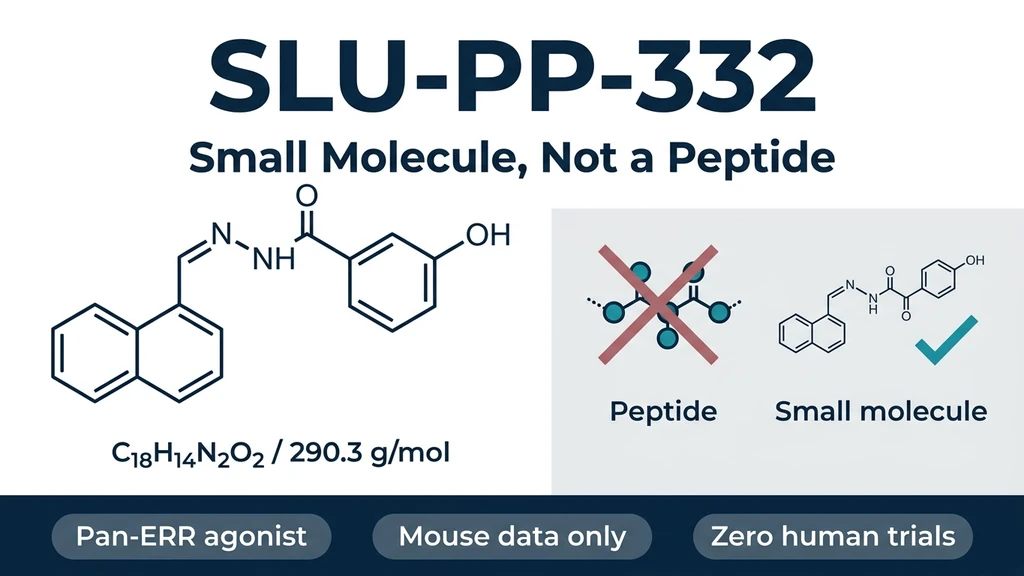
You searched for the SLU-PP-332 peptide because a vendor listed it under peptides. The listing is wrong. SLU-PP-332 is a synthetic small molecule, a pan-agonist of the estrogen-related receptors ERRα, ERRβ, and ERRγ. It contains no amino acids and no peptide bonds. It has also never been given to a human being in a registered clinical trial. Every SLU-PP-332 dose circulating online is arithmetic performed on mice.
| SLU-PP-332 at a Glance | Detail |
|---|---|
| What it actually is | Synthetic small molecule (a benzamide hydrazone) |
| Is it a peptide? | No. No amino acids, no peptide bonds |
| Molecular formula | C18H14N2O2, 290.3 g/mol |
| Target | Pan-agonist of ERRα, ERRβ, ERRγ |
| Potency | EC50 of 98 nM at ERRα |
| Origin | Burris lab, Saint Louis University ("SLU") |
| Human trials | Zero. No FDA approval, no Phase 1 |
| Source of all efficacy data | Mice, 12 to 28 days, intraperitoneal injection |
| Dose used in mice | 50 mg/kg, twice daily, intraperitoneal |
| Typical vendor "protocol" | 500 to 1,500 mcg/day subcutaneous |
| Oral bioavailability | Poor. The compound is not orally active |
| Legal status | Unapproved research chemical, not for human use |
Nothing below is a dosing protocol. Read it as an inventory of what is known, what is guessed, and where the guessing gets expensive. For general context on unapproved compounds, start with our peptide safety guide and are peptides legal.
Get your custom peptide protocol:
- Tailored to your body and goals
- Precise dosing and cycle length
- Safe stacking combinations
- Backed by peer-reviewed studies
- Ready in under 2 minutes
What SLU-PP-332 Actually Is
Nuclear receptors sit inside the cell and switch genes on. Estrogen-related receptors (ERRα, ERRβ, ERRγ) are three of them, and despite the name they do not bind estrogen. They govern mitochondrial biogenesis, fatty acid oxidation, and the oxidative fiber program in skeletal muscle.
Picture the lighting board in a theatre. Endurance exercise walks along the board and pushes up a specific bank of sliders: mitochondrial genes, fat-burning enzymes, PGC-1α. SLU-PP-332 reaches over and pushes up one of those sliders directly, with nobody on stage. Literally: it binds ERRα and stabilizes the active conformation, transcribing a gene program that resembles the molecular signature of acute aerobic exercise (Billon et al., ACS Chem Biol, 2023).
That mechanism is real chemistry, verified in cells and in mice. It is also completely unlike how a peptide works. Peptides such as MOTS-c or BPC-157 are short amino acid chains that act on membrane receptors or signaling cascades. SLU-PP-332 is a 290-dalton lipophilic molecule that crosses into the nucleus. Selling it beside tirzepatide on a peptide storefront is a chemistry error, repeated until it became a search term.
"Exercise in a pill" is a headline written by science journalists in 2023. The compound is not a pill. It is not orally active, which is why the same lab built a separate, orally bioavailable follow-up (SLU-PP-915).
The Only Real Evidence: Two Mouse Papers
Two peer-reviewed studies carry the entire reputation of this compound. Both come from the Burris group. Both used mice.
Endurance (Billon et al., ACS Chem Biol, 2023;18(4):756-771). Untrained mice received 50 mg/kg by intraperitoneal injection, either once an hour before a treadmill test or twice daily for 10 days. Treated mice increased type IIa oxidative muscle fibers and ran measurably longer and farther than vehicle controls, without ever training.
Metabolic syndrome (Billon et al., J Pharmacol Exp Ther, 2024;388(2):232-240; PMID 37739806). Diet-induced obese mice received 50 mg/kg intraperitoneally twice daily for 28 days. Body weight fell roughly 12% versus vehicle. Fat mass gain over the study was under 0.5 g on drug against about 5 g on vehicle. Fatty acid oxidation rose about 25%, glucose tolerance improved, and hepatic triglycerides dropped. In leptin-deficient ob/ob mice dosed for 12 days, adiposity, liver weight, and hepatic steatosis all fell.
The safety observations in that paper amount to minor shifts in plasma cholesterol and liver enzymes with no frank hepatotoxicity, across 28 days, in mice. Pharmacokinetics: six hours after a single 30 mg/kg intraperitoneal dose, plasma exposure was 0.2 μM and muscle exposure 0.6 μM.
That is the complete efficacy record. No human dose-response curve exists. No human safety database exists. Nothing published tells you what SLU-PP-332 does to a person over eight weeks, because nobody has published it. Compare that to retatrutide, which has Phase 2 data in hundreds of humans, and the gap is not subtle. See how does retatrutide work.
Danger One: The Rodent Dose Does Not Scale The Way Vendors Assume
Mice in both papers received 50 mg/kg twice daily, so 100 mg/kg per day. Converting animal doses to a human-equivalent dose uses body surface area, not body weight. The FDA's standard conversion divides the mouse dose by 12.3 (the ratio of the mouse Km factor of 3 to the human Km factor of 37).
Run the arithmetic. 100 mg/kg per day ÷ 12.3 = 8.1 mg/kg per day. For an 80 kg adult, that is roughly 650 mg per day, split into two doses of about 325 mg.
Now look at what the internet sells. The most repeated SLU-PP-332 dosage circulating on vendor blogs is 500 to 1,500 mcg per day subcutaneous. At the top of that range, 1.5 mg per day, you are taking about 430 times less than the surface-area-scaled equivalent of the dose that moved the needle in mice.
Both readings of that gap are bad. If 1.5 mg/day is meaningfully below any active threshold, buyers are injecting an unapproved research chemical for no pharmacological return, at $40 to $90 a vial. If it is active at that dose in humans, then human ERR pharmacology diverges wildly from mouse ERR pharmacology, and nobody has any idea where the ceiling is. There is no third possibility, because there is no human dose-response data to define one.
The fix: treat every published SLU-PP-332 dosing chart as a number someone invented, then reverse-engineered a justification for. Nobody titrated it in a person. If you want to see what a dose actually validated in humans looks like, read the retatrutide dosage escalation schedule or the peptide dosage chart.
Danger Two: The Route And The Solvent Nobody Copies
Every efficacy number for this compound came from intraperitoneal injection, a needle into the abdominal cavity. Human medicine essentially never uses that route outside dialysis and certain chemotherapy. Zero published SLU-PP-332 data used subcutaneous injection, and every online protocol prescribes subcutaneous injection.
The solvent problem is worse. SLU-PP-332 has low aqueous solubility and lacks oral bioavailability, which the anti-doping literature states explicitly (Möller, Krug & Thevis, Rapid Commun Mass Spectrom, 2026;40(8):e70039). Peptides dissolve in bacteriostatic water because they are charged, water-loving amino acid chains. A naphthalene ring bolted to a hydroxybenzamide is greasy. It does not go into water the way semaglutide does.
So buyers add DMSO. DMSO is a powerful aprotic solvent and a tissue irritant; it also carries whatever else is dissolved in it straight across membranes, including contaminants from an unregulated vial. Subcutaneous injection of a DMSO-solubilized research chemical risks local irritation, injection-site necrosis, and systemic delivery of impurities that no certificate of analysis ever quantified.
A cloudy vial after adding bacteriostatic water is not "mixing wrong." It is the compound refusing to dissolve, and it means the volume you draw contains an unknown fraction of the labeled dose. If you have used our peptide reconstitution calculator for a real peptide, the math assumed full dissolution. That assumption fails here.
Danger Three: Systemic ERR Agonism Over Timelines Nobody Has Studied
SLU-PP-332 is a pan-agonist. It does not select for muscle. It activates ERRα, ERRβ, and ERRγ in every tissue that expresses them, which includes heart, liver, kidney, and breast tissue.
ERRα is not a neutral target. Elevated ERRα expression associates with unfavorable biomarkers and worse prognosis in human breast cancer, while ERRγ associates with favorable ones (Ariazi, Clark & Mertz, Cancer Res, 2002;62(22):6510-6518). That is a statement about receptor biology. Whether SLU-PP-332 raises cancer risk in a human is unanswerable today, because no carcinogenicity study has ever been run on it.
Here is the timeline that should stop people. The longest published exposure to SLU-PP-332 in any species is 28 days, in mice. A typical online "cycle" is 8 to 12 weeks. At 12 weeks you are running an exposure three times longer than the longest experiment ever conducted on this molecule, in any animal, ever, while chronically agonizing a receptor with documented oncology associations.
Add the doping problem. Anti-doping laboratories have already built LC-HRMS/MS detection methods for SLU-PP-332 and its nine identified phase-I and phase-II metabolites (Möller, Krug & Thevis, Rapid Commun Mass Spectrom, 2026), with a parallel metabolite characterization published the same year (Avliyakulov et al., Drug Test Anal, 2026). WADA's S0 category prohibits any pharmacological substance not approved by any government health authority for human therapeutic use, at all times, in and out of competition. SLU-PP-332 sits squarely in S0. Tested athletes should read do peptides show up on drug tests.
The fix: if you are drug tested, this compound is a positive waiting for an assay rollout. If you are not, the exposure question remains unanswered and you are the experiment.
Practical Skill: Reading a Research Chemical COA And Knowing What It Cannot Tell You
Most buyers glance at a certificate of analysis, see "99.2% purity," and stop. That number answers one narrow question and stays silent on four that matter more.
What HPLC purity actually means. High-performance liquid chromatography separates a sample and reports each peak as a percentage of total peak area. "99.2%" means 99.2% of the material that eluted and absorbed at the detector wavelength was one peak. It does not confirm which molecule that peak is.
Purity is not identity. Identity requires mass spectrometry matched against a reference standard, or NMR. Peptide vendors run HPLC-MS routinely. SLU-PP-332 is a small molecule, and a mass spec run without an authentic reference standard confirms a mass, not a structure. Ask whether the COA includes an MS trace and what standard it was compared against. Most cannot answer.
Purity says nothing about mass. A vial labeled 5 mg at 99% purity can contain 3 mg or 9 mg of powder. Assay by weight is a separate test. Almost no research chemical COA includes it.
Purity says nothing about sterility, endotoxin, or residual solvent. Nothing on a standard COA rules out bacterial endotoxin or leftover DMF, dichloromethane, or hydrazine from synthesis. Hydrazone chemistry starts from hydrazides. Residual hydrazine is genotoxic. No COA you will be shown tests for it.
Check the lot number. The COA must carry the same lot as the vial in your hand. A generic COA posted once on a product page and never updated tells you about a batch synthesized who knows when. If the lot does not match, the document describes someone else's powder.
Run the same skepticism on price. A 5 mg vial at $40 to $90 sits in the same range as legitimate research peptides, which tells you nothing about what is inside. Model total spend with the peptide cost calculator and read where to buy peptides in 2026 and the FDA peptide crackdown before you order anything from a research-chemical storefront.
Comprehensive Reference: Published Science vs Internet Protocol
One table, side by side. The left column is peer-reviewed. The right column is marketing.
| Parameter | Published mouse research | Typical online SLU-PP-332 protocol |
|---|---|---|
| Species | Mouse (C57BL/6, DIO, ob/ob) | Human |
| Route | Intraperitoneal injection | Subcutaneous injection |
| Dose | 50 mg/kg, twice daily | 500 to 1,500 mcg total per day |
| Human-equivalent of the mouse dose | ~650 mg/day for an 80 kg adult | ~430x lower than that |
| Vehicle | Laboratory solubilizing vehicle | Bacteriostatic water, or DMSO |
| Longest exposure | 28 days | 8 to 12 week "cycles" |
| Dosing frequency rationale | Twice daily, per protocol | 2 to 3x daily, from a rodent half-life |
| Endpoint measured | Treadmill distance, fat mass, glucose tolerance | Subjective endurance and fat loss |
| Safety monitoring | Plasma cholesterol, liver enzymes, histology | None |
| Toxicology | No carcinogenicity, no reprotox, no chronic study | Not mentioned |
| Human PK | None exists | Half-life quoted from rodents |
| Regulatory status | Unapproved. No IND, no Phase 1 | "Research use only" disclaimer |
Now place it against compounds with actual human evidence:
| Compound | Class | Human data | Status |
|---|---|---|---|
| SLU-PP-332 | Small molecule, pan-ERR agonist | None | Research chemical |
| Tirzepatide | Peptide, GIP/GLP-1 agonist | Phase 3, tens of thousands | FDA approved |
| Retatrutide | Peptide, triple agonist | Phase 2 complete, Phase 3 running | Investigational |
| Cagrilintide | Peptide, amylin analog | Phase 2 and 3 | Investigational |
| 5-Amino-1MQ | Small molecule, NNMT inhibitor | None | Research chemical |
| MOTS-c | Mitochondrial peptide | Minimal | Research chemical |
Two entries on that list are also small molecules dressed up as peptides. 5-Amino-1MQ is an NNMT inhibitor with the same evidence problem. We have flagged this pattern before with lipo-C, which is a MIC plus B12 blend, and pinealon, whose evidence base is preclinical and largely Russian. On these storefronts, the word "peptide" describes a shelf.
If endurance and mitochondrial function are the actual goal, the interventions with the most human support remain the boring ones: structured training, sleep, and the metabolic drugs carrying Phase 3 files. See peptides for recovery, peptides for energy, and peptides vs steroids for how these categories differ in evidence and risk.
Common Mistakes
Mistake 1: Calling it a peptide and reasoning from peptide rules. Peptide handling assumptions (dissolves in bacteriostatic water, degrades by proteolysis, subcutaneous depot absorption) all fail for a 290-dalton lipophilic small molecule. The consequence is a cloudy vial, an unknown drawn dose, and a solvent you did not plan for. The fix: treat it as a small-molecule research chemical, and stop using the peptide stacking guide logic on it.
Mistake 2: Believing a published dosing chart implies a validated dose. No SLU-PP-332 dose has ever been titrated in a human. Every chart online is either a scaled rodent number or a copied guess. The consequence: you are dosing 430x below the scaled effective dose, or somewhere unmapped above it. The fix: recognize that a confident table on a vendor blog is not evidence.
Mistake 3: Running 8 to 12 week cycles. The longest exposure in any published study is 28 days in mice. A 12-week run triples that, in a species with no toxicology data, on a receptor with oncology associations. The fix: nothing about this compound supports chronic use, and no protocol length is defensible from the literature.
Mistake 4: Assuming "research chemical" is a legal safe harbor. The label protects the seller, not the buyer. SLU-PP-332 is unapproved for human use anywhere, prohibited under WADA's S0 category, and sits in the exact market the FDA has been narrowing. Read are peptides legal and peptide therapy cost before treating any of this as routine.
Frequently Asked Questions
Is SLU-PP-332 a peptide?
No. SLU-PP-332 is a synthetic small molecule of 290.3 g/mol (C18H14N2O2), a benzamide hydrazone with no amino acids and no peptide bonds. It is a pan-agonist of the ERRα, ERRβ, and ERRγ nuclear receptors. Vendors file it under peptides for marketplace convenience. Compare a real peptide profile like MOTS-c.
What is the SLU-PP-332 dose used in research?
Mice received 50 mg/kg twice daily by intraperitoneal injection, for 10 to 28 days (Billon et al., ACS Chem Biol, 2023; J Pharmacol Exp Ther, 2024). Surface-area scaling puts the human equivalent near 650 mg per day for an 80 kg adult. No human has ever received a measured dose. See peptide dosage chart for compounds that do have human data.
Is there a safe SLU-PP-332 dosage for humans?
No safe human dosage exists, because no human dose-response or safety study exists. Vendor protocols of 500 to 1,500 mcg per day are roughly 430 times below the surface-area-scaled equivalent of the effective mouse dose, and neither number has any human validation. Review our peptide safety guide before considering unapproved compounds.
Does SLU-PP-332 actually work as an exercise mimetic?
In mice, yes. Untrained mice on 50 mg/kg intraperitoneally increased type IIa oxidative muscle fibers and ran longer than controls, and diet-induced obese mice lost about 12% body weight over 28 days. In humans, unknown. Zero trials. "Exercise in a pill" is a media phrase. See peptides for energy for the evidence landscape.
What are the side effects of SLU-PP-332?
Unknown in humans. Mouse studies over 28 days reported minor changes in plasma cholesterol and liver enzymes without frank hepatotoxicity. No carcinogenicity, reproductive, or chronic toxicity study has been published in any species, and ERRα agonism is systemic rather than muscle-selective. Compare documented profiles like MOTS-c side effects.
Will SLU-PP-332 show up on a drug test?
Anti-doping laboratories have published LC-HRMS/MS methods for SLU-PP-332 and nine of its metabolites (Möller, Krug & Thevis, Rapid Commun Mass Spectrom, 2026). WADA's S0 category prohibits any substance unapproved for human therapeutic use, at all times. Detection is a matter of assay deployment. See do peptides show up on drug tests.
Can SLU-PP-332 be taken orally?
No. The compound lacks oral bioavailability, which is precisely why the Saint Louis University group developed SLU-PP-915, a chemically distinct, orally active pan-ERR agonist. Capsules sold as oral SLU-PP-332 contradict the published pharmacokinetics. For a compound with real oral evidence, see does tirzepatide come in pill form.
How does SLU-PP-332 compare to retatrutide or tirzepatide for fat loss?
Not comparable on evidence. Tirzepatide has Phase 3 data across tens of thousands of patients and FDA approval; retatrutide has completed Phase 2 with substantial human weight-loss data. SLU-PP-332 has 28 days in obese mice. See retatrutide vs tirzepatide and how much do peptides cost.
The Bottom Line
SLU-PP-332 is a small-molecule pan-agonist of ERRα, ERRβ, and ERRγ, developed as a laboratory tool at Saint Louis University. It is not a peptide. It has no human trials, no human pharmacokinetics, no toxicology beyond 28 days in mice, and no validated dose in any person.
The mouse science is genuinely interesting. Untrained animals ran farther, obese animals lost fat, and the mechanism is clean and well characterized. That is exactly the point at which a compound enters formal development, not the point at which it should be arriving in a mailbox in an unlabeled vial with a lot number that matches nothing.
If you want compounds that have been measured in humans, start with our profiles for retatrutide and tirzepatide, price a realistic protocol with the peptide cost calculator, and check any combination against the peptide interaction checker. Read more evidence-first peptide guides at PeptidesExplorer.com, and take nothing unapproved without a physician who knows exactly what you are taking.
Related Articles
Where to Inject IGF-1 LR3: Sites, SubQ vs IM, Rotation
Where to inject IGF-1 LR3: abdomen, thigh or glute, subcutaneous, 29-31G needle. Why site-specific growth is a myth, a rotation map, and the hypoglycemia rule.
When to Take IGF-1 LR3: Best Time & Fed vs Fasted
When to take IGF-1 LR3: post-workout with carbs on training days, morning with breakfast on rest days, never fasted. Half-life, spacing from GH peptides, FAQ.
Where to Inject BPC-157 for Back Pain: Lower Back Sites
Where to inject BPC-157 for lower back pain, herniated disc, sciatica and SI joint pain: abdomen vs paraspinal sites, landmarks, zones to avoid, red flags.
Best Time to Take Retatrutide: Morning or Night?
Best time to take retatrutide: any hour, same weekday. Evening blunts nausea, morning suits diarrhea. Missed-dose rule, day switching, food, travel, alcohol.