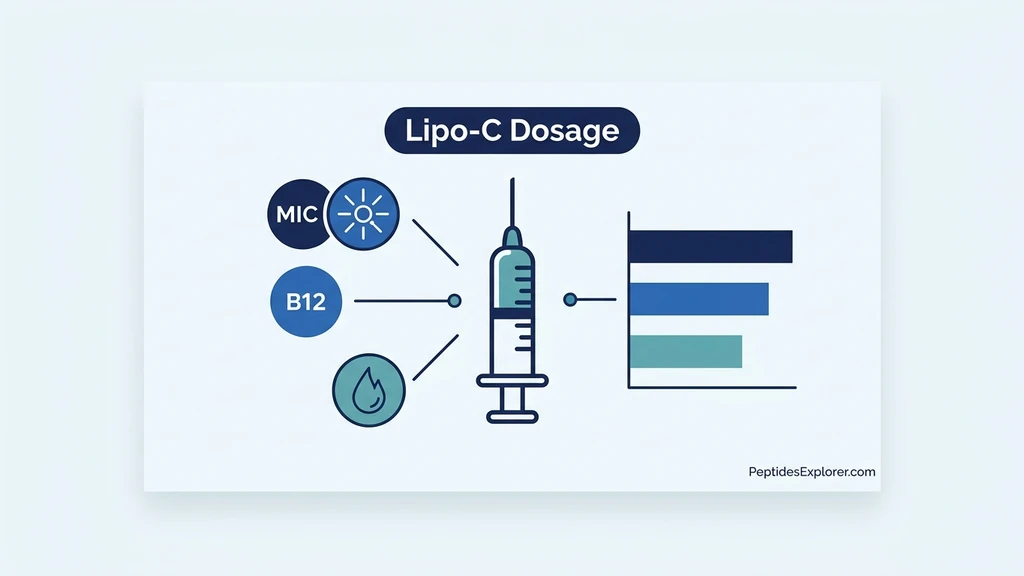
You are holding a vial labeled "Lipo-C" and your clinic told you to inject 1 mL once a week. The standard Lipo-C dose is 1 mL administered once weekly, either intramuscularly or subcutaneously, often alongside a GLP-1 medication. One detail matters before you draw the syringe: Lipo-C is not a peptide.
Lipo-C (also sold as "Lipo-Mino" or simply "MIC+B12") is a lipotropic injection blend. It combines Methionine, Inositol, and Choline, the three compounds abbreviated as MIC, with Vitamin B12 and frequently L-Carnitine. Search engines file it under "peptide" because clinics market it next to semaglutide, but chemically it is an amino acid and vitamin cocktail, not a chain of peptide bonds.
| Quick Reference | Details |
|---|---|
| Product | Lipo-C / Lipo-Mino (MIC + B12 blend) |
| What it is | Lipotropic injection (amino acids + vitamins), not a peptide |
| Core components | Methionine, Inositol, Choline, Vitamin B12 |
| Common add-on | L-Carnitine |
| Standard dose | 1 mL per injection |
| Frequency | Once weekly (some clinics 1-2x weekly) |
| Route | Intramuscular or subcutaneous |
| Common pairing | Semaglutide or tirzepatide |
| Storage | Refrigerated, protected from light |
The honest version: clinical evidence that lipotropic injections drive meaningful standalone fat loss is weak. Most of the felt benefit comes from B12 correcting an energy deficit, and from Lipo-C acting as a supportive add-on to diet and GLP-1 therapy. For more on energy-supporting compounds, see our guide to peptides for energy.
This is educational content. Consult a healthcare provider before starting lipotropic injections.
Get your custom peptide protocol:
- Tailored to your body and goals
- Precise dosing and cycle length
- Safe stacking combinations
- Backed by peer-reviewed studies
- Ready in under 2 minutes
Lipo-C Dosage Chart
Lipo-C dosing is volume-based, not milligram-based, because it is a fixed-concentration blend. You measure the dose by the milliliters you draw, not by converting a target mass.
| Protocol | Volume | Frequency | Route | Typical Use |
|---|---|---|---|---|
| Standard | 1 mL | Once weekly | IM or SubQ | Most clinic protocols |
| Conservative | 0.5 mL | Once weekly | SubQ | First dose, dose testing |
| Aggressive | 1 mL | Twice weekly | IM | Provider-directed only |
| GLP-1 adjunct | 1 mL | Once weekly | SubQ | Paired with semaglutide injection day |
Most clinics standardize on 1 mL weekly because the formulation is designed around that volume. The B12 content of a single 1 mL dose typically covers and exceeds the daily requirement many times over, which is why weekly dosing is enough.
Lipo-C is not reconstituted at home the way lyophilized peptides are. It ships as a pre-mixed liquid, so you skip the mixing math. If you do work with separate powdered components, our peptide reconstitution calculator handles the volume conversions, and our peptide dosage chart covers cross-compound comparisons.
Component Reference Table
Each Lipo-C formulation is compounded by a specific pharmacy, so exact amounts vary. The ranges below reflect what most clinics list per 1 mL. Treat them as typical, not universal.
| Component | Typical Amount per mL | Role |
|---|---|---|
| Methionine | 25 mg | Essential amino acid; supports fat metabolism in the liver |
| Inositol | 50 mg | Sugar alcohol involved in lipid signaling |
| Choline | 50 mg | Required for transporting fat out of the liver |
| Vitamin B12 (cyanocobalamin or methylcobalamin) | 1,000 mcg | Energy metabolism, red blood cell formation |
| L-Carnitine (when included) | 100-250 mg | Shuttles fatty acids into mitochondria |
Methionine, inositol, and choline are the "lipotropic" agents, meaning they participate in fat processing in the liver. Choline deficiency causes fat to accumulate in liver tissue, and supplementation reverses that specific deficiency (Corbin & Zeisel, Curr Opin Gastroenterol, 2012). That is a real and documented effect on liver fat, which is different from burning fat off your waistline.
Vitamin B12 is the component you will actually feel. It supports energy metabolism, and correcting a B12 deficiency reverses fatigue, but supplementing a person who is already B12-sufficient produces no extra energy (Stabler, N Engl J Med, 2013). L-Carnitine transports long-chain fatty acids into mitochondria for oxidation, though oral and injected carnitine show inconsistent effects on body composition in trials (Pooyandjoo et al., Obes Rev, 2016).
Because formulations differ, always read your own vial label. If your clinic adds B-complex vitamins or changes the B12 form, your dose volume may stay the same while the contents differ.
Why the Concentration Works Like a Smoothie
Think of Lipo-C like a pre-blended smoothie. The shop already mixed the spinach, banana, and protein into one cup at a set recipe. You do not measure each ingredient. You drink the cup.
Lipo-C works the same way. The pharmacy fixed the ratio of methionine, inositol, choline, and B12 inside the vial. Your dose is the volume you draw, and 1 mL delivers the whole recipe in its intended proportions.
This is why Lipo-C dosing looks simpler than peptide dosing. With semaglutide, you convert a milligram target into syringe units based on concentration. With Lipo-C, the math is already baked in. You draw to the 1 mL mark on the syringe and you are done.
The trade-off is that you cannot easily adjust one ingredient. If you want more B12 without more choline, a fixed blend will not let you. That is when a provider switches you to separate injections instead.
Quantified Dosing Scenarios
Lipo-C is far safer than potent peptides, but specific mistakes still waste money or cause discomfort. Each scenario below names the error, the result, and the fix.
Scenario 1: Daily dosing instead of weekly. You inject 1 mL every day because more feels better. A weekly 1 mL dose already delivers roughly 1,000 mcg of B12, around 400 times the daily reference intake. Daily injection floods you with water-soluble vitamins your kidneys simply excrete in urine, turning it bright yellow and burning money on output you flush away. The fix: hold to once weekly unless a provider directs otherwise.
Scenario 2: Expecting fat loss with no calorie deficit. You inject Lipo-C weekly, eat the same, and expect the scale to drop. Lipotropic injections do not create a calorie deficit, and trials show no meaningful standalone weight loss from MIC injections without diet change. The result is zero loss and disappointment. The fix: treat Lipo-C as an adjunct to a calorie deficit or GLP-1 therapy, never as a replacement.
Scenario 3: Already B12-sufficient. Your B12 levels are normal and you add weekly Lipo-C expecting an energy surge. A person with adequate B12 gains no additional energy from more B12 (Stabler, N Engl J Med, 2013). You feel nothing and assume the product is fake. The fix: check serum B12 first; the energy benefit is real only when you are deficient.
For the broader picture of which compounds actually move energy levels, see our peptides for energy guide.
How to Read Your Syringe
Lipo-C is dosed in milliliters, but the syringe you receive may be marked in insulin units, which confuses people the first time. Here is how to read both.
A standard 1 mL (100-unit) insulin syringe has marks from 0 to 100 units. On that syringe, 1 mL equals 100 units, and 0.5 mL equals 50 units. So a "1 mL Lipo-C dose" means you draw all the way to the 100-unit line.
A 3 mL syringe with a luer-lock tip is marked directly in milliliters, usually in 0.1 mL increments. For intramuscular Lipo-C, clinics often use this larger syringe with a 1 to 1.5 inch needle, because muscle injection needs to reach deeper tissue.
The volume is the dose. Whether your syringe says "100 units" or "1.0 mL," draw to the line that equals 1 mL. For step-by-step technique on holding the barrel and clearing air bubbles, see our how to inject peptides guide.
Step-by-Step Injection Procedure
Lipo-C can go intramuscular (deltoid, thigh, or glute) or subcutaneous (abdomen, fat of the thigh). Subcutaneous is easier to self-administer. Follow these steps.
- 1.Wash and gather. Wash your hands. Set out the vial, a syringe with the correct needle, two alcohol swabs, and a sharps container.
- 1.Inspect the vial. Check the liquid is clear and the expiration date has not passed. Lipo-C with B12 often has a pink or red tint, which is normal.
- 1.Swab the stopper. Wipe the rubber vial top with one alcohol swab. Let it dry for 5 seconds.
- 1.Draw to 1 mL. Pull back the plunger to draw 1 mL (the 100-unit line on an insulin syringe). Tap the barrel with your fingernail to float air bubbles to the top, then push them back into the vial.
- 1.Clean the site. Swab your injection site with the second alcohol swab. For subcutaneous, pinch a fold of abdominal fat two inches from the navel. For intramuscular deltoid, find the meaty part of the upper arm.
- 1.Insert the needle. For subcutaneous, insert at 45 degrees into the pinched fold. For intramuscular, insert at 90 degrees into the muscle.
- 1.Inject slowly. Push the plunger steadily. Count to 5 before withdrawing the needle so the liquid disperses.
- 1.Dispose and rotate. Drop the needle in the sharps container. Note the site so you rotate next week. For injection site selection across the body, see our where to inject walkthrough.
Rotate sites weekly to avoid soreness and tissue buildup. The same rotation logic applies to any weekly injection.
Lipo-C With GLP-1 Therapy
Most people taking Lipo-C are already on a GLP-1 medication. The pairing is logical, because the two do different jobs.
Semaglutide and tirzepatide suppress appetite and create the calorie deficit that actually drives weight loss. Lipo-C supplies B12 and lipotropic support that GLP-1 users sometimes want when energy dips during aggressive cutting.
| Combination | Lipo-C Role | GLP-1 Role |
|---|---|---|
| Lipo-C + semaglutide | B12 energy support, fat metabolism support | Appetite suppression, deficit |
| Lipo-C + tirzepatide | Same supportive role | Stronger dual-agonist appetite control |
A practical scheduling note: many clinics have patients inject Lipo-C on the same day as their weekly GLP-1 shot to consolidate the routine. They are separate injections in separate sites, not mixed in one syringe.
The honest framing is that the GLP-1 does the heavy lifting on the scale. Lipo-C is the support player. For combining B12 with GLP-1 medications, see compound semaglutide with B12 and tirzepatide with B12.
Storage and Stability
Lipo-C is a compounded liquid with light-sensitive B12, so storage protects both potency and safety.
Keep the vial refrigerated between 36 and 46 degrees Fahrenheit (2 to 8 degrees Celsius). Do not freeze it, because freezing can damage the solution. Store it in its box or wrapped to block light, since B12 degrades when exposed to it.
A compounded multi-dose vial typically holds a beyond-use date of around 28 days once opened, though your pharmacy label is the authority. Discard the vial on that date even if liquid remains.
If the solution turns cloudy, develops particles, or changes color beyond its normal pink tint, throw it away. For the general principles behind peptide and injectable shelf life, see our how to store peptides guide and our breakdown of how long reconstituted peptides last.
Common Mistakes
Four errors account for most Lipo-C problems. Each has a clear consequence and a simple fix.
Believing it melts fat on its own. The most common mistake is expecting Lipo-C to replace a diet. MIC injections show no meaningful standalone fat loss in controlled settings. The fix: pair it with a calorie deficit or GLP-1 medication and treat it as support.
Over-injecting for faster results. Daily dosing does not multiply benefits. Your body excretes the excess water-soluble vitamins within hours. The fix: stay at the prescribed weekly schedule.
Skipping the B12 baseline. Without checking serum B12, you cannot know whether the energy benefit applies to you. If you are already sufficient, the energy lift will not appear. The fix: get a baseline level before assuming the product failed.
Storing it at room temperature. Leaving the vial on a counter exposes light-sensitive B12 and shortens potency. The fix: refrigerate it in the dark and respect the beyond-use date. Our peptide cost calculator helps you weigh whether weekly Lipo-C is worth the per-dose spend.
Frequently Asked Questions
Is Lipo-C a peptide?
No. Lipo-C is a lipotropic injection blend of methionine, inositol, choline, and vitamin B12, often with L-carnitine. These are amino acids and vitamins, not peptides. Clinics market it beside peptides like semaglutide, which is why it gets called a peptide in search results.
What is the standard Lipo-C dosage?
Most clinics use 1 mL once weekly, given intramuscularly or subcutaneously. Some protocols allow up to twice weekly under provider direction. The dose is measured by volume, not milligrams, because the blend ships pre-mixed. See our peptide dosage chart for how this compares to other compounds.
Does Lipo-C actually cause weight loss?
On its own, the evidence is weak. MIC lipotropic injections show no meaningful standalone fat loss without a calorie deficit. Most benefit comes from B12 energy support and its role as an adjunct to diet or GLP-1 therapy like compound semaglutide with B12.
Can I take Lipo-C with semaglutide or tirzepatide?
Yes, and the pairing is common. The GLP-1 drives appetite suppression and the calorie deficit, while Lipo-C supplies B12 and lipotropic support. Many clinics schedule both on the same day in separate sites. See tirzepatide with B12 for the combined approach.
How do I inject Lipo-C?
Draw 1 mL into the syringe, clear air bubbles, swab the site, and inject. Subcutaneous goes into pinched abdominal fat at 45 degrees; intramuscular goes into the deltoid or thigh at 90 degrees. Rotate sites weekly. Our how to inject peptides guide covers full technique.
How should I store Lipo-C?
Refrigerate between 36 and 46 degrees Fahrenheit, never freeze, and keep it out of light because B12 degrades when exposed. A compounded vial usually carries a 28-day beyond-use date once opened. See how to store peptides for the underlying principles.
Will Lipo-C give me energy?
Only if you are B12-deficient. Correcting low B12 reverses fatigue, but adding B12 to someone already sufficient produces no extra energy (Stabler, N Engl J Med, 2013). Check a baseline level first. For other options, see our peptides for energy guide.
Is Lipo-C the same as Lipo-Mino?
They are closely related lipotropic blends. Lipo-Mino is a common brand of the MIC + B12 formula, frequently with added L-carnitine and B-complex vitamins. Exact amounts vary by compounding pharmacy, so always read your vial label. The peptide cost calculator helps compare per-dose value.
The Bottom Line
The standard Lipo-C dose is 1 mL once weekly, intramuscular or subcutaneous, and it is a lipotropic MIC + B12 injection rather than a true peptide. The principle to remember: the volume is the dose, and the GLP-1 does the heavy lifting while Lipo-C plays support.
Set realistic expectations. The B12 lift is real only when you are deficient, and meaningful fat loss comes from a calorie deficit, not the injection itself.
For preparation and value math, use our reconstitution calculator and cost calculator, and explore our peptides for energy guide for related options.
This is educational content. Consult a healthcare provider before starting lipotropic injections. Learn more at https://peptidesexplorer.com.
Helpful Tools
Related Articles
Kisspeptin Dosage: Every Human Study Dose Explained
Kisspeptin dosage from human trials: KP-10 at 0.01-3 mcg/kg, KP-54 at 3.2-12.8 nmol/kg. Doses for men and women, mcg conversions, and why they desensitize.
Ipamorelin Dosage: Solo Protocols, Timing & Unit Math
Ipamorelin dosage: 200-300 mcg subcutaneous, 1-3x daily, bedtime fasted. Charts by goal and weight, saturation dose, reconstitution units, safety data.
Epitalon Dosage: Khavinson Protocol, Cycles & Unit Math
Epitalon dosage: 5-10 mg/day subcutaneous for 10-20 days, 1-2 courses per year. Khavinson protocol, reconstitution units for 10-50 mg vials, evidence review.
HGH Fragment 176-191 Dosage: What Research Supports
HGH Fragment 176-191 dosage: 250-500 mcg/day subcutaneous, fasted, 8-12 week cycles. Unit math for 2 mg and 5 mg vials, rodent vs human evidence, safety.