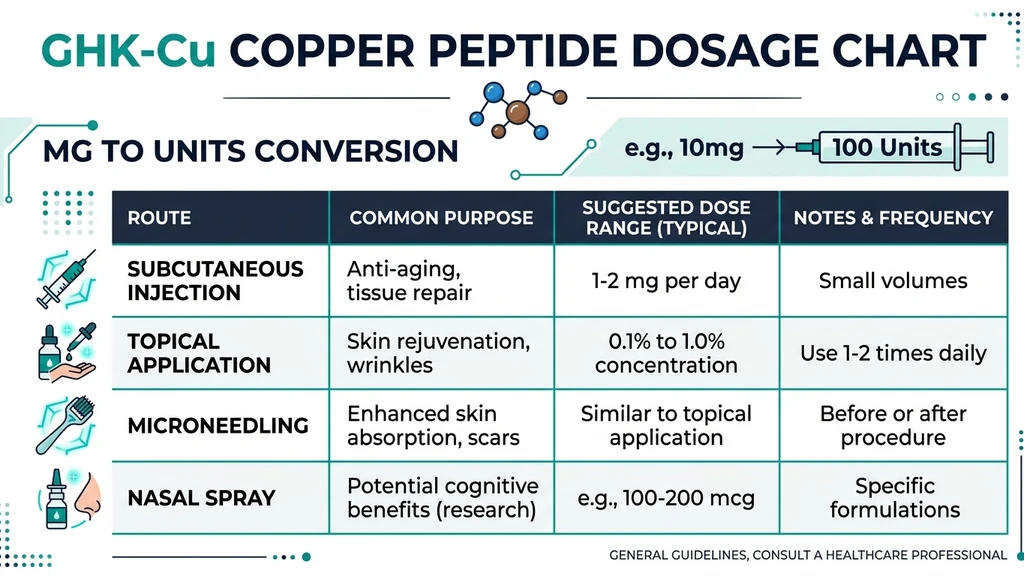
You have a vial of GHK-Cu on the counter, an insulin syringe in hand, and a label that lists milligrams while the syringe only shows units. You want one number to draw, not an essay. The standard GHK-Cu (copper tripeptide-1) dose is 1 to 2 mg subcutaneously once daily, five days per week, in cycles of 4 to 12 weeks. Topical use runs 1 to 3 percent concentration, and microneedling uses roughly 50 to 200 mcg per scalp session. Your exact syringe units depend on how you reconstitute the vial.
| Route | Standard Dose | Frequency |
|---|---|---|
| Subcutaneous injection | 1-2 mg/day | 5 days/week, 4-12 wk cycle |
| Topical serum or cream | 1-3% concentration | 1-2x daily |
| Microneedling / intradermal | 50-200 mcg/session | Weekly to bi-weekly, then monthly |
| Nasal | Low, undefined | Limited evidence |
The route you pick changes everything about the number. A 1 mg subcutaneous dose, a 2 percent topical serum, and a 100 mcg microneedling split are three different math problems with the same molecule. The full master chart below puts all four routes in one place, and the mg-to-units reconstitution table translates milligrams into the units you actually draw. These are research-context ranges, not prescriptions.
Get your custom peptide protocol:
- Tailored to your body and goals
- Precise dosing and cycle length
- Safe stacking combinations
- Backed by peer-reviewed studies
- Ready in under 2 minutes
GHK-Cu Dosage Chart at a Glance
This is the master chart. Every common GHK-Cu route, goal, dose, and frequency in one block, with the syringe-draw note pointing to the reconstitution sub-table below.
| Route | Goal | Typical Dose | Frequency | Units to Draw |
|---|---|---|---|---|
| Subcutaneous | Skin rejuvenation | 1 mg/day | 5 days/week, 4-12 wk cycle | See reconstitution table |
| Subcutaneous | Hair growth | 2 mg/day | 5 days/week, 8-12 wk cycle | See reconstitution table |
| Subcutaneous | Wound healing / recovery | 2-3 mg/day | Daily, cycle to goal | See reconstitution table |
| Subcutaneous | Beginner / titration | 1.0 to 2.0 mg ramp | See titration note | See reconstitution table |
| Topical (serum/cream) | Anti-aging skin | 1-3% concentration | 1-2x daily | Not applicable |
| Topical (clinical) | Stubborn photoaging | up to 5% | 1x daily, watch irritation | Not applicable |
| Microneedling / intradermal | Hair loss (scalp) | 50-200 mcg/session | Weekly-biweekly, then monthly | Per-session split |
| Post-microneedling serum | Penetration boost | 0.05% serum | Immediately after needling | Not applicable |
| Nasal | Experimental | Low / undefined | Limited evidence | See nasal guide |
The "units to draw" column is blank on purpose for injectable rows. You cannot know units until you know your concentration, and concentration depends on how much bacteriostatic water you added. The mg-to-units reconstitution table below fills that gap for both vial sizes. Treat every figure here as a research-context range drawn from published copper-peptide work and community protocols, not as medical advice.
Injectable (Subcutaneous) Dosing
Subcutaneous injection is the primary route for GHK-Cu when the goal is systemic skin, hair, or recovery support. The standard dose is 1 to 2 mg per day, with a working range of roughly 0.5 to 4 mg depending on goal and experience. Skin rejuvenation sits at the low end near 1 mg; hair growth and tissue recovery push toward 2 to 3 mg.
GHK was first isolated by Loren Pickart in 1973 from human plasma, and the copper-bound form drives the collagen and remodeling effects most users are after. In cultured fibroblasts and wound models, GHK-Cu stimulated collagen, glycosaminoglycans, and decorin, and increased expression of repair-associated genes (Pickart, Vasquez-Soltero & Margolina, 2015).
Most protocols run 5 days on, 2 days off, in cycles of 4 to 12 weeks. A longer alternative is 30 days on, 14 days off, repeated as needed. The off-period gives skin and copper homeostasis a reset before the next block.
Titration for first-timers. Start at 0.5 to 1 mg per day for the first week and watch the injection site. If you tolerate it, step up to your target dose in week two. The full GHK-Cu injection dosage protocol covers the ramp and rotation in detail, and how often to inject GHK-Cu explains the 5-on/2-off rhythm.
Always reconstitute with bacteriostatic water, never saline, and never sterile water for a multi-dose vial. The benzyl alcohol in bac water keeps the solution stable across repeated draws. See how to reconstitute GHK-Cu for the full mixing procedure, and where to inject GHK-Cu for site rotation.
Reconstitution mg-to-Units Chart
Here is the centerpiece sub-table. On a standard 100-unit (U-100) insulin syringe, 100 units equals 1 mL, so the conversion is always: units to draw = (dose in mg ÷ concentration in mg/mL) × 100.
| Vial Size | BAC Water Added | Concentration | 1 mg Dose | 2 mg Dose |
|---|---|---|---|---|
| 50 mg | 2 mL | 25 mg/mL | 4 units (0.04 mL) | 8 units (0.08 mL) |
| 50 mg | 3 mL | ~16.7 mg/mL | 6 units (0.06 mL) | 12 units (0.12 mL) |
| 50 mg | 5 mL | 10 mg/mL | 10 units (0.10 mL) | 20 units (0.20 mL) |
| 100 mg | 2 mL | 50 mg/mL | 2 units (0.02 mL) | 4 units (0.04 mL) |
| 100 mg | 3 mL | ~33.3 mg/mL | 3 units (0.03 mL) | 6 units (0.06 mL) |
| 100 mg | 5 mL | 20 mg/mL | 5 units (0.05 mL) | 10 units (0.10 mL) |
Read it like this. A 50 mg vial in 2 mL of bac water is 25 mg/mL, so a 1 mg dose is (1 ÷ 25) × 100 = 4 units. A 100 mg vial in 2 mL is 50 mg/mL, so the same 1 mg dose is only 2 units. Same milligrams, half the volume, because the second vial is twice as concentrated.
When your target draw lands at 10 units or below, switch to a 30-unit or 50-unit insulin syringe. The markings are wider and a 2-unit draw is far easier to read accurately. Run your own vial size and volume through the peptide reconstitution calculator, and convert any leftover mg-to-unit questions with the peptide unit converter. For a worked 50 mg example, see reconstituting a 50 mg GHK-Cu vial.
Topical Dosing (Creams and Serums)
Topical GHK-Cu skips the syringe entirely. Concentration is the dose, expressed as a percentage of the finished serum or cream. Cosmetic formulas run 1 to 3 percent, and clinical formulas reach up to 5 percent for stubborn photoaging.
Percent maps cleanly to milligrams. A 1 percent serum holds 10 mg of GHK-Cu per mL; a 2 percent serum holds 20 mg/mL; a 3 percent serum holds 30 mg/mL. Multiply the percentage by 10 to get mg per mL.
Irritation tracks concentration. Copper peptides can flush, sting, or trigger contact dermatitis as you climb past 2 to 3 percent, especially on sensitive or barrier-compromised skin. Start at 1 percent, use it for two weeks, then step up only if your skin stays calm. The GHK-Cu benefits overview covers what topical use realistically delivers, and GHK-Cu side effects covers the irritation pattern in full.
Microneedling and Intradermal Dosing
Microneedling pairs GHK-Cu with a dermaroller or dermapen to drive it past the stratum corneum. Scalp protocols for hair loss use roughly 50 to 200 mcg per session, weekly to bi-weekly during the active 8 to 12 week phase, then tapering to monthly maintenance.
The mechanism is timing. Needling opens microchannels that stay open for roughly 15 minutes, so a low-concentration serum applied immediately after needling reaches the dermis instead of sitting on the surface. A common pairing is a 0.05 percent GHK-Cu serum applied right after the pass.
Split the session dose across the treated area rather than concentrating it in one spot. The GHK-Cu microneedling protocol walks through needle depth, serum timing, and frequency, and GHK-Cu for hair growth covers how the scalp protocol fits the wider hair-loss picture.
Nasal Dosing
Nasal GHK-Cu is the least-studied route, and the evidence is thin. Doses are low and poorly defined, and there is no published clinical protocol that establishes a reliable nasal range.
Treat nasal use as experimental and lower-priority than the subcutaneous and topical routes that carry actual research behind them. If you are exploring it, the GHK-Cu nasal spray dosing guide covers the limited protocols and the open questions. For systemic skin and hair goals, subcutaneous injection remains the better-supported choice.
Dosing by Goal: Skin, Hair, and Wound Healing
The same molecule serves three goals at three different intensities. Matching the dose to the goal is the difference between under-dosing skin and over-dosing recovery.
| Goal | Route | Target Dose | Notes |
|---|---|---|---|
| Skin rejuvenation | Subcutaneous or 1-3% topical | ~1 mg/day | Lower end; collagen support |
| Hair growth | Subcutaneous + microneedling | 2 mg/day + 50-200 mcg/session | Combine routes for scalp |
| Wound healing / recovery | Subcutaneous | 2-3 mg/day | Higher end, daily through repair |
Skin rejuvenation is the gentlest target. Around 1 mg per day subcutaneously, or a 1 to 3 percent topical serum, supports the collagen and glycosaminoglycan production GHK-Cu is known for (Pickart et al., 2015).
Hair and wound healing push higher, toward 2 to 3 mg per day. Hair protocols often stack subcutaneous dosing with scalp microneedling. The GHK-Cu injection dosage protocol and GHK-Cu for hair growth cover the goal-specific tuning.
Cycle Length and Frequency
GHK-Cu is dosed in cycles, not indefinitely. Two patterns dominate. The standard cycle is 30 days on, 14 days off. The intensive cycle is 8 weeks on, 4 weeks off, for users pushing a specific goal.
Within a cycle, the common rhythm is 5 days on, 2 days off, which lands you near 20 to 22 dosing days per month. Once-daily dosing is standard. Some users split into a morning and evening dose, which does not change the total daily milligrams.
The off-weeks matter for copper balance and to read whether the results are holding. The GHK-Cu injection dosage protocol details cycle structure, and how long does reconstituted GHK-Cu last tells you whether your mixed vial survives a 14-day break in the fridge.
Safety, Side Effects, and FDA Status
No GHK-Cu product is FDA-approved for any medical use. Injectable copper-peptide vials are sold for research purposes only, and topical GHK-Cu is sold as a cosmetic ingredient, not a drug. State that plainly before you dose: there is no approved indication, dose, or manufacturing standard behind a research vial. See is GHK-Cu FDA-approved for the regulatory detail.
The most common adverse effects are local: injection-site stinging, redness, or bruising, and topical irritation that rises with concentration. Copper sensitivity exists, so a flush or rash after dosing is a signal to drop the dose or stop. The GHK-Cu side effects guide covers the full pattern.
The efficacy claims behind GHK-Cu, collagen synthesis, wound remodeling, and antioxidant gene expression, come from cell and animal work plus a body of cosmetic research, not large human dosing trials (Pickart et al., 2015). Frame your dose as research-context, keep it conservative, and consult a licensed provider before injecting anything.
Frequently Asked Questions
What is the standard GHK-Cu injection dose?
The standard GHK-Cu injection dose is 1 to 2 mg subcutaneously once daily, five days per week. Most cycles run 4 to 12 weeks, with skin goals near 1 mg and hair or recovery goals near 2 to 3 mg. See the full GHK-Cu injection dosage protocol for the titration ramp and rotation.
How many units of GHK-Cu is 1 mg?
It depends on reconstitution. A 50 mg vial in 2 mL of bacteriostatic water makes 1 mg equal 4 units on a U-100 syringe; a 100 mg vial in 2 mL makes 1 mg equal 2 units. Confirm your own vial with the peptide reconstitution calculator.
How much bacteriostatic water do I add to a 50 mg GHK-Cu vial?
Adding 2 mL gives 25 mg/mL and clean unit math, so 1 mg equals 4 units. Use 3 to 5 mL if you want a larger, easier-to-read draw. Always use bacteriostatic water, never saline. The reconstituting a 50 mg GHK-Cu vial guide walks through it.
What concentration should a topical GHK-Cu serum be?
A 1 to 3 percent concentration is standard for cosmetic GHK-Cu use, where 1 percent equals 10 mg per mL. Clinical formulas reach 5 percent, but irritation rises as you climb. Start at 1 percent and step up slowly. See GHK-Cu side effects for the irritation pattern.
What is the GHK-Cu dose for hair growth?
Injectable users target around 2 mg per day, five days a week, for 8 to 12 weeks. Microneedling protocols use 50 to 200 mcg per scalp session, weekly to bi-weekly during the active phase. Many stack both routes. The GHK-Cu microneedling protocol covers the scalp method.
How long should a GHK-Cu cycle last?
Common cycles are 30 days on and 14 days off, or 8 weeks on and 4 weeks off for intensive use. Within a cycle, most users dose 5 days on, 2 days off. The off-weeks support copper balance. See how often to inject GHK-Cu for the weekly rhythm.
Is GHK-Cu FDA-approved?
No. No injectable or topical GHK-Cu product is FDA-approved for any medical use. Injectable vials are sold for research only, and topical GHK-Cu is a cosmetic ingredient, not a drug. The is GHK-Cu FDA-approved guide covers the regulatory status in full.
Should I dose GHK-Cu once or twice a day?
Once daily is the standard for GHK-Cu. Some users split the dose into a morning and evening injection, which does not change the total daily milligrams you take. Stick to your target mg per day either way. The GHK-Cu injection dosage protocol covers timing options.
The Bottom Line
The standard GHK-Cu dose is 1 to 2 mg subcutaneously once daily, five days per week, in cycles of 4 to 12 weeks. Topical use runs 1 to 3 percent concentration, and microneedling uses 50 to 200 mcg per scalp session. Your syringe units come straight from your reconstitution: 1 mg is 4 units from a 50 mg vial in 2 mL, or 2 units from a 100 mg vial in 2 mL.
The route sets the math. Concentration is the topical dose, milligrams are the injectable dose, and a U-100 syringe converts the two with one formula: units = (mg ÷ mg/mL) × 100. No GHK-Cu product is FDA-approved, so keep every dose in the research-context range and verify it against your own vial.
Run your numbers through the peptide reconstitution calculator, check any leftover conversions with the peptide unit converter, and read the wider peptide dosage chart for cross-peptide context. Learn more at peptidesexplorer.com.
This is educational content, not medical advice. Consult a licensed healthcare provider before injecting any peptide.
Related Articles: - GHK-Cu Injection Dosage Protocol - How to Reconstitute GHK-Cu - Reconstituting a 50 mg GHK-Cu Vial - GHK-Cu Microneedling Protocol - GHK-Cu Side Effects - GHK-Cu Benefits
Related Articles
Kisspeptin Dosage: Every Human Study Dose Explained
Kisspeptin dosage from human trials: KP-10 at 0.01-3 mcg/kg, KP-54 at 3.2-12.8 nmol/kg. Doses for men and women, mcg conversions, and why they desensitize.
Ipamorelin Dosage: Solo Protocols, Timing & Unit Math
Ipamorelin dosage: 200-300 mcg subcutaneous, 1-3x daily, bedtime fasted. Charts by goal and weight, saturation dose, reconstitution units, safety data.
Epitalon Dosage: Khavinson Protocol, Cycles & Unit Math
Epitalon dosage: 5-10 mg/day subcutaneous for 10-20 days, 1-2 courses per year. Khavinson protocol, reconstitution units for 10-50 mg vials, evidence review.
HGH Fragment 176-191 Dosage: What Research Supports
HGH Fragment 176-191 dosage: 250-500 mcg/day subcutaneous, fasted, 8-12 week cycles. Unit math for 2 mg and 5 mg vials, rodent vs human evidence, safety.