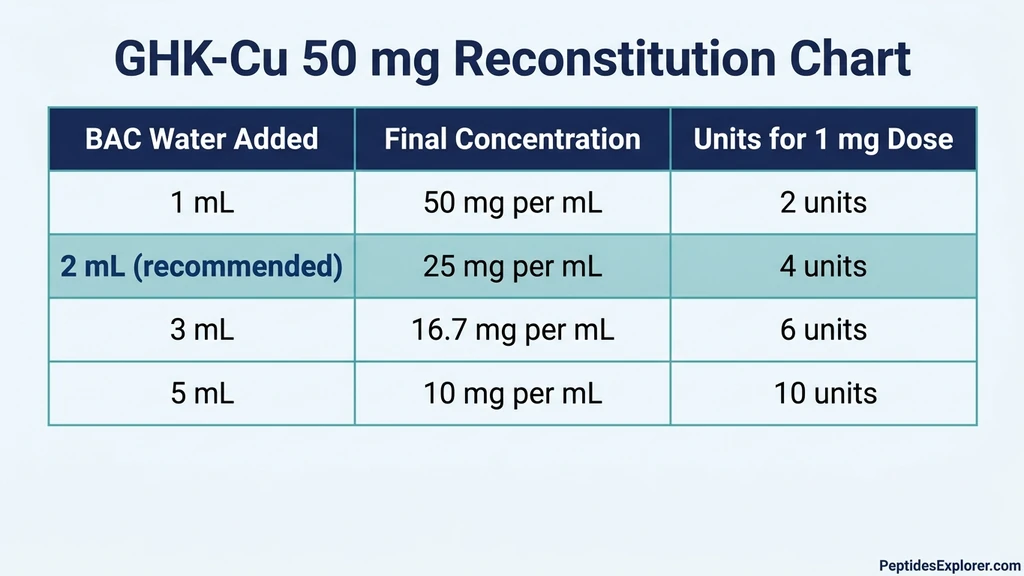
Your 50mg GHK-Cu vial arrived and the instructions stopped at "add bacteriostatic water." That leaves out the part that actually matters: how much water, what concentration it produces, and how many units to draw for a 1mg or 2mg dose. For a 50mg GHK-Cu vial, the cleanest reconstitution is 2 mL of bacteriostatic water, which produces a 25 mg/mL solution. At that concentration, 1 mg = 4 units and 2 mg = 8 units on a standard U-100 insulin syringe. If you want a lower concentration that is easier to read on the syringe, add 5 mL of BAC water instead for a 10 mg/mL solution where 1 mg = 10 units.
| BAC Water Added | Final Concentration | 1 mg Dose | 2 mg Dose | 3 mg Dose |
|---|---|---|---|---|
| 1 mL | 50 mg/mL | 2 units | 4 units | 6 units |
| 2 mL (recommended) | 25 mg/mL | 4 units | 8 units | 12 units |
| 3 mL | 16.67 mg/mL | 6 units | 12 units | 18 units |
| 5 mL | 10 mg/mL | 10 units | 20 units | 30 units |
50mg is a larger-than-average GHK-Cu vial. Most entry-level copper peptide protocols use 10mg or 30mg vials. A 50mg vial is typically purchased for intensive multi-month skin or wound-healing protocols, or to reduce cost per milligram on a longer cycle. The tradeoff: the vial is dense enough that your reconstitution math needs to be right the first time, because a miscount at 25 mg/mL produces a much bigger dose error than the same miscount at 2 mg/mL.
This is educational content. Consult a healthcare provider before starting any peptide protocol.
Get your custom peptide protocol:
- Tailored to your body and goals
- Precise dosing and cycle length
- Safe stacking combinations
- Backed by peer-reviewed studies
- Ready in under 2 minutes
The 2 mL Reconstitution: Why It Is the Default for 50mg
Adding 2 mL of bacteriostatic water to a 50mg GHK-Cu vial is the reconstitution volume most experienced users land on. Here is why.
The math works out cleanly. 50 mg divided by 2 mL equals 25 mg per mL. On a U-100 insulin syringe (where 100 units = 1 mL), each unit holds 0.25 mg of GHK-Cu. A 1 mg dose is 4 units. A 2 mg dose is 8 units. A 3 mg dose is 12 units. These are whole numbers that land on printed tick marks, not fractional draws between lines.
The vial geometry cooperates. Most 50mg GHK-Cu vials are supplied in 3 mL glass vials. Adding 2 mL of diluent leaves about 1 mL of headspace, which is enough to avoid pressure issues when you invert the vial but not so much that the powder fails to fully dissolve when you gently swirl.
The concentration is manageable. At 25 mg/mL, a typical 1-2 mg dose translates to 4-8 units. That is well within the readable range of a standard U-100 insulin syringe, with enough precision that small variations (one or two units) do not meaningfully change the delivered dose.
Alternative: 5 mL for easier reading. If you prefer a more dilute solution where 1 mg equals 10 units (a round number and easier to eyeball on the syringe), add 5 mL of BAC water instead. This produces 10 mg/mL. The tradeoff: your vial must be large enough to hold 5 mL plus the lyophilized powder. Most 50mg vials are 3 mL glass and will not accommodate 5 mL without overflow. Check your vial size before choosing this volume.
Use the peptide reconstitution calculator to verify concentration and unit counts for any volume you pick. For general principles across peptides, see how to reconstitute GHK-Cu.
Step-by-Step: Reconstituting a 50mg GHK-Cu Vial
Supplies to have ready: - 1 vial of GHK-Cu 50mg (lyophilized powder) - 1 vial of bacteriostatic water (not sterile water; see bacteriostatic water vs sterile water) - 1 mL U-100 insulin syringe with 29 to 31-gauge needle (for drawing diluent) - Alcohol prep pads - Clean work surface
Procedure:
- 1.Let both vials reach room temperature. Cold BAC water can cause condensation around the stopper and make the draw less clean.
- 1.Wipe the stopper of both vials with alcohol pads. Let dry for 10 seconds.
- 1.Draw 2 mL (200 units on a U-100 syringe, or a full 1 mL syringe drawn twice) of bacteriostatic water. If using a single 1 mL syringe, you will need to draw and inject the water into the GHK-Cu vial in two passes.
- 1.Angle the needle against the inside wall of the GHK-Cu vial (not directly onto the powder). Slowly push the water down the glass wall. This prevents foaming, which can damage the peptide.
- 1.Do NOT shake the vial. Swirl gently or let it sit for 30-60 seconds. The powder should dissolve into a clear blue or turquoise solution. See the color check section below.
- 1.Inspect for particulates. A properly reconstituted 50mg GHK-Cu solution should be clear with no floating particles and a characteristic blue-green color.
- 1.Label the vial with the reconstitution date, concentration (25 mg/mL at 2 mL), and discard date (28 days from reconstitution under refrigeration).
- 1.Store in the refrigerator (2 to 8 degrees Celsius / 36 to 46 Fahrenheit).
For complete injection technique and site rotation, see how to inject peptides and where to inject GHK-Cu.
The Color Check: Blue Means Good
GHK-Cu is the only common research peptide that arrives as a colored powder. The "Cu" stands for copper, and the peptide is always supplied as a copper complex. Properly manufactured GHK-Cu has a distinct blue-green or turquoise color in both powder and reconstituted forms. The tripeptide glycyl-L-histidyl-L-lysine has a high natural affinity for divalent copper, with histidine and lysine residues coordinating the Cu(II) ion to form the active GHK-Cu complex (Pickart et al., 2018).
What the color tells you:
- Bright blue or turquoise: Correct. The copper is coordinated with the tripeptide (glycyl-L-histidyl-L-lysine) as intended.
- Pale blue or almost colorless: Possibly under-copper-loaded or degraded. Contact your supplier before injecting.
- Dark blue or purple: Unusual. Could indicate higher copper saturation than expected, or contamination. Do not inject without verification.
- Clear (no color): This is NOT GHK-Cu. If the powder reconstitutes to a clear colorless solution, you likely have plain GHK (no copper) or a different peptide entirely. Do not inject.
After reconstitution, the blue color should persist for the entire usable life of the vial. If the solution becomes noticeably paler over time or develops a brownish tint, the peptide may be degrading. Discard and start a new vial.
Why this matters more at 50mg than at 10mg: A 50mg vial has a more saturated color than a smaller vial. If your 50mg vial looks "light blue," compare against a photo from your supplier at the time of shipment. A 50mg vial reconstituted in 2 mL should look quite saturated, similar to a dark aquamarine.
For full shelf-life details, see how long does GHK-Cu last and how long reconstituted peptides last.
Dosing From a 50mg Vial: Typical Protocols
A 50mg GHK-Cu vial is sized for multi-month protocols. At typical doses of 1-2 mg per injection, you have enough peptide for 25-50 doses.
Standard dosing ranges:
- Skin / cosmetic: 1-2 mg subcutaneous, 3-5x per week
- Hair restoration adjunct: 1-2 mg near the scalp perimeter, 3x per week
- Wound healing / tissue repair: 1-3 mg near the affected area, daily for 1-2 weeks then tapered. The wound-healing rationale traces to early work showing GHK-Cu stimulates collagen synthesis and glycosaminoglycan production in dermal fibroblasts (Maquart et al., 1988).
- Systemic anti-inflammatory: 2-3 mg subcutaneous, 3-4x per week. GHK-Cu also modulates expression of antioxidant enzymes and tissue remodeling factors that underpin its broader regenerative profile (Pickart, 2008).
Cycle math for 50mg at 25 mg/mL (2 mL reconstitution):
- 1 mg dose, 3x per week: 50 doses = ~16 weeks of supply
- 2 mg dose, 3x per week: 25 doses = ~8 weeks of supply
- 2 mg dose, 5x per week: 25 doses = 5 weeks of supply
Reconstituted GHK-Cu has a 28-day refrigerated shelf life, so a single 2 mL reconstitution may not cover a 16-week cycle. Most users consume a reconstituted 50mg vial within the 28-day window by dosing 3-5x per week.
For frequency guidance, see GHK-Cu injection frequency. For dose selection by goal, see GHK-Cu injection dosage.
Storage and Handling After Reconstitution
Once the 50mg vial is reconstituted, the clock starts.
Temperature: Refrigerated between 2 and 8 degrees Celsius (36-46 Fahrenheit). Do not freeze. Freezing can damage the peptide structure and cause particulate formation.
Light: Keep in the original amber glass vial or in a dark container. Copper peptides are mildly photosensitive.
Duration: 28 days refrigerated is the standard conservative limit. Past 28 days you are outside the well-characterized stability window.
Transport: Use an insulated cooler with ice packs (not frozen packs touching the vial). Short exposures to room temperature are acceptable; repeated warming/cooling cycles are not.
Signs the peptide has degraded: fading of the blue color, brownish tint or precipitate, cloudiness, or ineffectiveness after previously working doses. If any appear, discard the vial.
For shelf life details across peptides, see how long reconstituted peptides last and how long does GHK-Cu last.
Common Mistakes With 50mg Reconstitution
A 50mg GHK-Cu vial is concentrated enough that small errors compound fast. The recurring mistakes:
Using 1 mL of BAC water instead of 2 mL. Produces a 50 mg/mL solution where 1 mg is only 2 units. A 1-unit miscount represents a 50% dose change.
Shaking the vial. Vigorous shaking introduces air bubbles and shear stress that can degrade the peptide. Swirl gently instead.
Using sterile water instead of bacteriostatic water. Sterile water lacks the benzyl alcohol preservative; you get roughly 24 hours of stability instead of 28 days. See bacteriostatic water vs sterile water.
Injecting water directly onto the powder. Causes foaming. Angle the needle against the glass wall.
Calculating as if the concentration is 25 mg/mL when you actually used 1 mL of water. Your 4-unit draw delivers 2 mg instead of 1 mg. Re-check the label.
Not labeling the vial. 28 days is easy to miscount. Write the date the same minute you finish reconstituting.
Freezing the reconstituted vial. Freezing destroys the peptide-copper complex. Refrigerate only.
For dose safety and adverse effect profile, see GHK-Cu side effects.
Frequently Asked Questions
How much bacteriostatic water should I add to a 50mg GHK-Cu vial?
2 mL is the standard recommended volume. This produces a 25 mg/mL solution where 1 mg = 4 units and 2 mg = 8 units on a U-100 insulin syringe. Some users prefer 5 mL (for a 10 mg/mL solution where 1 mg = 10 units), but this requires a vial large enough to hold 5 mL. For principles, see how to reconstitute GHK-Cu.
How many units is 1 mg of GHK-Cu from a 50mg vial reconstituted with 2 mL?
4 units on a U-100 insulin syringe. At 25 mg/mL, every unit (0.01 mL) contains 0.25 mg of peptide. A 1 mg dose therefore requires 4 units. A 2 mg dose requires 8 units. See the peptide reconstitution calculator for any other volume.
What color should reconstituted 50mg GHK-Cu be?
Bright blue or turquoise. The copper in GHK-Cu gives the solution a characteristic aquamarine color. A 50mg vial reconstituted in 2 mL will appear highly saturated. If the solution is colorless or very pale, the product may not be genuine GHK-Cu or may have degraded. See GHK-Cu side effects for warnings.
Can I use sterile water to reconstitute 50mg GHK-Cu?
Technically yes, but you lose the 28-day refrigerated shelf life. Sterile water has no preservative; reconstituted peptides are good for about 24 hours refrigerated. Bacteriostatic water contains 0.9% benzyl alcohol which prevents microbial growth and extends usability. Use BAC water for any multi-dose vial. See bacteriostatic water vs sterile water.
How long does reconstituted 50mg GHK-Cu last in the fridge?
28 days refrigerated at 2-8 degrees Celsius, assuming reconstitution with bacteriostatic water and protection from light. Label the vial with the reconstitution date and discard after 28 days even if peptide remains. See how long reconstituted peptides last.
What syringe size do I need for 50mg GHK-Cu at 25 mg/mL?
A standard 1 mL (100-unit) U-100 insulin syringe with a 29 to 31-gauge, 5/16-inch needle is sufficient for subcutaneous injection. Typical draws at this concentration are 4-12 units (for 1-3 mg doses), well within the syringe's range. For injection site guidance, see where to inject GHK-Cu.
Should I split a 50mg vial into two reconstitutions?
Only if you dose infrequently and cannot finish the vial within 28 days. Splitting means drawing out half the powder, but peptide powder is difficult to accurately partition. A cleaner approach is to time your 50mg reconstitution with an active 3-5x per week protocol so you consume the vial within the 28-day window. For frequency guidance, see GHK-Cu injection frequency.
Is a 50mg GHK-Cu vial stronger than a 10mg vial?
No. The peptide molecule is identical. A 50mg vial simply contains more total peptide. You can make any concentration by choosing your reconstitution volume. The per-dose strength depends on how many milligrams you draw, not vial size. A 50mg vial is more cost-effective per milligram for users running multi-month protocols. See GHK-Cu injection dosage.
The Bottom Line
A 50mg GHK-Cu vial reconstitutes cleanly with 2 mL of bacteriostatic water to produce a 25 mg/mL solution. At that concentration, 1 mg = 4 units, 2 mg = 8 units, and 3 mg = 12 units on a U-100 insulin syringe. These are whole-number draws that land on printed tick marks, which is the main reason this volume is the default. If you need lower concentration for easier unit counting, 5 mL of BAC water gives 10 mg/mL (1 mg = 10 units), but requires a larger vial.
The rules that matter: use bacteriostatic water (not sterile water), swirl instead of shaking, verify the solution is bright blue-green (the copper color check), label the vial with the reconstitution date, and store refrigerated for up to 28 days. A 50mg vial lasts 5-16 weeks depending on dosing frequency, which means you should time your reconstitution with an active protocol rather than reconstituting speculatively.
For the calculator, use the peptide reconstitution calculator. For the companion guides, see how to reconstitute GHK-Cu, GHK-Cu injection dosage, and how to inject peptides.
Related Articles: - How to Reconstitute GHK-Cu - GHK-Cu Injection Dosage - GHK-Cu Injection Frequency - How Long Does GHK-Cu Last - Where to Inject GHK-Cu - Bacteriostatic Water vs Sterile Water - How to Inject Peptides - GHK-Cu Side Effects
Related Articles
How to Inject Peptides: Full Guide
How to inject peptides subcutaneously and intramuscularly: supplies, needle gauge, injection sites, sterile technique, and site rotation.
How to Inject BPC-157: Sites & Guide
How to inject BPC-157 subcutaneously: step-by-step technique, injection site selection by injury, needle gauge, reconstitution, and sterile protocol.
How to Reconstitute GHK-Cu: Guide
How to reconstitute GHK-Cu step by step for 50mg and 100mg vials. Concentration table, bacteriostatic water volumes, syringe units, and storage instructions.
GHK-Cu Dosage: Protocols & Charts
GHK-Cu dosage guide with injection protocols by goal (skin, hair, healing), reconstitution steps, dosage charts, side effects, and before/after timeline.