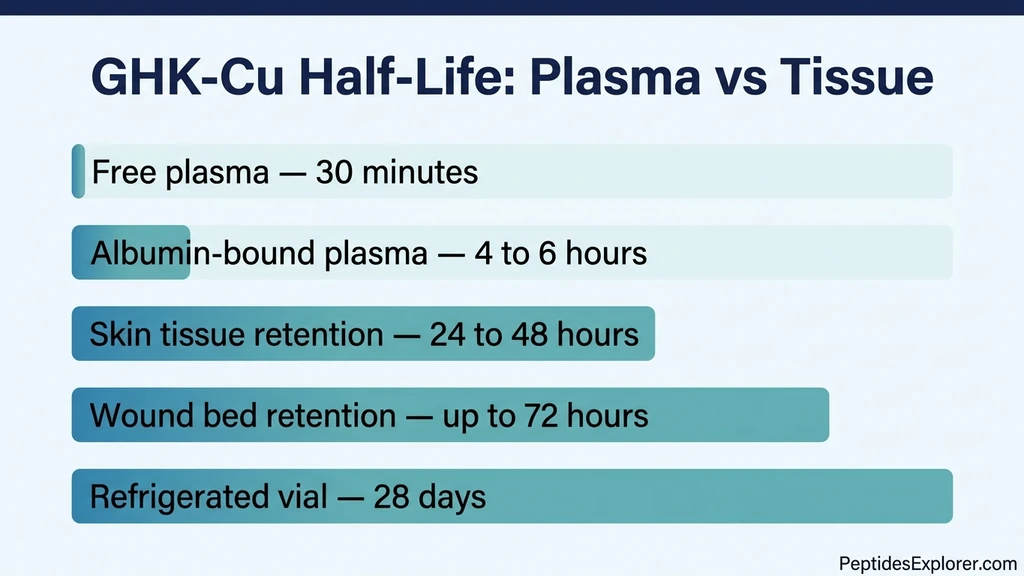
You just injected 1 mg of GHK-Cu and you are wondering how long it actually stays in your body. The plasma number on a pharmacokinetics chart is going to disappoint you. Free GHK-Cu has a plasma half-life of only about 30 minutes. But that number is misleading. Once GHK-Cu reaches tissue, it binds albumin and is retained at active sites for 24 to 48+ hours. That tissue-level retention is what drives clinical effect, not the plasma concentration. This is why once-daily dosing works despite the short plasma half-life, and why you do not feel "wear-off" symptoms between doses.
| Quick Reference | Duration |
|---|---|
| Plasma half-life (free GHK-Cu) | ~30 minutes |
| Plasma half-life (albumin-bound) | 4 to 6 hours |
| Tissue retention (skin, connective tissue) | 24 to 48+ hours |
| Peak plasma after SC injection | 30 to 60 minutes |
| Clinical effect duration (one injection) | 24 to 48 hours |
| Topical skin penetration duration | 8 to 24 hours |
| Reconstituted vial (refrigerated) | 28 days |
| Reconstituted vial (room temperature) | 24 to 48 hours |
| Unreconstituted lyophilized vial | 2+ years |
The gap between plasma and tissue pharmacokinetics is the single most important thing to understand about GHK-Cu dosing. For the full dosage protocol and injection schedule, see our GHK-Cu dosage guide. For injection frequency specifics, see GHK-Cu injection frequency.
This is educational content. Consult a healthcare provider before starting any peptide.
Get your custom peptide protocol:
- Tailored to your body and goals
- Precise dosing and cycle length
- Safe stacking combinations
- Backed by peer-reviewed studies
- Ready in under 2 minutes
GHK-Cu Plasma Half-Life: The 30-Minute Number
Free GHK-Cu circulating in plasma has a half-life of approximately 30 minutes. Plasma levels of GHK decline from approximately 200 ng/mL at age 20 to 80 ng/mL by age 60, which parallels the decline in tissue regenerative capacity (Pickart, 2008). If you stopped the story here, you would conclude that GHK-Cu is a peptide that flashes through the bloodstream and vanishes. That is not how the molecule actually behaves.
The 30-minute figure applies to the free, unbound tripeptide in plasma. In reality, most of the injected GHK-Cu rapidly binds to albumin and other plasma proteins. Albumin itself has a half-life of 19 to 21 days, and when a small peptide hitches a ride on albumin, its effective circulating half-life extends to 4 to 6 hours before it distributes into tissue.
Peak plasma concentration after a subcutaneous injection is reached at 30 to 60 minutes. The peptide then redistributes from blood to target tissues (skin, dermal fibroblasts, wound sites, connective tissue) over the next 2 to 4 hours. By 6 hours post-injection, plasma levels are minimal but tissue-level GHK-Cu is high and working.
This distribution pattern is why blood tests are useless for monitoring GHK-Cu therapy. The peptide is not supposed to be in your blood 8 hours after injection. It is supposed to be in your skin, your tendons, your wound bed, doing its work.
Why Tissue Half-Life Matters More Than Plasma Half-Life
GHK-Cu acts locally. Its job is to bind copper in a specific, bioavailable form and deliver it to copper-dependent enzymes at the cellular level. Lysyl oxidase needs copper to cross-link collagen. Superoxide dismutase (SOD) needs copper to neutralize free radicals. Cytochrome c oxidase needs copper for mitochondrial energy production. GHK-Cu stimulates collagen synthesis in fibroblasts at concentrations as low as 10^-12 M, with maximal stimulation at 10^-9 M (Maquart et al., 1988).
The tripeptide-copper complex delivers copper where it needs to go, then gets recycled back to plasma or degraded by peptidases. This recycling is what produces the 24 to 48-hour effective window.
Skin and dermal tissue: GHK-Cu is retained at active fibroblasts for 24 to 48 hours after a single dose. This is why daily injection (or injection every 48 hours for maintenance) works. Collagen synthesis stimulation continues long after plasma levels are undetectable.
Wound beds and connective tissue: Retention is even longer at sites of active repair. GHK-Cu has been documented to drive angiogenesis signaling and tissue regeneration at wound sites for prolonged periods after a single application (Pickart & Margolina, 2018).
Hair follicles: Retention time parallels the follicular growth cycle. Topical GHK-Cu applied at bedtime remains bioavailable to hair bulb cells through the anagen phase proliferation window. See GHK-Cu hair growth for the full hair protocol.
Liver and kidney: GHK-Cu is cleared primarily by hepatic peptidases. A small fraction is renally excreted unchanged. Elimination is essentially complete within 24 hours.
The practical implication: even if you miss a dose by 24 hours, therapeutic tissue levels are still active. You do not need to "catch up" or double-dose.
How Half-Life Affects Injection Frequency
The tissue half-life window is the reason standard GHK-Cu protocols run once-daily (or 5-days-on, 2-days-off) rather than more frequent dosing.
Daily injection (1 to 2 mg SC): The standard protocol for skin rejuvenation, hair growth, and general anti-aging. Tissue levels build to steady state within 5 to 7 days. This is the default.
Every-other-day (2 mg SC): A valid alternative that leverages the 48-hour tissue retention window. Slightly cheaper (fewer injections, same total weekly dose) and equally effective for chronic maintenance. Used by people who dislike daily injections.
Twice-daily dosing (splitting the daily dose): Not standard and not needed for most applications. The only context where BID GHK-Cu makes sense is acute wound healing or post-surgical recovery where sustaining maximal tissue concentration matters more than convenience.
Frequency should match your goal, not the plasma half-life. For skin, daily is enough. For acute tendon injury, daily or BID during the first 2 weeks then taper. For chronic anti-aging, daily or every-other-day indefinitely. See GHK-Cu injection frequency for the full frequency-by-goal breakdown.
What does not work: Stacking 2 mg + 2 mg twice-daily thinking it will double the effect. Receptor saturation at the fibroblast level occurs around 1 to 2 mg equivalent. Anything above that does not produce proportionally more collagen synthesis; it just increases injection volume and cost.
Topical GHK-Cu Half-Life on Skin
Topical GHK-Cu (serums, creams, and microneedling-delivered formulations) behaves differently than injectable. The peptide is delivered directly to the stratum corneum and penetrates through the epidermis to the dermis where fibroblasts live.
Skin retention duration: A properly formulated topical GHK-Cu serum provides 8 to 24 hours of bioavailable peptide at the fibroblast level after a single application. Nighttime application maximizes the 6 to 8-hour uninterrupted contact window.
Penetration time to dermis: 30 to 90 minutes for standard serum formulations. Faster with penetration enhancers (hyaluronic acid, DMSO) or mechanical disruption (microneedling). Slower if applied under heavy occlusive moisturizers.
Why evening application wins: Mitotic and repair activity in skin peaks between 10 PM and 2 AM. Applying GHK-Cu at bedtime aligns peptide retention with peak fibroblast activity. See GHK-Cu microneedling for how mechanical delivery extends effective dosing windows.
Formulation pH matters: GHK-Cu is most stable between pH 6.5 and 7.5. Acidic serums (vitamin C, AHAs) degrade the copper-peptide bond within hours. If you use both, apply GHK-Cu first, wait 15 minutes, then layer the acidic actives.
Sunscreens interfere. Zinc oxide and avobenzone disrupt the copper-peptide coordination. Morning topical GHK-Cu application under sunscreen wastes the product. Evening is the only effective topical window.
Reconstituted Vial Stability (Your Other Half-Life Question)
When people ask "how long does GHK-Cu last," they sometimes mean vial stability rather than in-body pharmacokinetics. Both matter.
Unreconstituted lyophilized GHK-Cu: 2+ years at room temperature if kept dry and dark. Lyophilized (freeze-dried) peptide is extremely stable. Most vials ship with a 2-year expiration date, but peptide integrity often exceeds that. Light and humidity are the enemies.
Reconstituted with bacteriostatic water, refrigerated: 28 days is the conservative estimate used by most providers. Real-world stability data suggests 30 to 60 days without significant degradation when stored at 2 to 8 degrees Celsius in the original vial.
Reconstituted with sterile water (not bacteriostatic): 24 to 48 hours maximum. Sterile water has no preservative. Bacterial growth and peptide degradation accelerate after the first day. Use sterile water only if you plan to finish the vial within 48 hours, otherwise bacteriostatic water is standard. See bacteriostatic water vs sterile water.
Reconstituted and left at room temperature: 24 to 48 hours is the maximum. The copper-peptide bond is heat-sensitive. A vial left on the counter degrades faster than one in the fridge. Discard any reconstituted vial that has been unrefrigerated for more than 48 hours.
How to tell if a reconstituted vial has gone bad: GHK-Cu has a characteristic blue color (copper). A properly reconstituted solution is pale blue and clear. If the solution turns dark blue, cloudy, or develops visible particles, the peptide has degraded. Discard.
For the complete reconstitution protocol with volume ratios and syringe sizing, see how to reconstitute GHK-Cu and how long do reconstituted peptides last.
What the Short Plasma Half-Life Means for Side Effects
The 30-minute plasma half-life has an upside: systemic side effects resolve quickly. Any transient reaction to injection (mild flushing, temporary fatigue, injection site sensation) peaks within 30 to 60 minutes and resolves within 2 to 4 hours.
What you might feel during peak plasma: - Mild warmth at injection site (vasodilation) - Brief metallic taste (some users, linked to copper) - Slight fatigue in the first week (rare, mechanism unclear)
What resolves within 4 hours: - All transient systemic effects - Injection site sensation (vasodilation-mediated)
What persists because it is tissue-level, not plasma-level: - Wanted effects: collagen synthesis, fibroblast activation, wound healing signals - Unwanted effects (at copper-sensitive individuals): theoretical copper accumulation with chronic high-dose use, though this is not documented in standard 1 to 2 mg daily protocols
The mismatch between plasma and tissue pharmacokinetics also explains why side effects from GHK-Cu are usually not dose-sensitive in the narrow therapeutic range. Doubling a 1 mg dose to 2 mg does not double the "felt" effects because receptor saturation occurs at tissue, not plasma.
For the full side effect profile and safety limitations, see GHK-Cu side effects.
Frequently Asked Questions
What is the half-life of GHK-Cu?
Free GHK-Cu has a plasma half-life of about 30 minutes. When bound to albumin, effective plasma half-life extends to 4 to 6 hours. Tissue retention at active sites (skin, connective tissue, wound beds) lasts 24 to 48+ hours. The tissue half-life is what determines clinical effect, not plasma.
Why does GHK-Cu work when its plasma half-life is only 30 minutes?
Because plasma is not where GHK-Cu acts. After injection, the peptide distributes to tissue within 2 to 4 hours and binds albumin locally. Tissue-level GHK-Cu remains bioavailable to fibroblasts for 24 to 48 hours. Clinical effect tracks tissue retention, not plasma concentration.
How often should I inject GHK-Cu given the short half-life?
Once daily is standard. The 24 to 48-hour tissue half-life means daily injection maintains steady therapeutic levels without stacking. Every-other-day dosing also works for chronic maintenance. BID dosing is rarely needed outside of acute wound protocols. See our GHK-Cu injection frequency guide for the full breakdown.
How long does reconstituted GHK-Cu last?
28 days refrigerated with bacteriostatic water (standard). Up to 60 days in real-world stability testing but 28 is the conservative recommendation. Only 24 to 48 hours if reconstituted with plain sterile water or left at room temperature. Color change from pale blue to dark or cloudy indicates degradation.
How long does topical GHK-Cu stay on skin?
8 to 24 hours of bioavailable peptide at the fibroblast level after a single application. Penetration to the dermis takes 30 to 90 minutes. Evening application maximizes the 6 to 8-hour overnight contact window when skin repair activity peaks. Sunscreens and acidic serums shorten effective retention. See GHK-Cu microneedling for enhanced delivery methods.
Can I blood-test my GHK-Cu levels?
No, and there is no reason to. Plasma levels drop rapidly after injection because GHK-Cu is supposed to be in tissue, not circulating. A blood test 8 hours post-injection would show nothing even during a fully effective protocol. Clinical response (skin changes, wound healing, visible results) is the only meaningful monitoring.
Does the short half-life mean I will feel GHK-Cu wear off between doses?
No. The tissue half-life of 24 to 48 hours means therapeutic effects are continuous. There is no withdrawal, crash, or wear-off sensation between daily doses. If you missed a dose by 24 to 48 hours and felt no change, that is normal and expected.
How long until I see results from GHK-Cu?
Skin improvements: 4 to 8 weeks of daily application for visible changes in texture and fine lines. Wound healing: 2 to 4 weeks for accelerated repair on acute injuries. Hair growth: 8 to 12 weeks of topical daily use for visible regrowth. Results track treatment duration more than plasma kinetics. For the complete timeline, see our GHK-Cu benefits guide.
The Bottom Line
GHK-Cu's 30-minute plasma half-life is the wrong number to focus on. What matters is tissue retention at active repair sites, which runs 24 to 48+ hours after a single dose. That is why daily (or every-other-day) dosing works, why you do not feel wear-off between doses, and why blood tests cannot monitor the peptide.
The practical rules follow from the pharmacokinetics. Inject daily for consistency, at the same time each day, ideally morning. Apply topical GHK-Cu at night so retention aligns with skin repair cycles. Reconstitute with bacteriostatic water and refrigerate for 28 days of usable vial life. Discard reconstituted solution after 48 hours at room temperature or if the blue color shifts to dark or cloudy.
For the complete dosage protocol across all goals (skin, hair, wound healing, stacking), see our GHK-Cu dosage guide. For injection frequency by use case, see GHK-Cu injection frequency. For reconstitution step-by-step, see how to reconstitute GHK-Cu. For safety limits and side effect profile, see GHK-Cu side effects and the peptide safety guide.
Related Articles: - GHK-Cu Dosage: Protocols & Charts - GHK-Cu Injection Frequency - How to Reconstitute GHK-Cu - GHK-Cu Hair Growth - GHK-Cu Side Effects - How Long Do Reconstituted Peptides Last
Related Articles
What Happens When You Stop Taking GHK-Cu
If you stop GHK-Cu: no true withdrawal. Benefits fade over 4-12 weeks. Hair changes fade first, collagen persists longest. Restart protocol.
How Long Does PT-141 Last? Full Timeline
PT-141 effects last 6-72 hours despite a 2.7-hour half-life. Onset at 30-45 min, peak at 1-3 hours, residual effects up to 72 hours. Full timeline.
Can Copper Peptides Cause Acne? Purge vs Breakout
Can copper peptides cause acne? GHK-Cu itself is not comedogenic. How to tell purging from a breakout or a copper allergy, who is prone, and a 6-week plan.
Semaglutide: How Long in Your System?
Semaglutide stays in your system for about 5 weeks after your last injection. Learn the 7-day half-life, elimination timeline, and factors affecting clearance.