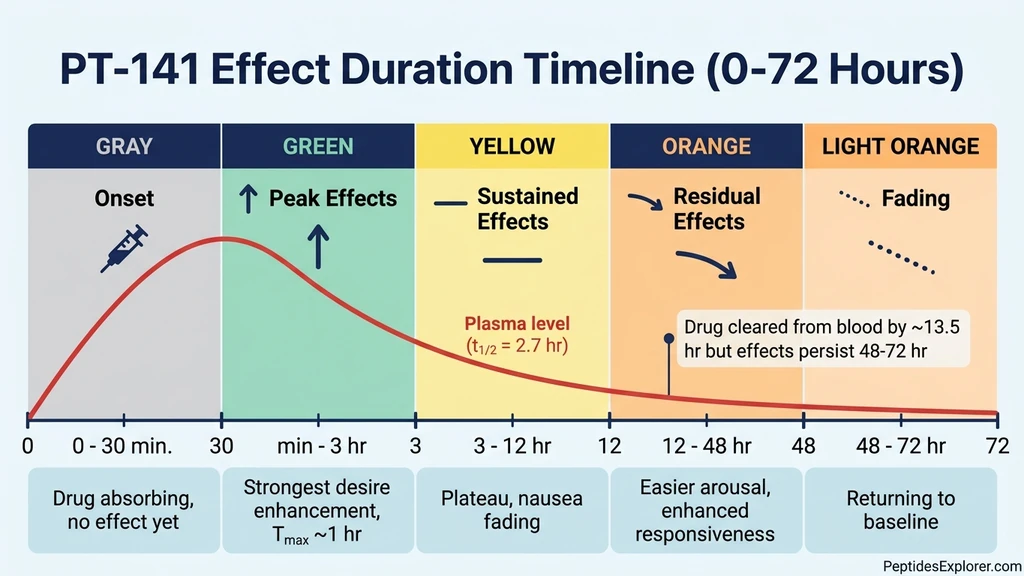
You injected 1.75 mg of PT-141 four hours ago and the effects are still building. Or you used it last night and feel heightened desire into the next afternoon. Both are normal. PT-141 (bremelanotide) effects last 6 to 72 hours, with most users experiencing peak effects for 4 to 8 hours and residual enhancement for 24 to 48 hours. The plasma half-life is only 2.7 hours, but receptor-level changes persist far longer than the drug itself.
| PT-141 Duration Summary | Timeline |
|---|---|
| Onset of effects | 30-45 minutes after injection |
| Peak effect window | 1-3 hours post-injection |
| Primary effect duration | 4-8 hours (most users) |
| Residual effects (enhanced desire) | 24-48 hours |
| Maximum reported duration | Up to 72 hours |
| Plasma half-life | 2.7 hours (range 1.9-4.0 hours) |
| Drug cleared from blood | ~13.5 hours (5 half-lives) |
| Reconstituted vial shelf life | 28 days refrigerated |
This is the dedicated deep-dive on PT-141 duration. For dosing protocols and reconstitution, see our PT-141 dosage guide. For male-specific clinical data, see PT-141 for men.
This is educational content. Consult a healthcare provider before starting any medication.
Get your custom peptide protocol:
- Tailored to your body and goals
- Precise dosing and cycle length
- Safe stacking combinations
- Backed by peer-reviewed studies
- Ready in under 2 minutes
PT-141 Effect Duration Timeline
The gap between PT-141's short half-life and its long-lasting effects confuses most users. The timeline below maps what happens at each stage after a standard 1.75 mg subcutaneous injection.
| Time After Injection | What Happens | Plasma Level |
|---|---|---|
| 0-30 minutes | Drug absorbing; no noticeable effect yet | Rising toward peak |
| 30-60 minutes | First effects: warmth, subtle shift in desire | Approaching Cmax |
| 1-3 hours | Peak effect: strongest desire enhancement, possible nausea | At Tmax (~1 hour), then declining |
| 3-6 hours | Effects plateau; nausea fading if present | Dropping below 50% of peak |
| 6-12 hours | Sustained desire enhancement; physical sensitivity heightened | Below 10% of peak |
| 12-24 hours | Residual effects: easier arousal, enhanced responsiveness | Trace amounts only |
| 24-48 hours | Subtle residual effects in some users | Drug effectively cleared |
| 48-72 hours | Effects fading to baseline; some users still report mild enhancement | Undetectable |
The FDA label for Vyleesi confirms a Tmax (time to peak blood concentration) of approximately 1 hour and a terminal half-life of 2.7 hours, range 1.9 to 4.0 hours (FDA Vyleesi Label, 2019). Pharmacokinetically, the drug is gone from your blood within 13 to 14 hours. The effects, clearly, are not.
Why Effects Last 6-72 Hours Despite a 2.7-Hour Half-Life
This is the pharmacological question that defines PT-141. A 2.7-hour half-life means the drug concentration halves every 2.7 hours. After five half-lives (roughly 13.5 hours), less than 3.2% remains in your bloodstream. Yet users report effects lasting 24, 48, even 72 hours. The explanation lies in what the drug triggers, not how long it circulates.
Think of it like striking a match in a room full of candles. The match burns out in seconds, but the candles keep the room lit for hours. PT-141 is the match. The melanocortin receptors and their downstream signaling cascades are the candles.
Receptor Residence Time
When PT-141 binds to melanocortin-4 receptors (MC4R) in the hypothalamus, it does not simply touch and release. The drug-receptor complex has a residence time that exceeds the drug's plasma half-life. Even as free PT-141 is cleared from the blood, molecules already bound to MC4R continue activating the receptor. This "hit and hold" pattern is well-documented in GPCR pharmacology. The receptor continues signaling until the drug-receptor complex dissociates and the receptor resets (Molinoff et al., Ann NY Acad Sci, 2003, PMID: 12851303).
Downstream Neurochemical Cascade
MC4R activation triggers dopamine and oxytocin release from the paraventricular nucleus (PVN) and medial preoptic area (MPOA) of the hypothalamus. These neurotransmitters have their own signaling timelines. Dopamine elevations in reward circuits can sustain motivational states for hours after the initial trigger. Oxytocin release enhances bonding and sensitivity through pathways that operate on a longer timescale than the peptide that initiated them.
The downstream cascade is self-reinforcing to a degree. Heightened desire leads to sexual activity, which releases additional dopamine and oxytocin, which sustains the enhanced state. This feedback loop helps explain why some users report effects lasting 48 to 72 hours: the drug started a neurochemical process that, once running, partially maintains itself.
Gene Expression and Receptor Sensitization
MC4R activation also triggers intracellular signaling through the cAMP/PKA pathway, which can alter gene expression in hypothalamic neurons. These transcriptional changes take hours to develop and hours to reverse. One dose of PT-141 may temporarily upregulate components of the arousal circuitry, creating a window of enhanced responsiveness that outlasts both the drug and its immediate neurochemical effects.
No human study has measured these transcriptional changes directly for bremelanotide. The mechanism is inferred from MC4R signaling research in animal models (King et al., Curr Top Med Chem, 2007, PMID: 17584134). The clinical observation (effects lasting 24 to 72 hours) is robust. The molecular explanation is plausible but not yet fully confirmed in humans.
Half-Life vs. Effect Duration: The Numbers
Understanding the distinction between plasma half-life and effect duration prevents two common mistakes: redosing too early (because you think the drug is "gone") and expecting effects to end on a predictable schedule (because they do not).
| Metric | Value | What It Means |
|---|---|---|
| Plasma half-life | 2.7 hours | Time for blood concentration to drop by 50% |
| Time to peak (Tmax) | ~1 hour | When blood levels are highest |
| 90% cleared from blood | ~9 hours | After ~3.3 half-lives |
| 99% cleared from blood | ~18 hours | After ~6.6 half-lives |
| Effect onset | 30-45 minutes | When you first notice changes |
| Peak effect | 1-3 hours | Strongest desire enhancement |
| Primary effects | 4-8 hours | The reliable therapeutic window |
| Residual effects | 12-48 hours | Enhanced sensitivity, easier arousal |
| Maximum reported | 72 hours | Uncommon but documented |
The FDA studied this discrepancy directly. In the RECONNECT Phase 3 trials enrolling over 1,200 women, participants reported increased sexual desire events for up to 24 hours after a single 1.75 mg dose, even though the drug was pharmacokinetically cleared within 14 hours (Kingsberg et al., Obstet Gynecol, 2019, PMID: 31599840).
Compare this to Viagra (sildenafil), where the 4-hour plasma half-life closely tracks the 4 to 6 hour effect window. Viagra works by maintaining a chemical environment (elevated cGMP) that requires the drug's continuous presence. PT-141 works by triggering a cascade that becomes self-sustaining. The drug is the spark, not the fuel.
Factors That Affect How Long PT-141 Lasts
The 6 to 72 hour range is wide. Where you fall within it depends on several measurable variables.
Dose
Higher doses produce longer-lasting effects because more drug molecules occupy more receptors for a longer period. At 1.0 mg, most users report 4 to 6 hours of effect. At 1.75 mg (the FDA-approved dose), 6 to 12 hours is typical. At 2.0 mg or above, effects can persist 12 to 24 hours or longer.
This does not mean higher is better. The RECONNECT trials showed diminishing returns above 1.75 mg: more nausea, more flushing, minimal additional efficacy. The sweet spot for duration and tolerability is 1.5 to 1.75 mg. See the full PT-141 dosage guide for protocols.
Body Weight and Composition
PT-141 has a volume of distribution of approximately 25 liters, which is larger than plasma volume alone. This means the drug distributes into tissues beyond the bloodstream. Individuals with higher body weight may experience slightly shorter peak effects because the same 1.75 mg dose distributes across a larger volume, producing lower peak receptor occupancy.
The FDA label does not include weight-based dosing adjustments. The 1.75 mg dose was studied across a range of body weights in the RECONNECT trials without significant weight-dependent differences in efficacy. For most users, body weight has a minor effect on duration compared to dose and individual receptor sensitivity.
Frequency of Use
First-time users often report the strongest and longest-lasting effects. With repeated use (more than 2 to 3 times per week), melanocortin receptor desensitization can reduce both intensity and duration. The FDA limits dosing to once per 24 hours and 8 times per month specifically to prevent this downregulation.
Spacing doses 48 to 72 hours apart preserves receptor sensitivity and maintains consistent effect duration. Users who dose daily often report diminishing returns within 1 to 2 weeks.
Individual Receptor Sensitivity
Genetic variation in MC4R expression and sensitivity accounts for most of the 6 to 72 hour range. Some individuals have highly responsive melanocortin systems and experience prolonged effects from a single dose. Others metabolize the downstream neurochemical changes more quickly. There is no way to predict this in advance. Your first dose reveals your personal response profile.
The 72-hour outliers are uncommon. In clinical practice, the median effect duration is closer to 8 to 12 hours, with 24 to 48 hours of subtle residual enhancement.
Administration Route
Subcutaneous injection (the FDA-approved route) provides approximately 100% bioavailability and the most predictable duration. Intranasal administration has lower and more variable bioavailability (estimated 30 to 50%), which typically produces shorter and less consistent effects. The intranasal route was studied by Diamond et al. (2004, PMID: 14963471) but rejected by the FDA due to blood pressure variability at the higher doses required.
If you use a compounded nasal spray, expect a shorter effect window (3 to 6 hours for most users) compared to subcutaneous injection (6 to 12 hours).
How Long PT-141 Stays in Your System
"How long it lasts" (effect duration) and "how long it stays in your system" (detectability) are different questions. PT-141 clears the bloodstream faster than its effects fade.
| Measurement | Timeline |
|---|---|
| Plasma half-life | 2.7 hours |
| 50% cleared from blood | 2.7 hours |
| 90% cleared from blood | ~9 hours |
| 97% cleared from blood | ~13.5 hours (5 half-lives) |
| Urinary excretion | 64.8% of dose recovered in urine |
| Fecal excretion | 22.8% of dose recovered in feces |
| Estimated complete clearance | 24-48 hours |
The FDA label reports that 64.8% of a radiolabeled bremelanotide dose was recovered in urine and 22.8% in feces. The drug is metabolized primarily through multiple peptide hydrolyses (it is a 7-amino-acid cyclic peptide, and the body breaks it down the way it breaks down any small peptide). Only 21% binds to plasma proteins, which means the drug is largely free in circulation and cleared relatively quickly.
For practical purposes, PT-141 is pharmacokinetically cleared from your blood within 24 hours of a standard dose. Urine elimination of metabolites may continue for 24 to 48 hours. There is no long-term tissue accumulation at recommended dosing frequencies.
Drug Testing and Detection
PT-141 is not included in standard workplace drug panels (5-panel, 10-panel, or 12-panel urine screens). These tests screen for amphetamines, opioids, cannabinoids, benzodiazepines, and similar classes. Bremelanotide is a synthetic peptide, structurally unrelated to any of these categories.
For competitive athletes, the situation is different. WADA (World Anti-Doping Agency) classifies bremelanotide under peptide hormones, growth factors, related substances, and mimetics on the Prohibited List. Specialized anti-doping laboratories use LC-MS/MS (liquid chromatography-tandem mass spectrometry) to detect peptides at extremely low concentrations. Detection windows for peptides in anti-doping testing can extend beyond standard pharmacokinetic clearance times.
If you are subject to WADA or USADA testing, PT-141 is prohibited both in-competition and out-of-competition. The short half-life does not guarantee a negative test. Consult your sport's anti-doping authority before use.
Military drug testing (DoD panels) does not routinely screen for bremelanotide. However, commander-directed testing can include expanded panels. The safest assumption: if you are in a tested population, disclose any prescription use to your medical provider.
Common Mistakes with PT-141 Timing
Understanding duration prevents the three most frequent timing errors users make.
Mistake 1: Redosing Because You Think It Stopped Working
A user injects 1.75 mg, feels strong effects for 3 hours, then notices a plateau around hour 4. They assume the drug has worn off and inject another 1.75 mg. They have now taken 3.5 mg within 5 hours.
The consequence: nausea spikes dramatically at cumulative doses above 2.0 mg. Blood pressure elevation stacks. The second dose does not double the effect but does roughly double the side effects. The first dose was still active at the receptor level; the perceived "plateau" was the transition from peak to sustained effect.
The fix: never redose within 24 hours. The FDA label explicitly states a maximum of 1 dose per 24-hour period. If the first dose felt insufficient, increase the dose by 0.25 mg next time rather than stacking.
Mistake 2: Injecting Too Late
A user injects PT-141 thirty minutes before a planned encounter, expecting Viagra-like speed. At the 30-minute mark, they feel nothing. PT-141 onset is 30 to 60 minutes, and for some users, the full effect builds over 1 to 3 hours.
The consequence: a frustrating window where the user feels nothing, potentially undermining confidence, followed by strong effects that arrive after the moment has passed.
The fix: inject at least 45 to 60 minutes before anticipated activity. For first-time users or those with slower onset, 90 minutes provides a comfortable margin. PT-141 is not on-demand the way Viagra is. Plan for a longer runway.
Mistake 3: Not Accounting for Residual Effects
A user injects PT-141 on Saturday evening and plans a normal workday Monday. They are surprised by persistent heightened sensitivity and arousal 36 hours later. This is within the normal range for PT-141.
The consequence: social or professional awkwardness. No health risk, but an unexpected experience.
The fix: for your first few uses, choose a time window where prolonged effects (up to 48 hours) would not cause inconvenience. Weekend evenings work well. Once you know your personal response duration, you can adjust timing accordingly.
Shelf Life: How Long Reconstituted PT-141 Lasts
Duration of effect is one question. How long the vial remains usable is another. PT-141 is a cyclic heptapeptide, and its stability depends on how you store it.
| Form | Storage Condition | Shelf Life |
|---|---|---|
| Lyophilized powder (sealed) | Room temperature (below 25C / 77F) | 12-24 months |
| Lyophilized powder (sealed) | Refrigerated (2-8C / 36-46F) | 24-36 months |
| Lyophilized powder (sealed) | Frozen (-20C / -4F) | 36+ months |
| Reconstituted with bacteriostatic water | Refrigerated (2-8C / 36-46F) | 28 days |
| Reconstituted with sterile water | Refrigerated (2-8C / 36-46F) | 3-5 days |
The 28-day limit for reconstituted peptides in bacteriostatic water is the pharmacy standard. Bacteriostatic water contains 0.9% benzyl alcohol, which inhibits bacterial growth. After 28 days, the preservative weakens and contamination risk increases, regardless of how careful your technique is.
Practical storage rules for reconstituted PT-141: - Refrigerate immediately after reconstitution. Never leave at room temperature for more than 1 hour. - Use an alcohol swab on the rubber stopper before every needle insertion. - Do not freeze reconstituted solution. Ice crystals can denature the peptide. - If the solution turns cloudy, develops particles, or changes color, discard it regardless of age. - Mark the reconstitution date on the vial with a permanent marker.
At 1.75 mg per dose from a 10 mg vial, you get roughly 5.7 doses per vial. At 2 to 3 uses per week, a single vial lasts approximately 2 weeks, well within the 28-day window. If you use PT-141 less frequently (once per week or less), consider reconstituting with a smaller volume of bacteriostatic water to avoid wasting product beyond the 28-day limit.
For detailed reconstitution math, use our peptide reconstitution calculator. For general peptide storage guidance, see how long reconstituted peptides last.
Frequently Asked Questions
How long does PT-141 last after injection?
PT-141 effects last 6 to 72 hours after a single 1.75 mg subcutaneous injection. Most users experience peak effects for 4 to 8 hours, with residual desire enhancement persisting 24 to 48 hours. The wide range reflects individual variation in melanocortin receptor sensitivity. The plasma half-life is 2.7 hours, but receptor-level changes outlast the drug's presence in blood.
Why do PT-141 effects last longer than its half-life?
PT-141 activates melanocortin-4 receptors (MC4R) in the hypothalamus, triggering dopamine and oxytocin cascades that persist after the drug clears. The receptor residence time exceeds the plasma half-life, and downstream neurochemical changes sustain the enhanced arousal state. The drug is the trigger; the neurochemical cascade is the sustained effect.
How long does PT-141 stay in your system for drug testing?
PT-141 is pharmacokinetically cleared from blood within 24 hours (5 half-lives at 2.7 hours each equals 13.5 hours). Standard workplace drug panels do not test for bremelanotide. WADA anti-doping tests can detect peptides at trace concentrations using LC-MS/MS, with detection windows potentially exceeding 48 hours. If subject to WADA testing, PT-141 is prohibited.
Can I take PT-141 two days in a row?
The FDA label limits PT-141 to 1 dose per 24 hours and 8 doses per month. Technically, consecutive-day dosing is within the 24-hour limit, but spacing doses 48 to 72 hours apart preserves melanocortin receptor sensitivity. Daily use leads to desensitization and diminishing returns within 1 to 2 weeks.
How long does reconstituted PT-141 last in the fridge?
Reconstituted PT-141 in bacteriostatic water lasts 28 days refrigerated at 2-8C (36-46F). The benzyl alcohol preservative in bacteriostatic water inhibits bacterial growth for approximately four weeks. If reconstituted with sterile water (no preservative), use within 3 to 5 days. Discard any solution that turns cloudy or develops particles.
How long before sex should I take PT-141?
Inject PT-141 at least 45 to 60 minutes before anticipated sexual activity. Peak plasma concentration occurs at approximately 1 hour, and subjective effects build over 1 to 3 hours. First-time users should allow 90 minutes. PT-141 is not as rapid as Viagra (which works in 30 minutes) but its effects last significantly longer.
Does PT-141 work faster the second time?
Onset timing (30 to 60 minutes) is generally consistent across uses. However, some users report that the second and third doses produce effects more quickly, possibly because receptor priming from the first exposure reduces the threshold for activation. Nausea also diminishes with repeated use, making the onset feel smoother.
How long do PT-141 side effects last?
Nausea (the most common side effect at 40% incidence) typically lasts 1 to 2 hours, peaking at 30 to 60 minutes post-injection. Flushing lasts 30 to 60 minutes. Transient blood pressure elevation (+6 mmHg systolic) normalizes within 6 to 8 hours. Side effects clear faster than the therapeutic effects because they are driven by peak plasma levels, not downstream signaling.
The Bottom Line
PT-141 effects last 6 to 72 hours from a single 1.75 mg dose. The plasma half-life of 2.7 hours clears the drug from your blood within 14 hours, but melanocortin receptor activation and downstream dopamine and oxytocin cascades sustain the arousal enhancement far longer. Most users experience 4 to 8 hours of peak effect and 24 to 48 hours of residual enhancement.
Reconstituted PT-141 is stable for 28 days refrigerated in bacteriostatic water. The drug does not appear on standard workplace drug panels but is prohibited under WADA anti-doping rules. Space doses at least 24 hours apart (48 to 72 hours is optimal) to maintain receptor sensitivity.
Use our reconstitution calculator for mixing math. For the full dosing protocol, see our PT-141 dosage guide. For male-specific clinical data, see PT-141 for men. For broader sexual health peptide options, read our peptides for libido guide.
Helpful Tools
Related Articles
GHK-Cu Half-Life: How Long It Lasts
How long does GHK-Cu last? Plasma half-life is ~30 minutes, but tissue retention lasts 24-48+ hours. Injection frequency and stability.
PT-141 Peptide: What It Is and How It Works
PT-141 peptide (bremelanotide) explained: MC4R mechanism in the brain, FDA approval as Vyleesi for HSDD, real benefits, RECONNECT trial data, and safety limits.
PT-141 Dosage Guide: Chart & Protocol
PT-141 (bremelanotide) dosage guide: FDA-approved 1.75mg (Vyleesi), research protocols 1.0-2.0mg subcutaneous. Side effects, timing, and dosing.
5 Best Peptides for Libido (2026)
5 best peptides for libido ranked: PT-141 (FDA-approved), kisspeptin (56% increase), melanotan II, oxytocin, gonadorelin. Dosages for men and women.