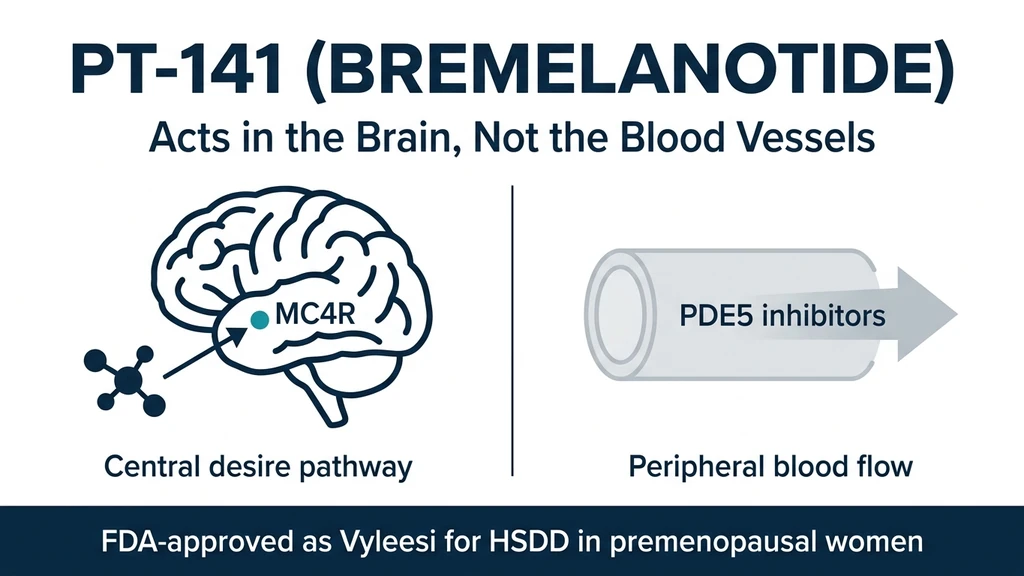
Someone sold you PT-141 as "the libido peptide," and the label told you nothing else. PT-141 is bremelanotide, a melanocortin receptor agonist that binds MC4R inside the hypothalamus and raises sexual desire from the brain rather than the bloodstream. It is FDA-approved as Vyleesi, for acquired, generalized hypoactive sexual desire disorder (HSDD) in premenopausal women. It is not approved for men, and it is not approved for erectile dysfunction.
| Quick Reference | Details |
|---|---|
| Chemical identity | Bremelanotide, a cyclic 7-amino-acid analogue of alpha-MSH |
| Receptor target | Melanocortin receptors, primarily MC4R (also MC3R) |
| Site of action | Hypothalamus (central nervous system) |
| Brand name | Vyleesi |
| FDA approval | June 2019 |
| Approved indication | Acquired, generalized HSDD in premenopausal women |
| Approved in men? | No. Off-label only |
| Route | Subcutaneous injection |
| Dominant side effect | Nausea, 40.0% |
| Contraindications | Uncontrolled hypertension, known cardiovascular disease |
| Chemical relative | Melanotan II |
Bremelanotide is the only drug in the peptide world with a real sexual-desire indication and a real FDA label behind it. That label is also the reason its limits are unusually well documented. This is educational content, not medical advice.
Get your custom peptide protocol:
- Tailored to your body and goals
- Precise dosing and cycle length
- Safe stacking combinations
- Backed by peer-reviewed studies
- Ready in under 2 minutes
What PT-141 Does Inside the Brain
PT-141 is a cyclic seven-amino-acid peptide derived from alpha-melanocyte-stimulating hormone (alpha-MSH). It activates melanocortin receptors, and the effect that matters for sexual function comes from MC4R and MC3R in the hypothalamus (Molinoff et al., Ann N Y Acad Sci, 2003, PMID: 12851303).
Receptor activation in the medial preoptic area and paraventricular nucleus increases dopamine signalling along the neural circuits that generate sexual motivation. Oxytocin release from the same nuclei contributes. The drug never touches penile or vaginal blood vessels.
Picture a house in winter. A radiator valve controls how much heat reaches one room, and the thermostat decides whether the boiler fires at all. Sildenafil and tadalafil open the radiator valve: they block PDE5 in vascular smooth muscle and amplify a nitric-oxide signal that only exists once arousal has already begun. PT-141 turns the thermostat.
Stated literally: PDE5 inhibitors act peripherally on blood flow and require sexual stimulation to do anything. Bremelanotide acts centrally on desire circuitry and produced erections in men with psychogenic erectile dysfunction in the absence of sexual stimulation (Wessells et al., J Urol, 1998, PMID: 9679884). Two different organs, two different problems, two different drugs. Our libido peptide guide covers where the other candidates sit on the same axis.
Effects persist far longer than the 2.7-hour plasma half-life would predict, which is a receptor-occupancy story covered in how long PT-141 lasts.
Where PT-141 Came From
PT-141 is a tanning drug that failed upward. Researchers at the University of Arizona were developing melanotan compounds as synthetic alpha-MSH analogues for photoprotection. Male volunteers reported spontaneous erections.
Palatin Technologies took the melanocortin scaffold and engineered away most of the MC1R activity that drives pigmentation, keeping the MC4R activity that drives desire. The result was bremelanotide. Its parent compound, Melanotan II, still carries both effects, which is why the tanning peptide community reports arousal as a side effect and the desire peptide still carries a pigmentation warning.
That shared ancestry is not trivia. Read the Melanotan 2 dosage protocol and you will recognise the same receptor family, the same pigmentation warning, and the same dose-frequency ceiling showing up in a drug marketed for something else entirely.
PT-141 Benefits: What the Evidence Actually Supports
Two identical phase 3 trials, RECONNECT (studies 301 and 302), randomized 1,267 premenopausal women with HSDD to bremelanotide 1.75 mg as needed or placebo for 24 weeks (Kingsberg et al., Obstet Gynecol, 2019, PMID: 31599840).
Bremelanotide beat placebo on both coprimary endpoints. Desire, measured on the Female Sexual Function Index desire domain, improved by 0.35 points in the integrated analysis (P<.001). Distress about low desire, measured on item 13 of the Female Sexual Distress Scale, fell by 0.33 points (P<.001).
Those are statistically clean and clinically modest numbers. A 0.35-point shift on a scale that runs from 1.2 to 6.0 is a real effect, not a transformation. The dose was selected from an earlier randomized dose-finding trial in premenopausal women (Clayton et al., Womens Health (Lond), 2016, PMID: 27181790), and safety held over 52 weeks of open-label extension (Simon et al., Obstet Gynecol, 2019, PMID: 31599847).
| Benefit claim | Evidence quality | Population studied |
|---|---|---|
| Increases sexual desire | Phase 3, two trials, n=1,267 | Premenopausal women with HSDD |
| Reduces distress about low desire | Phase 3, coprimary endpoint met | Premenopausal women with HSDD |
| Works without sexual stimulation | Phase 2, small crossover | Men with psychogenic ED |
| Improves erectile function | Phase 2 only, never phase 3 | Men with ED, including sildenafil non-responders |
| Increases muscle, fat loss, recovery | No evidence of any kind | None |
| Restores testosterone | No evidence of any kind | None |
The male data stops at phase 2 and never produced an approval. The specifics of that evidence, the off-label reality, and who among men responds are covered in PT-141 for men. If your interest is testosterone rather than desire, PT-141 is the wrong molecule; see best peptides for testosterone and gonadorelin, which act on the HPG axis instead.
Two Ways PT-141 Hurts People
The FDA label reads calmly because the trials excluded the people most likely to be harmed. Two failure modes account for most real-world damage.
Scenario 1: stacking with a PDE5 inhibitor on an untreated blood pressure.
A 47-year-old man with a resting pressure of 154/96 injects 1.75 mg of PT-141 and swallows 20 mg of tadalafil an hour before sex. Bremelanotide raises systolic pressure by up to 6 mmHg and diastolic by up to 3 mmHg, peaking 2 to 4 hours after the dose, and lowers heart rate by up to 5 beats per minute. That effect usually resolves within 12 hours. Uncontrolled hypertension and known cardiovascular disease are outright contraindications on the Vyleesi label.
Tadalafil pushes the other way, dropping systolic pressure and staying in the system for 36 hours. He now has a bradycardic heart, a pressor peaking at hour three, and a vasodilator running until Sunday. If he develops chest pain during sex, nitroglycerin is unusable for 48 hours after tadalafil, because nitrates plus a PDE5 inhibitor can drop systolic pressure by 25 to 50 mmHg. The only published co-administration study used 7.5 mg of intranasal PT-141 with 25 mg of sildenafil, the lowest tablet strength, and reported no new adverse events (Diamond et al., Urology, 2005, PMID: 15833522). Nobody has tested full-dose subcutaneous bremelanotide with 20 mg of tadalafil.
The fix: get the pressure under 130/80 first, run one drug at a time, and check combinations with the peptide interaction checker before you stack anything on a melanocortin agonist.
Scenario 2: daily dosing and permanent skin darkening.
A woman decides that eight doses a month is too conservative and takes bremelanotide daily for eight consecutive days. In the FDA's own dosing study, focal hyperpigmentation occurred in 1% of patients using it intermittently at eight or fewer doses per month. With eight consecutive daily doses, the rate was 38%. Eight more daily doses added another 14%.
That is a 38-fold increase from a schedule change, not a dose change. The pigment lands on the face, gums, and breasts, and it does not always resolve after stopping. The mechanism is residual MC1R activity, the same receptor that made Melanotan II a tanning drug.
The fix: one dose per 24 hours, eight doses per month, no exceptions. The approved protocol and its frequency ceiling exist because of that 38% figure.
How to Tell a Desire Problem From a Blood Flow Problem
Nobody teaches this, and getting it wrong is why PT-141 disappoints half the people who buy it. Desire lives in the hypothalamus. Erection and lubrication live in the vasculature. A drug aimed at one does close to nothing for the other.
Work through these before spending money on any molecule.
- 1.Check for morning erections or nocturnal tumescence. If they still happen, the vascular hardware works. A drug for blood flow has nothing left to fix.
- 1.Compare solo and partnered response. A rigid erection alone but not with a partner points away from vascular disease and toward desire, anxiety, or relationship context.
- 1.Ask which sentence is true. "I want sex and my body will not cooperate" is an arousal and blood-flow problem. "My body cooperates and I never want sex" is a desire problem. Only the second is bremelanotide's target.
- 1.Time the onset. Desire that vanished within weeks of starting an SSRI, finasteride, an opioid, or hormonal contraception is a medication effect, and the answer is usually the medication. See peptides for depression for how that overlap plays out.
- 1.Apply the HSDD definition. The approved indication requires low desire that is acquired (you used to have it), generalized (across all partners and contexts), present for at least six months, and causing marked distress. Low desire without distress is not a disorder.
- 1.Check the cardiovascular numbers. Absent morning erections plus a blood pressure of 150/95 plus a rising A1c is a cardiology appointment before it is a peptide purchase.
| What you notice | Likely mechanism | What actually addresses it |
|---|---|---|
| No desire, normal erections | Central, MC4R pathway | PT-141 (women, on label; men, off label) |
| Desire present, weak erection | Peripheral, vascular | PDE5 inhibitor, cardiovascular workup |
| Both absent, low testosterone | Endocrine, HPG axis | Hormone evaluation, HPG-axis peptides |
| Both absent after starting an SSRI | Drug-induced | Prescriber review of the SSRI |
| Desire loss at perimenopause | Hormonal transition | See peptides for perimenopause |
| Desire loss after 40, gradual | Multifactorial | Sleep, alcohol, bloodwork, peptides for men over 40 |
The FDA approved bremelanotide for exactly one row of that table. Everything else is extrapolation.
PT-141 Reference Table
| Parameter | Value |
|---|---|
| Generic name | Bremelanotide |
| Brand name | Vyleesi |
| Class | Melanocortin receptor agonist |
| Primary receptor | MC4R (secondary MC3R, residual MC1R) |
| Parent compound | Melanotan II |
| Approval date | June 2019 (FDA) |
| Indication | Acquired, generalized HSDD, premenopausal women |
| Route | Subcutaneous, autoinjector or reconstituted vial |
| Approved dose | 1.75 mg |
| Frequency ceiling | 1 dose per 24 hours, 8 doses per month |
| Timing | At least 45 minutes before anticipated activity |
| Plasma half-life | ~2.7 hours |
| Nausea | 40.0% |
| Flushing | 20.3% |
| Injection site reactions | 13.2% |
| Headache | 11.3% |
| Vomiting | 4.8% |
| Blood pressure | +6 mmHg systolic, +3 mmHg diastolic, peak 2-4 h, resolves by 12 h |
| Heart rate | Decrease up to 5 bpm |
| Focal hyperpigmentation | 1% at 8 doses/month; 38% after 8 consecutive daily doses |
| Contraindications | Uncontrolled hypertension, known cardiovascular disease |
| Key interaction | Reduces systemic exposure to oral naltrexone; avoid |
| Secondary interaction | Slows gastric emptying, delays absorption of oral drugs such as indomethacin |
| Approved in men | No |
| WADA status | Not prohibited |
Adverse event rates come from the RECONNECT phase 3 population and the FDA label. Frequency, storage, and reconstitution details sit in the PT-141 dosage guide and the reconstitution calculator.
Common Mistakes With PT-141
Mistake 1: buying it to fix an erection. PT-141 has never completed a phase 3 trial for erectile dysfunction and carries no such indication. A man with absent morning erections and normal desire is treating the wrong organ, and the 40% nausea rate buys him nothing. The fix: work through the desire-versus-vascular checklist, then treat the vascular finding as a cardiology question.
Mistake 2: treating it like a growth peptide. It builds no muscle, burns no fat, and does not raise testosterone. The bodybuilding association exists because the compound was discovered inside a tanning drug that gym communities were already using. The fix: for those goals, start with getting started with peptides and leave bremelanotide out of the stack.
Mistake 3: ignoring the eight-dose monthly ceiling. The ceiling is not a marketing constraint. Eight consecutive daily doses produced focal hyperpigmentation in 38% of subjects against 1% on the approved schedule. The fix: one dose per 24 hours, eight per month, and track them.
Mistake 4: stacking it on an unmeasured blood pressure. Bremelanotide is contraindicated in uncontrolled hypertension and known cardiovascular disease, and most people buying research vials have never taken a cuff reading. The fix: measure first, read the peptide safety guide, and understand that a grey-market vial carries no label, no contraindication list, and no assay. Legal status is covered in are peptides legal.
Frequently Asked Questions
What is the PT-141 peptide?
PT-141 is bremelanotide, a cyclic seven-amino-acid analogue of alpha-MSH that activates melanocortin receptors, mainly MC4R, in the hypothalamus. It raises sexual desire through brain signalling rather than blood flow. It is FDA-approved as Vyleesi for premenopausal women with HSDD. See the PT-141 peptide profile.
What are the main PT-141 peptide benefits?
In the RECONNECT phase 3 trials of 1,267 women, bremelanotide 1.75 mg improved sexual desire by 0.35 points and reduced distress about low desire by 0.33 points versus placebo. Both endpoints reached P<.001. It has no proven benefit for muscle, fat loss, or testosterone. See peptides for libido.
Is PT-141 FDA-approved?
Yes, since June 2019, under the brand name Vyleesi, for acquired, generalized hypoactive sexual desire disorder in premenopausal women. It is not approved for men, for postmenopausal women, or for erectile dysfunction. Any other use is off-label. Male evidence stops at phase 2, as covered in PT-141 for men.
How is PT-141 different from Viagra?
Sildenafil inhibits PDE5 in vascular smooth muscle and only works once arousal has already triggered nitric-oxide release. PT-141 activates MC4R in the hypothalamus and generates desire upstream of that signal. One treats blood flow, the other treats wanting. Duration also differs sharply, as explained in how long PT-141 lasts.
Does PT-141 cause skin darkening?
It can. Focal hyperpigmentation occurred in 1% of patients on the approved schedule of eight or fewer doses per month, but in 38% of those dosing daily for eight consecutive days. Residual MC1R activity is the cause, inherited from its parent compound Melanotan II.
Who should not take PT-141?
Anyone with uncontrolled hypertension or known cardiovascular disease. Bremelanotide raises systolic pressure by up to 6 mmHg and slows heart rate by up to 5 bpm for several hours. It also cuts systemic exposure to oral naltrexone. Screen combinations with the peptide interaction checker.
Can you combine PT-141 with tadalafil or sildenafil?
Only under medical supervision, and only with a measured blood pressure. The single published co-administration study used 7.5 mg intranasal PT-141 with 25 mg sildenafil, not full subcutaneous doses. Bremelanotide raises pressure while PDE5 inhibitors lower it. Read the peptide safety guide before combining anything.
How much does PT-141 cost?
Prescription Vyleesi autoinjectors run several hundred dollars per four-dose pack without insurance, while grey-market lyophilized vials sell for a fraction of that with no purity guarantee. Cost, sourcing risk, and third-party testing are broken down in how much peptides cost.
The Bottom Line
PT-141 is bremelanotide, a melanocortin receptor agonist that activates MC4R in the hypothalamus to increase sexual desire. It is FDA-approved as Vyleesi for acquired, generalized HSDD in premenopausal women, and for nothing else. Nausea affects 40% of users, and the eight-dose monthly ceiling exists to keep focal hyperpigmentation near 1% instead of 38%.
The principle worth carrying: desire and blood flow are separate systems with separate drugs. Match the molecule to the mechanism, and check the blood pressure before either one goes anywhere near a syringe.
Work out the dose in the PT-141 dosage guide and the timing in how long PT-141 lasts. More evidence-based peptide research at PeptidesExplorer. Consult a healthcare provider before using any peptide, particularly with any cardiovascular history.
Helpful Tools
Related Articles
5 Best Peptides for Libido (2026)
5 best peptides for libido ranked: PT-141 (FDA-approved), kisspeptin (56% increase), melanotan II, oxytocin, gonadorelin. Dosages for men and women.
Peptides for Men: Best Options by Goal (2026 Guide)
Best peptides for men ranked by goal: muscle growth, fat loss, libido, testosterone, sleep, hair loss, and longevity. Protocols with doses.
PT-141 for Men: Dosage, Results & How It Works
PT-141 (bremelanotide) for men: 34% success in Viagra non-responders. Dosage, mechanism, clinical trial data, side effects, and comparison to PDE5 inhibitors.
Where to Inject IGF-1 LR3: Sites, SubQ vs IM, Rotation
Where to inject IGF-1 LR3: abdomen, thigh or glute, subcutaneous, 29-31G needle. Why site-specific growth is a myth, a rotation map, and the hypoglycemia rule.