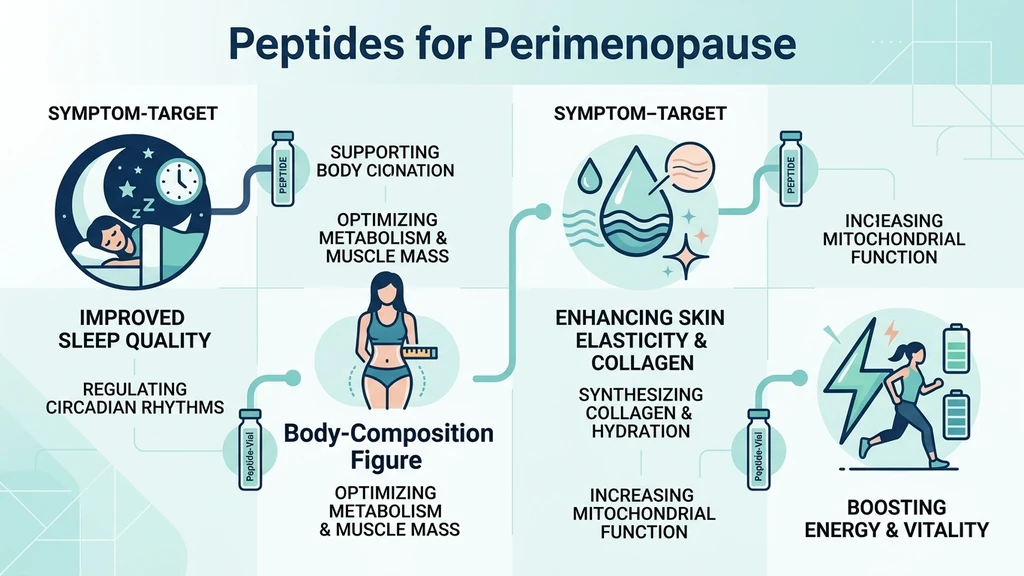
You are navigating perimenopause and wondering whether peptides can help with the sleep disruption, weight changes, skin shifts, and fatigue that come with fluctuating hormones. The honest answer: certain peptides target specific perimenopause symptoms, but none address the underlying hormonal change, and none replace evidence-based care like hormone therapy when it is appropriate. Peptides are a complementary tool, not a hormonal fix.
| Quick Reference | Details |
|---|---|
| Do peptides treat perimenopause? | No; they target individual symptoms |
| Sleep support | DSIP, growth-hormone secretagogues |
| Body composition | CJC-1295/ipamorelin, tesamorelin |
| Skin and collagen | GHK-Cu, copper peptides |
| Energy and recovery | Various GH secretagogues |
| Replace HRT? | No |
| FDA status | Most are not FDA-approved for this use |
These peptides are not FDA-approved for perimenopause, and research in midlife women specifically is limited. This guide explains realistic, symptom-targeted options and their limits. It is education, not medical advice. Always consult a licensed provider, ideally one versed in menopause care.
For related goals, see peptides for women over 40 and peptides for sleep.
Get your custom peptide protocol:
- Tailored to your body and goals
- Precise dosing and cycle length
- Safe stacking combinations
- Backed by peer-reviewed studies
- Ready in under 2 minutes
What Peptides Can and Cannot Do in Perimenopause
Perimenopause is driven by declining and fluctuating estrogen and progesterone. That hormonal shift cascades into sleep problems, mood swings, weight redistribution, skin thinning, and low energy. Setting expectations correctly is the most important part of this conversation.
Peptides do not restore estrogen or progesterone. They cannot reverse the hormonal transition itself. What some peptides can do is target the downstream symptoms: a sleep peptide may improve sleep quality, a growth-hormone secretagogue may support body composition, a copper peptide may support skin.
Think of it like managing a house during a renovation. The renovation (hormonal change) is happening regardless. Peptides are like fixing individual rooms (sleep, skin, muscle) to make the house more livable during the process. They do not stop the renovation.
This framing matters because the most effective intervention for many perimenopausal women is hormone therapy, which directly addresses the root cause when appropriate and safe. Peptides sit alongside lifestyle, nutrition, and medical care, not in place of them. Discuss the full picture, including hormone therapy, with a menopause-literate clinician before adding peptides. See our peptide safety guide.
Peptides for Perimenopause Sleep Disruption
Sleep is one of the first and most disruptive perimenopause symptoms. Falling estrogen and progesterone undermine sleep architecture, and night sweats fragment it further.
DSIP (Delta Sleep-Inducing Peptide). Studied for its potential role in promoting deeper, more restorative sleep. Evidence in humans is limited, but it is among the peptides people turn to for sleep specifically. See our DSIP peptide dosage guide.
Growth-hormone secretagogues (CJC-1295, ipamorelin). These stimulate the body's own growth-hormone release, much of which occurs during deep sleep. Some users report improved sleep depth as a secondary benefit. See CJC-1295 ipamorelin benefits.
The realistic expectation: peptides may improve sleep quality at the margins, but they do not fix the hormonal driver of perimenopausal insomnia. Sleep hygiene, managing night sweats, and addressing hormones directly often matter more.
If sleep is your primary complaint, start there with non-peptide fundamentals and consider whether the disruption is severe enough to warrant medical evaluation. Peptides are an adjunct. See peptides for sleep for the broader rundown.
Peptides for Body Composition and Metabolism
Perimenopause commonly brings weight gain, especially around the midsection, and loss of lean muscle. Falling estrogen shifts fat distribution and slows metabolism, and this frustrates many women who feel their old habits no longer work.
Growth-hormone secretagogues (CJC-1295/ipamorelin). By stimulating natural growth-hormone release, these may support lean mass retention and fat metabolism. They are popular for body-composition goals in midlife. See CJC-1295 ipamorelin benefits.
Tesamorelin. Specifically studied for reducing visceral (deep abdominal) fat, which is exactly the fat that accumulates in perimenopause. See our tesamorelin dosage for fat loss guide.
GLP-1 medications (semaglutide, tirzepatide). Not peptides used casually, but prescription GLP-1 drugs are highly effective for weight management when clinically appropriate. See peptides for women over 40.
The caveat: these support body composition but cannot override the hormonal and metabolic shift on their own. Resistance training, adequate protein, and sleep do the heavy lifting; peptides may amplify the results. Anyone considering growth-hormone secretagogues should be screened for cancer risk and metabolic conditions first. Use the peptide interaction checker before combining anything.
Peptides for Skin, Collagen, and Hair
Declining estrogen accelerates collagen loss, and women can lose a significant portion of skin collagen in the years around menopause. Skin thins, loses elasticity, and wrinkles more readily. Hair may thin too.
GHK-Cu (copper peptides). The most evidence-backed peptide for skin. GHK-Cu stimulates collagen synthesis, supports skin remodeling, and has antioxidant activity (Pickart & Margolina, Int J Mol Sci, 2018). It is used topically and via microneedling for skin firmness and appearance. See GHK-Cu benefits and what do peptides do for skin.
Copper peptides for hair. GHK-Cu is also explored for hair density and scalp health. See GHK-Cu hair growth.
This is the area where peptides have the clearest, most direct application in perimenopause, because skin remodeling is a local process a topical peptide can genuinely influence. Topical GHK-Cu also avoids the systemic considerations of injectable peptides.
A caution: copper peptides can irritate sensitive skin if overused or layered poorly, and midlife skin is often more reactive. Start low and slow. See copper peptides ruined my skin and GHK-Cu side effects.
Safety Considerations Specific to Midlife Women
Perimenopausal women face safety considerations that deserve extra attention before adding any peptide.
Cancer screening. Growth-hormone secretagogues raise theoretical concerns around stimulating growth pathways. Midlife is also when breast and other cancer screening matters most. Discuss your history and screening status with a physician before using GH-related peptides.
Hormone interactions. If you are on or considering hormone therapy, adding peptides introduces variables. Coordinate everything through one clinician rather than stacking independently.
Bone health. Perimenopause accelerates bone loss. Any intervention should support, not undermine, bone density. Hormone therapy and resistance training are the proven tools here; peptides are not a substitute.
Cardiovascular and metabolic health. Risk shifts in midlife. Screen for blood pressure, glucose, and lipid changes before metabolic peptides.
Quality and sourcing. Most peptides for these uses are unregulated research compounds. Quality varies, and an unverified vial adds risk on top of an already complex midlife health picture. See where to buy peptides in 2026.
The throughline: perimenopause is a higher-stakes life stage for adding experimental compounds. Medical oversight is not optional. Review our peptide safety guide.
Building a Realistic Perimenopause Approach
Peptides work best as one layer in a comprehensive approach, not as a standalone solution. Here is a sensible order of operations.
Foundation first. Sleep hygiene, resistance training, adequate protein, stress management, and nutrition address multiple perimenopause symptoms at once and carry no risk. Nothing replaces these.
Medical evaluation. A menopause-literate clinician can assess whether hormone therapy is appropriate, which is often the single most effective intervention for moderate to severe symptoms.
Targeted peptides as adjuncts. Once the foundation is in place, peptides can target specific stubborn symptoms: GHK-Cu for skin, a GH secretagogue for body composition, a sleep peptide for sleep quality.
Monitor and adjust. Track symptoms, use one change at a time, and reassess regularly.
| Symptom | First-line | Peptide adjunct |
|---|---|---|
| Sleep | Sleep hygiene, hormone eval | DSIP, GH secretagogues |
| Weight/muscle | Resistance training, protein | CJC-1295/ipamorelin, tesamorelin |
| Skin/collagen | Sunscreen, retinoids | Topical GHK-Cu |
| Energy | Sleep, nutrition | GH secretagogues |
The peptides amplify a solid foundation; they do not replace it. See peptides for women over 40 for more.
Common Mistakes With Peptides in Perimenopause
Mistake 1: Expecting peptides to fix hormones. They target symptoms, not the hormonal transition. The fix: address hormones with a clinician and use peptides as adjuncts.
Mistake 2: Skipping the foundation. Peptides cannot compensate for poor sleep, no resistance training, or low protein. The fix: build the basics first.
Mistake 3: Stacking multiple peptides at once. This makes it impossible to know what works or what caused a side effect. The fix: change one variable at a time. Use the peptide interaction checker.
Mistake 4: Ignoring cancer and bone screening. Midlife raises the stakes for GH-related compounds and bone loss. The fix: screen first with a physician.
Mistake 5: Buying unverified research peptides. Quality varies widely and adds risk to a complex health stage. The fix: prioritize sourcing and medical oversight. See where to buy peptides in 2026.
Frequently Asked Questions
Can peptides help with perimenopause symptoms?
Certain peptides can target specific symptoms, such as GHK-Cu for skin collagen, growth-hormone secretagogues for body composition, and sleep peptides for sleep quality. But none address the underlying hormonal change or replace hormone therapy when appropriate. Peptides are complementary tools, not a hormonal fix. See peptides for women over 40.
What is the best peptide for perimenopause weight gain?
For body composition, growth-hormone secretagogues like CJC-1295/ipamorelin and tesamorelin (for visceral fat) are the commonly used options, while prescription GLP-1 drugs are highly effective when clinically appropriate. None override the metabolic shift alone; resistance training and protein do the heavy lifting. See tesamorelin dosage for fat loss.
Do peptides help perimenopausal sleep problems?
Peptides like DSIP and growth-hormone secretagogues may improve sleep quality at the margins, but they do not fix the hormonal driver of perimenopausal insomnia. Sleep hygiene, managing night sweats, and addressing hormones often matter more. Start with fundamentals before adding peptides. See peptides for sleep and DSIP peptide dosage.
Are peptides safe during perimenopause?
Perimenopause raises the stakes for adding experimental compounds. Growth-hormone peptides carry theoretical concerns around growth pathways, and midlife is critical for cancer and bone screening. Most peptides are unregulated research compounds. Medical oversight is essential, ideally from a menopause-literate clinician. Review our peptide safety guide.
Can peptides replace hormone therapy?
No. Peptides do not restore estrogen or progesterone and cannot reverse the hormonal transition. For moderate to severe symptoms, hormone therapy is often the single most effective intervention when appropriate and safe. Peptides sit alongside hormone therapy and lifestyle, not in place of them. Discuss the full picture with a clinician.
Which peptide is best for perimenopausal skin?
Topical GHK-Cu (copper peptides) has the clearest application, stimulating collagen synthesis and supporting skin remodeling, which counters the collagen loss that accelerates around menopause. Start low and slow, since midlife skin can be reactive. See GHK-Cu benefits and the cautions in copper peptides ruined my skin.
Should I see a doctor before using peptides for perimenopause?
Yes, and ideally one versed in menopause care. They can assess whether hormone therapy is appropriate, screen for cancer and bone-health risks, and coordinate any peptides safely. Given the higher-stakes health picture in midlife and the unregulated nature of most peptides, medical oversight is not optional. See peptides for women over 40.
The Bottom Line
Peptides can play a supporting role in perimenopause, but only a supporting one. They target individual symptoms, GHK-Cu for skin, growth-hormone secretagogues for body composition, sleep peptides for sleep, without touching the hormonal change underneath. Anyone promising that peptides fix perimenopause is overselling.
The most effective approach builds from the foundation up: sleep, resistance training, protein, and stress management first, then a medical evaluation that considers hormone therapy, then targeted peptides as adjuncts for stubborn symptoms. The peptides amplify a solid base; they cannot replace it.
Midlife raises the stakes for adding experimental compounds, so cancer and bone screening and medical oversight matter more than ever. Check combinations with the peptide interaction checker, explore symptom-specific options in peptides for women over 40 and peptides for sleep, and always work with a menopause-literate healthcare provider.
Helpful Tools
Related Articles
Glutathione Peptide: Is It Actually a Peptide?
Glutathione is a genuine tripeptide with an unusual gamma bond. What bioavailability trials actually found, why IV skin lightening is risky, and what works.
Peptides for Psoriasis: The Evidence
Peptides for psoriasis: the honest evidence on KPV, GHK-Cu, BPC-157, and why LL-37 drives the disease rather than treating it. See a dermatologist.
Peptides for Eczema: What Helps?
Peptides for eczema: which ones support skin barrier repair and inflammation, the evidence behind GHK-Cu and KPV, safety cautions, and what they cannot replace.
BPC-157 Benefits for Women: Guide
Evidence-based guide to BPC-157 benefits for women. Gut healing, joint recovery, skin repair, hormonal considerations, and safety data from published studies.