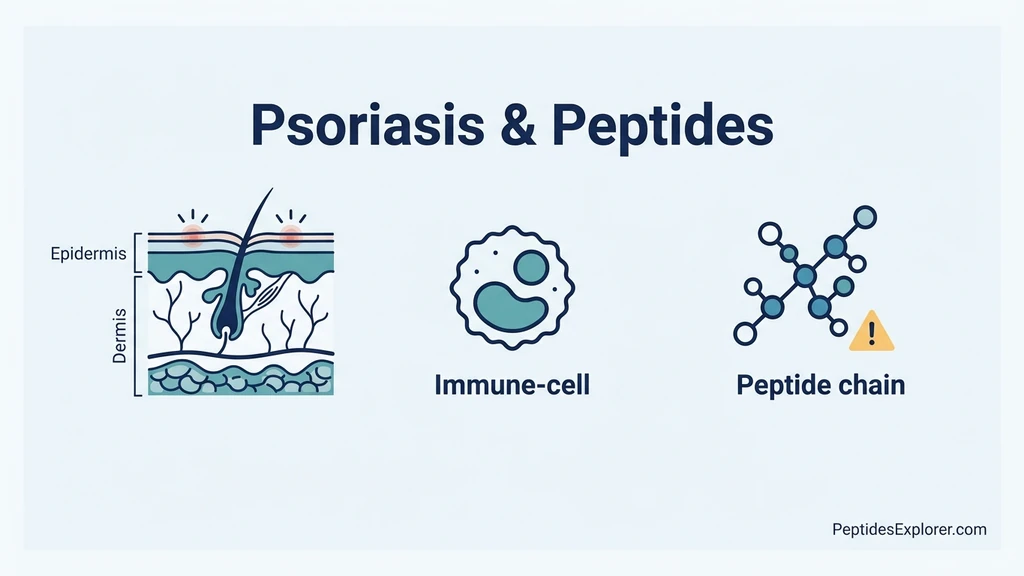
You have scaly, red, itchy plaques on your elbows or scalp, and you are wondering whether a peptide can quiet them down. Here is the honest answer up front: no peptide is an FDA-approved treatment for psoriasis. Psoriasis is a chronic autoimmune disease, and the treatments with real evidence are dermatology-directed: topical steroids and vitamin D analogs, phototherapy, and biologics that target IL-17 and IL-23.
| Quick Reference | Details |
|---|---|
| Do peptides cure psoriasis? | No; none are FDA-approved for it |
| Anti-inflammatory interest | KPV (preclinical) |
| Skin remodeling interest | GHK-Cu (cosmetic/wound) |
| Immune-modulation interest | BPC-157, Thymosin Alpha-1 (weak/indirect) |
| LL-37 (cathelicidin) | DRIVES psoriasis; do NOT use it for psoriasis |
| Established care | Topicals, phototherapy, IL-17/IL-23 biologics |
| Manage with | A dermatologist |
A few peptides have anti-inflammatory research that makes them topics of discussion, and one peptide, LL-37, is actively implicated in causing psoriasis. This guide separates the two honestly. It is educational content, not medical advice, and psoriasis should be managed by a dermatologist.
For related skin context, see peptides for eczema and what do peptides do for skin.
Get your custom peptide protocol:
- Tailored to your body and goals
- Precise dosing and cycle length
- Safe stacking combinations
- Backed by peer-reviewed studies
- Ready in under 2 minutes
Why Psoriasis Is an Immune Disease, Not a Skin Surface Problem
Psoriasis looks like a skin condition, but the driver sits in the immune system. Overactive T-cells and dendritic cells flood the skin with inflammatory signals, mainly along the IL-23 to IL-17 axis, which forces skin cells to multiply far too fast and pile up as plaques.
Think of healthy skin turnover like a slow conveyor belt that renews the surface over about a month. In psoriasis the belt runs at roughly five times normal speed, so immature cells stack up faster than they can shed. The plaque is the visible traffic jam, but the engine is immune signaling underneath.
This is why surface treatments alone rarely control moderate or severe disease, and why modern care targets the immune drivers directly. Biologics that block IL-17 or IL-23 can clear skin dramatically because they shut off the signal at its source (Hawkes et al., J Allergy Clin Immunol, 2017).
Peptides enter the conversation because some influence inflammation. The honest framing: a peptide that calms inflammatory signaling has a plausible rationale, but plausible is not proven, and no peptide matches what targeted biologics already do. For how peptides interact with inflammation broadly, see peptides for inflammation.
KPV: The Anti-Inflammatory Peptide With the Most Rationale
KPV is a tripeptide fragment of alpha-melanocyte-stimulating hormone, studied for its anti-inflammatory activity. Because psoriasis is fundamentally inflammatory, KPV draws the most legitimate interest of any peptide here.
KPV appears to enter cells and downregulate pro-inflammatory signaling, including the NF-kB pathway that drives inflammatory gene expression (Dalmasso et al., Am J Physiol Gastrointest Liver Physiol, 2008). NF-kB sits upstream of many of the cytokines that inflame psoriatic skin, which is the basis for the theory that KPV could help.
The reality check is firm. KPV research is largely preclinical and centered on gut and general skin inflammation models, not psoriasis trials in humans. There is no robust clinical evidence that KPV clears psoriatic plaques.
Treat KPV for psoriasis as experimental. The mechanism is plausible and the anti-inflammatory rationale is real, but you would be extrapolating from non-psoriasis research. If you explore it, do so with a dermatologist and modest expectations. For dosing background, see our KPV dosage guide.
GHK-Cu: Skin Remodeling, Mostly From Cosmetic Research
GHK-Cu, the copper tripeptide, is the most evidence-backed peptide for skin in general, which is why it surfaces in psoriasis discussions. Its documented actions sit on the repair and remodeling side of skin biology.
GHK-Cu stimulates collagen and glycosaminoglycan synthesis, supports tissue remodeling, and shows antioxidant and anti-inflammatory properties (Pickart & Margolina, Int J Mol Sci, 2018). These are the actions that make it popular for aging skin and wound healing.
The caveat matters. Almost all GHK-Cu research is cosmetic and wound-focused, not psoriasis-focused. Remodeling intact or healing skin is a different task from switching off the autoimmune cascade that produces plaques, and GHK-Cu does not address that cascade.
For psoriasis, GHK-Cu is at best a supportive cosmetic adjunct on calm skin, not a treatment for active disease. It can also sting on broken or inflamed skin, so patch testing applies. See GHK-Cu benefits for what it actually does well.
BPC-157 and Thymosin Alpha-1: Weak and Indirect Evidence
BPC-157 and Thymosin Alpha-1 come up because both touch the immune and healing systems, but the evidence linking either to psoriasis is weak and indirect.
BPC-157 is studied mostly for tissue and gut healing, with anti-inflammatory effects reported in animal models (Sikiric et al., Curr Pharm Des, 2018). None of that work establishes any benefit for psoriatic plaques in humans.
Thymosin Alpha-1 is an immune-modulating peptide used in some countries as an adjunct in infection and immune conditions (King & Tuthill, Vitam Horm, 2016). Because psoriasis is an immune disease, the idea of immune modulation is tempting, but modulation is not the same as the targeted IL-17/IL-23 blockade that works, and a peptide that nudges immunity broadly could just as easily do nothing or worsen an autoimmune process.
The honest verdict: both are speculative for psoriasis. Use them, if at all, only under medical supervision, and never as a substitute for proven care. Review our peptide safety guide first.
LL-37: The Peptide That Drives Psoriasis, Not Treats It
This is the most important section in the guide, and it cuts against what some sellers imply. LL-37, the human cathelicidin antimicrobial peptide, is not a treatment for psoriasis. It is a driver of the disease.
In psoriatic skin, LL-37 is overexpressed in the plaques. It binds to the body's own DNA and RNA released from damaged skin cells, forming complexes that activate plasmacytoid dendritic cells. Those cells then pour out type I interferon and ignite the autoimmune cascade that produces psoriasis (Lande et al., Nature, 2007).
Later work confirmed LL-37 acts as a self-antigen that T-cells in many psoriasis patients directly attack, tying it deeper into the disease mechanism (Lande et al., Nat Commun, 2014). In other words, LL-37 is part of the fire, not the water.
Do not use LL-37 for psoriasis. Adding more of a peptide that is overexpressed in your plaques and helps trigger the autoimmune response is the opposite of what the disease needs, and it carries a real theoretical risk of making things worse. If you have read that LL-37 helps skin conditions, that interest comes from its antimicrobial role in other contexts, which does not transfer to psoriasis. See LL-37 benefits for that nuance and its limits.
What the Evidence Actually Shows
Psoriasis is a condition where chasing unproven remedies wastes time and can let the disease, and its joint and cardiovascular risks, progress.
What is established: KPV downregulates inflammatory signaling in preclinical models. GHK-Cu supports skin remodeling in cosmetic and wound research. LL-37 is firmly implicated in driving psoriasis, which is a warning, not a benefit.
What is not established: No peptide has robust human trials showing it clears or controls psoriatic plaques. The supportive rationales are extrapolated from adjacent research, not psoriasis-specific evidence.
What this means for you: Peptides are not a substitute for dermatology care. First-line and advanced treatments, topical steroids and vitamin D analogs, phototherapy, and IL-17/IL-23 biologics, have strong evidence that peptides cannot match.
The responsible position: standard care first, always, with a dermatologist. Any peptide experiment, limited to those with a genuine anti-inflammatory rationale like KPV, would sit on top of proven treatment, never in place of it, and never including LL-37. For how injectable peptides are even prepared, see how to inject peptides.
Quantified Scenarios: What Going Off-Script Costs
Scenario 1: Dropping a biologic for KPV. You stop an IL-17 biologic that had cleared 90% of your skin and switch to research KPV. Within weeks the plaques return, because nothing is now blocking the IL-17 signal. You have traded a proven 90% clearance for an unproven peptide and a flare. The fix: never stop prescribed therapy to substitute a peptide.
Scenario 2: Using LL-37 hoping it heals skin. You buy LL-37 because a forum called it a skin peptide. LL-37 is already overexpressed in your plaques and helps activate the dendritic cells that drive the disease (Lande et al., Nature, 2007). Adding more risks feeding the exact cascade that inflames your skin. The fix: avoid LL-37 for psoriasis entirely.
Scenario 3: Applying GHK-Cu to raw, active plaques. You apply copper peptide directly to weeping, cracked lesions. Active peptides on broken skin sting, irritate, and can worsen the local inflammation. The fix: use GHK-Cu, if at all, only on calm intact skin and patch test first.
The throughline is simple. The downside of going off-script ranges from a wasted flare to potentially feeding the disease. See peptides for inflammation for the broader picture and the peptide reconstitution calculator if a clinician has you preparing an injectable.
Comprehensive Reference: Peptides and Psoriasis
One table to bookmark, summarizing where each peptide stands for psoriasis specifically.
| Peptide | Proposed role | Evidence for psoriasis | Verdict |
|---|---|---|---|
| KPV | Anti-inflammatory, downregulates NF-kB | Preclinical only; no psoriasis trials | Experimental adjunct at most |
| GHK-Cu | Skin remodeling, antioxidant | Cosmetic/wound research; not psoriasis | Cosmetic support on calm skin only |
| BPC-157 | Tissue healing, anti-inflammatory | Weak, indirect, animal models | Speculative; supervision only |
| Thymosin Alpha-1 | Immune modulation | Weak, indirect | Speculative; supervision only |
| LL-37 | Antimicrobial cathelicidin | DRIVES psoriasis pathogenesis | Avoid for psoriasis |
| IL-17/IL-23 biologics | Block core immune drivers | Strong human trial evidence | Established dermatology care |
The pattern is clear. The peptides with any rationale are unproven for psoriasis, the one peptide with strong psoriasis evidence is implicated in causing it, and the treatments that actually work are prescribed by dermatologists. For safe handling of any injectable, review how to inject peptides.
Common Mistakes With Peptides for Psoriasis
Mistake 1: Treating peptides as a cure. None are FDA-approved for psoriasis and none have robust human trials. The fix: keep peptides, if used at all, as an unproven adjunct behind dermatology care.
Mistake 2: Using LL-37 for psoriasis. LL-37 is overexpressed in plaques and helps drive the autoimmune cascade. The fix: do not use LL-37 for psoriasis under any circumstances.
Mistake 3: Stopping prescribed treatment. Replacing biologics or topicals with research peptides invites a fast flare. The fix: never substitute; only add on top with medical guidance.
Mistake 4: Applying actives to raw plaques. GHK-Cu and similar peptides sting and can worsen broken, inflamed skin. The fix: use only on calm intact skin and patch test first.
Mistake 5: Skipping the dermatologist. Psoriasis carries joint and cardiovascular risk that needs monitoring. The fix: build an evidence-based plan with a dermatologist. See our peptide safety guide.
Frequently Asked Questions
Can peptides cure psoriasis?
No. No peptide is FDA-approved for psoriasis, and none have robust human trials showing they clear plaques. A few, like KPV, have an anti-inflammatory rationale extrapolated from preclinical research, but that is experimental, not proven. Established care means topicals, phototherapy, and IL-17/IL-23 biologics directed by a dermatologist. See peptides for inflammation.
Is LL-37 good for psoriasis?
No, and this is critical. LL-37 (cathelicidin) is overexpressed in psoriatic plaques and forms complexes with self-DNA and RNA that activate dendritic cells and drive the autoimmune cascade (Lande et al., Nature, 2007). It is a driver of psoriasis, not a treatment, so do not use it for this condition. See LL-37 benefits for its real, unrelated roles.
Does KPV help psoriasis?
KPV downregulates inflammatory signaling including NF-kB in preclinical models, which is the basis for interest in inflammatory skin conditions. But there are no human psoriasis trials, so it remains experimental and is not a substitute for proven care. Explore it only with a dermatologist. See our KPV dosage guide for background.
Can GHK-Cu treat psoriasis plaques?
GHK-Cu supports skin remodeling and has antioxidant properties, but its research is cosmetic and wound-focused, not psoriasis-focused. It does not address the autoimmune cascade that produces plaques, and it can sting on broken skin. At most it is a cosmetic adjunct on calm, intact skin. See GHK-Cu benefits for what it does well.
Are BPC-157 or Thymosin Alpha-1 useful for psoriasis?
The evidence is weak and indirect for both. BPC-157 is studied for tissue healing and Thymosin Alpha-1 for immune modulation, but neither has evidence for clearing psoriatic plaques, and broad immune nudging carries unknown risk in an autoimmune disease. Use only under supervision, never as a substitute. Review the peptide safety guide first.
Can I use peptides instead of my prescribed psoriasis treatment?
No. Topical steroids, vitamin D analogs, phototherapy, and IL-17/IL-23 biologics have strong evidence that peptides cannot match. Stopping them to use a research peptide invites a fast flare and can let joint and cardiovascular risks progress. Keep prescribed care and add peptides, if at all, only on top with medical guidance. See how to inject peptides.
Should I see a dermatologist before trying peptides for psoriasis?
Yes. Psoriasis is a chronic autoimmune disease with joint and cardiovascular implications that need monitoring, and modern biologics far outperform any research peptide. A dermatologist builds an evidence-based regimen and can advise whether any adjunct makes sense. If a clinician has you preparing an injectable, use the peptide reconstitution calculator.
The Bottom Line
No peptide is an FDA-approved treatment for psoriasis. The peptides with any rationale, like KPV for inflammation, are unproven and extrapolated from preclinical work, while GHK-Cu, BPC-157, and Thymosin Alpha-1 have weak or purely cosmetic relevance here.
The sharpest point to remember is about LL-37. It is overexpressed in psoriatic plaques and helps drive the autoimmune cascade that causes the disease, so it is a driver of psoriasis, not a remedy. Do not use LL-37 for psoriasis.
Psoriasis responds to evidence-based dermatology: topicals, phototherapy, and IL-17/IL-23 biologics. This is educational content and not medical advice. Psoriasis should be managed by a dermatologist. For related reading see peptides for eczema and the peptide safety guide, and learn more at https://peptidesexplorer.com.
Helpful Tools
Related Articles
Peptides for Eczema: What Helps?
Peptides for eczema: which ones support skin barrier repair and inflammation, the evidence behind GHK-Cu and KPV, safety cautions, and what they cannot replace.
Peptides for Inflammation: 7 Best Ranked
Top 7 anti-inflammatory peptides ranked: BPC-157, KPV, LL-37, thymosin alpha-1, GHK-Cu, TB-500, Selank. Mechanisms, dosage protocols, and 10+ PubMed citations.
KPV Peptide Benefits: What the Evidence Shows
KPV peptide benefits ranked by evidence: strong preclinical colitis data, plausible skin effects, weak systemic claims. No registered human trial exists.
KLOW Peptide: Benefits, Dosage, and KLOW vs GLOW
KLOW peptide benefits, blend composition (GHK-Cu, BPC-157, TB-500, KPV), per-component dosing math, the copper ceiling, and how KLOW differs from GLOW.