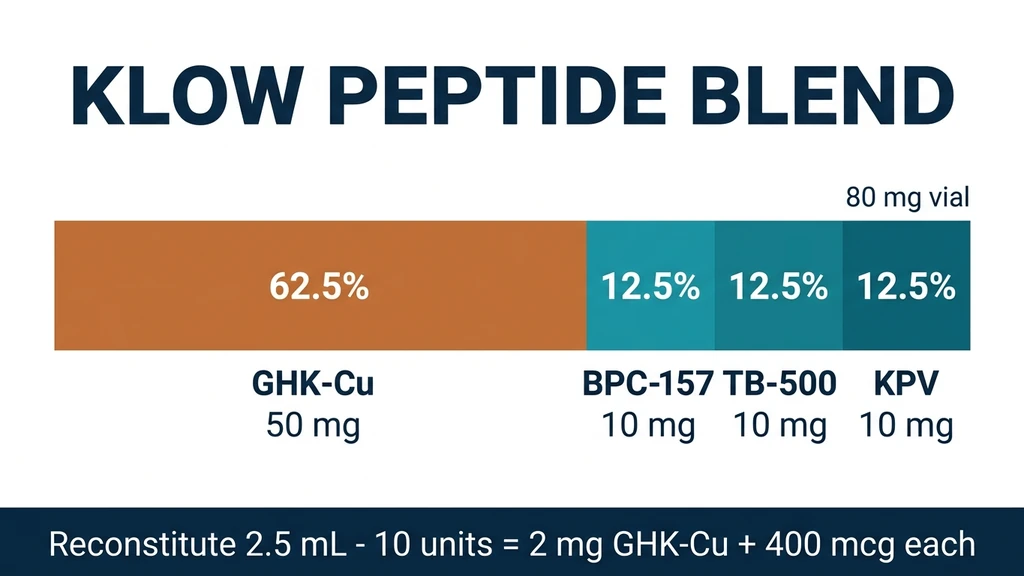
You are holding an 80 mg vial labeled KLOW and there is no dosing insert in the box. KLOW is a compounded four-peptide blend: 50 mg GHK-Cu, 10 mg BPC-157, 10 mg TB-500, and 10 mg KPV. Reconstituted with 2.5 mL of bacteriostatic water, a 10-unit draw delivers 2 mg GHK-Cu plus 400 mcg each of BPC-157, TB-500, and KPV. That vial holds 25 doses.
| Quick Reference | Details |
|---|---|
| What KLOW contains | GHK-Cu, BPC-157, TB-500, KPV |
| Standard vial | 80 mg lyophilized |
| Component split | 50 / 10 / 10 / 10 mg |
| Common reconstitution | 2.5 mL bacteriostatic water |
| Per-dose volume | 0.1 mL (10 units on a U-100 syringe) |
| Per-dose delivery | 2 mg GHK-Cu, 400 mcg each of the rest |
| Doses per vial | 25 |
| Typical cycle | 4 weeks daily, then taper |
| FDA status | Not approved; compounded, research-use labeling |
| Difference from GLOW | GLOW omits KPV (70 mg, three peptides) |
No regulator has approved KLOW as a drug. It is a vendor-assembled mixture, and the evidence supporting each individual peptide is far stronger than the evidence supporting the four of them injected together. Nobody has run a clinical trial on this blend. What follows is what the component research shows, what the arithmetic on the vial says, and where the dosing goes wrong.
Get your custom peptide protocol:
- Tailored to your body and goals
- Precise dosing and cycle length
- Safe stacking combinations
- Backed by peer-reviewed studies
- Ready in under 2 minutes
What Is Actually in a KLOW Blend Peptide Vial
The dominant formulation across vendors is 80 mg total: 50 mg GHK-Cu, 10 mg BPC-157, 10 mg TB-500 (thymosin beta-4 fragment), and 10 mg KPV. GHK-Cu makes up 62.5% of the vial by mass. The other three split the remainder evenly.
Vendors do not agree on what the letters stand for, and several offer variants. A minority sell a five-peptide version that adds 5 mg of LL-37, and at least one substitutes thymosin alpha-1 for TB-500. If your label lists anything beyond the four core peptides, the dosing math below does not apply to your vial.
Check the label before you reconstitute anything. A 70 mg vial is almost certainly GLOW, not KLOW, and drawing a KLOW volume from it changes what you receive.
The blend is compounded, which means someone weighed four powders and lyophilized them together. Purity, ratio accuracy, and endotoxin load depend entirely on that vendor. The FDA placed BPC-157 in Category 2 of its 503A bulk substances review, meaning significant safety concerns, so no licensed compounding pharmacy in the United States legally makes this blend for patient use.
Why a Blend Behaves Differently Than Four Separate Vials
A blend is a spice mix. You bought the jar because the four ingredients belong together, but the ratio was fixed by whoever filled it. When you want more cumin, you shake harder and you also get more cayenne, whether you wanted it or not.
Literally: in KLOW, GHK-Cu is locked at a 5:1 ratio against every other component. Raise your dose to get 800 mcg of BPC-157 and you have simultaneously raised GHK-Cu to 4 mg. You cannot tune one peptide without tuning all four.
That matters because GHK-Cu is the component with a hard ceiling. Copper accounts for roughly 16% of GHK-Cu by mass (63.5 g/mol of copper in a complex near 404 g/mol), so a 2 mg GHK-Cu dose carries about 314 mcg of elemental copper straight past the intestine. The gut normally regulates copper absorption. A subcutaneous injection does not consult it.
Separate vials cost more and take more time. They also let you run 500 mcg of BPC-157 daily while holding GHK-Cu at three times a week, which is closer to how the GHK-Cu injection frequency research actually reads. Weigh that against the convenience before committing to a blend. Our peptide stacking guide covers when a fixed ratio helps and when it handcuffs you.
KLOW Peptide Benefits: What Each Component Has Evidence For
Every claim below belongs to a single peptide studied alone. None of it was measured on the blend.
GHK-Cu. The tripeptide glycyl-L-histidyl-L-lysine bound to copper stimulates collagen and glycosaminoglycan synthesis, upregulates antioxidant defenses, and modulates genes tied to tissue remodeling (Pickart & Margolina, Int J Mol Sci, 2018). This is the skin and wound-repair engine of the blend, and it is the reason KLOW gets marketed for aesthetics. See GHK-Cu benefits for the full picture.
BPC-157. A 15-amino-acid sequence from gastric juice. In rat tendon models it promoted fibroblast outgrowth, survival, and migration through FAK-paxillin signaling (Chang et al., J Appl Physiol, 2011). Every published efficacy result is animal data. No human trial has confirmed a healing benefit at any dose.
TB-500. A synthetic fragment of thymosin beta-4, an actin-sequestering protein. Topical and systemic thymosin beta-4 accelerated dermal wound closure and promoted keratinocyte migration and angiogenesis in rodent models (Malinda et al., J Invest Dermatol, 1999; Goldstein et al., Trends Mol Med, 2005). Read what TB-500 does for the mechanism in plain terms.
KPV. Lysine-proline-valine, the C-terminal tripeptide of alpha-MSH. Oral KPV taken up through the PepT1 transporter reduced colonic inflammation in mouse colitis at doses several orders of magnitude below alpha-MSH (Dalmasso et al., Gastroenterology, 2008). KPV is the one component in KLOW that targets inflammatory signaling rather than structural repair, which is the entire argument for choosing KLOW over GLOW. See KPV dosage.
Four peptides with four separate mechanisms, mixed in one syringe, tested together by nobody. Treat the blend as an extrapolation, and read peptides for inflammation for how these pathways overlap.
Two Dosing Errors That Change Your Dose by 2.5x
Reconstitution volume is the only variable that decides what leaves the syringe. Get it wrong and the label on the vial tells you nothing about what entered your body.
Error 1: reconstituting 80 mg with 1 mL instead of 2.5 mL. The vial now holds 80 mg/mL. A 10-unit draw (0.1 mL) delivers 8 mg of blend: 5 mg GHK-Cu, 1 mg BPC-157, 1 mg TB-500, 1 mg KPV. That is 2.5 times the intended amount of every peptide. The copper load per injection rises from 314 mcg to roughly 785 mcg, injected daily, bypassing the intestinal absorption control that keeps dietary copper in check. Your 25-dose vial is also now a 10-dose vial. The fix: confirm your bacteriostatic water volume with the peptide reconstitution calculator before the needle touches the stopper.
Error 2: reconstituting with 5 mL and drawing 10 units anyway. At 16 mg/mL, a 10-unit draw gives 1.6 mg of blend: 1 mg GHK-Cu and 200 mcg of each other peptide. Half the intended dose. Users then run six weeks, see nothing, and conclude KLOW does not work. At 5 mL the correct draw is 20 units. The fix: recalculate the draw every time you change the diluent volume, and use the peptide unit converter to translate mg into syringe units.
Error 3: running KLOW on top of a separate BPC-157 and TB-500 protocol. A standard BPC-157 and TB-500 stack runs 500 mcg BPC-157 daily and 2.5 mg TB-500 twice weekly. Add daily KLOW and you are at 900 mcg BPC-157 per day and 7.8 mg TB-500 per week, roughly 1.6 times the stack's own weekly target, plus 2 mg of daily GHK-Cu you never planned for. The fix: run one or the other. Check overlaps with the peptide interaction checker.
None of these produce a dramatic emergency. They produce injection-site welts, prolonged nausea, a copper burden nobody is tracking, and a wasted 12-week cycle. Review BPC-157 and TB-500 side effects and GHK-Cu side effects before you start.
KLOW Peptide Dosing: Reading the Vial and Drawing the Volume
Here is the skill nobody teaches. An 80 mg vial does not contain 80 mg of anything you inject directly. It contains a dry cake that becomes a concentration only after you add water.
Step 1: Divide. Total mg divided by mL of bacteriostatic water equals mg/mL. 80 mg into 2.5 mL is 32 mg/mL.
Step 2: Find your per-unit value. On a U-100 insulin syringe, 1 unit equals 0.01 mL. At 32 mg/mL, each unit carries 0.32 mg of total blend.
Step 3: Split it four ways. Of that 0.32 mg per unit, 62.5% is GHK-Cu (0.2 mg) and 12.5% each is BPC-157, TB-500, and KPV (0.04 mg, or 40 mcg). Multiply by 10 units and you have the standard dose.
Step 4: Add the water slowly. Angle the needle so the stream runs down the inside glass wall, never directly onto the powder cake. GHK-Cu turns the solution a clear blue. Cloudiness or particulates mean discard.
Step 5: Swirl, never shake. Roll the vial between your palms for 30 seconds. Let it sit until fully dissolved rather than agitating it.
Use only bacteriostatic water for a multi-dose vial. Sterile water has no preservative and turns a 25-dose vial into a same-day vial (bacteriostatic water vs sterile water). Once mixed, refrigerate at 2-8°C; see how long reconstituted peptides last and how to store peptides.
Inject subcutaneously into abdominal fat two inches from the navel, rotating sites. GHK-Cu stings more than most peptides, and injection-site redness lasting an hour is common at 2 mg. Where to inject GHK-Cu and how to inject peptides cover technique. For a female-specific per-day protocol, see KLOW peptide dose per day for females.
KLOW Dosage Chart: Per-Component Delivery by Reconstitution Volume
Every row assumes a standard 80 mg KLOW vial (50 / 10 / 10 / 10 mg). Units refer to a U-100 insulin syringe.
| BAC Water | Concentration | Draw | GHK-Cu | BPC-157 | TB-500 | KPV | Doses/Vial |
|---|---|---|---|---|---|---|---|
| 1 mL | 80 mg/mL | 10 units | 5 mg | 1 mg | 1 mg | 1 mg | 10 |
| 2 mL | 40 mg/mL | 10 units | 2.5 mg | 500 mcg | 500 mcg | 500 mcg | 20 |
| 2.5 mL | 32 mg/mL | 10 units | 2 mg | 400 mcg | 400 mcg | 400 mcg | 25 |
| 2.5 mL | 32 mg/mL | 5 units | 1 mg | 200 mcg | 200 mcg | 200 mcg | 50 |
| 3 mL | 26.7 mg/mL | 10 units | 1.67 mg | 333 mcg | 333 mcg | 333 mcg | 30 |
| 5 mL | 16 mg/mL | 20 units | 2 mg | 400 mcg | 400 mcg | 400 mcg | 25 |
| 5 mL | 16 mg/mL | 10 units | 1 mg | 200 mcg | 200 mcg | 200 mcg | 50 |
The 2.5 mL / 10 unit and 5 mL / 20 unit rows deliver identical peptide amounts. The 5 mL version simply gives you a larger, easier-to-read draw on the syringe barrel.
Common cycle structure across vendor protocols: daily for weeks 1-4, five days per week for weeks 5-8, then two to three days per week as maintenance. Twelve weeks at that schedule consumes roughly three vials. Copper load across those three vials is about 23.5 mg of elemental copper, averaging 280 mcg per day, which is why cycling off matters. Compare against the standalone GHK-Cu dosage chart and BPC-157 dosage calculator if you would rather dose the components separately. Run the numbers on cost with the peptide cost calculator.
KLOW vs GLOW Peptide: The One-Ingredient Difference
GLOW is a 70 mg three-peptide blend: 50 mg GHK-Cu, 10 mg BPC-157, 10 mg TB-500. KLOW is that same vial with 10 mg of KPV added. Nothing else changes.
| Attribute | GLOW | KLOW |
|---|---|---|
| Peptides | 3 | 4 |
| Total mass | 70 mg | 80 mg |
| GHK-Cu | 50 mg | 50 mg |
| BPC-157 | 10 mg | 10 mg |
| TB-500 | 10 mg | 10 mg |
| KPV | None | 10 mg |
| Added mechanism | Structural repair only | Structural repair + immune signaling |
| Per 10 units at 2.5 mL | 2.5 mg / 500 mcg / 500 mcg | 2 mg / 400 mcg x3 |
| Typical use case | Skin texture, tone, tissue repair | Repair where inflammation dominates |
The dosing consequence is easy to miss. Reconstitute both with 2.5 mL and draw 10 units: GLOW is 28 mg/mL and delivers 2.5 mg of GHK-Cu, while KLOW is 32 mg/mL and delivers 2 mg. Same volume, 20% less copper peptide, because the KPV displaced it in the concentration.
KPV is the reason to pay more. It downregulates NF-kappaB and inflammatory cytokine production (Dalmasso et al., Gastroenterology, 2008), which is a different job from collagen synthesis. If your target is post-procedure redness, inflammatory acne, rosacea-adjacent flushing, or gut inflammation, KPV earns its place. If your target is skin texture and elasticity, GLOW does the same work with one fewer variable.
Neither blend has a trial behind it. The full breakdown of the three-peptide version lives in our GHK-Cu, BPC-157, TB-500 blend guide and its GLOW peptide dosage companion. For a heavier tissue-repair protocol, compare against the Wolverine peptide stack.
Common Mistakes With KLOW
Mistake 1: Dosing KLOW by total milligrams. People read "3.2 mg per dose" and compare it to a 500 mcg BPC-157 protocol, concluding they are underdosed. In reality 3.2 mg of blend is 400 mcg of BPC-157 and 2 mg of GHK-Cu. The fix: always convert to per-component amounts using the chart above before comparing to any single-peptide protocol.
Mistake 2: Ignoring cumulative copper. Daily 2 mg GHK-Cu delivers roughly 314 mcg of injected elemental copper, on top of an average dietary intake near 1,400 mcg. Injected copper skips the intestinal gate that normally limits absorption. The fix: run four weeks daily at most, then taper to two or three sessions per week, and stop between cycles. If you stop GHK-Cu, what happens covers the washout.
Mistake 3: Assuming the blend was tested as a blend. No trial, human or animal, has evaluated GHK-Cu, BPC-157, TB-500, and KPV administered together. Vendor claims for the blend are stitched together from four separate literatures. The fix: judge KLOW by the weakest evidence among its components, which is BPC-157 (animal models only).
Mistake 4: Injecting GHK-Cu at 2 mg into thin subcutaneous tissue. Copper peptide is the most irritating component, and shallow injections raise welt and discoloration risk. Some users report lasting skin reactions (copper peptides ruined my skin). The fix: use abdominal fat, rotate sites, and read the peptide safety guide before your first dose.
Frequently Asked Questions
What are the benefits of KLOW peptide?
Each component has separate evidence: GHK-Cu for collagen synthesis and tissue remodeling, BPC-157 for tendon and gut repair in rodents, TB-500 for wound closure and angiogenesis, and KPV for inflammatory signaling. No study has tested the four together. See GHK-Cu benefits for the strongest component evidence.
What is the standard KLOW peptide dosage?
Reconstitute an 80 mg vial with 2.5 mL bacteriostatic water for 32 mg/mL, then draw 10 units on a U-100 syringe. That delivers 2 mg GHK-Cu and 400 mcg each of BPC-157, TB-500, and KPV. One vial yields 25 doses. Verify your volume with the peptide reconstitution calculator.
What exactly is in a KLOW blend peptide vial?
The standard 80 mg vial contains 50 mg GHK-Cu, 10 mg BPC-157, 10 mg TB-500, and 10 mg KPV. A minority of vendors sell variants adding 5 mg LL-37 or swapping thymosin alpha-1 for TB-500. Read the label, because dosing math changes. See KPV dosage and LL-37 benefits.
What is the difference between KLOW and GLOW peptide?
GLOW is a 70 mg three-peptide blend of GHK-Cu, BPC-157, and TB-500. KLOW adds 10 mg of KPV, an anti-inflammatory tripeptide, bringing the vial to 80 mg. The added mass also drops GHK-Cu delivery per 10-unit draw from 2.5 mg to 2 mg. See the GHK-Cu, BPC-157, TB-500 blend guide.
How often should you inject KLOW?
Common vendor protocols run daily for weeks 1-4, five days weekly for weeks 5-8, then two to three days weekly for maintenance. Twelve weeks consumes about three vials and roughly 23.5 mg of injected elemental copper. Cycling off matters for that reason. Compare with GHK-Cu injection frequency.
Is KLOW peptide FDA approved?
No. KLOW is a compounded blend sold with research-use labeling, and BPC-157 sits in Category 2 of the FDA's 503A bulk substances review, flagged for significant safety risks. No licensed pharmacy legally compounds it for patient use. See the FDA peptide crackdown and are peptides legal.
Can you stack KLOW with other peptides?
Adding a separate BPC-157 and TB-500 protocol pushes you to roughly 900 mcg BPC-157 daily and 7.8 mg TB-500 weekly, well above either protocol's own target, plus unplanned daily copper. Run one or the other. Check overlaps with the peptide interaction checker.
What are the side effects of KLOW?
Injection-site stinging, redness, and welts are the most reported, driven largely by the 2 mg GHK-Cu dose. Nausea and lightheadedness appear with the BPC-157 and TB-500 components. Cumulative copper is the underdiscussed risk on daily protocols. Review GHK-Cu side effects and BPC-157 and TB-500 side effects.
The Bottom Line
KLOW is 50 mg GHK-Cu, 10 mg BPC-157, 10 mg TB-500, and 10 mg KPV in one 80 mg vial. Reconstituted with 2.5 mL of bacteriostatic water, a 10-unit draw delivers 2 mg GHK-Cu and 400 mcg of each remaining peptide, 25 doses per vial. GLOW is the same blend minus the KPV.
The principle that governs every blend: the ratio was decided by the vendor, not by your goal. Raising the dose to chase one component drags the other three along, and in KLOW the one being dragged is a copper complex your gut never gets to regulate. Judge the blend by its weakest component evidence, which is animal-only for BPC-157.
Confirm your concentration before you draw with the peptide reconstitution calculator, translate milligrams into syringe units with the peptide unit converter, and screen your stack with the peptide interaction checker. Explore the full peptide library at peptidesexplorer.com. This is educational content, not medical advice. Work with a licensed clinician before injecting anything.
Related Articles
Peptides for Healing: What the Evidence Shows
Peptides for healing by tissue: tendon, bone, wound, gut, post-surgery. Which claims rest on human trials, which rest on rat studies, and what is unsafe.
Regenerative Peptides: Full Guide
Compare the 7 most studied regenerative peptides for tissue repair: BPC-157, TB-500, GHK-Cu, KPV, thymosin alpha-1, MOTS-c, and IGF-1 LR3.
How to Take BPC-157: Dosage and Timing
How to take BPC-157: inject 250-500 mcg subcutaneously near the injury once daily for 4-8 weeks. Reconstitution, dosing, and cycle length.
How Long Do Reconstituted Peptides Last?
Reconstituted peptide shelf life by type: BPC-157, semaglutide, TB-500, GHK-Cu. Bac water vs sterile water, storage temps, and signs of degradation.