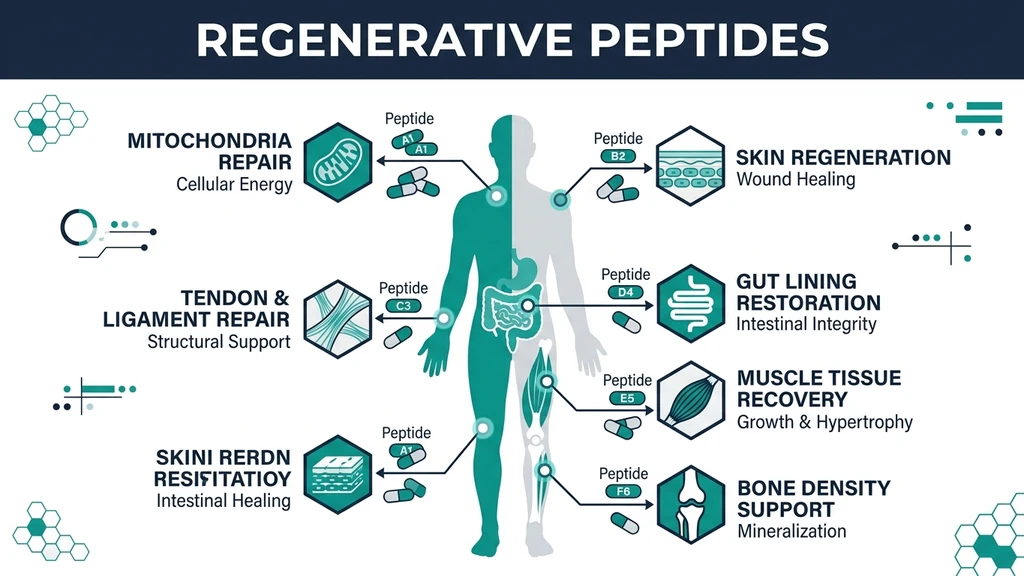
You tore something in the gym, or you are reading a supplier menu trying to figure out which peptide actually rebuilds tissue and which one is hype. The category is crowded and the marketing rarely tells you what each one repairs. Regenerative peptides are short chains of amino acids that signal the body to repair and rebuild tissue, and the most studied ones target distinct sites: BPC-157 and TB-500 for tendon, ligament, and muscle, GHK-Cu for skin and connective tissue, KPV and thymosin alpha-1 for gut and immune repair, MOTS-c for mitochondrial and metabolic recovery, and IGF-1 LR3 for muscle growth. The right choice depends entirely on the tissue you want to fix.
| Peptide | Primary Regenerative Target | Mechanism (short) | Evidence Level | Typical Research Dose |
|---|---|---|---|---|
| BPC-157 | Tendon, ligament, gut | VEGF/angiogenesis, GH-receptor upregulation | Strong preclinical, limited human | 250-500 mcg/day |
| TB-500 (thymosin beta-4) | Muscle, tendon, wounds | G-actin sequestration, cell migration, anti-fibrotic | Strong preclinical | 2-2.5 mg, 2x/week |
| GHK-Cu | Skin, connective tissue | Collagen/elastin synthesis, MMP/TIMP balance | Moderate (in-vitro + topical human) | 1-2 mg/day or topical |
| KPV | Gut, inflamed skin | NF-kB/MAPK inhibition via PepT1 | Preclinical | 250-500 mcg/day |
| Thymosin alpha-1 | Immune-driven repair | TLR9, T-cell maturation, cytokine modulation | Human (approved abroad) | 1.6 mg, 2x/week |
| MOTS-c | Mitochondria, metabolism | AMPK activation, exercise mimetic | Emerging preclinical | 5-10 mg/week |
| IGF-1 LR3 | Skeletal muscle | IGF-1R, satellite cell activation | Preclinical/applied | 20-50 mcg/day |
These are research-reference figures, not prescriptions. Every peptide below is sold for laboratory use only in the United States, with thymosin alpha-1 the one exception that carries human approval abroad. Cross-check each dose against the linked profile and treat this as education, not medical advice. For the canonical recovery pairing, start with BPC-157 vs TB-500.
Get your custom peptide protocol:
- Tailored to your body and goals
- Precise dosing and cycle length
- Safe stacking combinations
- Backed by peer-reviewed studies
- Ready in under 2 minutes
What Are Regenerative Peptides?
Regenerative peptides are short amino-acid chains that act as signaling molecules, telling cells when to migrate, divide, build matrix, or stand down inflammation. They do not replace tissue directly. They orchestrate the cells that do.
The word "regenerative" separates this category from metabolic peptides. GLP-1 drugs like semaglutide and tirzepatide change appetite and glucose handling. Regenerative peptides instead push the biology of repair: new blood vessels, fresh collagen, and resolved inflammation.
Five pillars define how any tissue rebuilds. Blood supply restores oxygen and nutrients through angiogenesis. Cell migration brings repair cells to the injury. Matrix building lays down collagen and elastin scaffolding. Inflammation resolution clears the wound without scarring it shut. Mitochondrial energy powers the entire process.
A review of therapeutic peptides in orthopaedics frames this category around exactly these repair signals, mapping individual peptides to angiogenesis, cell proliferation, and matrix remodeling (PMC12753158). Each peptide here owns one or two of the five pillars. None covers all five, which is why stacking exists. If you are new to the category, the getting started with peptides primer covers the basics first.
BPC-157: Tendon, Ligament, and Gut Repair
BPC-157 is the most cited tissue repair peptide for connective tissue and the gut. It is a synthetic fragment of a protein found in gastric juice, which is why it earned the "body protection compound" nickname.
Mechanism. BPC-157 drives angiogenesis by upregulating VEGF and its receptor VEGFR2, working through the VEGFR2-Akt-eNOS pathway to grow new blood vessels into damaged tissue (PMID 20388964). It also raises growth hormone receptor expression in tendon fibroblasts, which increases their proliferation and ramps up the repair response (PMC6271067). A review of its nitric-oxide-system effects ties these angiogenic actions together across multiple tissue types (PMC12195719).
What it regenerates. Tendon, ligament, muscle, and gastrointestinal mucosa. The angiogenesis-plus-fibroblast combination makes it the default choice for slow-healing connective tissue and gut lining.
Evidence level. Strong in rodent models, limited in humans. The preclinical record is deep and consistent, but controlled human trials remain scarce, so treat the dosing as research reference.
Typical research protocols run 250 to 500 mcg per day. For the full picture see the BPC-157 profile, the detailed BPC-157 benefits breakdown, and how to inject BPC-157 for technique.
TB-500 / Thymosin Beta-4: Muscle, Tendon, and Wound Healing
TB-500 is the synthetic version of thymosin beta-4, a peptide your body already uses during wound healing. It pairs naturally with BPC-157 because the two work on different parts of the same repair sequence.
Mechanism. Thymosin beta-4 binds G-actin one-to-one, building an actin reservoir that cells draw on to move toward an injury (PMID 14500546). That same actin-binding site promotes angiogenesis. It also activates ILK-Akt survival signaling, pushes macrophages toward inflammation resolution, and reduces fibrosis by modulating myofibroblasts, so wounds close with less scar tissue.
What it regenerates. Skeletal muscle through satellite cell chemoattraction, tendon, skin and wounds, and the vasculature. A scoping review of thymosin beta-4 catalogs its role across musculoskeletal and wound repair (MDPI 16/12/6202).
Evidence level. Strong preclinical. In a rat wound model, re-epithelialization improved by 42 percent at day 4 and 61 percent at day 7, the kind of quantified result that makes it a staple of the recovery literature.
Research doses cluster around 2 to 2.5 mg, twice weekly. See the TB-500 profile, the deeper what does TB-500 do explainer, and BPC-157 vs TB-500 to understand why the two are run together.
GHK-Cu: Skin and Connective Tissue Remodeling
GHK-Cu is a copper-binding tripeptide and the leading peptide for skin and connective tissue. Copper sits at the center of its activity, which is why it is sold as a blue solution.
Mechanism. GHK-Cu transactivates the EGFR pathway and upregulates type I and III collagen, with fibroblast cultures showing collagen increases above 70 percent (PMC4508379). It also boosts elastin and glycosaminoglycans, the molecules that hold water and bounce in skin, and balances MMP and TIMP enzymes so the matrix remodels instead of degrading. Its gene-modulating reach is broad, touching thousands of genes tied to tissue repair.
What it regenerates. Skin, dermis, hair follicles, connective tissue, and wound beds. A review of tripeptides in wound healing places GHK-Cu among the most active small peptides for skin regeneration (medsci.org v22p4175).
Evidence level. Moderate. The in-vitro data is strong and topical human cosmetic data is solid, but injectable human trials are thin.
Research use runs 1 to 2 mg per day by injection, or topically in serums. See GHK-Cu benefits, GHK-Cu for hair growth, and the broader what do peptides do for skin overview.
KPV: Gut and Anti-Inflammatory Repair
KPV is the smallest peptide here, a three-amino-acid tail end of the alpha-MSH hormone. Its job is to calm inflammation so damaged tissue can rebuild.
Mechanism. KPV works without binding a classic cell-surface receptor. The PepT1 transporter carries it directly into intestinal and colonic cells, where it inhibits the NF-kB and MAPK signaling pathways and lowers pro-inflammatory cytokine output (PMID 12750433). Less inflammation means the gut lining stops getting attacked and can heal.
What it regenerates. Gut mucosa in colitis and inflammatory bowel disease models, plus inflamed skin. A review of alpha-MSH-related peptides documents this anti-inflammatory mechanism across tissues (PMID 17934097).
Evidence level. Preclinical. Two separate murine IBD models showed reduced colonic damage, but human data is not yet established.
Research protocols run 250 to 500 mcg per day. For dosing and timing detail, see KPV peptide dosage and the broader peptides for gut health guide, since KPV is often layered into a gut-repair stack.
Thymosin Alpha-1: Immune-Driven Repair
Thymosin alpha-1 is a 28-amino-acid thymic peptide and the one entry here with a genuine human track record. It repairs by tuning the immune system rather than building tissue directly.
Mechanism. Thymosin alpha-1 signals through TLR9 on dendritic cells, driving T-cell maturation and raising IL-2 and interferon-gamma while lowering TNF-alpha and IL-6 (Nature s41598-018-30956-y). It also stimulates cell migration and wound re-epithelialization, linking immune balance to the physical close of a wound.
What it regenerates. Immune resilience that underpins all repair, plus direct wound healing shown in rat models. A balanced immune response is what lets every other repair pillar function.
Evidence level. The strongest human evidence in this group. Thymosin alpha-1 is approved as Zadaxin in several countries for immune indications, which puts it in a different regulatory class from the research-only peptides around it.
Research doses run near 1.6 mg, twice weekly. See thymosin alpha-1 benefits and the wider peptides for immune system overview for context on where it fits.
MOTS-c: Mitochondrial and Metabolic Recovery
MOTS-c is unusual. It is a 16-amino-acid peptide encoded inside mitochondrial DNA, the body's own signal for metabolic and energetic recovery. It repairs the engine rather than the chassis.
Mechanism. MOTS-c activates AMPK, the cellular energy sensor, and regulates PGC-1alpha to improve insulin sensitivity and glucose metabolism. It behaves like an exercise mimetic, switching on many of the same pathways a hard workout would (Nature s41598-021-99568-3).
What it regenerates. Mitochondrial function, metabolic homeostasis, and physical capacity. MOTS-c levels decline with age, and a review of its role in diabetes and aging ties that drop to metabolic decline (e-dmj 2725).
Evidence level. Emerging preclinical. Rodent data is encouraging and early human plasma correlations exist, but controlled human dosing trials are still missing.
Research use runs 5 to 10 mg per week. See MOTS-c dosage for protocol detail and peptides for energy for how mitochondrial peptides fit the wider recovery picture.
IGF-1 LR3: Muscle Growth and Repair
IGF-1 LR3 is the most potent muscle-building peptide here and the highest-risk. It is a long-acting analog of insulin-like growth factor 1, engineered to stay active in the blood far longer than the natural hormone.
Mechanism. IGF-1 LR3 binds the IGF-1 receptor and activates the PI3K/Akt/mTOR and MAPK/ERK pathways. Its defining action is potent activation of satellite cells, the muscle stem cells that fuse into fibers to drive hypertrophy and repair (PMC8968951).
What it regenerates. Skeletal muscle, with research interest in models of muscle wasting and sarcopenia. The satellite-cell mechanism is what separates growth from simple recovery.
Evidence level. Preclinical and applied research. The growth signal is powerful, but so is the risk profile, since broad IGF-1R activation touches many tissues and raises safety questions that the gentler peptides do not.
Research doses run 20 to 50 mcg per day. See the IGF-1 LR3 protocol, the IGF-1 LR3 results breakdown, and peptides for muscle growth before considering it.
How Regenerative Peptides Work and How They Stack
Map the seven peptides onto the five pillars and the logic of stacking becomes obvious. BPC-157 and TB-500 own angiogenesis and cell migration. GHK-Cu owns matrix building. KPV and thymosin alpha-1 own inflammation resolution. MOTS-c owns mitochondrial energy. No single peptide covers all five, so stacks combine peptides that fill different gaps.
BPC-157 plus TB-500 is the canonical recovery stack because the two are complementary, not redundant. BPC-157 grows blood vessels and recruits local growth factors into the injury. TB-500 moves repair cells in and suppresses the fibrosis that would otherwise scar the tissue. Together they cover blood supply, migration, and clean healing.
GHK-Cu gets added when skin or connective tissue is the goal, layering matrix synthesis onto the recovery base. KPV gets layered in when gut or systemic inflammation is driving the damage, since calming inflammation lets the rebuild pillars work. This is the difference between peptides for joint pain protocols and skin or gut protocols.
Cycle framing matters. Tissue repair stacks are typically run in 4 to 6 week blocks, with skin and longevity goals often run longer because matrix remodeling is slow. Doses here are research-reference figures, and every peptide except thymosin alpha-1 is sold for laboratory use only, with no prescription protection.
Before stacking anything, read the peptide stacking guide and the peptide safety guide, and model your combination with the peptide stack calculator. For ready-made recovery framing, the peptides for recovery and best peptides for tendon repair guides translate these mechanisms into protocols.
Frequently Asked Questions
What are regenerative peptides?
Regenerative peptides are short amino-acid chains that signal cells to repair and rebuild tissue. They drive angiogenesis, collagen synthesis, cell migration, and inflammation control. The most studied are BPC-157, TB-500, GHK-Cu, KPV, thymosin alpha-1, MOTS-c, and IGF-1 LR3. Start with getting started with peptides for the basics.
What is the best regenerative peptide for tendon and joint repair?
BPC-157 and TB-500 are the most cited for tendon, ligament, and joint tissue. BPC-157 drives angiogenesis and growth hormone receptor expression in tendon fibroblasts, while TB-500 promotes cell migration and reduces scar tissue. They are commonly researched together. See best peptides for tendon repair for protocols.
Which regenerative peptide is best for skin?
GHK-Cu is the leading skin and connective-tissue peptide. It upregulates type I and III collagen, elastin, and glycosaminoglycans while balancing matrix remodeling through MMP and TIMP enzymes. It works both topically and by injection. The GHK-Cu benefits guide covers dosing and the full skin mechanism.
Can you stack regenerative peptides?
Yes. BPC-157 plus TB-500 is the canonical recovery stack because their mechanisms are complementary, covering angiogenesis, migration, and anti-fibrotic healing. GHK-Cu is added for skin and connective tissue, and KPV is layered in for gut and inflammation. Follow research protocols in the peptide stacking guide.
Are regenerative peptides FDA-approved?
Most are not approved for human use in the United States and are sold for research only. Thymosin alpha-1 is the exception, approved as Zadaxin in several countries for immune indications. Treat the rest as research compounds with no prescription protection. The peptide safety guide covers the legal and safety reality.
How long do regenerative peptides take to work?
Tissue repair peptides are typically cycled in 4 to 6 week blocks, with skin and longevity goals often run longer because matrix remodeling is slow. Timelines vary by peptide, dose, and the tissue involved. Preclinical data is far stronger than long-term human evidence. See peptides for recovery for realistic timelines.
What is the difference between regenerative peptides and GLP-1 peptides?
Regenerative peptides target tissue repair across tendon, muscle, skin, gut, and mitochondria. GLP-1 peptides like semaglutide and tirzepatide target metabolism and weight loss instead. They serve entirely different goals and work through unrelated pathways, so a recovery peptide will not drive fat loss.
Which regenerative peptide has the strongest human evidence?
Thymosin alpha-1 has the strongest human track record, with regulatory approval abroad for immune indications. BPC-157 and TB-500 have robust preclinical data but limited human trials, while MOTS-c and IGF-1 LR3 remain mostly preclinical. The thymosin alpha-1 benefits guide covers its clinical record.
The Bottom Line
Regenerative peptides are short amino-acid chains that signal the body to repair tissue, and the seven most studied each own a different site: BPC-157 and TB-500 for tendon, ligament, and muscle, GHK-Cu for skin and connective tissue, KPV and thymosin alpha-1 for gut and immune repair, MOTS-c for mitochondria, and IGF-1 LR3 for muscle growth.
The principle that ties them together is the five pillars of repair: blood supply, cell migration, matrix building, inflammation resolution, and mitochondrial energy. No single peptide covers all five, which is why the canonical stacks pair complementary mechanisms like BPC-157 with TB-500 and add GHK-Cu or KPV for the tissue in front of you.
Match the peptide to the tissue, respect the evidence levels, and model any combination with the peptide stack calculator before sourcing. Learn more at peptidesexplorer.com.
This is educational content, not medical advice. Every peptide here except thymosin alpha-1 is sold for laboratory use only. Consult a healthcare provider before starting any peptide protocol.
Related Articles: - BPC-157 vs TB-500 - Best Peptides for Tendon Repair - Peptides for Recovery - Peptide Stacking Guide - GHK-Cu Benefits - Peptides for Muscle Growth - Peptides for Gut Health
Related Articles
Peptides for Healing: What the Evidence Shows
Peptides for healing by tissue: tendon, bone, wound, gut, post-surgery. Which claims rest on human trials, which rest on rat studies, and what is unsafe.
KLOW Peptide: Benefits, Dosage, and KLOW vs GLOW
KLOW peptide benefits, blend composition (GHK-Cu, BPC-157, TB-500, KPV), per-component dosing math, the copper ceiling, and how KLOW differs from GLOW.
How Long Do Reconstituted Peptides Last?
Reconstituted peptide shelf life by type: BPC-157, semaglutide, TB-500, GHK-Cu. Bac water vs sterile water, storage temps, and signs of degradation.
BPC-157 TB-500 Capsules: Oral Blend Guide
BPC-157 TB-500 capsules: oral bioavailability data, dosage protocols, side effects, and buyer checklist. TB-500 oral evidence gap explained.