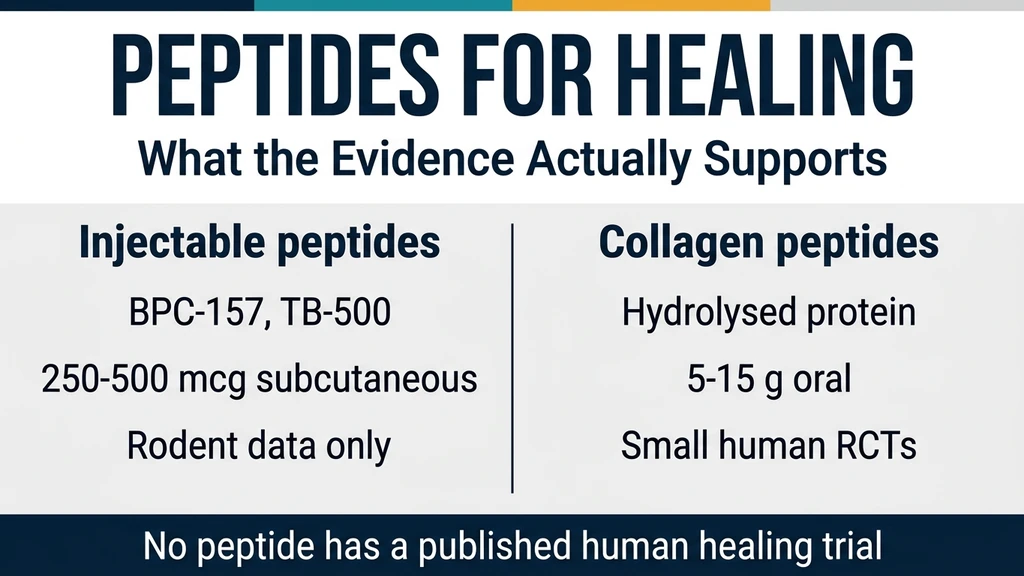
You tore a tendon, or you are three weeks post-op and the scar still feels wrong, and somebody in a forum told you a peptide would fix it. Here is the direct answer: no peptide has been shown to speed tissue healing in a published human efficacy trial. BPC-157 and TB-500 rest entirely on animal data. Collagen peptides, a separate product category, do have small human trials.
| Tissue | Peptide most discussed | Evidence tier | Human efficacy trials? |
|---|---|---|---|
| Tendon | BPC-157, TB-500 | Rat tendon and cell culture | No |
| Tendon (oral supplement) | Collagen peptides | Randomised human pilot (n=20) | Yes |
| Ligament | BPC-157 | Rat ligament transection | No |
| Bone | BPC-157 | Rabbit segmental defect | No |
| Bone density | Collagen peptides | Randomised human trial (n=131) | Yes |
| Skin and wound | GHK-Cu | Preclinical, cosmetic formulation | Limited |
| Pressure ulcers | Collagen hydrolysate | Randomised human trial (n=89) | Yes |
| Gut lining | BPC-157 | Rat ulcer and fistula models | No |
| Post-surgical | Any of the above | None | No |
Two things follow from that table. Everything sold as a healing peptide injection is supported by rodents. Everything supported by humans is a powder you drink, and it is a different molecule doing a different job. Sorting out which one you are actually looking at is most of the work, and the BPC-157 vs TB-500 comparison is the next question most people ask once they get there.
This page is educational and is not medical advice. Talk to a clinician before using any of it, especially after surgery.
Get your custom peptide protocol:
- Tailored to your body and goals
- Precise dosing and cycle length
- Safe stacking combinations
- Backed by peer-reviewed studies
- Ready in under 2 minutes
Healing Runs on a Schedule, and Peptides Only Talk to the Crew Already on Site
Think about a house going up. Foundation, framing, rough electrical, insulation, drywall, paint. You can hire more electricians and finish the rough-in faster. You cannot hire more painters and skip drywall, and no amount of shouting at the crew makes concrete cure in a day.
Tissue repair works the same way. Bleeding stops, inflammation clears the debris, proliferation lays down new vessels and disorganised collagen, and remodelling slowly reorganises that collagen along lines of load. Each phase depends on the one before it finishing.
Signalling peptides act inside the proliferation phase. BPC-157 promotes new vessel growth through VEGFR2 activation and the Akt-eNOS pathway, shown in chick membrane, rat hind-limb ischaemia, and cultured human endothelial cells (Hsieh et al., J Mol Med (Berl), 2017). TB-500 is a fragment of thymosin beta-4, an actin-sequestering protein that helps cells migrate into a wound bed (Goldstein et al., Trends Mol Med, 2005).
The literal statement: a peptide can accelerate a phase that is already running. It cannot re-appose two torn tendon ends, remove a mechanical block, restore blood supply to a tissue that has none, or substitute for immobilisation. If the inflammatory phase has not cleared, or the ends are not touching, there is no phase to speed up.
That is also why the timelines people quote are unreliable. Reports of feeling better in ten days say something about pain signalling, and very little about collagen.
Collagen Peptides Are Not Signalling Peptides
Search volume for "collagen peptides for wound healing" runs into the hundreds every month, and most of those searches land on articles about BPC-157. The two categories share the word "peptide" and share almost nothing else.
Collagen peptides are hydrolysed animal collagen. Bovine hide or fish skin gets broken into a mixture of short fragments, mostly 2 to 6 kilodaltons, which you drink in water. They are food. Signalling peptides are synthetic sequences of 5 to 15 amino acids, injected subcutaneously in microgram doses, designed to bind or modulate a receptor.
| Signalling peptides (BPC-157, TB-500, GHK-Cu) | Collagen peptides | |
|---|---|---|
| What it is | Defined synthetic amino acid sequence | Mixture of hydrolysed collagen fragments |
| Typical dose | 250 to 500 mcg | 5 to 15 g |
| Route | Subcutaneous injection, some oral or topical | Oral powder |
| Proposed mechanism | Receptor signalling, angiogenesis, cell migration | Substrate supply, possible signalling by di- and tripeptides |
| Regulatory status | Not FDA-approved for any healing indication | Sold as food or dietary supplement |
| Human efficacy trials for healing | None | Several, small |
The evidence gap runs the other way from the marketing. Collagen peptides, the boring supermarket product, have randomised human data. The injectable research chemicals, sold at ten times the price with far louder claims, have rats.
Collagen peptides are also modest performers, so this is not a swap recommendation. Their oral evidence for skin, tendon and bone is real, small, and mostly industry-funded, which is a fair description of the whole peptide literature.
What the Evidence Actually Shows, Tissue by Tissue
Tendon. BPC-157 increased tendon fibroblast outgrowth, survival and migration in rat Achilles explants and cell culture (Chang et al., J Appl Physiol (1985), 2011). The 2019 review that pulled the musculoskeletal literature together was blunt about the ceiling: the majority of studies used small rodent models, and efficacy in humans has not been confirmed (Gwyer et al., Cell Tissue Res, 2019). That is the honest state of tendon peptide science in 2026.
On the oral side, 20 patients with chronic mid-portion Achilles tendinopathy took 5 g of specific collagen peptides or placebo alongside twice-daily calf strengthening for six months. The collagen group gained 12.6 points on the VISA-A function score at three months against 5.3 in placebo (Praet et al., Nutrients, 2019). Everyone in that trial did the exercises. The peptide was an add-on to loading, never a replacement for it.
Bone. BPC-157 improved healing of a segmental bone defect in rabbits, with radiographic and histological gains comparable to bone marrow transplantation (Sebecić et al., Bone, 1999). Rabbits, 1999, no follow-up in humans in the 27 years since. For bone density rather than fracture healing, 5 g/day of collagen peptides for 12 months raised spine and femoral neck T-scores against placebo in 131 postmenopausal women (König et al., Nutrients, 2018).
Skin and wounds. GHK-Cu has the deepest preclinical wound literature of any peptide here. It stimulates collagen, elastin and glycosaminoglycan synthesis, supports blood vessel and nerve outgrowth, and shows tissue-repair activity across skin, lung, bone and stomach models (Pickart & Margolina, Int J Mol Sci, 2018). Most of that work is animal, cell culture, or cosmetic formulation testing rather than controlled wound trials, a limit worth reading alongside the practical GHK-Cu benefits breakdown.
For a hard clinical wound endpoint, the strongest peptide data belongs to the powder again. Eighty-nine long-term care residents with pressure ulcers received a fortified collagen protein hydrolysate or control for eight weeks, and the supplemented group healed at roughly twice the rate on the PUSH tool (Lee et al., Adv Skin Wound Care, 2006).
Gut. The rat data for BPC-157 in gastric ulcers, colitis and fistulas is the largest single body of work on the compound, and it is the origin of the whole "body protection compound" story. It is also the source of the oral dosing rationale covered in peptides for gut health. Still rats.
Joints and ligaments. Animal transection models only. People injecting near a joint, as described in where to inject BPC-157 for knee pain, are extrapolating from a rat ligament study to their own knee. Sometimes that extrapolation is right. Nobody has tested it. TB-500's mechanism is genuinely interesting and genuinely unproven in humans, which is the argument laid out in what TB-500 does.
Two Ways This Goes Badly Wrong
Scenario one: an angiogenic peptide meets an undiagnosed tumour. A 52-year-old man runs BPC-157 at 500 mcg/day for eight weeks for a shoulder problem. He is four years overdue for a colonoscopy and carries a 6 mm adenocarcinoma he does not know about.
A solid tumour stalls at roughly 1 to 2 mm in diameter until it recruits its own blood supply. Growth past that size requires new vessels. BPC-157's documented action is the upregulation of VEGFR2 and the activation of the VEGFR2-Akt-eNOS pathway, the same axis tumours exploit to build vasculature (Hsieh et al., J Mol Med (Berl), 2017).
Zero human trials have measured what eight weeks of a pro-angiogenic peptide does to an occult malignancy. The risk is not quantified because nobody has quantified it, which is a different statement from "the risk is low." The fix: be current on age-appropriate cancer screening before using any pro-angiogenic peptide, and treat a personal history of cancer as a hard stop pending oncology input. The interaction between peptide signalling and tumour biology is more tangled than the marketing admits, as the discussion in KPV and cancer shows, and the general BPC-157 side effect picture is thinner than most buyers assume.
Scenario two: pain resolves before structure does, and the tear completes. A 34-year-old runner has a 40% partial-thickness Achilles tear confirmed on ultrasound. Conservative management would mean roughly 6 to 12 weeks of graded loading. She starts BPC-157 and TB-500, and by day 10 the pain is down about 70%.
She reads the pain drop as a structural report and returns to tempo running in week three. Tendon remodelling, the phase that reorganises new collagen along load lines and restores tensile strength, is measured in months, not days. The partial tear completes to a full rupture at week five. Surgical repair plus rehabilitation now runs 4 to 6 months, so a 10-week problem became a 6-month problem, and the peptide is the reason she moved early.
Nothing in Chang's rat tendon work measured tensile strength restoration in a loaded human tendon. The fix: pain is an input, never a clearance. Re-image before you progress load, and let the imaging and a clinician set the timeline, not the symptom. Injecting near a partially torn structure carries its own mechanical risk, which is why BPC-157 injection technique matters as much as the compound.
How to Judge Any Peptide Healing Claim in Sixty Seconds
Every claim you will read traces back to a study. Five questions strip a claim down to what the study actually supports, and you can run them on any abstract, forum post or vendor page.
1. What species? Rat, rabbit, chick membrane, human. Rodent healing is faster and more regenerative than human healing at baseline. A rat result is a hypothesis about humans, never a finding in humans.
2. What injury model? A surgically transected tendon in an anaesthetised rat, cut cleanly and sutured, is not a degenerative tendinopathy that developed over three years in a 45-year-old. Acute transection models heal by mechanisms partly unavailable to chronic degenerative tissue.
3. What route and dose? Intraperitoneal injection in a rat at 10 mcg/kg does not translate to 500 mcg subcutaneous in a person. Ask whether the study route matches your route, and whether the dose was ever scaled by anything other than guesswork. The BPC-157 dosage calculator and the TB-500 dosage calculator exist because that scaling has no trial behind it.
4. What endpoint? Fibroblast migration in a culture dish, vessel density on histology, and a patient walking without pain are three different endpoints separated by years of unfinished science. Surrogate endpoints are cheap. Function is expensive.
5. Is the study tissue your tissue? A gastric ulcer model tells you about mucosa. It tells you nothing about a rotator cuff. Most peptide marketing works by silently swapping the tissue between the study and the sales page.
Run those five on the Praet trial and you get: humans, chronic Achilles tendinopathy, 5 g oral, VISA-A function score, tendon. Every box matches, which is why that pilot study is worth more than a dozen enthusiastic rat papers. Run them on any injectable healing peptide and question one already fails.
Peptides After Surgery: A Safety Question, Not an Optimisation Question
Post-surgical peptide use gets discussed as a way to shave weeks off recovery. The biology says it is a question about whether it is safe at all, and there is no trial that answers it.
Consider what a fresh surgical site contains. A bowel anastomosis holding under tension. A tumour bed that was resected with margins that may or may not be clean. A graft depending on controlled, not accelerated, vascular ingrowth. Angiogenic and proliferative signalling in that environment is not obviously benign, and nobody has run the study that would tell you.
Oncologic surgery is the sharpest version. The whole point of resection with margins is that residual microscopic disease, if present, stays avascular and dormant. Introducing a compound whose documented mechanism is VEGFR2-driven neovascularisation into that window has no safety data behind it in any species, let alone humans.
There is no responsible protocol to give here. Do not use peptides after surgery without your surgeon's explicit knowledge, and expect most surgeons to say no, because they have nothing to base a yes on. Surgeons already ask patients to pause specific medications before an operation for exactly this class of reason, as with stopping tirzepatide before surgery, and the peptide question sits in the same conversation. The published TB-500 side effect profile is drawn from anecdote, not from surgical populations.
Regulation reflects the uncertainty. In April 2026 the FDA signalled it would remove BPC-157 from Category 2 of the 503A bulk drug substances list, the category flagged for significant safety concerns, with a Pharmacy Compounding Advisory Committee review scheduled for 23 and 24 July 2026. Removal from Category 2 is not FDA approval and does not by itself place a substance on the 503A bulks list, so as of July 2026 BPC-157 remains unapproved for every indication. Track the current position through are peptides legal and the FDA peptide crackdown coverage.
Reference Table: Healing by Tissue Type
The table below is the whole page compressed. Evidence tier is what exists, not what is claimed.
| Tissue or goal | Most-discussed compound | Best available evidence | Species | Human efficacy trial | What that evidence actually supports |
|---|---|---|---|---|---|
| Acute tendon injury | BPC-157 | Chang, J Appl Physiol, 2011 | Rat, cell culture | No | Fibroblast outgrowth and migration |
| Chronic Achilles tendinopathy | Collagen peptides, 5 g oral | Praet, Nutrients, 2019 | Human, n=20 | Yes, pilot | +12.6 VISA-A vs +5.3 placebo, with exercise |
| Ligament | BPC-157 | Rat transection models | Rat | No | Faster histological repair |
| Fracture and bone defect | BPC-157 | Sebecić, Bone, 1999 | Rabbit | No | Radiographic and histological healing |
| Bone mineral density | Collagen peptides, 5 g oral | König, Nutrients, 2018 | Human, n=131 | Yes | T-score gain over 12 months |
| Wound and scar, topical | GHK-Cu | Pickart, Int J Mol Sci, 2018 | Mostly animal and in vitro | Limited | Collagen, elastin, GAG synthesis |
| Pressure ulcer | Collagen hydrolysate | Lee, Adv Skin Wound Care, 2006 | Human, n=89 | Yes | ~2x PUSH healing rate over 8 weeks |
| Gut mucosa | BPC-157 | Rat ulcer and fistula models | Rat | No | Mucosal repair, VEGF signalling |
| General angiogenesis | BPC-157 | Hsieh, J Mol Med, 2017 | Chick, rat, human cells | No | VEGFR2-Akt-eNOS activation |
| Cell migration into wound bed | TB-500, thymosin beta-4 | Goldstein, Trends Mol Med, 2005 | Animal, in vitro | No | Actin sequestration, cell motility |
| Skin inflammation | KPV | Preclinical | Rodent, in vitro | No | Anti-inflammatory signalling |
| Post-surgical recovery | Any | None | None | No | Nothing |
Blends complicate this further, not less. A product mixing GHK-Cu, BPC-157 and TB-500, marketed under names covered in KLOW peptide benefits, inherits every evidence gap in its components and adds an untested interaction on top. The same applies to KPV peptide benefits: promising mechanism, no healing trial.
Four Mistakes That Show Up Over and Over
Mistake 1: Reading "healing peptide" as "proven treatment." Every efficacy result for BPC-157 and TB-500 comes from animals, and the 2019 review says so in plain language (Gwyer et al., Cell Tissue Res, 2019). The fix: describe them to yourself as experimental compounds with rodent support, and price the risk accordingly.
Mistake 2: Buying collagen powder for a torn tendon and expecting a signalling effect. Collagen peptides supplied substrate to people already doing six months of calf strengthening. Nobody has tested them as a standalone treatment for an acute tear. The fix: collagen peptides support loading programmes, and the loading programme does the work.
Mistake 3: Stacking three compounds and learning nothing. Running BPC-157, TB-500 and GHK-Cu together, as in the protocols described in BPC-157 and TB-500 dosing, means any effect and any adverse event is unattributable. The fix: change one variable, and check combinations with the peptide interaction checker before you add anything. The peptide stacking guide explains why stacks multiply unknowns rather than benefits.
Mistake 4: Skipping the boring inputs. Protein intake near 1.6 g/kg, seven to nine hours of sleep, and progressive mechanical loading have larger and better-documented effects on tendon and bone outcomes than any peptide named above. The fix: get those to ceiling first. Everything in peptides for recovery sits on top of that foundation, and a peptide added to poor sleep and 0.6 g/kg protein is buying the wrong thing.
Frequently Asked Questions
What are the best peptides for healing?
BPC-157 has the broadest animal healing literature, TB-500 the clearest cell-migration mechanism, and GHK-Cu the deepest wound-repair preclinical work. None has a human efficacy trial. The only healing peptides with human randomised data are oral collagen peptides at 5 g/day. See BPC-157 vs TB-500.
Do peptides for tendon healing actually work?
In rats, yes. BPC-157 increased tendon fibroblast outgrowth and migration in rat Achilles explants (Chang, J Appl Physiol, 2011), and no human trial has followed. Oral collagen peptides at 5 g/day improved VISA-A scores by 12.6 points in 20 Achilles tendinopathy patients doing calf exercises. Read best peptides for tendon repair.
Are collagen peptides the same as BPC-157?
No. Collagen peptides are hydrolysed dietary protein fragments you drink at 5 to 15 g. BPC-157 is a synthetic 15 amino acid sequence injected at 250 to 500 mcg to act on receptors. Different molecules, routes, doses and evidence bases. The overview at regenerative peptides covers where the categories overlap.
Can peptides help bone healing?
BPC-157 improved segmental bone defect healing in rabbits (Sebecić, Bone, 1999), with no human follow-up in 27 years. For bone density rather than fracture repair, 5 g/day of collagen peptides for 12 months improved spine and femoral neck T-scores in 131 postmenopausal women. See BPC-157 benefits for the full animal picture.
Are peptides safe to use for healing after surgery?
There is no trial answering this, and the mechanism raises real questions. BPC-157 drives angiogenesis through VEGFR2, and pushing new vessel growth around a fresh tumour bed or an unhealed anastomosis has no safety data in any species. Do not use peptides post-surgically without your surgeon's knowledge. Review the peptide safety guide.
Do collagen peptides help wound healing?
The best human evidence is 89 long-term care residents with pressure ulcers who healed at roughly twice the rate on the PUSH tool over 8 weeks with a fortified collagen protein hydrolysate (Lee, Adv Skin Wound Care, 2006). That is nutritional support in undernourished patients, not a signalling effect. See what peptides do for skin.
How long does it take peptides to heal an injury?
Users report pain changes within 7 to 14 days, which reflects symptom modulation rather than restored tensile strength. Tendon remodelling runs for months. Treating a fast pain drop as structural clearance is how partial tears become full ruptures. The timeline evidence is unpacked in how long BPC-157 takes to work.
Should I stack BPC-157 and TB-500 for faster healing?
No human trial has tested either compound alone, so a stack tests two unknowns at once and makes any result or side effect unattributable. Combined protocols circulate widely, but the BPC-157 and TB-500 side effect data is anecdotal. Check combinations with the peptide interaction checker first.
The Bottom Line
No peptide has been shown to speed healing in a human efficacy trial. BPC-157, TB-500 and GHK-Cu are supported by rats, rabbits and cell culture. Collagen peptides, a different molecule taken orally at 5 g/day, carry small randomised human data for tendinopathy, bone density and pressure ulcers, and they work as an adjunct to loading and nutrition rather than instead of them.
The principle underneath all of it: a signal can only accelerate a phase of repair that is already running. It cannot re-appose torn ends, replace immobilisation, or make remodelling take weeks instead of months. Judge every claim you meet by species, model, route, endpoint, and whether the tissue in the study is the tissue you injured.
Start with the boring inputs, get imaging before you progress load, and keep your clinician in the loop, especially around surgery. Read the peptide safety guide before you buy anything, and if you are new to all of this, begin with getting started with peptides. More evidence-first peptide research at PeptidesExplorer.com.
Related Articles
KLOW Peptide: Benefits, Dosage, and KLOW vs GLOW
KLOW peptide benefits, blend composition (GHK-Cu, BPC-157, TB-500, KPV), per-component dosing math, the copper ceiling, and how KLOW differs from GLOW.
Regenerative Peptides: Full Guide
Compare the 7 most studied regenerative peptides for tissue repair: BPC-157, TB-500, GHK-Cu, KPV, thymosin alpha-1, MOTS-c, and IGF-1 LR3.
How Long Do Reconstituted Peptides Last?
Reconstituted peptide shelf life by type: BPC-157, semaglutide, TB-500, GHK-Cu. Bac water vs sterile water, storage temps, and signs of degradation.
GHK-Cu Dosage: Protocols & Charts
GHK-Cu dosage guide with injection protocols by goal (skin, hair, healing), reconstitution steps, dosage charts, side effects, and before/after timeline.