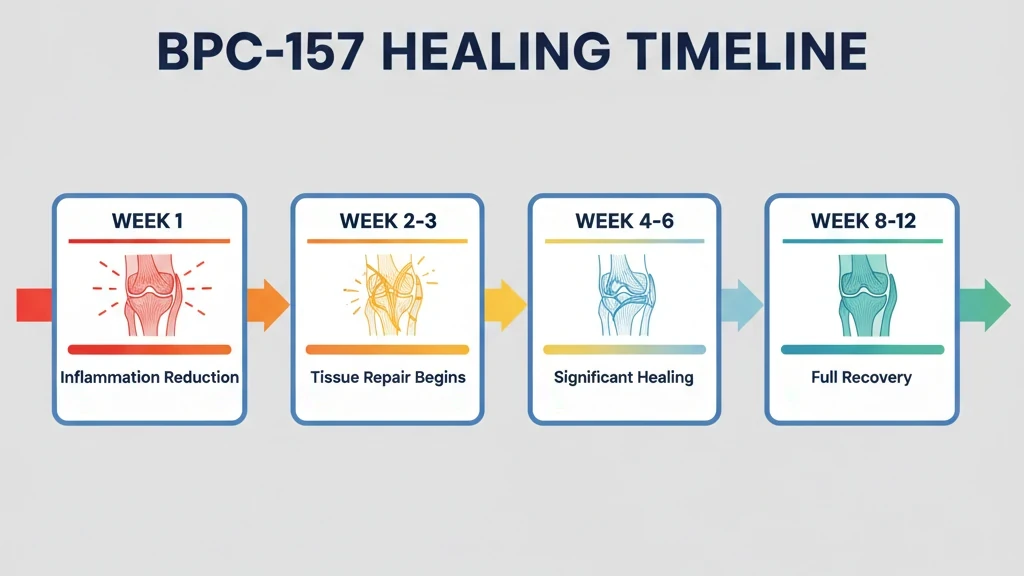
You are two weeks into a BPC-157 protocol for a nagging Achilles tendon. The swelling went down, but the tendon still aches under load. You are wondering if it is working or if you wasted your money. BPC-157 produces noticeable anti-inflammatory and pain relief effects within 1 to 2 weeks. Structural tissue repair, the kind that actually fixes a tendon or ligament, requires 4 to 8 weeks. The gap between feeling better and being healed is where most people make mistakes.
| Condition | First Noticeable Effects | Structural Repair Timeline | Full Protocol Length |
|---|---|---|---|
| Gut issues (ulcers, IBS, leaky gut) | 3 to 7 days | 2 to 4 weeks | 4 to 6 weeks |
| Pain and inflammation | 5 to 14 days | 1 to 2 weeks | 4 to 6 weeks |
| Muscle tears and strains | 7 to 14 days | 3 to 6 weeks | 6 to 8 weeks |
| Tendon injuries | 7 to 14 days | 4 to 8 weeks | 8 to 12 weeks |
| Ligament sprains | 7 to 14 days | 4 to 8 weeks | 8 to 12 weeks |
| Joint pain and arthritis | 7 to 21 days | 4 to 8 weeks | 8 to 12 weeks |
| Bone injuries | 14 to 28 days | 6 to 12 weeks | 12 to 16 weeks |
| Wound healing | 3 to 7 days | 2 to 4 weeks | 4 to 6 weeks |
These timelines come from animal studies. No large human clinical trial has measured BPC-157 healing durations. The ranges above reflect rat and mouse data extrapolated through anecdotal clinical observation. Use the BPC-157 dosage calculator to plan your protocol length and daily dose.
BPC-157 is not FDA-approved for any medical use. Consult a licensed healthcare provider before using any peptide.
Get your custom peptide protocol:
- Tailored to your body and goals
- Precise dosing and cycle length
- Safe stacking combinations
- Backed by peer-reviewed studies
- Ready in under 2 minutes
Why BPC-157 Healing Speed Varies by Tissue Type
Different tissues heal at different speeds because they receive different amounts of blood. A muscle fiber gets 10 to 50 mL of blood per 100 grams of tissue per minute. A tendon gets 1 to 2 mL. Bone sits somewhere in between. Gut mucosa, rich with capillaries, turns over faster than any connective tissue in your body.
BPC-157's core mechanism is angiogenesis: building new blood vessels at the injury site through the VEGF-NO-cGMP signaling cascade (Sikiric et al., Curr Pharm Des, 2018). Think of a highway construction crew that needs supply trucks to deliver asphalt and concrete. The crew cannot work faster than the trucks can deliver materials. BPC-157 builds more access roads so more supply trucks arrive simultaneously.
In well-vascularized tissue like the gut lining, those access roads are already partially built. BPC-157 finishes the job quickly. In avascular tissue like tendons and ligaments, the peptide has to construct the entire supply network from scratch. That takes weeks, not days.
Gut Healing: 1 to 4 Weeks
Gut conditions respond fastest to BPC-157 because the peptide originates from gastric juice. Oral BPC-157 bathes the entire GI tract in concentrated repair signals, and the intestinal lining already has dense blood supply.
Sikiric et al. documented BPC-157's protective and healing effects across over 50 models of gastrointestinal injury, including esophageal, gastric, duodenal, and colonic damage. The peptide accelerated gastric ulcer closure, counteracted NSAID-induced gut erosion, and reduced inflammatory markers in colitis models (PMID: 29879879). Chang et al. showed a 78% improvement in gastric ulcer closure over 14 days compared to controls in rats (PMID: 24574767).
What 'Working' Looks Like for Gut Conditions
Days 3 to 7: Reduced bloating, less post-meal discomfort, decreased urgency. These early changes reflect inflammation reduction rather than mucosal repair.
Weeks 1 to 2: Improved stool consistency, reduced abdominal cramping, less sensitivity to previously triggering foods. The intestinal epithelium turns over every 3 to 5 days, so damaged cells are replaced quickly once the repair environment improves.
Weeks 2 to 4: Sustained symptom relief without daily fluctuations. This suggests structural mucosal repair, not just inflammation masking. Users with IBS often report that their "bad days" become notably less severe and less frequent.
Oral BPC-157 at 500 to 1000 mcg per day is the preferred route. The peptide remains stable in gastric acid, which is expected given its origin from gastric juice (PMID: 21548867). For a broader gut-healing protocol, see peptides for gut health.
Tendon Injuries: 4 to 8 Weeks
Tendons are the slowest-healing connective tissue you are likely to target with BPC-157. Their poor blood supply means every repair process depends on BPC-157's ability to build new vasculature first, then deliver repair materials through it.
Staresinic et al. transected rat Achilles tendons and assessed healing at days 1, 4, 7, 10, 14, and 21. BPC-157-treated animals showed improved biomechanical properties, greater tensile strength, and superior collagen fiber organization at each time point compared to controls (PMID: 16137775). Chang et al. confirmed that BPC-157 promotes tendon healing through tendon outgrowth, cell survival, and fibroblast migration via the FAK-paxillin pathway (PMID: 21030672).
Separate research showed that BPC-157 enhanced growth hormone receptor expression in tendon fibroblasts, making damaged cells more responsive to circulating repair signals (Lovric-Bencic et al., J Physiol Pharmacol, 2004).
What 'Working' Looks Like for Tendons
Week 1: Reduced swelling and warmth around the tendon. Morning stiffness improves. These are inflammatory markers resolving, not structural repair.
Weeks 2 to 3: Pain during daily activities decreases. You can walk, type, or grip without wincing. The tendon still hurts under load. Collagen deposition has begun but the fibers are disorganized.
Weeks 4 to 6: Gradual return of load tolerance. Light resistance exercises become manageable. The collagen fibers are organizing into parallel bundles that can bear directional force.
Weeks 6 to 8: Functional use returns. Tennis elbow allows a racquet swing. Achilles tendonitis allows a short jog. The tendon is structurally repaired but not fully remodeled. Full collagen maturation continues for months after the protocol ends.
The critical mistake: Pain relief at week 2 is not permission to resume full training. Collagen fiber organization lags behind pain resolution by 3 to 4 weeks. Returning to heavy loads on a half-healed tendon tears the new fibers before they mature. Complete the full 8 to 12 week protocol. For injection placement guidance, see where to inject BPC-157 for knee pain. For the complete BPC-157 protocol, see how to take BPC-157.
Ligament Sprains: 4 to 8 Weeks
Ligaments follow a healing timeline similar to tendons. Both are dense connective tissues with limited blood supply, and both depend on organized collagen deposition for structural integrity.
Cerovecki et al. studied BPC-157 in a rat medial collateral ligament (MCL) transection model. BPC-157 was administered daily at 10 mcg/kg intraperitoneally or applied locally. Treated animals showed improved ligament healing throughout the 90-day observation period, with superior biomechanical properties and organized collagen on histological examination (PMID: 20225319).
What 'Working' Looks Like for Ligaments
Week 1: Joint swelling decreases. The sensation of instability persists because the ligament fibers have not reconnected. Anti-inflammatory effects are creating the illusion of progress that has not yet occurred structurally.
Weeks 2 to 4: Range of motion improves. The joint feels less "loose" during controlled movements. Early collagen bridges are forming across the tear, but they lack the tensile strength to resist sudden lateral force.
Weeks 4 to 8: Stability during moderate activity returns. Lateral movements that previously caused the joint to "give way" become tolerable. The collagen matrix is thickening and organizing.
Week 8 and beyond: Functional stability for sport-specific movements. Full ligament remodeling continues for 3 to 6 months. Pair BPC-157 with TB-500 for severe ligament injuries, as TB-500 promotes systemic cell migration while BPC-157 drives localized repair.
Muscle Tears and Strains: 3 to 6 Weeks
Muscle heals faster than tendons and ligaments because muscle tissue receives 5 to 25 times more blood flow per gram. BPC-157 does not need to build an entirely new vascular network; it amplifies one that already exists.
Novinscak et al. crushed rat quadriceps and administered BPC-157 intraperitoneally. Treated animals showed accelerated muscle fiber regeneration, reduced fibrosis (scar tissue), and faster functional recovery over a 72-day observation period (PMID: 18668315). Pevec et al. demonstrated that BPC-157 reversed corticosteroid-impaired muscle healing, restoring the repair process that steroid use had suppressed (PMID: 20190676).
What 'Working' Looks Like for Muscle Injuries
Days 5 to 10: Acute pain diminishes. Bruising fades faster than expected. The inflammatory phase is resolving.
Weeks 2 to 3: Muscle contraction against light resistance becomes comfortable. The damaged fibers are regenerating, and satellite cells (muscle stem cells) are active at the injury site.
Weeks 3 to 6: Progressive loading becomes tolerable. A hamstring strain allows jogging. A pec tear allows light bench pressing. New muscle fibers are integrating with surrounding healthy tissue.
BPC-157's critical advantage in muscle healing is reducing fibrosis. Without intervention, muscle tears often fill with scar tissue that creates a stiff, weak spot prone to re-injury. BPC-157 promotes regeneration of actual muscle fibers rather than fibrotic patching (PMID: 18668315). For muscle-specific research, see BPC-157 and muscle growth.
Joint Pain and Arthritis: 2 to 8 Weeks
Joint conditions involve overlapping pathologies: inflamed synovial membrane, degraded cartilage, and sometimes damaged ligaments or tendons within the joint capsule. BPC-157 addresses the inflammation quickly but the structural damage slowly.
In adjuvant arthritis models, BPC-157 reduced joint swelling and inflammatory markers without the gastric side effects of NSAIDs (Seiwerth et al., J Pharmacol Sci, 2014). One small human trial tested BPC-157 intra-articularly for chronic knee pain. Seven of 12 participants reported relief lasting over six months after a single injection (PMID: 40756949).
What 'Working' Looks Like for Joint Pain
Week 1: Morning stiffness duration shortens. The first 10 steps after getting out of bed become less painful.
Weeks 2 to 4: Weight-bearing becomes more comfortable. Stairs cause less grief. Swelling is visibly reduced. These changes reflect synovial inflammation resolving and improved joint fluid dynamics.
Weeks 4 to 8: Range of motion expands. Activities that were abandoned (squatting, kneeling, overhead reaching) become possible again. Cartilage does not regenerate in 8 weeks, but the inflammatory cascade that was accelerating its destruction has slowed substantially.
For joint-specific injection protocols, use the BPC-157 dosage calculator. Subcutaneous injection near the affected joint at 250 to 500 mcg per day is the standard approach.
Bone Injuries: 6 to 12 Weeks
Bone is the slowest tissue to heal, even with BPC-157. Fracture consolidation requires callus formation, mineralization, and remodeling, processes that cannot be compressed below a biological minimum.
Sebecic et al. found that BPC-157 increased callus formation and osteoblast activity at fracture sites in a rat segmental bone defect model at 14 and 28 days (PMID: 10451703). Sikiric et al. documented improved pseudoarthrosis (non-union fracture) healing with BPC-157 treatment, suggesting the peptide may be most useful when natural healing has stalled (PMID: 29998800).
What 'Working' Looks Like for Bone Injuries
Weeks 2 to 4: Surrounding soft tissue inflammation resolves. Pain at rest decreases. The fracture itself is forming a soft callus that is not yet visible on standard X-ray.
Weeks 4 to 8: The soft callus mineralizes into a hard callus. Imaging may show early bridging. Weight-bearing tolerance increases but controlled loading is essential, not full activity.
Weeks 8 to 12: Hard callus strengthens. Progressive loading becomes safe under clinical guidance. Remodeling of the callus into mature bone continues for 6 to 12 months after the protocol ends.
Bone healing protocols typically run 12 to 16 weeks. BPC-157 may be most beneficial for stress fractures and non-union fractures where blood supply to the fracture site is compromised, precisely the scenario where angiogenesis makes the largest difference.
Six Factors That Speed or Slow BPC-157 Results
The timelines above assume a standard protocol: 250 to 500 mcg per day, subcutaneous injection, healthy adult, moderate injury. Six variables shift those timelines forward or backward.
1. Dose: 250 mcg vs. 500 mcg vs. Higher
Animal studies use dose ranges equivalent to 200 to 800 mcg per day in humans. The standard range is 250 to 500 mcg. Most anecdotal reports suggest 500 mcg produces faster noticeable results than 250 mcg, particularly for musculoskeletal conditions. Going above 500 mcg has not been studied systematically and does not guarantee faster healing. BPC-157 activates signaling cascades that then proceed independently of the peptide's presence. Doubling the trigger does not double the response.
Use the BPC-157 dosage calculator to calculate exact injection volumes for your reconstitution.
2. Injury Severity: Mild Strain vs. Complete Tear
A mild tendon strain with partial fiber disruption heals in half the time of a complete transection. Animal studies that show the most dramatic BPC-157 results use complete transection models, the worst-case scenario. If your injury is a partial tear or chronic overuse condition, expect results toward the faster end of each range.
Complete tears may require surgical intervention regardless of peptide use. BPC-157 does not reattach a fully severed tendon. It accelerates the biological repair process in tissue that is still connected.
3. Administration Route: Injection vs. Oral
Subcutaneous injection near the injury site delivers higher local tissue concentrations than oral administration. For musculoskeletal conditions (tendon, ligament, muscle, joint, bone), injection is faster-acting because the peptide reaches the target tissue directly without first-pass metabolism.
Oral administration is preferred only for gut conditions, where the peptide contacts the intestinal lining directly. BPC-157 remains stable in gastric acid, achieving an oral bioavailability sufficient for GI targets but lower systemic levels than injection (PMID: 34267654). Pharmacokinetic data shows the mean absolute bioavailability following intramuscular injection is approximately 14 to 19% in rats and 45 to 51% in dogs (PMID: 36551977). For route selection guidance, see how to take BPC-157.
4. Injection Proximity to the Injury
BPC-157 has a plasma half-life of less than 30 minutes. Local tissue concentration matters. Injecting subcutaneously within 2 to 3 centimeters of the injury site delivers a concentrated bolus to the damaged area before systemic circulation dilutes it.
Injecting in the abdomen for a knee tendon injury still works because BPC-157 reaches the injury through systemic circulation. But local injection provides higher peak concentrations at the repair site. For a rotator cuff tear, inject near the shoulder. For a patellar tendon, inject near the knee. For knee-specific guidance, see where to inject BPC-157 for knee pain.
5. Age and Baseline Health
Healing slows with age. A 25-year-old produces more growth hormone, has denser vascular networks, and turns over collagen faster than a 55-year-old. BPC-157 upregulates growth hormone receptor expression at the injury site (PMID: 16137775), which partially compensates for age-related decline in circulating GH. But it does not eliminate the age factor entirely.
Chronic conditions that impair healing (diabetes, autoimmune disease, long-term corticosteroid use) extend expected timelines by 25 to 50%. Pevec et al. showed that BPC-157 reversed corticosteroid-impaired muscle healing in rats, but the recovery took longer than in non-impaired animals (PMID: 20190676).
6. Concurrent Therapies and Lifestyle
BPC-157 does not work in isolation. Sleep quality, protein intake, and controlled rehabilitation all influence healing speed. The peptide builds blood vessels and activates repair signaling. Your body supplies the raw materials: amino acids from dietary protein, oxygen from adequate sleep, and mechanical stimulus from progressive loading.
Stacking BPC-157 with TB-500 is the most common combination for accelerating musculoskeletal repair. TB-500 coordinates systemic cell migration while BPC-157 drives localized angiogenesis. They use different signaling pathways with minimal overlap. Adding physical therapy or controlled rehabilitation alongside a BPC-157 protocol produces faster structural outcomes than the peptide alone. For stacking protocols, see the BPC-157 + TB-500 dosage guide.
Week-by-Week Expectations: Standard BPC-157 Protocol
This timeline assumes a standard musculoskeletal protocol: 500 mcg per day subcutaneous injection near the injury, for a moderate tendon or ligament injury in a healthy adult.
| Week | What You Feel | What Is Happening Biologically |
|---|---|---|
| 1 | Reduced swelling, less resting pain | Inflammatory cytokines decreasing, NO system modulating blood flow |
| 2 | Morning stiffness shortens, daily activities improve | VEGF upregulation begins new capillary sprouting at injury site |
| 3 | Pain during light activity fades | Early collagen deposition begins, fibroblast migration accelerates |
| 4 | Light loading tolerable, range of motion expands | Collagen fibers organizing, new blood vessels delivering repair materials |
| 5 | Noticeable strength returning, confidence in the tissue grows | Collagen cross-linking strengthening, tensile load capacity increasing |
| 6 | Moderate activity possible, injury feels "stable" | Collagen matrix approaching functional density |
| 7 | Progressive loading with minimal pain | Tissue remodeling shifting from repair to maturation |
| 8 | Near-normal function for daily activities | Structural repair largely complete; full remodeling continues for months |
Week 2 trap: Most people feel dramatically better by week 2. The temptation to declare victory and stop the protocol is strong. Resist it. The pain relief at week 2 is inflammation resolving. The collagen that will actually hold your tendon together under load does not reach functional strength until week 5 or 6. Stopping at week 2 is like pulling wet concrete forms off a foundation.
When to Worry: Signs BPC-157 Is Not Working
Not every protocol succeeds. Knowing the difference between normal patience and genuine failure prevents both premature quitting and pointless persistence.
Normal: No Need to Worry
Slow start (days 1 to 7 with no change). BPC-157 initiates gene expression changes within minutes of injection, but downstream effects take days to manifest as perceptible improvements. No visible change in the first week is standard for musculoskeletal conditions.
Fluctuating symptoms (weeks 2 to 4). Good days followed by bad days is normal during tissue remodeling. Collagen repair is not linear. The tissue is being actively remodeled, torn down in some areas and rebuilt in others simultaneously.
Injection site redness or mild swelling. Transient redness lasting 15 to 30 minutes at the injection site is a normal histamine response. It is not an adverse reaction and does not indicate the peptide is ineffective.
Concerning: Consider Adjusting Protocol
Zero improvement after 3 weeks for gut conditions. Gut mucosa turns over every 3 to 5 days. If oral BPC-157 at 500 to 1000 mcg per day has produced no symptom change in 3 weeks, the issue may be structural rather than mucosal (stricture, fistula, celiac disease requiring diagnosis).
Zero pain improvement after 4 weeks for musculoskeletal conditions. Anti-inflammatory effects should be detectable by week 3 to 4 at the latest. If resting pain has not decreased at all, consider: Is the dose adequate? Is the injection site close enough to the injury? Is the peptide sourced from a reputable supplier? Degraded or counterfeit product is a real possibility in the peptide market. For sourcing guidance, see where to buy peptides in 2026.
Worsening symptoms. BPC-157 does not cause tissue damage in any published study. If symptoms worsen during a protocol, the underlying condition is progressing independently. Seek medical evaluation. The injury may require intervention beyond what any peptide can address.
Protocol Adjustments If Progress Stalls
Increase dose from 250 to 500 mcg. If you started conservatively at 250 mcg per day and progress has stalled at week 3, moving to 500 mcg is reasonable. This aligns with the upper end of commonly studied dose ranges.
Switch injection site to closer proximity. If you have been injecting abdominally for a shoulder injury, try subcutaneous injection near the deltoid insertion. Higher local concentration may overcome a distribution bottleneck.
Add TB-500. For stubborn injuries, stacking with TB-500 at 5 to 10 mg per week adds a systemic cell migration signal that complements BPC-157's localized angiogenesis. See BPC-157 vs TB-500 for the rationale and BPC-157 + TB-500 dosage guide for protocol details.
Extend the protocol. Severe injuries or compromised healers (older adults, diabetics, steroid users) may need 10 to 12 weeks rather than 8. Sikiric's rat studies documented beneficial effects persisting throughout 72 to 90 day observation periods without diminishing returns (PMID: 20225319).
Common Mistakes That Delay BPC-157 Results
Four errors account for most failed or underwhelming BPC-157 protocols.
1. Stopping when the pain stops. Pain relief arrives at weeks 1 to 2. Structural repair completes at weeks 6 to 8. Quitting at week 2 and returning to full activity tears partially healed tissue. The re-injury is often worse than the original because the new collagen fibers are fragile and disorganized. Complete the full protocol duration regardless of how you feel.
2. Wrong route for the condition. Injecting subcutaneously for gut conditions delivers the peptide systemically but bypasses direct contact with the intestinal lining. Oral BPC-157 at 500 to 1000 mcg per day is the correct route for IBS, ulcers, and leaky gut. Conversely, taking oral BPC-157 for a torn hamstring relies on low systemic bioavailability when a subcutaneous injection near the tear would provide 5 to 10 times the local tissue concentration.
3. Injecting far from the injury. BPC-157's plasma half-life is under 30 minutes. Injecting in the abdomen when the injury is in the elbow means the peptide has dispersed into full systemic circulation before it reaches the target. Local injection within 2 to 3 cm of the injury maximizes tissue concentration during the critical absorption window.
4. Using degraded peptide. BPC-157 degrades in heat, direct sunlight, and when reconstituted with non-sterile water. A reconstituted vial left on a countertop for two days has lost an unknown percentage of its activity. Refrigerate immediately after reconstitution, use within 28 days, and source from reputable suppliers. See our peptide storage guide for proper handling.
BPC-157 vs. Natural Healing: How Much Faster?
A reasonable question: does BPC-157 actually speed healing, or do these timelines just describe what would happen anyway?
Staresinic et al. transected rat Achilles tendons and compared BPC-157-treated animals to saline controls. At each assessment point (days 1, 4, 7, 10, 14, and 21), treated animals had significantly greater tensile strength and superior collagen organization (PMID: 16137775). Chang et al. found that BPC-157 accelerated gastric ulcer closure by 78% over 14 days versus controls (PMID: 24574767).
In practical terms, the animal data suggests BPC-157 reduces typical healing time by roughly 30 to 50% for the conditions studied. A tendon injury that takes 12 weeks to heal naturally may reach the same functional state in 6 to 8 weeks. A gastric ulcer that resolves in 4 weeks may close in 2 to 3 weeks.
These are estimates, not guarantees. No human trial has directly compared healing timelines with and without BPC-157. The animal data is consistent across multiple research groups and tissue types, but extrapolating rat data to human healing remains scientifically uncertain. For real-world progress examples and user-reported timelines, see BPC-157 before and after results.
Frequently Asked Questions
How long does BPC-157 take to work for tendon injuries?
Pain relief from BPC-157 typically begins within 7 to 14 days for tendon injuries. Structural tendon repair requires 4 to 8 weeks because tendons receive minimal blood flow and BPC-157 must build new vasculature before repair materials can reach the injury site. Complete the full 8 to 12 week protocol even if pain resolves early. Collagen maturation lags behind pain relief by 3 to 4 weeks.
How fast does BPC-157 heal gut issues like leaky gut or IBS?
Gut conditions respond fastest to BPC-157, with noticeable improvements in bloating and discomfort within 3 to 7 days. Structural mucosal repair takes 2 to 4 weeks. Oral BPC-157 at 500 to 1000 mcg per day is the preferred route because the peptide contacts the intestinal lining directly. The intestinal epithelium turns over every 3 to 5 days, which explains the rapid response.
Can I speed up BPC-157 results?
Three strategies improve BPC-157 outcomes. Inject subcutaneously within 2 to 3 cm of the injury for maximum local concentration. Use 500 mcg per day rather than 250 mcg. Stack with TB-500 at 5 to 10 mg per week for stubborn musculoskeletal injuries. Sleep quality, protein intake above 1.6 g/kg/day, and controlled rehabilitation also accelerate structural repair.
Why does BPC-157 reduce pain before the injury heals?
BPC-157 modulates the nitric oxide system and resolves inflammation within 1 to 2 weeks. Pain is generated by inflammatory mediators at the injury site. When inflammation drops, pain drops. But structural repair (collagen deposition, fiber organization, tensile strength recovery) requires 4 to 8 additional weeks. Pain relief without structural repair means the tissue remains vulnerable to re-injury under load.
Is BPC-157 faster when injected near the injury?
Yes. BPC-157 has a plasma half-life under 30 minutes. Subcutaneous injection within 2 to 3 cm of the injury delivers 5 to 10 times the local tissue concentration compared to abdominal injection. For gut conditions, oral administration is faster because it delivers the peptide directly to the intestinal lining without requiring systemic distribution.
How long should a BPC-157 cycle last?
Cycle length depends on the target condition. Gut healing protocols run 4 to 6 weeks. Muscle injuries require 6 to 8 weeks. Tendon and ligament injuries need 8 to 12 weeks. Bone injuries may require 12 to 16 weeks. These ranges reflect the time needed for structural repair, not just symptom relief. Animal studies document beneficial effects throughout 72 to 90 day observation periods without diminishing returns.
What if BPC-157 is not working after 3 weeks?
For gut conditions, zero change after 3 weeks suggests a structural issue (stricture, fistula) rather than mucosal damage. For musculoskeletal conditions, check three variables: dose (increase from 250 to 500 mcg), injection proximity (move closer to the injury), and peptide quality (degraded or counterfeit product is common). If all variables are optimized and 4 weeks produce no improvement, the injury likely requires clinical evaluation.
Does BPC-157 work faster when stacked with TB-500?
Anecdotal reports suggest the BPC-157 plus TB-500 combination produces faster structural repair than either peptide alone. BPC-157 drives localized angiogenesis through VEGF upregulation. TB-500 promotes systemic cell migration through actin regulation. The mechanisms are complementary with minimal overlap. Standard stacking protocol: BPC-157 at 250 to 500 mcg per day plus TB-500 at 5 to 10 mg per week, both subcutaneous.
The Bottom Line
BPC-157 healing timelines depend on the tissue you are targeting. Gut conditions improve fastest (1 to 4 weeks) because the intestinal lining is well-vascularized and turns over rapidly. Muscle injuries follow (3 to 6 weeks). Tendons and ligaments need 4 to 8 weeks of structural repair after the initial 1 to 2 weeks of pain relief. Bone injuries are slowest at 6 to 12 weeks. In every case, the gap between feeling better and being healed is where most protocol failures occur.
The principle is simple: BPC-157 builds blood vessels. Better blood supply means faster delivery of repair materials. Tissues with poor baseline vascularity (tendons, ligaments) take longer because the peptide must construct the supply network before repair can begin. Tissues with rich blood supply (gut mucosa, muscle) respond faster because the infrastructure already exists.
Plan your protocol with the BPC-157 dosage calculator. For administration guidance, see how to take BPC-157. For a complete overview of the peptide's effects, read BPC-157 benefits. For dosing specifics, consult the BPC-157 dosage chart.
Related Articles
How to Take BPC-157: Dosage and Timing
How to take BPC-157: inject 250-500 mcg subcutaneously near the injury once daily for 4-8 weeks. Reconstitution, dosing, and cycle length.
KLOW Peptide: Benefits, Dosage, and KLOW vs GLOW
KLOW peptide benefits, blend composition (GHK-Cu, BPC-157, TB-500, KPV), per-component dosing math, the copper ceiling, and how KLOW differs from GLOW.
Where to Inject BPC-157: Site Guide
Where to inject BPC-157 for shoulder, back, hip, gut, elbow, and Achilles injuries. Anatomical sites, local vs systemic delivery, and rotation.
BPC-157 Oral Pills & Capsules: Do They Work?
BPC-157 oral pills deliver 250-500 mcg to the gut. Oral vs injectable vs nasal comparison, dosing protocols, and sourcing guidance.