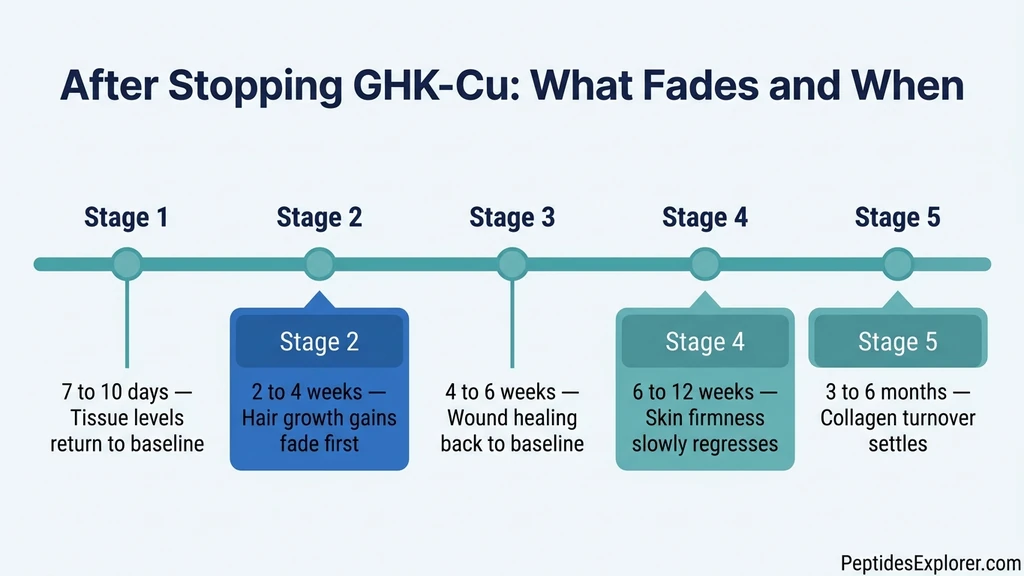
You just finished 8 weeks of GHK-Cu and you are wondering what happens next. The skin in the mirror looks better than it did in February. The small scar on your forearm faded faster than you expected. Now the vial is empty and you are deciding whether to reorder or take a break. GHK-Cu has no true withdrawal syndrome. It is not a hormone and it is not a stimulant. When you stop, tissue peptide levels drop to baseline within 7 to 10 days, but the downstream benefits fade gradually over 4 to 12 weeks depending on which tissue you are tracking. Hair changes fade first. Skin and collagen changes persist longest. There is no rebound aging and no sudden deterioration. Cycle breaks are part of the design, not a problem.
| Timeframe After Stopping | What Changes |
|---|---|
| 24 to 48 hours | Tissue GHK-Cu still active, no change |
| 7 to 10 days | Tissue levels return to baseline |
| 2 to 4 weeks | Hair growth benefits begin to fade |
| 4 to 6 weeks | Wound healing capacity returns toward baseline |
| 6 to 12 weeks | Skin firmness and texture gradually regress |
| 3 to 6 months | Collagen turnover completes, most surface changes settle |
| Any time | Restart is simple, no loading phase needed if < 30 days off |
The short version: you will not wake up old. Stopping GHK-Cu is gradual, predictable, and reversible. For the full pharmacokinetic picture behind these numbers, see our GHK-Cu half-life explainer. For the dosing protocol you were likely on, see the GHK-Cu dosage guide.
This is educational content. Consult a healthcare provider before starting, stopping, or cycling any peptide.
Get your custom peptide protocol:
- Tailored to your body and goals
- Precise dosing and cycle length
- Safe stacking combinations
- Backed by peer-reviewed studies
- Ready in under 2 minutes
The First 7 to 10 Days: Tissue Levels Drop to Baseline
GHK-Cu has a plasma half-life of about 30 minutes and a tissue half-life of 24 to 48 hours. After your last dose, the peptide continues working at active sites (skin fibroblasts, wound beds, hair follicles) for another day or two. By day 3 to 5, tissue concentration has fallen below the threshold that drives fibroblast stimulation. By day 7 to 10, GHK-Cu at the tissue level is effectively back to endogenous baseline.
During this window, nothing visible happens. Skin still looks the same. Hair growth that was already in the anagen phase continues. Any wound you were healing continues to heal at the rate set by the last week of treatment. The biology has quieted, but the results of the biology have not yet caught up.
This is the most important thing to understand about stopping GHK-Cu. The peptide is a signal, not a structure. When the signal stops, the structures that the signal built (new collagen, new capillaries, thicker hair shafts) do not dissolve. They persist and gradually turn over on their own natural timelines.
If you are cycling GHK-Cu on a standard 8-weeks-on, 4-weeks-off schedule, this 7 to 10 day washout is the intentional quiet period that lets receptors reset. Chronic uninterrupted dosing can blunt response over time. The pause restores sensitivity. For why this matters, see our GHK-Cu injection frequency guide.
Weeks 2 to 4: Hair Growth Effects Fade First
Hair is the fastest-cycling tissue that GHK-Cu supports. The anagen (growth) phase of a human hair follicle lasts 2 to 6 years, but the proliferative signals that GHK-Cu delivers have a much shorter effective window. Once tissue GHK-Cu drops to baseline, the follicle returns to its pre-treatment growth rate within 2 to 4 weeks.
What this looks like in practice:
Weeks 2 to 3: The new hairs that entered anagen during your last 2 weeks of GHK-Cu continue to grow. You do not see thinning. You may see the peak benefit from your cycle because late-stage follicle recruitment is still visible.
Weeks 3 to 4: Hair growth rate slows back to your baseline. If GHK-Cu added 15 to 20 percent to your growth velocity during the cycle, that bonus disappears. Shafts that were thickened by copper-driven matrix activity stop being replaced with thicker shafts.
Weeks 6 to 8: The hair density you gained during the cycle begins to settle. If your baseline was sparse and GHK-Cu added visible volume, some of that volume is lost by this point. Not all. Hairs that were fully cycled into anagen under treatment remain on scalp through their normal lifespan.
The fade is gradual and partial. People who used GHK-Cu topically for hair do not suddenly shed. The improvement softens over 1 to 2 months back toward pre-treatment density, not below it. For the full hair protocol and what to expect on-cycle, see GHK-Cu hair growth.
If you are cycling, restarting within 30 to 60 days of stopping preserves most of the hair gains. Longer breaks mean more regression.
Weeks 4 to 6: Wound Healing Capacity Normalizes
GHK-Cu's wound healing effect is strongest when the peptide is actively present. The molecule signals angiogenesis, recruits fibroblasts, and accelerates collagen deposition at repair sites. When you stop, the acute acceleration stops with it.
Within 4 to 6 weeks of stopping, your baseline wound healing rate returns. If you sustain a cut, abrasion, or surgical wound after that window, it heals on your body's normal timeline, not the accelerated GHK-Cu timeline. A superficial scratch that was closing in 3 days on-cycle now closes in 5 to 7 days, which is normal.
What persists: the scars you healed during the cycle stay healed. Tissue that remodeled under GHK-Cu treatment keeps its improved architecture. Collagen laid down during the cycle is already integrated and continues to mature on the normal 6 to 12 month scar maturation timeline.
What does not persist: the "always faster" repair capacity. You lose the on-demand acceleration. This is the practical reason some users cycle GHK-Cu around known injury windows (post-surgery, planned cosmetic procedures, athletic training blocks where soft tissue stress is high). The peptide provides most benefit during active repair.
For context on how GHK-Cu drives these repair signals at the molecular level, see GHK-Cu benefits. For the safety profile during wound healing use, see GHK-Cu side effects.
Weeks 6 to 12: Skin Firmness and Texture Gradually Regress
Skin is the slowest-reverting tissue after stopping GHK-Cu, and also the most forgiving. Collagen and elastin have a natural turnover of 3 to 6 months in healthy adult dermis. The collagen synthesis stimulation from GHK-Cu peaks at nanomolar concentrations and is independent of fibroblast proliferation, meaning the matrix you laid down during the cycle continues to mature even after dosing stops (Maquart et al., 1988). Changes laid down during a GHK-Cu cycle do not disappear when the peptide stops. They age at the normal rate.
Weeks 6 to 8: Fibroblast activity returns to baseline. New collagen synthesis drops back to whatever your body produces without peptide support. You will not see a difference yet.
Weeks 8 to 12: Daily micro-damage from sun, oxidation, and mechanical stress continues to degrade existing collagen at baseline rates. Without ongoing GHK-Cu support, the net collagen balance shifts slightly negative, the way it would for anyone your age not on the peptide. Fine line softening may gradually diminish. Firmness peaks established during the cycle start to soften.
Months 3 to 6: The collagen you built during the cycle finishes its natural turnover window. By this point, skin has largely returned to the trajectory it would have been on without the peptide. Not worse than baseline. Just on baseline's slope.
What stays: you do not lose the "floor" the cycle built. Skin does not regress below pre-treatment condition. The scaffolding remains; only the active synthesis bonus is gone.
This gradual, partial regression is why many users run GHK-Cu as semi-chronic therapy (5 days on, 2 days off, indefinitely) rather than discrete cycles. For topical users, the same logic applies. See GHK-Cu microneedling for how delivery method affects the longevity of topical results.
There Is No True Withdrawal Syndrome
Some peptides and most hormones produce a withdrawal state when stopped. Exogenous testosterone suppresses endogenous production, so stopping creates a hypogonadal crash. Stimulants downregulate receptors, so stopping causes fatigue and low mood. Corticosteroids suppress the HPA axis, so tapering is mandatory to avoid adrenal crisis.
GHK-Cu does none of this. It does not suppress endogenous GHK production (your body continues to make its own GHK tripeptide at the normal rate, though endogenous plasma levels naturally decline from ~200 ng/mL at age 20 to ~80 ng/mL by age 60; (Pickart, 2008)). It does not downregulate receptors in a way that creates a performance gap. It does not suppress any hormonal axis. There is no physiological dependence.
What this means practically:
- You can stop GHK-Cu abruptly without tapering.
- You will not experience fatigue, mood changes, or hormonal symptoms.
- You will not shed hair faster than baseline.
- You will not see "rebound aging" or sudden skin deterioration.
- Any transient sensations (injection site calm, skin returning to its normal feel) are subjective, not pharmacological.
The biggest mistake people make when stopping GHK-Cu is expecting withdrawal and interpreting normal life events through that lens. If you notice dry skin 3 weeks after stopping, that is probably because it is winter, not because you stopped GHK-Cu. If hair shedding feels high, check the season (telogen effluvium is cyclic) before blaming discontinuation.
For a broader view of what peptide safety looks like across starting, stopping, and cycling, see the peptide safety guide.
Why Cycle Breaks Are Intentional, Not a Problem
Standard GHK-Cu protocols include planned breaks for two reasons. First, chronic uninterrupted dosing can blunt fibroblast response over time. Second, breaks are simply not costly. The gradual fade means short pauses lose very little.
Common cycle designs:
- 8 weeks on, 4 weeks off: The most common protocol for skin rejuvenation. Peak benefit during the cycle, modest fade during the break, full re-sensitization before restart.
- 12 weeks on, 4 to 8 weeks off: For users targeting deeper collagen remodeling. Longer on-phase drives more structural change, longer off-phase lets tissue settle before the next push.
- 5 days on, 2 days off (weekly): Semi-chronic. Keeps tissue levels high almost continuously with a small weekly washout. Used for indefinite anti-aging maintenance.
- Seasonal cycling: 2 to 3 discrete cycles per year, timed around skin stressors (post-summer UV damage, post-winter dryness) or life events. Cost-efficient, preserves sensitivity.
The biological rationale for breaks: Receptors and signal pathways recover sensitivity during quiet periods. When you restart, tissue response to the peptide is as strong as it was the first time. Skipping breaks often does not harm you, but it reduces the marginal benefit of each additional week of dosing.
What about stopping permanently? Also fine. GHK-Cu is not a commitment. People who try an 8-week cycle, see modest results, and decide it is not worth the cost or injection burden can simply not reorder. The tissue returns to baseline on its own schedule. No follow-up protocol is needed.
For the full injection schedule options and how they map to goals, see GHK-Cu injection frequency.
Restarting GHK-Cu: No Loading Phase Needed
If you stopped GHK-Cu and decide to restart, the process is simple. There is no loading phase, no ramp-up protocol, no need to taper back in.
If you are off for less than 30 days: Restart at your previous effective dose. Tissue sensitivity is essentially unchanged. You will reach steady state faster than the first time (3 to 5 days instead of 5 to 7) because some downstream adaptations persist.
If you are off for 30 to 90 days: Restart at your previous effective dose. Steady state takes the normal 5 to 7 days. Any regression that occurred during the break will rebuild during the first 2 to 4 weeks of the new cycle.
If you are off for more than 90 days: Effectively a fresh cycle. Restart at whatever dose your protocol specifies (typically 1 to 2 mg daily subcutaneous for skin, or topical per your formulation). Expect the standard 4 to 12 week timeline for visible improvement to apply again.
Reconstitution on restart: If you kept a reconstituted vial refrigerated, check expiration (28 days is the standard window for bacteriostatic water reconstitution). If the vial has been sitting for longer than that, discard and reconstitute a fresh vial. Do not inject peptide from a vial that has shifted from pale blue to dark or cloudy. For the complete reconstitution protocol, see how to reconstitute GHK-Cu and the peptide reconstitution calculator.
Dose adjustments on restart: Most users restart at the dose that worked before. If you had adverse effects previously (injection site irritation, fatigue in the first week) consider dropping to 0.5 mg for the first 3 to 5 days before stepping up. If you had no effects at all, consider increasing by 25 to 50 percent to test for a stronger response.
Cycling is a tool. You will cycle on and off this peptide many times over many years if you use it long-term. Each restart is a normal event, not a reset of the protocol.
Frequently Asked Questions
Will I lose all my GHK-Cu results if I stop?
No. Benefits fade gradually over 4 to 12 weeks depending on tissue type, but they do not disappear. Hair changes fade fastest (2 to 4 weeks back toward baseline). Skin and collagen changes persist longest because collagen turnover takes 3 to 6 months. You do not regress below your pre-treatment baseline. For the dosing detail behind these timelines, see our GHK-Cu injection dosage guide.
Is there a withdrawal syndrome from stopping GHK-Cu?
No. GHK-Cu is not a hormone, not a stimulant, and does not suppress any axis. Your body continues to produce its own endogenous GHK tripeptide at the normal rate. You can stop abruptly without tapering and without physiological symptoms. Any perceived changes are the gradual fade of enhanced benefits, not withdrawal. For more on the safety profile, see GHK-Cu side effects.
How long until GHK-Cu is fully out of my system?
Plasma clearance is complete within 24 hours. Tissue levels drop to baseline within 7 to 10 days. The downstream biological effects (collagen synthesis bonus, fibroblast activation, wound repair acceleration) fade more slowly, over 4 to 12 weeks. For the complete pharmacokinetic picture, see how long does GHK-Cu last.
Will my hair fall out when I stop GHK-Cu?
Not faster than your normal baseline shedding rate. Hair growth benefits fade within 2 to 4 weeks as the anagen-phase recruitment bonus ends, so density you gained during the cycle softens over 1 to 2 months back toward (but not below) your pre-treatment level. Seasonal shedding is separate from peptide discontinuation. For the full hair protocol, see GHK-Cu hair growth.
How long should I take a break from GHK-Cu before restarting?
Standard protocols use 4 to 8 week breaks after 8 to 12 week cycles. This restores receptor sensitivity without letting tissue drift far from on-cycle state. Shorter breaks (1 to 2 weeks) are adequate for semi-chronic protocols. Longer breaks (3+ months) are fine but require treating the restart as a fresh cycle. For the frequency options, see GHK-Cu injection frequency.
Do I need to taper off GHK-Cu or can I stop cold?
You can stop cold. There is no tapering protocol and no pharmacological reason to step down. The peptide has a short plasma half-life and no suppressive effects. Whether you stop abruptly or gradually reduce, the tissue-level washout is the same 7 to 10 day window. For the broader peptide safety framework, see the peptide safety guide.
If I restart GHK-Cu after a break, do I need a loading phase?
No. Restart at the dose that worked previously. If you are off for less than 30 days, steady state returns in 3 to 5 days. If you are off longer, expect the normal 5 to 7 days to steady state and the 4 to 12 week timeline for visible results. For reconstitution on restart, use the peptide reconstitution calculator or see how to reconstitute GHK-Cu.
Will my skin suddenly look worse after stopping GHK-Cu?
No. Skin changes fade on the natural 3 to 6 month collagen turnover schedule, not abruptly. You will not wake up with fine lines or lose firmness overnight. The scaffolding built during the cycle stays; the active collagen synthesis bonus ends. Skin returns to its normal aging trajectory, not below baseline. For how to extend results with topical delivery between cycles, see GHK-Cu microneedling.
The Bottom Line
Stopping GHK-Cu is a gradual, predictable, reversible event. There is no withdrawal, no rebound aging, no sudden loss of what you built. Tissue peptide levels return to baseline within 7 to 10 days. Hair benefits fade in 2 to 4 weeks because hair is fast-cycling tissue. Wound healing capacity normalizes in 4 to 6 weeks. Skin and collagen changes persist longest and fade over 3 to 6 months as natural turnover completes. You do not drop below pre-treatment baseline. The scaffolding stays.
Cycle breaks are a design feature. Most protocols (8 weeks on, 4 off; or 5 days on, 2 off) include planned pauses so receptor sensitivity resets. Restarting is simple: no loading phase, no taper, just return to your previous effective dose. If you are off less than 30 days, nothing really changed. If you are off longer, treat restart as a fresh cycle with standard 4 to 12 week expectations.
The practical rules: do not panic about fading results during a break, do not blame unrelated life events (winter dryness, seasonal shedding) on discontinuation, and do not hesitate to restart when it makes sense. For the full dosing framework, see our GHK-Cu dosage guide. For pharmacokinetic specifics on half-life and tissue retention, see how long does GHK-Cu last. For the reconstitution step-by-step on restart, see how to reconstitute GHK-Cu and the peptide reconstitution calculator.
Related Articles: - GHK-Cu Half-Life: How Long It Lasts - GHK-Cu Dosage: Protocols & Charts - GHK-Cu Injection Frequency - GHK-Cu Hair Growth - GHK-Cu Benefits - GHK-Cu Side Effects - How to Reconstitute GHK-Cu - Peptide Safety Guide
Related Articles
GHK-Cu Half-Life: How Long It Lasts
How long does GHK-Cu last? Plasma half-life is ~30 minutes, but tissue retention lasts 24-48+ hours. Injection frequency and stability.
Can Copper Peptides Cause Acne? Purge vs Breakout
Can copper peptides cause acne? GHK-Cu itself is not comedogenic. How to tell purging from a breakout or a copper allergy, who is prone, and a 6-week plan.
How Long Does PT-141 Last? Full Timeline
PT-141 effects last 6-72 hours despite a 2.7-hour half-life. Onset at 30-45 min, peak at 1-3 hours, residual effects up to 72 hours. Full timeline.
Semaglutide: How Long in Your System?
Semaglutide stays in your system for about 5 weeks after your last injection. Learn the 7-day half-life, elimination timeline, and factors affecting clearance.