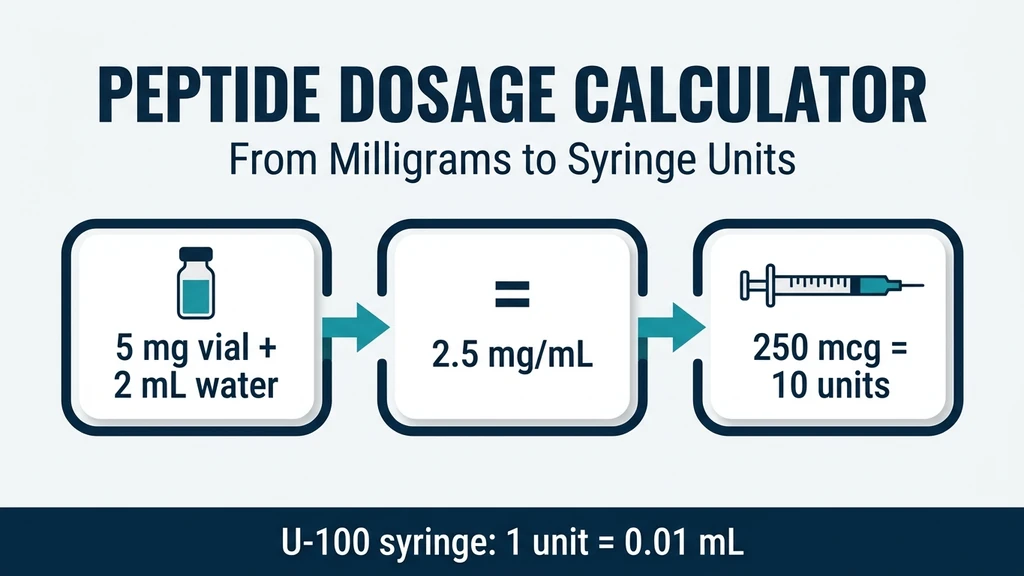
You have a vial marked 5 mg, a vial of bacteriostatic water, and a dose written in micrograms. The syringe is marked in units. Three numbers connect them: concentration equals vial mg divided by mL of water added, volume equals dose divided by concentration, and units equal volume in mL times 100 on a U-100 syringe. Add 2 mL to a 5 mg vial and a 250 mcg dose is 10 units.
| Quick Reference | Formula | Worked Example |
|---|---|---|
| Concentration | mg in vial ÷ mL of water added | 5 mg ÷ 2 mL = 2.5 mg/mL |
| Volume to draw | dose in mg ÷ concentration | 0.25 mg ÷ 2.5 mg/mL = 0.1 mL |
| Units on U-100 | mL to draw × 100 | 0.1 mL × 100 = 10 units |
| mcg per unit (U-100) | concentration in mg/mL × 10 | 2.5 × 10 = 25 mcg per unit |
| 1 unit on a U-100 syringe | 0.01 mL | 100 units fills 1 mL |
| 1 unit on a U-40 syringe | 0.025 mL | 40 units fills 1 mL |
| mg to mcg | × 1000 | 0.25 mg = 250 mcg |
Nothing on this page is a dose recommendation. The arithmetic below tells you how many units carry a given dose; which dose belongs in that syringe comes from your prescriber and from the peptide's own dosage chart. Run your own numbers in the peptide reconstitution calculator and check the mcg to mg step in the peptide unit converter.
Get your custom peptide protocol:
- Tailored to your body and goals
- Precise dosing and cycle length
- Safe stacking combinations
- Backed by peer-reviewed studies
- Ready in under 2 minutes
Which Peptide Dosage Calculator You Actually Need
Fourteen calculators sit behind this page. Find the row that matches the question in your head, then go straight to that tool.
| What you are trying to work out | Calculator |
|---|---|
| How much bacteriostatic water to add, and how many units to draw | Peptide Reconstitution Calculator |
| Converting mcg, mg and IU for the same compound | Peptide Unit Converter |
| Cost per dose, per week and per cycle | Peptide Cost Calculator |
| A BPC-157 dose scaled to body weight and healing goal | BPC-157 Dosage Calculator |
| TB-500 loading dose versus maintenance dose | TB-500 Dosage Calculator |
| Semaglutide units at any vial concentration | Semaglutide Dosage Calculator |
| A tirzepatide titration schedule with unit counts | Tirzepatide Dosage Calculator |
| Retatrutide titration steps and injection volume | Retatrutide Dosage Calculator |
| CJC-1295 and ipamorelin, solo or stacked, DAC or no-DAC | CJC-1295 / Ipamorelin Calculator |
| HGH Fragment 176-191 dosing by weight and experience | HGH Fragment Dosage Calculator |
| Daily IGF-1 LR3 dose and the exact syringe units | IGF-1 LR3 Dosage Calculator |
| A weekly injection schedule across several peptides | Peptide Stack Calculator |
| Whether two peptides can share a protocol | Peptide Interaction Checker |
| When a peptide has cleared your system | Peptide Half-Life Tracker |
Most people arrive needing two of these in sequence. The reconstitution calculator turns a dry vial into a concentration and a unit count. A compound-specific calculator such as the BPC-157 dosage calculator or the tirzepatide dosage calculator tells you which dose to feed it.
The rest of this page teaches the arithmetic those tools run. Learn it once and you can check any calculator's output, including ours.
Concentration Is the Only Number That Changes
The peptide inside a lyophilized vial is a fixed quantity. A vial labeled 5 mg holds 5 mg of powder whether you dissolve it in 1 mL of water or in 5 mL.
Think of a spoonful of salt. Stir it into a shot glass and a single drop is brutally salty. Stir the same spoonful into a jug and a single drop barely registers. The salt never changed. The water did.
Concentration is the amount of peptide per unit of liquid, written as mg/mL. Adding more bacteriostatic water lowers the concentration, so each unit on the syringe carries less peptide, so you draw more units for the same dose. The dose stays constant. The volume that delivers it does not.
This is why "how many units is my dose" has no answer until someone names the vial strength and the water volume. Two people injecting the same 250 mcg can correctly draw 10 units and 25 units, because one reconstituted at 2.5 mg/mL and the other at 1 mg/mL.
Choosing the water volume is a convenience decision, not a safety one. More water means larger, easier-to-read unit counts and less rounding error. Less water means a smaller injection volume. The peptide reconstitution calculator will show you both, and how to reconstitute a peptide covers the physical technique.
The Full Calculation, Step by Step
Here is the chain end to end, using a 5 mg vial, 2 mL of bacteriostatic water, and a 250 mcg dose.
- 1.Read the vial strength. The label says 5 mg. That is the total peptide in the vial, not a per-dose amount.
- 1.Choose the water volume and add it. You add 2 mL of bacteriostatic water, aiming the stream at the glass wall rather than at the powder. Whether that solvent is the same thing as reconstitution solution is a fair question, answered in is reconstitution solution the same as bacteriostatic water.
- 1.Calculate concentration. 5 mg ÷ 2 mL = 2.5 mg/mL. Write this on the vial with a marker. Six weeks later you will not remember it.
- 1.Convert the dose to milligrams. 250 mcg ÷ 1000 = 0.25 mg. Micrograms and milligrams differ by a factor of 1,000, and this is where the largest errors enter. The peptide unit converter does this step if you want a second opinion.
- 1.Calculate the volume to draw. 0.25 mg ÷ 2.5 mg/mL = 0.1 mL.
- 1.Convert volume to units. A U-100 syringe reads 100 units per 1 mL, so one unit is 0.01 mL. 0.1 mL × 100 = 10 units.
- 1.Sanity-check with the shortcut. On a U-100 syringe, one unit carries the concentration in mg/mL multiplied by 10, expressed in mcg. At 2.5 mg/mL, one unit is 25 mcg. 250 ÷ 25 = 10 units. The two routes agree.
- 1.Check how many doses the vial holds. 5 mg ÷ 0.25 mg = 20 doses. If you draw the vial dry at 12 doses, one of your numbers was wrong.
That is the whole method. Every compound-specific tool on this site, from the semaglutide dosage calculator to the IGF-1 LR3 dosage calculator, runs exactly these eight lines with the dose pre-filled.
Three Ways the Math Goes Wrong, With Numbers
Scenario 1: a U-40 syringe read as a U-100 syringe. Your calculator says 10 units. On a U-100 barrel that is 0.1 mL. Pull to the 10 mark on a U-40 barrel and you have drawn 0.25 mL, because a U-40 syringe puts only 40 units in a milliliter. At 2.5 mg/mL that syringe now holds 625 mcg instead of 250 mcg, exactly 2.5 times the intended dose. The 5 mg vial that should have lasted 20 injections empties after 8. U-40 syringes exist for veterinary insulin and turn up in cheap online kits. The fix: read the barrel print. If it does not say U-100, do not use it for a U-100 calculation.
Scenario 2: 1 mL of bacteriostatic water instead of 2 mL. The 5 mg vial is now 5 mg/mL, not 2.5 mg/mL. Draw the 10 units your calculator gave you and you inject 0.1 mL of a double-strength solution: 500 mcg instead of 250 mcg. Nothing looks wrong. The liquid is clear, the syringe looks identical, the injection feels the same. Every dose for the life of that vial is doubled, and the vial runs dry after 10 injections rather than 20. The fix: measure the water into the syringe before you add it, and write the resulting mg/mL on the vial label.
Scenario 3: counting lines on a 1 mL barrel. A 0.5 mL insulin syringe is usually marked in 1-unit increments. A 1 mL insulin syringe is usually marked in 2-unit increments. Count ten lines up from zero on the 1 mL barrel and you are at 20 units, not 10. At 2.5 mg/mL that is 500 mcg instead of 250 mcg, a doubled dose from a single misread. The fix: read the printed numbers, never the line count, and check the increment before the first draw.
None of these errors announces itself at the moment it happens. They surface later as an unexpectedly empty vial or a side-effect profile that does not match the protocol. Cross-check your volume against the peptide reconstitution calculator before the first injection, and read how to inject peptides for the handling steps around it.
How to Read an Insulin Syringe Barrel
The number printed on an insulin syringe is a unit count, not a volume. What that unit means depends entirely on the syringe's calibration, and the calibration is printed on the barrel or the wrapper.
U-100. 100 units per 1 mL. One unit is 0.01 mL. This is the standard for human insulin and the assumption behind every peptide calculator on this site, including the retatrutide dosage calculator and the TB-500 dosage calculator.
U-40. 40 units per 1 mL. One unit is 0.025 mL, two and a half times the U-100 unit. Sold for veterinary insulin. A U-100 unit count executed on a U-40 barrel delivers 2.5 times the dose.
U-500. 500 units per 1 mL. One unit is 0.002 mL, one fifth of the U-100 unit. Used for concentrated insulin. A U-100 unit count executed on a U-500 barrel delivers one fifth of the dose.
There is no such thing as a "U-50" calibration, and this is the single most common misunderstanding of the syringe. What people call a U-50 is a 50-unit barrel, a U-100 syringe with a 0.5 mL capacity. Barrel capacity and calibration are different properties. U-100 syringes are sold in three common sizes:
| Barrel | Capacity | Max units | Typical increment |
|---|---|---|---|
| 0.3 mL | 0.3 mL | 30 units | 1 unit (half-unit versions exist) |
| 0.5 mL | 0.5 mL | 50 units | 1 unit |
| 1.0 mL | 1.0 mL | 100 units | 2 units |
All three are U-100. All three make one unit equal 0.01 mL. The only thing that changes is how much they hold and how finely they are marked. For doses under 30 units, a 0.3 mL barrel gives you the most readable markings and the smallest rounding error.
Two habits make the reading reliable. Measure to the leading edge of the rubber stopper, the flat face nearest the needle, not the pointed tip behind it. And hold the barrel at eye level, because looking down at a syringe on a table introduces a parallax error of several units on a 1 mL barrel.
Reference Table: Vial Strength Times Water Volume
Find your vial strength in the left column and the water you plan to add across the top. The cell is your concentration in mg/mL.
| Vial | + 1 mL | + 2 mL | + 3 mL | + 5 mL |
|---|---|---|---|---|
| 2 mg | 2.0 mg/mL | 1.0 mg/mL | 0.67 mg/mL | 0.4 mg/mL |
| 5 mg | 5.0 mg/mL | 2.5 mg/mL | 1.67 mg/mL | 1.0 mg/mL |
| 10 mg | 10.0 mg/mL | 5.0 mg/mL | 3.33 mg/mL | 2.0 mg/mL |
| 15 mg | 15.0 mg/mL | 7.5 mg/mL | 5.0 mg/mL | 3.0 mg/mL |
| 20 mg | 20.0 mg/mL | 10.0 mg/mL | 6.67 mg/mL | 4.0 mg/mL |
| 30 mg | 30.0 mg/mL | 15.0 mg/mL | 10.0 mg/mL | 6.0 mg/mL |
Now convert that concentration into what one unit actually delivers on a U-100 syringe. Multiply the mg/mL by 10 and the answer is in micrograms.
| Concentration | mcg per U-100 unit | 10 units delivers |
|---|---|---|
| 0.5 mg/mL | 5 mcg | 50 mcg |
| 1.0 mg/mL | 10 mcg | 100 mcg |
| 2.0 mg/mL | 20 mcg | 200 mcg |
| 2.5 mg/mL | 25 mcg | 250 mcg |
| 5.0 mg/mL | 50 mcg | 500 mcg |
| 10.0 mg/mL | 100 mcg | 1,000 mcg (1 mg) |
| 15.0 mg/mL | 150 mcg | 1,500 mcg (1.5 mg) |
And the table most people want: units to draw on a U-100 syringe for a given dose at a given concentration.
| Dose | at 1 mg/mL | at 2.5 mg/mL | at 5 mg/mL | at 10 mg/mL |
|---|---|---|---|---|
| 100 mcg | 10 units | 4 units | 2 units | 1 unit |
| 200 mcg | 20 units | 8 units | 4 units | 2 units |
| 250 mcg | 25 units | 10 units | 5 units | 2.5 units |
| 300 mcg | 30 units | 12 units | 6 units | 3 units |
| 500 mcg | 50 units | 20 units | 10 units | 5 units |
| 750 mcg | 75 units | 30 units | 15 units | 7.5 units |
| 1 mg | 100 units | 40 units | 20 units | 10 units |
| 2 mg | over 1 mL | 80 units | 40 units | 20 units |
| 2.5 mg | over 1 mL | 100 units | 50 units | 25 units |
| 5 mg | over 1 mL | over 1 mL | 100 units | 50 units |
Cells reading "over 1 mL" mean the dose exceeds the capacity of a standard 1 mL insulin syringe at that concentration. Reconstitute with less water, or split the injection. For GLP-1 vials specifically, the semaglutide mixing chart and tirzepatide dosage chart in units carry the same math with the doses filled in.
What Bacteriostatic Water Does to the Math and the Peptide
Bacteriostatic water is sterile water with 0.9% benzyl alcohol added as a preservative, which is what allows repeated needle entries into the same vial. Sterile water has no preservative and is single-use once punctured. The difference is covered in bacteriostatic water vs sterile water.
Benzyl alcohol is not inert. It caused fatal metabolic acidosis and respiratory collapse in premature neonates exposed to benzyl alcohol-preserved flush solutions, the episode that named "gasping syndrome" (Gershanik et al., N Engl J Med, 1982). Adult exposures from a 2 mL vial are orders of magnitude smaller, but the preservative is a drug, not water.
It also interacts with the peptide. Benzyl alcohol increased aggregation of a reconstituted lyophilized protein formulation in a controlled study, an effect that scaled with alcohol concentration (Roy et al., J Pharm Sci, 2005). Aggregation removes active peptide from solution, which is one reason an old vial can feel weaker than a fresh one at the same calculated dose.
Peptides in aqueous solution degrade continuously through hydrolysis, deamidation, oxidation and aggregation, and the rate climbs with temperature (Manning et al., Pharm Res, 2010). Refrigeration slows the clock but does not stop it, which is the physical basis for the shelf-life numbers in how long do reconstituted peptides last and the handling rules in how to store peptides.
None of this changes the arithmetic. Concentration is still mg divided by mL on the day you mix. It changes how much of that calculated dose is still intact peptide eight weeks later.
Common Mistakes
Mistake 1: treating mcg and mg as interchangeable. A 1,000-fold error is the easiest one to make and the hardest to survive, since 0.25 mg and 250 mcg look nothing alike on paper but are identical. The fix: convert everything to milligrams before dividing, and verify with the peptide unit converter.
Mistake 2: recalculating from memory after a new vial. Vial strengths change between batches and suppliers. A 10 mg vial reconstituted with the 2 mL you used on a 5 mg vial gives 5 mg/mL, and your old unit count now delivers double. The fix: rerun the peptide reconstitution calculator for every new vial, then write the concentration on the label.
Mistake 3: over-correcting for the powder's volume. The lyophilized cake does occupy space, so 2 mL of water into a 5 mg vial yields marginally more than 2 mL of solution. At typical peptide masses that displacement is well under 1% of the total, smaller than the rounding error on a 1 mL barrel marked in 2-unit steps. The fix: add the full water volume the calculator specifies and never shave it down to "correct" for the powder.
Mistake 4: stacking two peptides in one syringe without checking. Combining compounds changes nothing about each one's concentration, but it does change compatibility and timing. The fix: verify the pairing in the peptide interaction checker, build the week in the peptide stack calculator, and read the peptide stacking guide before you draw anything.
Frequently Asked Questions
How many units is 250 mcg on a U-100 syringe?
It depends on concentration. At 2.5 mg/mL (a 5 mg vial with 2 mL of water) 250 mcg is 10 units. At 5 mg/mL it is 5 units, and at 1 mg/mL it is 25 units. One U-100 unit always equals 0.01 mL. Run your vial through the peptide reconstitution calculator.
How do I calculate peptide concentration?
Divide the milligrams printed on the vial by the millilitres of bacteriostatic water you added. A 10 mg vial plus 2 mL gives 5 mg/mL. A 5 mg vial plus 5 mL gives 1 mg/mL. Write the result on the vial label immediately. The peptide reconstitution calculator shows the resulting unit counts too.
What happens if I add more bacteriostatic water than planned?
The dose in the vial is unchanged, so nothing is lost. The solution is simply more dilute, and you draw more units for the same dose. Add 4 mL to a 5 mg vial instead of 2 mL and 250 mcg becomes 20 units rather than 10. Recalculate, do not re-mix. See how to reconstitute a peptide.
Is 10 units the same volume on every insulin syringe?
Only on syringes with the same calibration. Ten units is 0.1 mL on U-100, 0.25 mL on U-40, and 0.02 mL on U-500. The 0.3 mL, 0.5 mL and 1 mL barrels sold for human insulin are all U-100, so 10 units is 0.1 mL on all three. Check the printed calibration before drawing, and see how to inject peptides.
How long does a reconstituted peptide stay good?
Peptides in solution degrade through hydrolysis, deamidation and aggregation, and the rate rises with temperature (Manning et al., Pharm Res, 2010). Refrigerated at 2-8°C, most reconstituted peptides are used within 3 to 4 weeks. Full storage windows are in how long do reconstituted peptides last and how to store peptides.
Can I use sterile water instead of bacteriostatic water?
Sterile water has no preservative, so a punctured vial is single-use and cannot be re-entered safely over weeks. Bacteriostatic water carries 0.9% benzyl alcohol, which suppresses bacterial growth between draws. The trade-offs are laid out in bacteriostatic water vs sterile water and is reconstitution solution the same as bacteriostatic water.
How do I convert mcg to mg for a peptide dose?
Divide micrograms by 1,000. So 250 mcg is 0.25 mg, 500 mcg is 0.5 mg, and 1,500 mcg is 1.5 mg. Going the other way, multiply milligrams by 1,000. This single step causes more dosing errors than any other. Confirm it in the peptide unit converter before you divide by concentration.
Which calculator should I use for tirzepatide or semaglutide?
Use the tirzepatide dosage calculator or the semaglutide dosage calculator, both of which handle titration steps and unit counts at any vial concentration. For a triple agonist, use the retatrutide dosage calculator. Cost per dose across all three sits in the peptide cost calculator.
The Bottom Line
Three lines carry every peptide dose. Concentration equals vial mg divided by mL of water. Volume equals dose divided by concentration. Units equal volume times 100 on a U-100 syringe. A 5 mg vial with 2 mL of bacteriostatic water is 2.5 mg/mL, and a 250 mcg dose is 0.1 mL, which is 10 units.
The principle underneath all of it: the peptide in the vial never changes. Only the water you dissolve it in, and therefore the volume that carries a dose, ever moves.
Start with the peptide reconstitution calculator for the mixing math and the peptide unit converter for the mcg-to-mg step, then pick the compound-specific tool from the routing table above. All fourteen are free at PeptidesExplorer, no signup.
Doses themselves belong to your prescriber and to each peptide's own dosage chart. This page only makes sure the syringe reads what you meant.
Related Articles
How Much Bac Water for Semaglutide
For a 5mg semaglutide vial, add 2mL of bacteriostatic water for 2.5 mg/mL concentration, or 1mL for 5 mg/mL. Step-by-step mixing instructions.
Ipamorelin Dosage: Solo Protocols, Timing & Unit Math
Ipamorelin dosage: 200-300 mcg subcutaneous, 1-3x daily, bedtime fasted. Charts by goal and weight, saturation dose, reconstitution units, safety data.
How to Reconstitute Tesamorelin: Water Volumes & Units
How to reconstitute tesamorelin: bacteriostatic water volumes for 2, 5, 10 and 20 mg vials, U-100 unit math, mixing steps, storage window, and bad-vial signs.
How to Reconstitute CJC-1295 and Ipamorelin (Unit Math)
Reconstitute CJC-1295 and ipamorelin: 2 mL bacteriostatic water per 5 mg vial = 25 mcg per unit. Water volumes, unit tables, blend rules, storage.