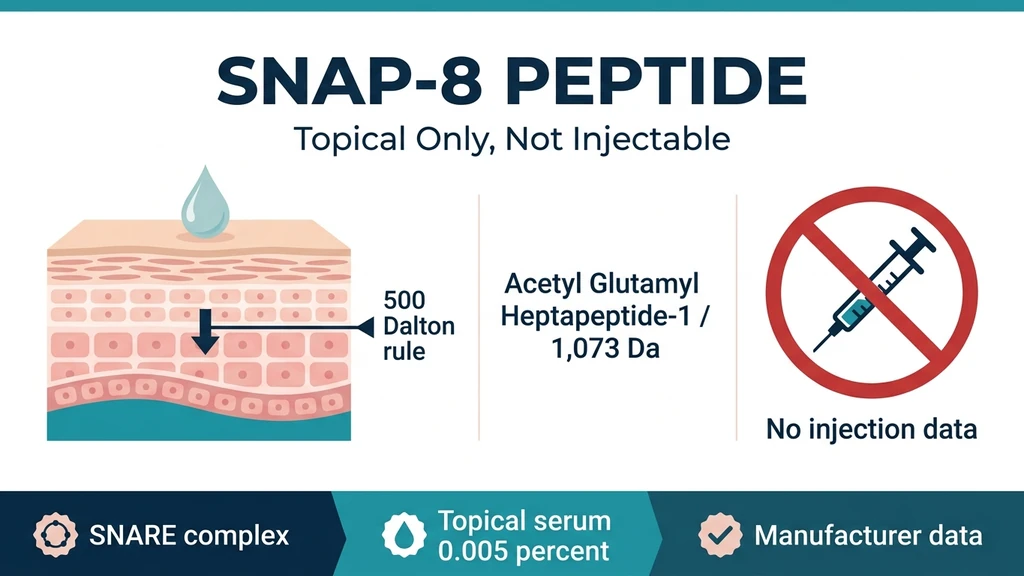
You are turning a serum bottle around and the ingredient list says acetyl octapeptide-3. The brand calls it SNAP-8 and sells it as a topical Botox alternative. Here is the direct answer: SNAP-8 is a cosmetic peptide designed to sit on the skin surface, and it is not formulated for injection. The wrinkle percentages you have seen come from the company that manufactures it.
| Quick Reference | Details |
|---|---|
| Full name | Acetyl octapeptide-3 (also listed as acetyl glutamyl heptapeptide-1) |
| Sequence | Ac-Glu-Glu-Met-Gln-Arg-Arg-Ala-Asp-NH2 |
| Molecular weight | 1,073 Da |
| Route | Topical only |
| Injectable? | No. No human injection safety data exists |
| Related to | Argireline (acetyl hexapeptide-8), plus two amino acids |
| Mechanism | Competes with SNAP-25 in the SNARE complex |
| Peptide in a finished serum | 0.0015% to 0.005% |
| Best evidence | Manufacturer in-vivo study, 17 women, 28 days |
| Independent replication | None published |
| FDA status | Cosmetic ingredient. Not FDA-approved for any use |
SNAP-8 is a cosmetic ingredient, and the FDA does not review or approve cosmetic ingredients before they reach the market. That means nobody outside the manufacturer has verified the numbers on the box. What follows is educational and is not medical advice.
For the wider skin-peptide picture, see what do peptides do for skin and the evidence behind GHK-Cu benefits.
Get your custom peptide protocol:
- Tailored to your body and goals
- Precise dosing and cycle length
- Safe stacking combinations
- Backed by peer-reviewed studies
- Ready in under 2 minutes
What SNAP-8 Actually Is
SNAP-8 is a synthetic chain of eight amino acids: Ac-Glu-Glu-Met-Gln-Arg-Arg-Ala-Asp-NH2. On an ingredient label it appears under its INCI name, acetyl octapeptide-3, and occasionally under the older synonym acetyl glutamyl heptapeptide-1. It was developed by Lipotec, a Spanish cosmetic ingredient company now owned by Lubrizol.
Its parent compound is Argireline, the hexapeptide Ac-Glu-Glu-Met-Gln-Arg-Arg-NH2. SNAP-8 is that same sequence with alanine and aspartate bolted onto the tail, which is why it is described as an elongated analogue rather than a new molecule (Errante et al., Front Chem, 2020).
Both sequences are copies of the N-terminal end of SNAP-25, a protein your nerve endings use to release the signal that tells a muscle to contract. That is the entire design premise. The peptide is a fragment of the machinery it is meant to jam.
Nothing about the molecule is a drug. It is sold to formulators as a dilute water solution, and it is sold to the research chemical market as a lyophilised powder in glass vials, which is where the trouble starts. See are peptides legal for how those two markets coexist.
How SNAP-8 Works, and Where the Logic Breaks
Picture a boat being winched to a dock by a rope that is braided on the spot from three separate cords. Each cord has to twist into the others for the rope to hold tension. Now toss a short, frayed offcut of one cord into the braid. The rope still forms, but it slips under load, and the boat comes in slowly.
Literally: nerve endings fuse acetylcholine-filled vesicles to their outer membrane by winding syntaxin, VAMP, and SNAP-25 into a four-helix bundle called the SNARE complex. SNAP-8 is a synthetic offcut of SNAP-25 that competes for a place in that bundle. A complex built around the fragment fuses vesicles less efficiently, less acetylcholine crosses to the muscle, and the muscle contracts with less force.
The mechanism is real. It was demonstrated for Argireline in isolated cells, where the peptide inhibited calcium-dependent neurotransmitter release with a potency similar to botulinum neurotoxin A but, in the authors' own words, much lower efficacy (Blanes-Mira et al., Int J Cosmet Sci, 2002). Potency describes the concentration needed. Efficacy describes how much the thing actually does at saturation.
Here is where the logic breaks. Every one of those experiments put the peptide directly onto a nerve terminal in a dish. On your face, the peptide has to first cross the stratum corneum, a 0.02 mm layer of dead, lipid-mortared cells that behaves as a molecular sieve.
Compounds heavier than roughly 500 Daltons do not meaningfully cross intact stratum corneum (Bos & Meinardi, Exp Dermatol, 2000). Argireline weighs about 890 Da. SNAP-8 weighs 1,073 Da, more than twice the threshold, and it is strongly hydrophilic and charged, which makes the crossing harder still.
So the honest statement is this. A molecule with a demonstrated mechanism in a dish faces a barrier that its own molecular weight says it should not cross, and the trials that claim it does are run by the people who sell it.
What the Evidence Really Shows
The manufacturer study. Lipotec's in-vivo data compared a 10% SNAP-8 trade solution against a 10% Argireline trade solution, applied twice daily for 28 days by 17 women. Wrinkle depth in the periocular area fell 34.98% for SNAP-8 versus 27.05% for Argireline, measured on silicone skin imprints. A separate manufacturer figure of 63.18% is a maximum single-subject reduction, not a group average. This is manufacturer data. It has not been published in a peer-reviewed journal, and it has never been independently replicated.
The originator study. Blanes-Mira's 2002 Argireline paper reported wrinkle depth reduced by up to 30% after 30 days of a 10% emulsion. The author list includes scientists employed by Lipotec, the company that developed and sells the peptide (Blanes-Mira et al., Int J Cosmet Sci, 2002). It is the most cited paper in this space and it is originator-funded.
The independent study. A split-face investigation applied an Argireline-containing hyaluronic acid serum to 19 women for four weeks and measured wrinkle scores with a Visia imaging system. Wrinkle score fell slightly on both sides. The difference between the treated and untreated sides was not statistically significant, and the author concluded that no effect of Argireline was found (Henseler, GMS Interdiscip Plast Reconstr Surg DGPW, 2023). The author declared no competing interests.
No equivalent independent trial of SNAP-8 has been published at all. The strongest claim the evidence supports: a mechanism that works in vitro, a modest effect measured by the manufacturer, and a single independent trial of the closely related parent peptide that found nothing.
For a comparison, copper peptides carry independent peer-reviewed dermatology data across multiple groups. SNAP-8 does not. That gap is worth knowing before you spend anything. Run the numbers with the peptide cost calculator.
Three Ways People Get Hurt With SNAP-8
Scenario 1: Injecting it. Research vendors sell SNAP-8 as a 10 mg lyophilised powder and publish "dosing protocols" suggesting 200 to 500 mcg subcutaneously. Do the arithmetic against the only route the peptide was ever designed for. A finished cosmetic serum contains 0.005% acetyl octapeptide-3 at the very most, so a 0.5 g layer over the face deposits about 25 mcg on the skin surface, of which an unknown but very small fraction crosses a barrier tuned to reject 1,073 Da molecules. A 250 mcg injection puts ten times that total mass directly into the tissue at roughly 100% bioavailability. Nobody has ever measured what happens next in a human being. There is no injection pharmacokinetic data, no dose-finding study, no adverse event registry, and no trial of any kind.
The problem compounds. Peptides made by solid-phase synthesis carry a trifluoroacetate counterion that typically accounts for 20% to 35% of the powder by mass, and TFA is documented to alter cell proliferation, increase cellular and hepatic toxicity, and provoke antibody responses (Erckes et al., Pharmaceuticals, 2025). A 10 mg research vial can therefore contain 2 to 3.5 mg of trifluoroacetate. Research vials are also not sterile-filled and not endotoxin-tested. Injecting that into facial tissue risks sterile abscess, granuloma, and cellulitis, and buys you a mechanism that has never once been shown to relax a human muscle from below the skin. The fix: SNAP-8 goes on skin. No injection protocol exists anywhere that is grounded in human data, so none appears below. If you are injecting other peptides, read how to inject peptides and bacteriostatic water vs sterile water to understand what sterile technique actually requires.
Scenario 2: Reading "10% SNAP-8" as 10% peptide. The 10% in the manufacturer's study refers to 10% of a trade solution whose peptide content is 0.05%. The finished product therefore contained 0.005% acetyl octapeptide-3. A person who buys 10 mg of raw powder and blends it into a cream at 10% w/w has built a formula 2,000 times more concentrated than anything ever tested. A 30 g jar at that strength requires 3 g of peptide, roughly 300 research vials. The realistic outcome is a stinging, unpreserved, pH-unadjusted water cream that grows bacteria within days. The fix: buy a finished, preserved formulation and read the label the way the next section teaches.
Scenario 3: Microneedling it in. Rolling a 0.5 mm needle through the skin drives channels roughly 25 times deeper than the 0.02 mm barrier you are trying to bypass. The serum's other ingredients, including its preservative system, were safety-assessed for application onto intact skin, never for delivery into the dermis. Non-sterile cosmetic solutions placed intradermally are a documented cause of granulomatous reactions. The fix: never needle a product that is not sterile and labelled for that use. The same warning applies to copper peptides, which is covered in detail in GHK-Cu microneedling and in the cautionary reports at copper peptides ruined my skin.
How to Read a SNAP-8 Serum Label
Almost nobody teaches this, and it is the single skill that separates a buyer who understands what they own from one who does not.
Step 1: Find the INCI name, not the trade name. SNAP-8 is a trademark. The regulated name on the ingredient list is acetyl octapeptide-3. If the marketing copy screams SNAP-8 and the INCI list never mentions acetyl octapeptide-3, the peptide is not in the bottle.
Step 2: Understand the trade solution. The raw material sold to formulators has the INCI declaration "Water, Acetyl Octapeptide-3, Caprylyl Glycol" and contains 0.05% peptide. The rest is water and a preservative-booster. The supplier's recommended use level is 3% to 10% of the finished formula.
Step 3: Multiply. A serum built at the supplier's maximum contains 10% of 0.05%, which is 0.005% acetyl octapeptide-3, or 50 micrograms per gram. At the minimum recommended level it contains 0.0015%, or 15 micrograms per gram.
Step 4: Translate that into what you own. A 30 mL bottle formulated at the maximum holds about 1.5 mg of peptide in total. One 10 mg research vial contains the peptide equivalent of roughly 400 topical applications, or about six and a half full bottles of serum.
Step 5: Check the position on the list. Ingredients above 1% are listed in descending order. Acetyl octapeptide-3 present at 0.005% belongs near the very bottom, alongside preservatives. A label that lists it third, above glycerin, is either using the trade solution name loosely or telling you nothing useful.
Step 6: Look at what else is in the bottle. Peptide serums are often carried in glycerin and hyaluronic acid, both of which plump the stratum corneum with water and soften the look of fine lines within minutes. That immediate improvement you see in the mirror on day one is hydration, and it will happen with or without the peptide.
Before layering a peptide serum with acids or retinoids, run the combination through the peptide interaction checker.
SNAP-8 Reference Table
Everything a buyer or formulator needs, in one place.
| Property | Value |
|---|---|
| INCI name | Acetyl octapeptide-3 |
| Synonym | Acetyl glutamyl heptapeptide-1 |
| Trade name | SNAP-8 (Lipotec / Lubrizol) |
| Sequence | Ac-EEMQRRAD-NH2 |
| Molecular formula | C42H72N16O15S |
| Molecular weight | 1,073 Da |
| Parent peptide | Argireline, acetyl hexapeptide-8 (~890 Da) |
| Difference from Argireline | Two extra residues: Ala, Asp |
| Trade solution peptide content | 0.05% |
| Supplier use level | 3% to 10% of formula |
| Actual peptide in finished serum | 0.0015% to 0.005% (15 to 50 mcg/g) |
| Peptide in a 30 mL bottle | ~0.45 mg to 1.5 mg |
| Formulation temperature | Add below 40 C, at cool-down |
| Storage of raw solution | Refrigerated, 4 C |
| Approved routes | Topical, intact skin |
| Injection | Never. No sterility, no dose data, no human safety data |
| Microneedling | Not appropriate. Non-sterile cosmetic solution |
Realistic timelines, stated honestly:
| Timeframe | Manufacturer claim | What to actually expect |
|---|---|---|
| Day 1 | Not measured | Lines look softer from hydration in the base, not the peptide |
| Weeks 1-2 | Not reported | No measurable change |
| Week 4 (28 days) | 34.98% mean wrinkle depth reduction, twice daily, n=17 | Subtle at best. Instrument-measured, never independently replicated |
| Weeks 8-12 | No controlled data | Unknown. No trial has run this long |
| After stopping | No data | No structural collagen change was ever demonstrated, so any effect is contingent on continued use |
For a peptide with genuinely independent human skin data, compare against GHK-Cu dosage chart and AHK-Cu vs GHK-Cu. If you are new to this category entirely, start with getting started with peptides.
Common Mistakes With SNAP-8
Mistake 1: Confusing the trade solution percentage with the peptide percentage. People read "10% SNAP-8" and buy raw powder to hit that number, arriving at a formula 2,000 times stronger than the tested one. The fix: 10% trade solution equals 0.005% peptide. Nothing above that has been tested on human skin.
Mistake 2: Buying a research vial to inject. A 10 mg vial exists because the research chemical market packages everything that way. It says nothing about whether injection is a valid route. There is zero human injection data and the powder carries 20% to 35% trifluoroacetate by mass. The fix: buy a finished cosmetic serum. Read peptide safety guide and where to buy peptides in 2026 before you buy anything from a research vendor.
Mistake 3: Expecting Botox-comparable results. The originator's own paper described the peptide's efficacy at neurotransmitter inhibition as much lower than botulinum neurotoxin (Blanes-Mira et al., Int J Cosmet Sci, 2002), and that was in a cell dish with no skin barrier in the way. The fix: judge SNAP-8 against other serums, never against an injectable neurotoxin.
Mistake 4: Dropping proven actives for it. Photoaging drives most visible wrinkling, and SNAP-8 does nothing to collagen synthesis. Trading a retinoid or daily sunscreen for a peptide serum trades strong evidence for weak evidence. The fix: keep the foundation, add the peptide on top, and see peptide therapy side effects if your skin reacts.
Frequently Asked Questions
What is SNAP-8 peptide?
SNAP-8 is acetyl octapeptide-3, a synthetic eight-amino-acid cosmetic peptide with the sequence Ac-EEMQRRAD-NH2 and a molecular weight of 1,073 Da. It is an elongated version of Argireline, designed for topical skincare formulations at 0.0015% to 0.005% in the finished product. See what do peptides do for skin.
Can you inject SNAP-8 peptide?
No. SNAP-8 is formulated for topical use. Research vials are not sterile-filled, not endotoxin-tested, and carry 20% to 35% trifluoroacetate by mass. No human injection pharmacokinetic, dosing, or safety study exists. Injecting non-sterile powder into facial tissue risks abscess and granuloma. Compare with how to inject peptides for what a legitimate injectable route requires.
Does SNAP-8 peptide actually work?
Manufacturer data reports a 34.98% mean wrinkle depth reduction after 28 days of twice-daily use in 17 women. No independent trial of SNAP-8 has been published, and the one independent trial of its parent peptide Argireline found no significant effect in 19 women over four weeks. Expect subtle results. See peptide statistics 2026.
What are SNAP-8 peptide benefits?
The claimed benefit is reduced expression-line depth around the eyes and forehead by weakening muscle contraction at the surface, achieved by competing with SNAP-25 in the SNARE complex. Evidence for that benefit comes almost entirely from the manufacturer. For peptides with independent skin data, see GHK-Cu benefits and GHK-Cu hair growth.
Is SNAP-8 the same as Argireline?
They are close relatives. Argireline is acetyl hexapeptide-8, six residues, roughly 890 Da. SNAP-8 is that sequence plus alanine and aspartate, making eight residues at 1,073 Da. Both mimic the N-terminal end of SNAP-25 and both exceed the 500 Da skin penetration threshold. Read AHK-Cu vs GHK-Cu for a comparable peptide-versus-analogue breakdown.
What concentration of SNAP-8 should a serum have?
The supplier recommends 3% to 10% of the trade solution, which contains 0.05% peptide. That means a properly built serum holds 0.0015% to 0.005% acetyl octapeptide-3, or 15 to 50 micrograms per gram. Anything advertising 10% pure peptide is either mislabelled or unsafe. Check layering with the peptide interaction checker.
How long does SNAP-8 take to work?
The only controlled endpoint is 28 days of twice-daily application. Any softening you notice on day one comes from glycerin and hyaluronic acid hydrating the stratum corneum. No trial has run past four weeks, and no structural collagen change has been shown, so effects depend on continued use. See if you stop GHK-Cu what happens for the same principle.
Is SNAP-8 safe?
Applied topically at cosmetic concentrations, adverse events are limited to occasional mild irritation. It is a cosmetic ingredient, so the FDA never reviewed or approved it. Injected or microneedled, it moves into territory with no safety data whatsoever. Review the peptide safety guide and GHK-Cu side effects for how cosmetic peptides go wrong.
The Bottom Line
SNAP-8 is acetyl octapeptide-3, a topical cosmetic peptide that competes with SNAP-25 for a place in the SNARE complex and weakens muscle contraction near the skin surface. It is applied to intact skin at 0.0015% to 0.005%. It is not injected, and no human injection data of any kind exists.
The mechanism is genuine and the effect size is small. A 1,073 Da hydrophilic molecule fighting a barrier calibrated to stop anything over 500 Da is a hard sell, and the best numbers behind it belong to the company that sells the powder. One independent trial of its parent peptide found nothing at all.
Buy the finished serum, read the INCI list, and treat any research vial with a "dosing protocol" as a warning sign rather than an invitation. Check what you can safely layer it with using the peptide interaction checker, price a routine with the peptide cost calculator, and read peptides for eczema if your skin is reactive. More evidence-first peptide guides are at peptidesexplorer.com.
Helpful Tools
Related Articles
Copper Peptides Ruined My Skin: Why
Copper peptides ruined my skin? Why GHK-Cu can cause breakouts, redness, purging, and irritation, who is at risk, how to recover, and when to stop.
Peptides for Eczema: What Helps?
Peptides for eczema: which ones support skin barrier repair and inflammation, the evidence behind GHK-Cu and KPV, safety cautions, and what they cannot replace.
Where to Inject IGF-1 LR3: Sites, SubQ vs IM, Rotation
Where to inject IGF-1 LR3: abdomen, thigh or glute, subcutaneous, 29-31G needle. Why site-specific growth is a myth, a rotation map, and the hypoglycemia rule.
When to Take IGF-1 LR3: Best Time & Fed vs Fasted
When to take IGF-1 LR3: post-workout with carbs on training days, morning with breakfast on rest days, never fasted. Half-life, spacing from GH peptides, FAQ.