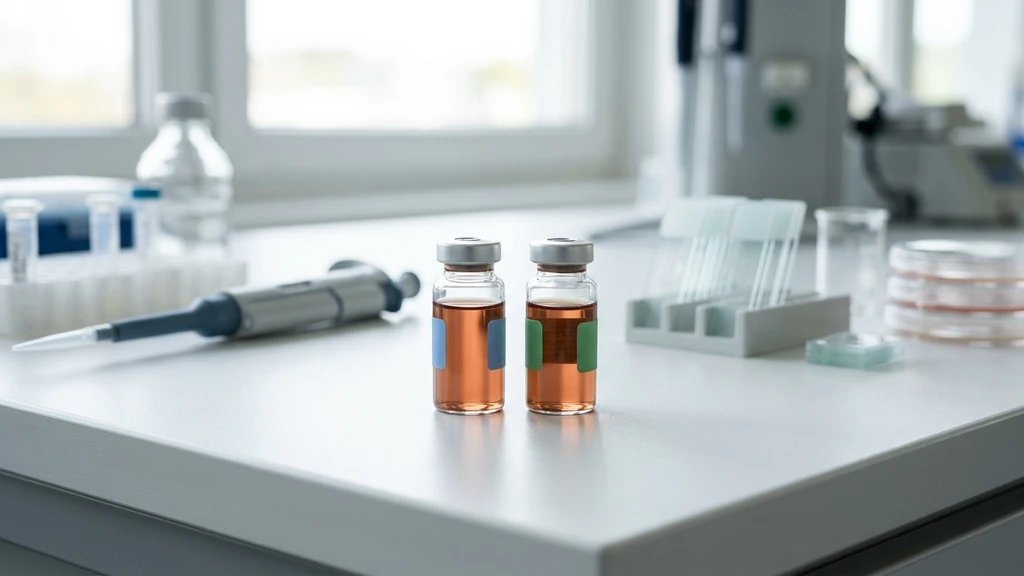
You are holding two copper peptide vials and need to decide which one goes on your scalp, your face, or both. GHK-Cu is the gold standard for skin repair and anti-aging with 50+ years of published research. AHK-Cu is a synthetic tripeptide specifically engineered for hair follicle stimulation, showing stronger dermal papilla cell proliferation than GHK-Cu in laboratory studies (Pickart et al., Int J Mol Sci, 2018; Pyo et al., Arch Pharm Res, 2007).
| Quick Reference | GHK-Cu | AHK-Cu |
|---|---|---|
| Full name | Copper Tripeptide-1 | Copper Tripeptide-3 |
| Sequence | Glycine-Histidine-Lysine + Cu2+ | Alanine-Histidine-Lysine + Cu2+ |
| Origin | Naturally occurring (human plasma) | Synthetic |
| Discovered | 1973 (Loren Pickart) | ~2000s (cosmetic research) |
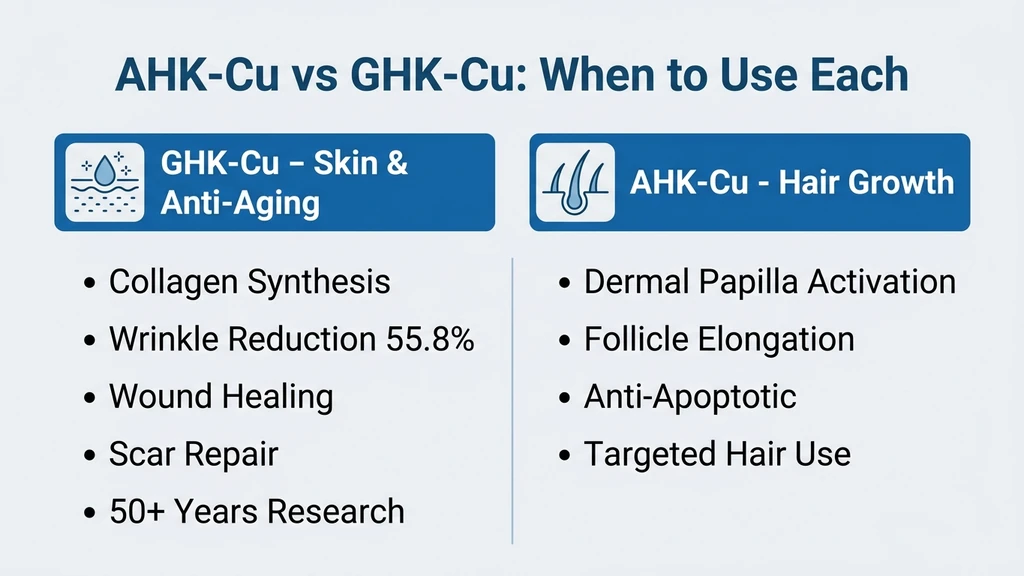
| Primary use | Skin anti-aging, wound healing | Hair follicle stimulation |
| Research depth | 50+ years, hundreds of studies | Limited, key 2007 study |
| DHT blocking | Yes (copper ions inhibit 5-AR type 1) | Indirect (copper delivery) |
| Best for | Skin rejuvenation, collagen, scars | Hair growth, follicle activation |
| Delivery methods | Topical, injection, microneedling, nasal | Topical, injection, microneedling |
For reconstitution guidance, use our peptide reconstitution calculator.
Get your custom peptide protocol:
- Tailored to your body and goals
- Precise dosing and cycle length
- Safe stacking combinations
- Backed by peer-reviewed studies
- Ready in under 2 minutes
What Is GHK-Cu (Copper Tripeptide-1)?
GHK-Cu is a naturally occurring tripeptide found in human plasma, saliva, and urine. Loren Pickart isolated it in 1973 while studying age-related changes in liver cell function. The peptide consists of three amino acids (glycine-histidine-lysine) bound to a copper(II) ion.
GHK-Cu concentrations in human plasma decline with age: approximately 200 ng/mL at age 20, dropping to 80 ng/mL by age 60. This decline correlates with reduced wound healing capacity, decreased collagen synthesis, and visible skin aging.
How GHK-Cu Works
GHK-Cu modulates the expression of over 4,000 human genes. The Pickart 2018 review documented effects on collagen synthesis, anti-inflammatory signaling, nerve regeneration, and stem cell recruitment (Pickart et al., Int J Mol Sci, 2018).
For skin, the primary mechanisms include stimulation of collagen I and III synthesis, increased production of decorin (which organizes collagen fibers), upregulation of VEGF for blood vessel formation, and activation of tissue remodeling through metalloproteinase regulation.
For hair, GHK-Cu delivers copper ions to the scalp. These copper ions inhibit type 1 5-alpha reductase by up to 90% in vitro (Sugimoto et al., 1995), reducing local DHT production. GHK-Cu also activates Wnt/beta-catenin signaling, a critical pathway for hair follicle cycling. For the complete DHT mechanism analysis, see our does GHK-Cu block DHT article.
Evidence Base: Five Decades of Research
GHK-Cu has the deepest research library of any copper peptide. Key findings include a 70% increase in skin thickness after 12 days of topical application, wrinkle volume reduction of 55.8% and depth reduction of 32.8% in clinical studies, and accelerated wound healing across multiple models (Pickart et al., 2018).
The breadth of data spans dermatology, wound healing, oncology (gene modulation studies), neurology, and orthopedics. No other cosmetic peptide has this range of published evidence. For the full benefits overview, see our GHK-Cu benefits guide.
What Is AHK-Cu (Copper Tripeptide-3)?
AHK-Cu is a synthetic copper tripeptide designed specifically for hair follicle activation. Its sequence is alanine-histidine-lysine bound to a copper(II) ion. The only structural difference from GHK-Cu is the first amino acid: alanine instead of glycine.
That single amino acid substitution changes the peptide's affinity for hair follicle cells. AHK-Cu shows enhanced activity at dermal papilla cells (DPCs), the specialized cells at the base of each hair follicle that control hair growth cycling.
How AHK-Cu Works
The Pyo 2007 study is the foundational reference for AHK-Cu's hair growth activity. In a human hair follicle organ culture model, AHK-Cu demonstrated three key effects at concentrations of 10^-12 to 10^-9 M (extremely low doses) (Pyo et al., Arch Pharm Res, 2007).
First, AHK-Cu stimulated hair follicle elongation, meaning existing follicles grew longer hair shafts. Second, it promoted dermal papilla cell proliferation, increasing the population of cells responsible for initiating new growth cycles. Third, it exhibited anti-apoptotic effects on outer root sheath cells, protecting follicle structures from programmed cell death.
These mechanisms are specific to the hair follicle microenvironment. AHK-Cu does not have the broad gene-modulating activity of GHK-Cu for skin repair or wound healing.
Evidence Base: Targeted but Limited
AHK-Cu's published evidence is narrow compared to GHK-Cu. The Pyo 2007 study provides solid in vitro data for hair follicle effects. Cosmetic industry formulation studies have incorporated AHK-Cu into hair growth serums and topical products. Clinical trial data in human subjects for hair growth endpoints (terminal hair count, follicle density) is not yet published.
This does not mean AHK-Cu is ineffective. It means the evidence is at an earlier stage. The in vitro data is promising, the mechanism is plausible, and clinical formulations are widely available. Full clinical validation is still pending.
AHK-Cu vs GHK-Cu: Head-to-Head Comparison
This table consolidates the key differences across every relevant parameter.
| Parameter | GHK-Cu | AHK-Cu |
|---|---|---|
| Amino acid sequence | Gly-His-Lys-Cu2+ | Ala-His-Lys-Cu2+ |
| Molecular weight | ~403 Da | ~417 Da |
| Origin | Natural (human plasma) | Synthetic |
| Primary target | Skin cells, fibroblasts, immune cells | Dermal papilla cells (hair follicles) |
| Genes modulated | 4,000+ | Limited data |
| Collagen stimulation | Strong (types I and III) | Weak |
| Wound healing | Extensively documented | Not documented |
| Hair follicle elongation | Moderate | Strong (Pyo 2007) |
| DPC proliferation | Moderate | Superior (Pyo 2007) |
| DHT reduction | Yes (copper ion mechanism) | Yes (copper ion mechanism) |
| Anti-inflammatory | Strong | Limited data |
| Research depth | 50+ years, hundreds of studies | ~15 years, limited studies |
| Best for | Skin anti-aging, wound healing, scars | Hair growth, follicle activation |
| Regulatory status | Research compound | Research compound |
For Hair Growth: AHK-Cu Has the Edge
When your primary goal is stimulating hair follicles, AHK-Cu outperforms GHK-Cu in the laboratory data that exists.
The Pyo 2007 study directly compared tripeptide-copper complexes for their effects on human hair follicles. AHK-Cu demonstrated stronger dermal papilla cell proliferation than GHK-Cu at equivalent concentrations. Hair follicle elongation was more pronounced. The anti-apoptotic effect on outer root sheath cells was significant at picomolar concentrations (Pyo et al., 2007).
Think of dermal papilla cells as the command center for each hair follicle. They send signals that determine whether the follicle grows (anagen phase), rests (catagen), or sheds (telogen). AHK-Cu's enhanced DPC proliferation means it is better at activating and sustaining this command center.
GHK-Cu still supports hair growth through complementary mechanisms: copper-mediated DHT reduction, Wnt/beta-catenin signaling, VEGF upregulation for scalp blood supply, and collagen remodeling in the surrounding tissue. These create a healthier environment for follicles to grow in, even though GHK-Cu does not stimulate the follicles as directly as AHK-Cu. For the detailed GHK-Cu hair growth guide, see our GHK-Cu for hair growth article.
For Skin Anti-Aging: GHK-Cu Wins Decisively
For skin rejuvenation, wrinkle reduction, scar healing, and collagen stimulation, GHK-Cu has no real competitor in the copper peptide category.
Clinical studies documented a 55.8% reduction in wrinkle volume and a 32.8% reduction in wrinkle depth with topical GHK-Cu application. Skin thickness increased by 70% after 12 days in one study. Collagen synthesis (types I and III) increased significantly, along with improvements in elastin and glycosaminoglycan production (Pickart et al., 2018).
GHK-Cu's wound healing properties accelerate scar maturation, reduce inflammation, and promote organized collagen deposition. Surgical wound studies have shown faster closure times and reduced scarring with GHK-Cu application.
AHK-Cu has minimal published data for skin outcomes. Its design targets hair follicle biology, not dermal repair or anti-aging. Using AHK-Cu for wrinkle reduction would be off-target. For GHK-Cu skin benefits, see our GHK-Cu benefits guide. For potential skin irritation management, see copper peptides and skin reactions.
For DHT Blocking: GHK-Cu Has an Edge
Both peptides deliver copper(II) ions, and copper ions are the active component for 5-alpha reductase inhibition. The Sugimoto 1995 study documented that copper ions inhibit type 1 5-alpha reductase by up to 90% in vitro, with 50% inhibition at 0.12 mcg copper/mL. This reduces local DHT production in hair follicles.
Type 1 5-alpha reductase is predominant in hair follicles and skin. Type 2 is predominant in the prostate. Finasteride primarily blocks type 2. Copper ions from GHK-Cu primarily block type 1. This makes the mechanisms complementary rather than redundant.
GHK-Cu has the better-documented delivery mechanism because the peptide portion (GHK) enhances cellular uptake of copper ions. AHK-Cu also delivers copper, but its delivery efficiency to the specific cells that express 5-alpha reductase has not been directly compared.
For the complete DHT mechanism analysis, including comparison with finasteride and dutasteride, see our does GHK-Cu block DHT article.
Can You Use AHK-Cu and GHK-Cu Together?
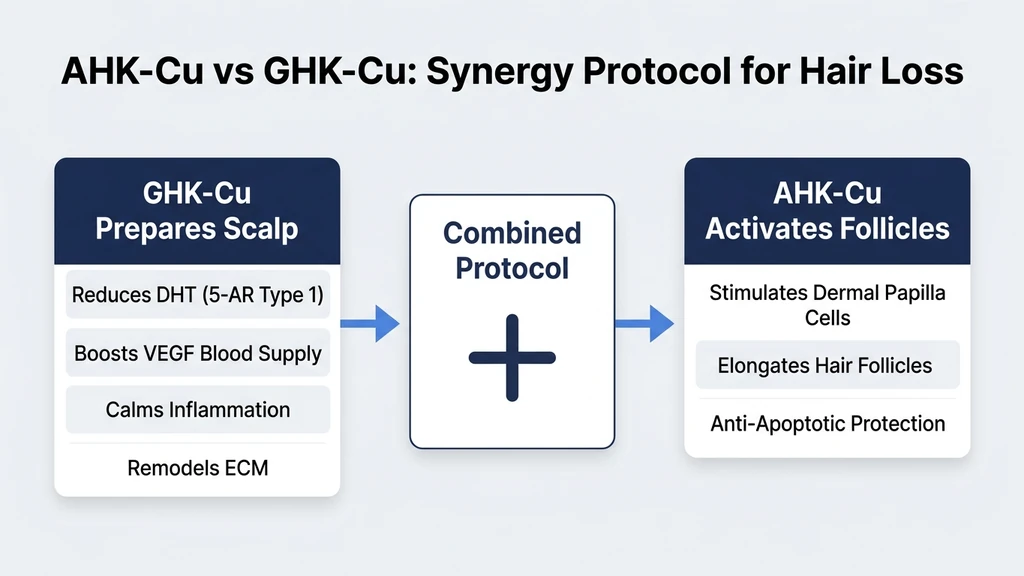
Yes. Using both copper peptides simultaneously is pharmacologically sound, and many practitioners recommend the combination for hair loss protocols.
The synergy works at two levels. GHK-Cu creates a healthier scalp environment: reducing local DHT, increasing blood supply through VEGF, calming inflammation, and remodeling the extracellular matrix around follicles. AHK-Cu then directly stimulates the follicles within that improved environment, promoting dermal papilla cell proliferation and follicle elongation.
Think of it as preparing the soil before planting. GHK-Cu conditions the scalp tissue. AHK-Cu activates the follicles within it. Neither step alone produces the best result.
Practical combination approaches include topical serums containing both peptides, alternating injection sites (GHK-Cu subcutaneous, AHK-Cu scalp mesotherapy), or using GHK-Cu via microneedling with AHK-Cu in a topical serum applied after.
Delivery Methods Compared
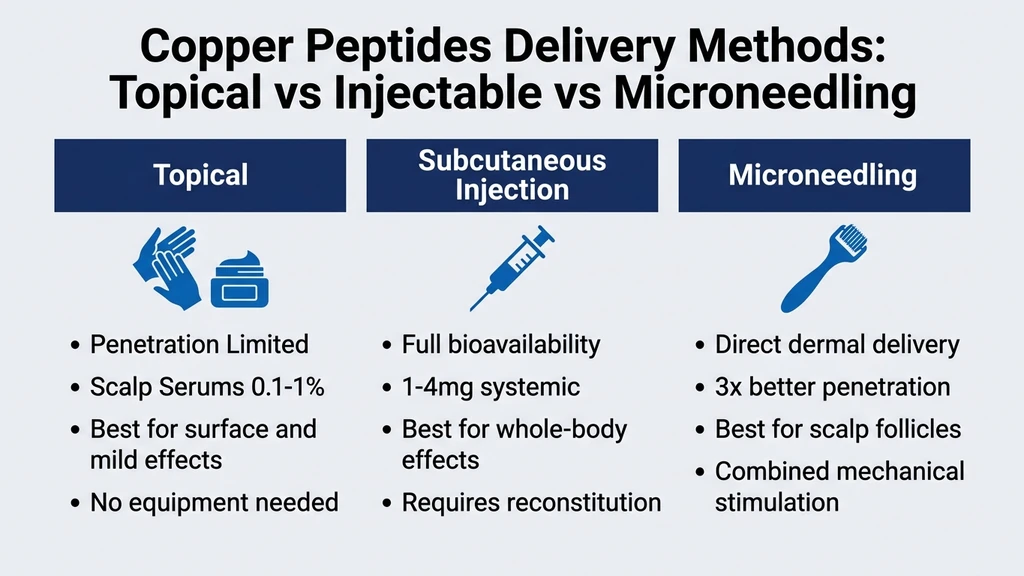
Both peptides are available in multiple delivery formats. The best method depends on your target (scalp vs face vs systemic) and comfort level.
Topical Application (Serums and Creams)
The most accessible delivery method. GHK-Cu serums at 0.1-1% concentration are widely available for facial anti-aging. AHK-Cu scalp serums are formulated for hair growth. Topical penetration is the limiting factor: copper peptides are large molecules that require formulation technology to cross the skin barrier.
A 2023 study demonstrated that ionic liquid microemulsion formulations improved GHK-Cu topical delivery by 3-fold compared to conventional vehicles (PMC10643103). Look for serums with advanced delivery systems rather than basic aqueous solutions.
Subcutaneous Injection
Injection bypasses the skin penetration barrier entirely. GHK-Cu is commonly injected subcutaneously at doses of 1-4 mg daily for systemic effects (skin, hair, wound healing). AHK-Cu can be injected near the scalp for localized follicle stimulation.
Injection produces higher tissue concentrations than topical application. For reconstitution and injection guidance, see our GHK-Cu injection dosage guide and how to reconstitute GHK-Cu.
Microneedling
Microneedling creates temporary micro-channels in the skin, dramatically increasing peptide penetration. Applying GHK-Cu or AHK-Cu immediately after microneedling delivers the peptide directly into the dermal layer where target cells reside.
For scalp hair loss protocols, microneedling at 0.5-1.5 mm depth followed by AHK-Cu serum application is a common clinical approach. For facial anti-aging, microneedling with GHK-Cu reaches fibroblasts in the dermis. See our GHK-Cu microneedling guide.
Nasal Spray (GHK-Cu Only)
GHK-Cu nasal spray delivers the peptide to the highly vascularized nasal mucosa for rapid systemic absorption. This route is used primarily for neurological and systemic anti-aging effects rather than localized skin or hair benefits. AHK-Cu is not commonly formulated as a nasal spray. See our GHK-Cu nasal spray guide.
Important Safety Considerations
Both GHK-Cu and AHK-Cu are research compounds without FDA approval for any indication. Neither has completed Phase III clinical trials for hair growth or skin anti-aging endpoints in humans.
Copper peptides are generally well tolerated. The most common side effects with topical use include mild redness, temporary stinging at application site, and initial purging (worsened appearance before improvement). Injection site reactions are typical of any subcutaneous peptide.
Excessive copper exposure is a theoretical concern with long-term, high-dose use. The amounts delivered by standard peptide protocols are far below toxic copper thresholds, but users with Wilson's disease or copper metabolism disorders should avoid copper peptides entirely. For side effect details, see our GHK-Cu side effects guide.
Frequently Asked Questions
Which copper peptide is better for hair loss?
AHK-Cu is specifically designed for hair follicle stimulation. The Pyo 2007 study showed AHK-Cu produces stronger dermal papilla cell proliferation and follicle elongation than GHK-Cu at equivalent concentrations. Choose AHK-Cu as the primary hair growth peptide. Use GHK-Cu as a complement for scalp environment (DHT reduction, VEGF, collagen remodeling).
Can I use both AHK-Cu and GHK-Cu at the same time?
Yes. The combination is synergistic. GHK-Cu prepares a healthier scalp environment by reducing DHT, increasing blood supply, and calming inflammation. AHK-Cu then directly stimulates follicle growth within that improved environment. Many topical hair serums now combine both peptides for this reason.
Does GHK-Cu block DHT?
GHK-Cu delivers copper ions that inhibit type 1 5-alpha reductase by up to 90% in laboratory studies (Sugimoto 1995). This reduces local DHT production in hair follicles. It is a mild, non-hormonal mechanism, not comparable in potency to finasteride or dutasteride, but carries none of their hormonal side effects.
Is GHK-Cu or AHK-Cu better for anti-aging skin care?
GHK-Cu is vastly superior for skin anti-aging. It stimulates collagen types I and III, reduces wrinkle volume by 55.8%, increases skin thickness by 70% in 12 days, and accelerates wound healing. AHK-Cu was designed for hair follicle cells, not dermal fibroblasts. Use GHK-Cu for all facial and skin anti-aging applications.
What is the difference between Copper Tripeptide-1 and Copper Tripeptide-3?
Copper Tripeptide-1 is GHK-Cu (glycine-histidine-lysine + copper). Copper Tripeptide-3 is AHK-Cu (alanine-histidine-lysine + copper). The only structural difference is the first amino acid: glycine vs alanine. This single substitution shifts biological activity from broad tissue repair (GHK-Cu) toward targeted hair follicle stimulation (AHK-Cu).
How long before copper peptides show results for hair growth?
Topical copper peptide protocols typically require 3-6 months of consistent use before visible hair growth changes appear. Microneedling with copper peptides may accelerate results to 2-4 months. Shedding may increase temporarily in the first 4-6 weeks as dormant follicles enter a new growth cycle. Patience and consistency are essential.
Are copper peptides safe for long-term use?
At standard concentrations (topical serums at 0.1-1%, injections at 1-4 mg daily), copper peptides deliver copper well below toxic thresholds. GHK-Cu has over 50 years of research with no serious safety signals. Long-term monitoring is still advisable. People with Wilson's disease or copper metabolism disorders should avoid copper peptides entirely.
Can copper peptides replace finasteride for hair loss?
No. Copper peptides provide mild type 1 5-alpha reductase inhibition, which is complementary to finasteride's type 2 inhibition. For significant androgenetic alopecia, copper peptides work best alongside pharmaceutical treatments, not as replacements. GHK-Cu plus finasteride plus minoxidil is a multi-mechanism protocol used in clinical practice.
The Bottom Line
GHK-Cu and AHK-Cu are complementary, not competing. GHK-Cu is the established workhorse for skin anti-aging, wound healing, and broad tissue repair with over 50 years of published research. AHK-Cu is the specialist for hair follicle stimulation, showing superior dermal papilla cell activation in the Pyo 2007 study.
For hair loss: start with AHK-Cu for direct follicle stimulation, add GHK-Cu for scalp environment optimization. For skin: GHK-Cu alone covers the full anti-aging spectrum. For both goals: use both peptides in a combined protocol.
For injection dosing, see our GHK-Cu injection dosage guide. For reconstitution, use our peptide reconstitution calculator. For the DHT mechanism deep dive, see does GHK-Cu block DHT.
Helpful Tools
Related Articles
What Do Peptides Do for Skin? Benefits & Types
Peptides boost collagen by up to 65%, reduce wrinkles, and strengthen the skin barrier. Which types work, how to use them, and clinical evidence.
Where to Inject GHK-Cu: Sites by Goal
Where to inject GHK-Cu for skin, hair, wounds, and anti-aging. Subcutaneous site map by goal, rotation patterns, needle depth, and angle guidance.
GHK-Cu Benefits: 8 Research-Backed Effects
8 GHK-Cu benefits: skin rejuvenation, wound healing, hair growth, anti-inflammatory, and antioxidant effects. PubMed-cited research with dosages.
Does GHK-Cu Cause Hair Loss?
GHK-Cu does not cause hair loss. Research shows it promotes hair growth by activating the Wnt/beta-catenin pathway and enlarging miniaturized follicles.