You read that copper peptides block DHT and want to know if it is true. GHK-Cu does not directly block DHT the way finasteride does. The copper ions that GHK-Cu delivers can inhibit type 1 5-alpha reductase by up to 90% in vitro, reducing local DHT production in hair follicles (Sugimoto et al., 1995). This makes GHK-Cu a mild, non-hormonal complement to hair loss treatment, not a replacement for pharmaceutical DHT blockers (Pickart et al., Int J Mol Sci, 2018).
| Quick Reference | Details |
|---|---|
| Does GHK-Cu block DHT directly? | No. The peptide itself does not inhibit 5-alpha reductase |
| What does block DHT? | Copper(II) ions delivered by GHK-Cu |
| Enzyme inhibited | Type 1 5-alpha reductase (predominant in hair follicles) |
| Inhibition strength | Up to 90% in vitro (Sugimoto 1995) |
| 50% inhibition concentration | 0.12 mcg copper/mL |
| Compared to finasteride | Much weaker; finasteride blocks type 2 (systemic) |
| Sexual side effects | None reported with GHK-Cu |
| Best use case | Complement to finasteride/minoxidil, not a replacement |
For the copper peptide comparison, see our AHK-Cu vs GHK-Cu guide.
Get your custom peptide protocol:
- Tailored to your body and goals
- Precise dosing and cycle length
- Safe stacking combinations
- Backed by peer-reviewed studies
- Ready in under 2 minutes
What Is DHT and Why Does It Cause Hair Loss?
Dihydrotestosterone (DHT) is the primary androgen responsible for androgenetic alopecia (pattern hair loss) in both men and women. Understanding how DHT damages hair follicles explains why blocking it matters and where GHK-Cu fits into the picture.
The DHT-Hair Loss Connection
Testosterone circulates in the bloodstream and enters hair follicle cells. Inside those cells, an enzyme called 5-alpha reductase converts testosterone into DHT. DHT binds androgen receptors in the dermal papilla cells with 5 times greater affinity than testosterone itself.
This binding triggers a miniaturization cascade. The hair follicle shrinks progressively over multiple growth cycles. Terminal hairs (thick, pigmented) become vellus hairs (thin, colorless). Eventually, the follicle stops producing visible hair entirely. The process is gradual, typically spanning years to decades.
Type 1 vs Type 2 5-Alpha Reductase
Two isoforms of 5-alpha reductase exist in human tissue, and each predominates in different locations.
| Isoform | Primary Location | Inhibited By |
|---|---|---|
| Type 1 | Hair follicles, skin, sebaceous glands | Copper ions (90% in vitro), dutasteride |
| Type 2 | Prostate, liver, seminal vesicles | Finasteride, dutasteride |
Type 1 is the dominant isoform in hair follicles and the scalp. Type 2 is dominant in the prostate. Finasteride (Propecia) primarily blocks type 2 5-alpha reductase, which explains why it reduces serum DHT by approximately 70% but does not fully eliminate DHT production in the scalp. Dutasteride blocks both isoforms.
This distinction matters for GHK-Cu. The copper ions it delivers inhibit type 1 preferentially. Finasteride inhibits type 2 preferentially. The two mechanisms are complementary, not redundant.
How GHK-Cu Interacts with DHT Pathways
The relationship between GHK-Cu and DHT is indirect. GHK-Cu itself does not bind to or inhibit 5-alpha reductase. The active agent is the copper(II) ion that GHK-Cu transports and releases.
Copper Ion Inhibition of 5-Alpha Reductase
Sugimoto et al. (1995) demonstrated that copper(II) ions inhibit type 1 5-alpha reductase in a concentration-dependent manner. At sufficient concentrations, inhibition reached 90%. The IC50 (concentration for 50% inhibition) was 0.12 mcg copper per mL.
The mechanism is straightforward. Copper ions interact with the enzyme's active site, reducing its ability to convert testosterone to DHT. This effect is local, occurring in the tissue where copper ions are present. Systemic DHT levels are not meaningfully affected by topical or even injectable GHK-Cu at standard doses.
The inhibition of type 2 5-alpha reductase by copper ions is approximately 10-fold weaker. This makes copper a more selective type 1 inhibitor than finasteride, which is a more selective type 2 inhibitor. The selectivity profiles are mirror images.
GHK-Cu Is Not a Direct DHT Blocker
The distinction between GHK-Cu and its copper cargo is important. GHK-Cu is a delivery vehicle for copper ions. The tripeptide (glycine-histidine-lysine) binds copper with high affinity and releases it at the cellular level. The peptide itself has no 5-alpha reductase inhibitory activity.
This means the DHT-blocking effect depends on copper ion concentration at the target tissue. Topical application delivers copper to the scalp surface. Subcutaneous injection delivers it systemically. Microneedling delivers it directly into the dermis. Each method produces different local copper concentrations, and therefore different degrees of 5-alpha reductase inhibition.
The in vitro data (90% inhibition) represents optimal conditions: isolated enzyme with controlled copper concentration. In vivo results in human hair follicles have not been measured in a published clinical trial. The biological plausibility is strong. The clinical proof is incomplete.
GHK-Cu vs Finasteride vs Dutasteride: DHT Inhibition Compared
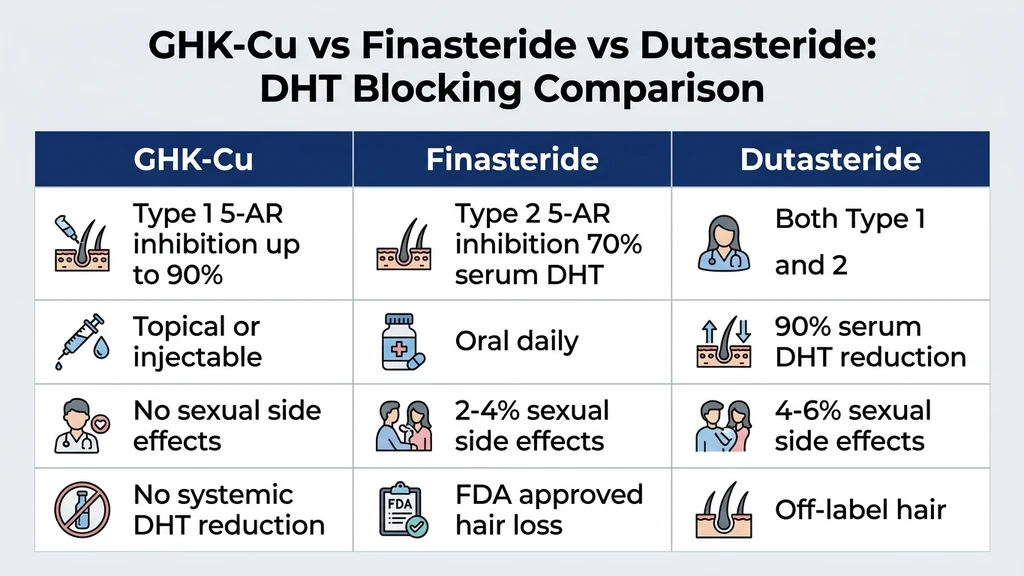
This comparison table puts GHK-Cu's DHT-blocking capacity in context against pharmaceutical options.
| Parameter | GHK-Cu (Copper Ions) | Finasteride | Dutasteride |
|---|---|---|---|
| Mechanism | Copper ion enzyme inhibition | Competitive 5-AR type 2 inhibitor | Dual 5-AR type 1 + 2 inhibitor |
| 5-AR type 1 inhibition | Up to 90% (in vitro) | Weak | Strong |
| 5-AR type 2 inhibition | Weak (~10% of type 1 potency) | Strong (~70% serum DHT reduction) | Very strong (~90% serum DHT reduction) |
| Administration | Topical, injection, microneedling | Oral (1 mg daily) | Oral (0.5 mg daily) |
| Systemic DHT effect | Minimal (local action) | Significant (systemic) | Very significant (systemic) |
| Sexual side effects | None reported | 2-4% (erectile dysfunction, decreased libido) | 4-6% (higher than finasteride) |
| Hormonal disruption | None | Yes (affects hormonal balance) | Yes (more pronounced) |
| Evidence for hair regrowth | In vitro + mechanism studies | Phase III RCTs (FDA approved) | Phase III RCTs (off-label for hair) |
| FDA approved for hair loss | No | Yes (Propecia) | No (approved for BPH only) |
| Cost | $50-200/month (peptide) | $10-30/month (generic) | $15-50/month (generic) |
Finasteride and dutasteride are proven treatments for androgenetic alopecia with Phase III clinical trial data. GHK-Cu provides a complementary, non-hormonal mechanism targeting the isoform that finasteride misses. GHK-Cu is not a replacement for pharmaceutical DHT blockers in moderate to severe hair loss.
For men concerned about finasteride's sexual side effects (2-4% incidence), GHK-Cu offers a side-effect-free partial contribution to DHT reduction. The potency gap is real, but for mild cases or as part of a multi-mechanism approach, copper peptides fill a useful niche.
Other Ways GHK-Cu Supports Hair Growth Beyond DHT
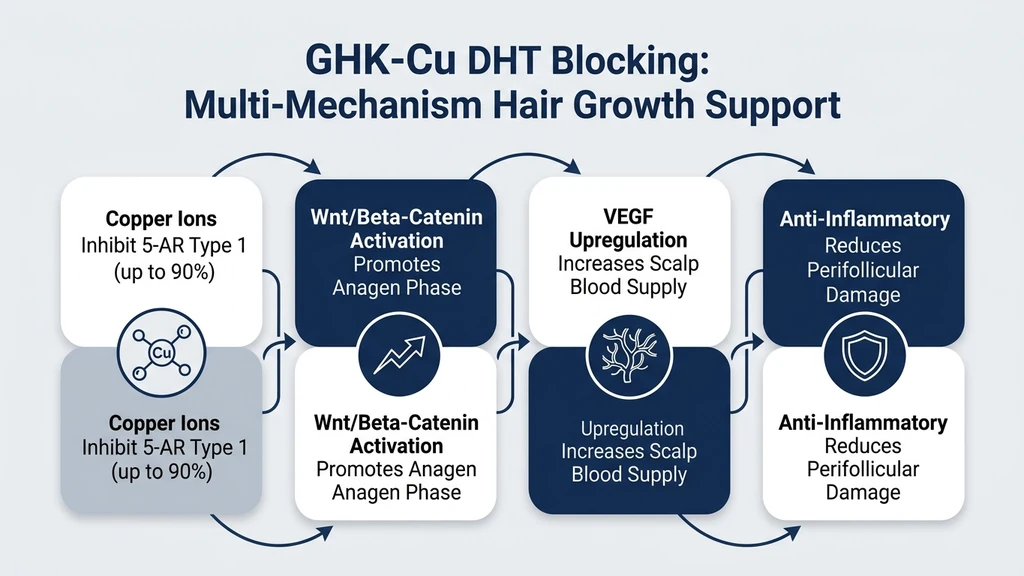
DHT blocking is only one of several mechanisms by which GHK-Cu supports hair growth. The peptide's gene-modulating activity provides additional pathways that operate independently of 5-alpha reductase inhibition.
Wnt/Beta-Catenin Signaling Activation
GHK-Cu activates the Wnt/beta-catenin signaling pathway, which is critical for hair follicle cycling. Beta-catenin accumulation in dermal papilla cells signals the follicle to enter anagen (active growth phase). Insufficient Wnt signaling keeps follicles dormant in telogen.
The Pickart 2018 review documented GHK-Cu's effects on multiple Wnt-related genes (Pickart et al., 2018). This mechanism directly promotes new hair growth cycles, independent of DHT levels.
Increased Follicle Size and Blood Supply (VEGF)
GHK-Cu upregulates vascular endothelial growth factor (VEGF), which increases blood vessel formation around hair follicles. Better blood supply means more oxygen and nutrients reach the follicle, supporting larger, thicker hair shafts.
The Pyo 2007 study on copper tripeptide complexes confirmed VEGF upregulation in dermal papilla cells (Pyo et al., 2007). Minoxidil works partly through a similar mechanism, which is why GHK-Cu and minoxidil are often used together.
Anti-Inflammatory Effects
Scalp inflammation accelerates hair loss. Perifollicular inflammation (microscopic inflammation around hair follicles) is found in the majority of androgenetic alopecia cases. GHK-Cu has well-documented anti-inflammatory properties, reducing pro-inflammatory cytokines and modulating immune cell activity.
By calming the inflammatory environment around follicles, GHK-Cu reduces one of the factors that accelerates miniaturization. This anti-inflammatory effect works synergistically with DHT reduction: less DHT-driven damage plus less inflammation-driven damage equals a better environment for hair retention.
Collagen and ECM Remodeling
GHK-Cu stimulates collagen synthesis and extracellular matrix (ECM) remodeling. The tissue surrounding each hair follicle provides structural support and signaling cues. Degraded ECM is associated with follicle miniaturization.
By promoting organized collagen deposition and matrix turnover, GHK-Cu maintains the structural scaffold that healthy follicles need. This is a long-term, foundational benefit rather than a rapid cosmetic effect. For the full GHK-Cu mechanism review, see our GHK-Cu benefits guide.
How to Use GHK-Cu for Hair Loss
Multiple delivery methods exist, each with different strengths for reaching hair follicles.
Topical Application (Scalp Serums)
The simplest approach. Apply a GHK-Cu serum (typically 0.1-1% concentration) directly to the scalp daily. The limitation is penetration: the stratum corneum of the scalp blocks large molecules. Advanced formulations using microemulsions or liposomes improve delivery by up to 3-fold (PMC10643103).
Apply to clean, dry scalp. Massage gently for 30 seconds to improve absorption. Leave on (do not rinse). Best applied at night, allowing the peptide to work during sleep when GH-mediated repair processes are most active.
Subcutaneous Injection
GHK-Cu at 1-4 mg injected subcutaneously distributes systemically, reaching the scalp through blood circulation. This bypasses the penetration barrier entirely but delivers copper ions to the entire body, not just the scalp.
Injections are typically administered once daily. For reconstitution and dosing, see our GHK-Cu injection dosage guide. For injection frequency optimization, see how often to inject GHK-Cu.
Microneedling with GHK-Cu
Microneedling at 0.5-1.5 mm depth creates micro-channels in the scalp, allowing GHK-Cu to bypass the skin barrier and reach dermal papilla cells directly. This method delivers the highest local concentration of copper ions to the follicle environment.
A typical protocol: microneedle the scalp once every 1-2 weeks. Apply GHK-Cu serum immediately after needling. Allow 24 hours before washing hair. The combination of mechanical stimulation (from needling) and peptide delivery (from GHK-Cu) produces better results than either intervention alone. See our GHK-Cu microneedling guide.
Combining GHK-Cu with Pharmaceutical DHT Blockers
The strongest hair loss protocols combine multiple mechanisms. GHK-Cu (copper-mediated type 1 5-AR inhibition, Wnt signaling, VEGF, anti-inflammatory) pairs well with finasteride (type 2 5-AR inhibition, systemic DHT reduction) and minoxidil (vasodilation, follicle stimulation).
This three-agent approach targets DHT from two enzyme pathways, improves blood supply, activates Wnt signaling, and reduces inflammation. Each agent addresses a different part of the hair loss mechanism. For men who tolerate finasteride well, adding GHK-Cu covers the type 1 isoform that finasteride misses.
For men who cannot tolerate finasteride (sexual side effects in 2-4%), GHK-Cu plus minoxidil provides a non-hormonal protocol. Expectations should be adjusted: this combination is milder than a finasteride-containing regimen. For those who want information about hair loss from other drugs, see our article on does GHK-Cu cause hair loss.
What GHK-Cu Cannot Do for DHT
Honest assessment of GHK-Cu's limitations is essential for realistic expectations.
GHK-Cu does not reduce systemic DHT levels. Blood DHT will remain unchanged on GHK-Cu alone. If your hair loss is driven by high systemic DHT (common in androgenetic alopecia), you need a systemic blocker like finasteride or dutasteride.
GHK-Cu's in vitro data has not been validated in a human clinical hair growth trial. The 90% type 1 inhibition figure comes from isolated enzyme assays. Actual inhibition in living human scalp tissue depends on copper ion concentration achieved at the follicle, which varies by delivery method.
GHK-Cu will not regrow hair on completely bald scalp where follicles have been destroyed. It may slow miniaturization, support existing follicles, and potentially reactivate dormant (but still viable) follicles. The earlier you start, the more follicles remain salvageable.
For the copper peptide that targets follicle cells more directly, see our AHK-Cu vs GHK-Cu comparison.
Important Safety Considerations
GHK-Cu is a research compound without FDA approval for hair loss treatment. The DHT-blocking mechanism is supported by in vitro data but lacks clinical trial validation specifically for hair growth endpoints.
Copper peptides are generally safe at standard doses. No sexual side effects have been reported, which is a meaningful advantage over finasteride and dutasteride. No hormonal disruption occurs because the mechanism is enzyme inhibition via a metal ion, not receptor modulation.
Excessive copper exposure is the primary theoretical risk. Standard peptide doses deliver far less copper than dietary intake from food. People with Wilson's disease or other copper metabolism disorders should not use copper peptides. For a complete side effect profile, see our GHK-Cu side effects guide. For broader context on hair loss from weight loss drugs, see our retatrutide hair loss analysis.
Frequently Asked Questions
Does GHK-Cu block DHT?
Not directly. GHK-Cu delivers copper(II) ions that inhibit type 1 5-alpha reductase by up to 90% in laboratory studies (Sugimoto 1995). This reduces local DHT production in hair follicles. The peptide itself does not interact with 5-alpha reductase. The copper ion is the active agent. Potency is substantially lower than pharmaceutical DHT blockers like finasteride.
Can GHK-Cu replace finasteride for hair loss?
No. GHK-Cu provides mild type 1 5-alpha reductase inhibition and supports hair growth through multiple other mechanisms (Wnt signaling, VEGF, anti-inflammatory). For moderate to severe androgenetic alopecia, it works best as a complement to finasteride, not a substitute. The combination covers both enzyme isoforms for broader DHT reduction.
Is GHK-Cu safer than finasteride for hair loss?
GHK-Cu has no reported sexual side effects, while finasteride causes erectile dysfunction or decreased libido in 2-4% of users. GHK-Cu does not affect systemic hormone levels. The tradeoff is substantially lower DHT-blocking potency. For men who cannot tolerate finasteride, GHK-Cu offers a milder, side-effect-free partial alternative.
How long does GHK-Cu take to work for hair loss?
Expect 3-6 months of consistent use before visible changes. Hair follicle cycling is slow: the shift from telogen (resting) to anagen (growth) takes weeks, and visible hair growth from new anagen follicles requires months. Microneedling with GHK-Cu may accelerate results to 2-4 months. Early shedding in weeks 4-6 is normal.
Does GHK-Cu affect testosterone levels?
No. GHK-Cu does not interact with testosterone production, testosterone receptors, or the hypothalamic-pituitary-gonadal axis. The copper ion mechanism inhibits the local conversion enzyme (5-alpha reductase type 1) in the scalp. Serum testosterone and free testosterone remain unaffected at any dose.
Which is better for DHT blocking: GHK-Cu or AHK-Cu?
Both peptides deliver copper ions, so both contribute to type 1 5-alpha reductase inhibition. GHK-Cu has better-documented copper delivery mechanisms and broader supporting evidence. AHK-Cu is superior for direct follicle stimulation but has less published data on its copper delivery efficiency. For DHT blocking specifically, GHK-Cu is the better choice.
Can I use GHK-Cu with minoxidil?
Yes. GHK-Cu and minoxidil use different mechanisms. GHK-Cu provides copper-mediated 5-AR inhibition, Wnt signaling, and anti-inflammatory effects. Minoxidil promotes vasodilation and direct follicle stimulation. Together, they address complementary aspects of hair loss. Apply minoxidil first, allow it to dry, then apply GHK-Cu serum.
Does topical GHK-Cu reach hair follicles effectively?
Standard topical formulations have limited penetration through the scalp's stratum corneum. Advanced delivery systems (microemulsions, liposomes) improve penetration by up to 3-fold. Microneedling before topical application bypasses the barrier entirely, delivering GHK-Cu directly to the dermal layer where follicle cells reside.
The Bottom Line
GHK-Cu provides a mild, non-hormonal contribution to DHT reduction through copper ion inhibition of type 1 5-alpha reductase. The in vitro data shows up to 90% enzyme inhibition. In practice, GHK-Cu is a complement to pharmaceutical DHT blockers, not a replacement.
Its real value lies in the multi-mechanism approach: DHT reduction plus Wnt signaling activation plus VEGF upregulation plus anti-inflammatory effects. No single mechanism alone reverses hair loss effectively. The combination of GHK-Cu with finasteride and minoxidil covers more pathways than any single agent.
For the copper peptide comparison, see our AHK-Cu vs GHK-Cu guide. For injection protocols, see GHK-Cu injection dosage. For reconstitution, use our peptide reconstitution calculator. For the broader hair growth peptide landscape, see GHK-Cu for hair growth.
Helpful Tools
Related Articles
Does GHK-Cu Cause Hair Loss?
GHK-Cu does not cause hair loss. Research shows it promotes hair growth by activating the Wnt/beta-catenin pathway and enlarging miniaturized follicles.
Copper Peptides Ruined My Skin: Why
Copper peptides ruined my skin? Why GHK-Cu can cause breakouts, redness, purging, and irritation, who is at risk, how to recover, and when to stop.
Is GHK-Cu FDA-Approved? Status Explained
GHK-Cu is not FDA-approved as a drug. Legal status in cosmetics, compounding access after 2026 reclassification, and why no clinical trials exist.
What Do Peptides Do for Skin? Benefits & Types
Peptides boost collagen by up to 65%, reduce wrinkles, and strengthen the skin barrier. Which types work, how to use them, and clinical evidence.