
You are three months into retatrutide and noticing more hair in the shower drain than usual. Hair loss was not reported as an adverse event in retatrutide's Phase 2 trial, but the drug's extreme weight loss (up to 24% of body weight) puts users at significant risk for telogen effluvium, a temporary form of shedding triggered by rapid caloric deficit (Jastreboff et al., NEJM, 2023). A growing body of GLP-1 class data confirms the link between aggressive weight loss and hair thinning (PMC12530271).
| Quick Reference | Details |
|---|---|
| Retatrutide trial data on hair loss | Not listed as adverse event in Phase 2 |
| GLP-1 class risk | Confirmed in systematic reviews |
| Cause | Telogen effluvium from rapid weight loss |
| Max weight loss in trials | 24.2% at 12 mg dose |
| Onset | 2-4 months after weight loss begins |
| Duration | 6-12 months of shedding |
| Full recovery | 12-18 months after weight stabilizes |
| Prevention | Protein intake 1.0-1.2 g/kg/day + key nutrients |
For dosage protocols that moderate weight loss pace, see the retatrutide dosage calculator. For the complete side effect picture, read our retatrutide side effects overview.
Get your custom peptide protocol:
- Tailored to your body and goals
- Precise dosing and cycle length
- Safe stacking combinations
- Backed by peer-reviewed studies
- Ready in under 2 minutes
What Do Clinical Trials Say About Retatrutide and Hair Loss?
The Phase 2 NEJM trial enrolling 338 participants did not list alopecia or hair loss as an adverse event (Jastreboff et al., NEJM, 2023). This absence is not proof of safety. Obesity trials historically underreport hair loss because it develops months after treatment starts, often outside the primary reporting window.
Phase 3 TRIUMPH data from Eli Lilly showed emerging safety signals, though the company has not released granular hair loss statistics. BioSpace reporting noted that adverse event profiles in Phase 3 were broadly consistent with Phase 2, with GI effects remaining the dominant concern.
The gap between trial data and real-world experience is significant. Semaglutide trials similarly did not highlight hair loss, yet subsequent systematic reviews confirmed it as a class-wide concern. Retatrutide, producing the highest weight loss of any GLP-1 class drug, carries at least equivalent risk.
GLP-1 Drugs and Hair Loss: The Growing Evidence
The connection between GLP-1 receptor agonists and hair loss is no longer speculative. Three major studies published in 2025 established the evidence base.
A systematic review found that GLP-1 RA use is associated with nonscarring hair loss, primarily telogen effluvium and, in some cases, acceleration of pre-existing androgenetic alopecia (PMC12530271). The TriNetX cohort study, drawing on multicenter real-world data from over 100,000 patients, confirmed an increased risk of hair loss with GLP-1 RA therapy compared to matched controls (PMC12997224).
Buontempo et al. raised clinical concern in the Journal of the European Academy of Dermatology and Venereology, calling hair loss an emerging adverse event that deserves prospective monitoring in GLP-1 trials (Buontempo et al., JEADV, 2025). A scoping review in Cureus reinforced these findings across the full GLP-1 class (PubMed 40951222).
Why Weight Loss Causes Hair Loss (Telogen Effluvium Explained)
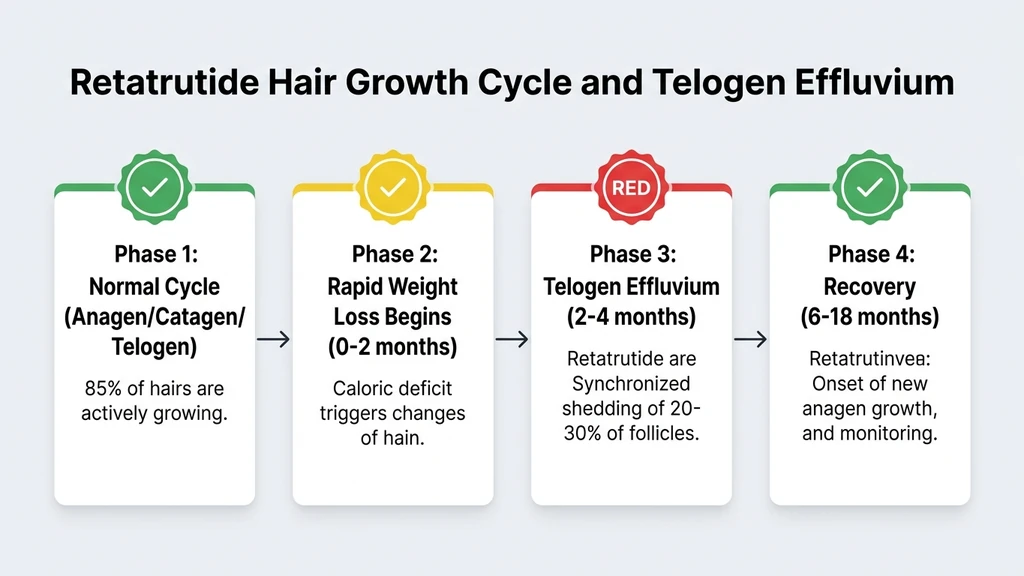
The hair loss from retatrutide is not caused by the drug's receptor activity. It is caused by the metabolic shock of rapid weight loss. Understanding the hair growth cycle explains why shedding appears months after the weight starts dropping.
The Hair Growth Cycle
Every hair on your head cycles through three phases. Anagen (growth) lasts 2-7 years. Catagen (transition) lasts 2-3 weeks. Telogen (rest) lasts 2-4 months, after which the hair falls out and a new anagen hair replaces it.
At any given time, 85-90% of your scalp hairs are in anagen and 10-15% are in telogen. This balance keeps daily shedding at a normal 50-100 hairs. Disrupting this ratio is what produces visible thinning.
How Rapid Weight Loss Triggers Shedding
Think of your body's energy budget like a household budget during a sudden income cut. Nonessential expenses get slashed first. Hair growth is biologically expensive, requiring constant cell division, protein synthesis, and nutrient delivery. When caloric deficit is severe, the body shifts hair follicles from anagen into telogen prematurely.
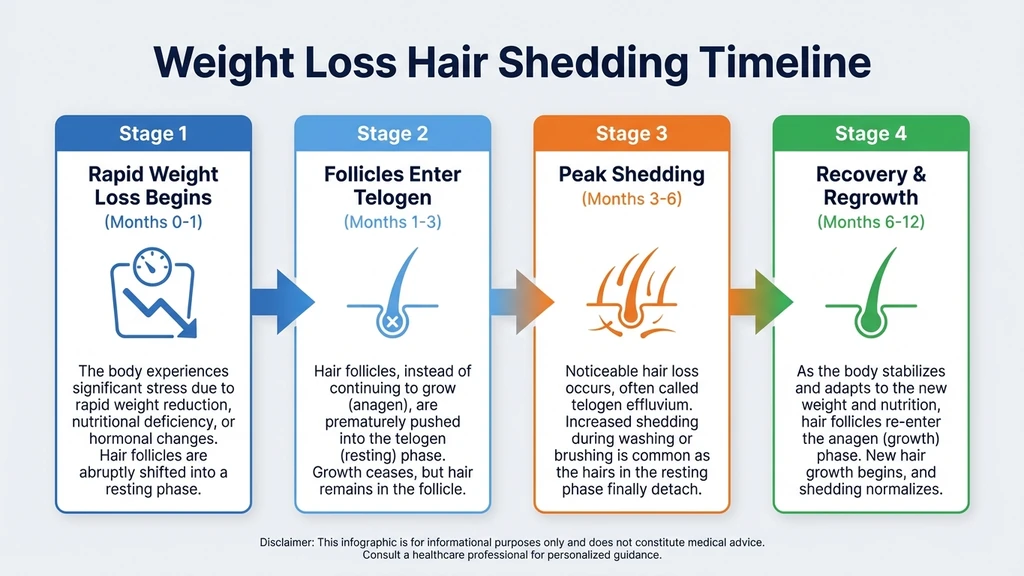
Retatrutide produces up to 24% body weight loss. That level of caloric deficit pushes 20-30% of scalp hairs into telogen simultaneously instead of the normal 10-15%. Two to four months later, when those telogen hairs reach the end of their rest phase, they all shed at once. This synchronized shedding is telogen effluvium.
Nutritional Deficiencies That Accelerate Hair Loss
Rapid weight loss depletes specific nutrients that hair follicles depend on. Iron, zinc, biotin, and vitamin D are the four most critical, and deficiency in any one of them can independently trigger or worsen telogen effluvium (PMC11909624).
Iron deficiency is the most common. Ferritin levels below 30 ng/mL correlate with increased shedding. Zinc supports keratin production. Biotin is a cofactor in keratin synthesis. Vitamin D activates hair follicle cycling. On retatrutide, reduced food intake makes it difficult to get adequate amounts of all four without supplementation.
Retatrutide vs Tirzepatide vs Semaglutide: Hair Loss Risk Compared
No head-to-head trials have compared hair loss rates across these three drugs. The comparison below uses weight loss magnitude as a proxy for telogen effluvium risk, since the mechanism (caloric deficit) is the same regardless of which drug produces the deficit.
| Drug | Max Weight Loss | Estimated Hair Loss Risk | Onset | Recovery |
|---|---|---|---|---|
| Semaglutide 2.4 mg | ~15% | Moderate | 2-4 months | 6-12 months |
| Tirzepatide 15 mg | ~22% | High | 2-4 months | 12-18 months |
| Retatrutide 12 mg | ~24% | Highest | 2-4 months | 12-18 months |
The math is straightforward. More weight loss means deeper caloric deficit. Deeper deficit means more follicles pushed into telogen. Retatrutide's 24% weight loss puts it at the top of the risk curve. For context, bariatric surgery patients (who lose 25-35% of body weight) experience telogen effluvium in 30-40% of cases.
For a full drug comparison, see retatrutide vs tirzepatide. For semaglutide-specific data, read does semaglutide cause hair loss.
How to Prevent Hair Loss on Retatrutide
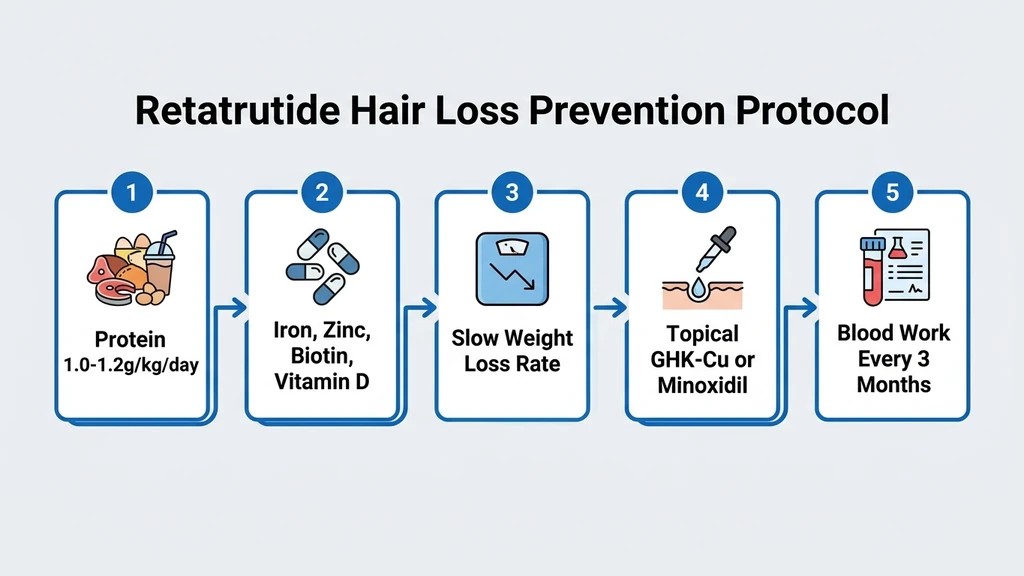
Prevention is more effective than treatment. These five strategies address the root causes of weight-loss-induced hair thinning.
1. Maintain Adequate Protein (1.0-1.2 g/kg/day)
Hair is 95% keratin, a protein. On retatrutide, your appetite is suppressed and total food intake drops. Without deliberate effort, protein intake falls below the threshold for healthy hair maintenance.
Target 1.0-1.2 grams of protein per kilogram of body weight daily. For a 180 lb (82 kg) person, that means 82-98 grams of protein per day. Prioritize complete protein sources: chicken breast (31g per 4 oz), Greek yogurt (17g per cup), eggs (6g each), whey protein isolate (25g per scoop). Spread protein across 4-6 small meals to maximize absorption.
2. Supplement Key Nutrients (Iron, Zinc, Biotin, Vitamin D)
Start these supplements at the same time you start retatrutide, not after hair loss appears. By the time you notice shedding, the telogen shift happened 2-4 months ago. Prevention requires proactive supplementation (PMC11909624).
| Nutrient | Daily Dose | Target Level | Why |
|---|---|---|---|
| Iron (as ferrous bisglycinate) | 18-27 mg | Ferritin >30 ng/mL | Oxygen delivery to follicles |
| Zinc | 15-30 mg | Serum zinc >80 mcg/dL | Keratin synthesis cofactor |
| Biotin | 2,500-5,000 mcg | N/A | Keratin production |
| Vitamin D3 | 2,000-4,000 IU | 40-60 ng/mL | Follicle cycle activation |
Get baseline blood work before starting retatrutide. Recheck iron, zinc, and vitamin D at 3 months.
3. Slow Your Rate of Weight Loss
Losing more than 1-1.5% of body weight per week increases telogen effluvium risk dramatically. Retatrutide at 12 mg can produce weight loss exceeding 2% per week during peak efficacy. Discuss with your prescriber whether a lower maintenance dose (8 mg instead of 12 mg) provides acceptable weight loss with lower hair loss risk.
Slower escalation through the dose tiers also helps. Following the retatrutide dosage guide with 4-week minimum holds at each dose moderates the weekly weight loss rate and gives your body time to adjust.
4. Consider Topical Treatments (Minoxidil, GHK-Cu)
Topical minoxidil 5% (Rogaine) applied to the scalp once daily can support existing follicles and accelerate regrowth. It works by increasing blood flow to the follicle and extending the anagen phase.
GHK-Cu for hair growth offers a complementary approach. GHK-Cu delivers copper ions that may inhibit type 1 5-alpha reductase by up to 90% in vitro, reducing local DHT production. It also activates Wnt/beta-catenin signaling, which promotes follicle cycling. Learn more about does GHK-Cu block DHT. For a full copper peptide comparison, see AHK-Cu vs GHK-Cu.
5. Monitor Blood Work Every 3 Months
Track ferritin, serum zinc, vitamin D, thyroid function (TSH, free T4), and a complete blood count at baseline and every 3 months. Iron deficiency is the most common correctable cause of hair loss during weight loss therapy.
If ferritin drops below 30 ng/mL despite supplementation, consider IV iron infusion. If thyroid function is abnormal, address it directly. Retatrutide does not cause thyroid dysfunction, but rapid weight loss can unmask subclinical hypothyroidism.
Recovery Timeline: When Does Hair Grow Back?
Telogen effluvium is reversible. Every hair that falls out will be replaced by a new anagen hair, provided the underlying trigger (caloric deficit, nutrient deficiency) is resolved. The timeline is slower than most people expect.
Months 1-3 after weight stabilization: Shedding gradually slows. New hairs enter anagen but are not yet visible above the scalp surface. This is the hardest phase psychologically because shedding continues while no new growth appears.
Months 3-6: New growth becomes visible as short hairs around the hairline and crown. The shedding rate returns to the normal 50-100 hairs per day. Hair density is still reduced but improving.
Months 6-12: Hair density approaches pre-treatment levels. The new hairs grow at approximately 0.5 inches (1.3 cm) per month. By month 12, most users report that their hair looks and feels normal. Full restoration of length and volume may take 12-18 months for those with longer hairstyles.
One critical requirement: your weight must stabilize. If you continue losing weight on retatrutide, new follicles will continue shifting into telogen. Recovery begins only after caloric balance is restored, either through dose reduction or reaching your target weight.
Related Side Effects
Retatrutide Nausea Nausea affects 25-48% of users and compounds the hair loss problem by further reducing food and nutrient intake. Managing nausea effectively preserves the protein and nutrient intake your hair needs.
Retatrutide Diarrhea Diarrhea reduces nutrient absorption, potentially worsening iron and zinc deficiency. Address GI symptoms to protect against compounded hair loss risk.
Retatrutide Side Effects Overview Complete guide covering all documented adverse events from Phase 2 and Phase 3 clinical trials.
Does Semaglutide Cause Hair Loss? Semaglutide produces less weight loss (~15%) and proportionally lower hair loss risk. Compare the profiles if you are choosing between GLP-1 drugs.
Does Tirzepatide Cause Hair Loss? Tirzepatide at 22% max weight loss falls between semaglutide and retatrutide in hair loss risk.
Frequently Asked Questions
Does retatrutide directly cause hair loss?
No direct evidence links retatrutide's receptor activity to hair loss. Phase 2 trials did not list alopecia as an adverse event. The hair thinning observed in GLP-1 drug users is telogen effluvium caused by rapid weight loss and caloric deficit, not the drug's pharmacological mechanism. With 24% body weight loss, retatrutide carries significant indirect risk.
How long does hair loss last on retatrutide?
Active shedding from telogen effluvium typically lasts 6-12 months. Full recovery takes 12-18 months after your weight stabilizes and caloric deficit resolves. New visible growth appears within 3-6 months. Hair grows approximately 0.5 inches per month, so length recovery depends on your starting hairstyle.
Can GHK-Cu help with retatrutide-related hair loss?
GHK-Cu may support hair follicle health through multiple mechanisms: copper ion inhibition of type 1 5-alpha reductase (up to 90% in vitro), Wnt/beta-catenin signaling activation, and VEGF upregulation for scalp blood flow. It complements nutritional strategies but is not a standalone solution for telogen effluvium caused by caloric deficit.
What nutrients prevent hair loss on retatrutide?
Four nutrients are critical: iron (ferritin target >30 ng/mL), zinc (15-30 mg daily), biotin (2,500-5,000 mcg daily), and vitamin D3 (2,000-4,000 IU daily). Start supplementation when you begin retatrutide, not after shedding starts. Protein intake of 1.0-1.2 g/kg/day preserves keratin production.
Is retatrutide hair loss worse than semaglutide hair loss?
Likely yes, due to greater weight loss magnitude. Retatrutide produces up to 24% body weight loss compared to semaglutide's 15%. More weight loss means deeper caloric deficit and more follicles pushed into telogen simultaneously. The telogen effluvium mechanism is identical; only the severity differs.
Does retatrutide hair loss affect men and women equally?
Telogen effluvium affects both sexes, but women notice it more because they typically have longer hair that shows thinning earlier. Men with pre-existing androgenetic alopecia may experience accelerated pattern hair loss on top of telogen effluvium. Both sexes benefit equally from protein and nutrient supplementation strategies.
Will my hair grow back after stopping retatrutide?
Yes. Telogen effluvium is fully reversible once the trigger (rapid weight loss) resolves. After weight stabilization, new anagen hairs replace every lost telogen hair. Visible regrowth appears within 3-6 months. Full density recovery takes 12-18 months. Maintaining adequate nutrition accelerates the timeline.
Should I take biotin while on retatrutide?
Yes. Biotin (2,500-5,000 mcg daily) supports keratin synthesis. Start it when you begin retatrutide, not after hair loss appears. Note that biotin can interfere with certain blood tests (troponin, thyroid panels), so inform your lab before draws. Combine biotin with iron, zinc, and vitamin D for comprehensive protection.
The Bottom Line
Retatrutide does not directly cause hair loss through its receptor activity. The risk comes from the drug's exceptional weight loss efficacy: up to 24% of body weight. That level of caloric deficit triggers telogen effluvium in a significant percentage of users, pushing normal hair follicle cycling into synchronized shedding 2-4 months after weight loss begins.
Prevention starts on day one. Maintain protein intake at 1.0-1.2 g/kg/day. Supplement iron, zinc, biotin, and vitamin D proactively. Monitor blood work every 3 months. Consider slowing your weight loss pace by holding at moderate doses longer. If shedding occurs, it is temporary: full recovery takes 12-18 months after weight stabilization.
Use the retatrutide dosage calculator to plan a gradual escalation that moderates weight loss speed. For copper peptide support, explore GHK-Cu for hair growth. Read the full retatrutide side effects overview for the complete safety picture.
Related Articles
Does Semaglutide Cause Hair Loss?
Semaglutide-related hair loss affects 3-5% of users. Learn why it happens, when it peaks, and 5 evidence-based strategies to minimize thinning.
Does Tirzepatide Cause Hair Loss?
Tirzepatide-related hair thinning affects 5.7% of users at the highest dose. Learn why it happens, how it compares to semaglutide, and how to minimize it.
Retatrutide Nausea: Rates, Timeline & Management
Retatrutide nausea affects 25-48% of users. Rates by dose, GLP-1 + glucagon mechanism, week-by-week timeline, and 8 management strategies.
Retatrutide Diarrhea: Rates, Causes & Management
Retatrutide diarrhea affects 16-34% of users by dose. Clinical trial rates, triple-agonist GI mechanism, comparison to semaglutide, and 7 evidence-based fixes.