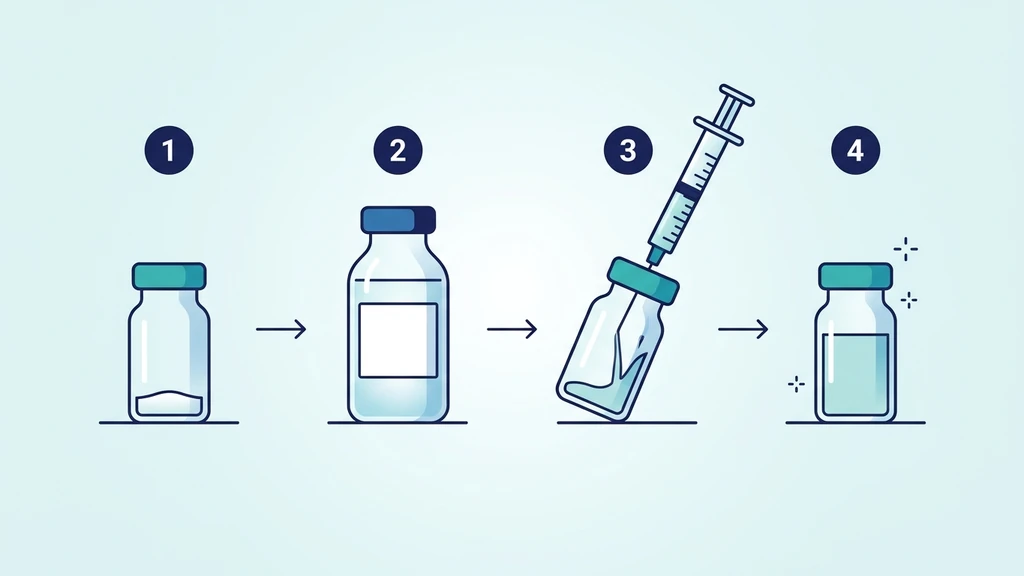
A 10 mg vial of PT-141, a bottle of bacteriostatic water, a strip of insulin syringes, and no instructions in the box. Here is the answer: add 2 mL of bacteriostatic water to a 10 mg PT-141 vial, run the stream down the glass, roll until clear, and refrigerate. That gives 5 mg/mL, so 1 mg is 20 units on a U-100 syringe and 2 mg is 40 units. Kept cold and dark, the mixed vial is good for 28 days.
| Question | Short answer |
|---|---|
| Water for a 10 mg vial | 2 mL bacteriostatic water (5 mg/mL) |
| Water for a 5 mg vial | 1 mL bacteriostatic water (5 mg/mL) |
| 1 mg draw at 5 mg/mL | 20 units |
| 2 mg draw at 5 mg/mL | 40 units |
| Good for after reconstitution | 28 days at 2 to 8 degrees C |
| Sterile water instead? | Only if the vial is finished within days |
This page covers mixing, drawing, and the shelf-life clock. Which dose to draw and when belongs to the PT-141 dosage guide, how long each dose keeps working is in how long PT-141 lasts, the male-use questions live in PT-141 for men, and storage rules for every other peptide are in how long reconstituted peptides last. The compound is profiled on the PT-141 peptide page.
Get your custom peptide protocol:
- Tailored to your body and goals
- Precise dosing and cycle length
- Safe stacking combinations
- Backed by peer-reviewed studies
- Ready in under 2 minutes
What You Need Before You Open the Vial
Lay everything out before a needle touches a stopper. Reconstitution goes wrong when a wet needle is waiting while you look for a swab.
- Lyophilized PT-141 vial, 5 mg or 10 mg, a white cake at the bottom
- Bacteriostatic water, 0.9% benzyl alcohol, 30 mL bottle
- One 3 mL syringe with an 18 to 22 gauge needle, for moving the water
- U-100 insulin syringes, 29 to 31 gauge, 0.5 mL or 1 mL
- Alcohol swabs, a fine permanent marker, a sharps container
The water choice sets how long the vial lives. Bacteriostatic water carries 0.9% benzyl alcohol, a preservative that holds microbial growth down across the repeated stopper punctures of a multi-dose vial (Meyer et al., J Pharm Sci, 2007, PMID 17722087). Sterile water has no preservative, which is acceptable only for a vial you empty within a few days.
PT-141 is used on demand, a dose at a time, so a 10 mg vial is punctured five to ten times over several weeks. That is the strongest possible case for the preserved water. The full comparison is in the bacteriostatic vs sterile water guide, and sourcing in where to buy bacteriostatic water.
How to Reconstitute a 10 mg PT-141 Vial, Step by Step
The whole procedure takes five minutes. The slow step is the water going in.
- 1.Warm and wash. Let the vial and the water bottle sit at room temperature for 15 minutes. Wash your hands.
- 2.Swab both stoppers. One swab for the PT-141 vial, a fresh one for the water bottle. Let both dry for 10 seconds.
- 3.Draw 2 mL of bacteriostatic water into the 3 mL syringe. Two refills of an insulin syringe is two chances to lose count.
- 4.Aim at the glass, not the powder. Enter the stopper at 45 degrees, bevel up, then straighten and rest the tip against the inside wall. Press the plunger over 30 to 60 seconds so the water sheets down and pools under the cake.
- 5.Roll, never shake. Roll the vial between your palms for 30 seconds. Mechanical stress drives peptides to aggregate in solution (Manning et al., Pharm Res, 2010, PMID 20143256), and aggregated peptide is peptide you cannot use.
- 6.Inspect against a white wall. Clear, colorless, nothing floating. Haze after 10 minutes of gentle rolling fails the vial.
- 7.Label the vial. Date, concentration (5 mg/mL), and your draw in units. Every mistake in the scenarios below starts with an unlabeled vial.
- 8.Refrigerate upright at 2 to 8 degrees C, in its box or an opaque container. The clock has started.
A 5 mg vial takes 1 mL of water for the same 5 mg/mL; every other step is identical. The generic technique, including a cake that refuses to dissolve, is in the peptide reconstitution walkthrough, needle choices are in what size needle for peptide injections, and the injection itself is in the peptide injection guide.
Why the Water, Not the Vial, Sets Your Units
Think of a bottle of concentrated cordial. One capful into a small glass makes a strong drink; the same capful into a jug makes a weak one. The syrup never changed, but each mouthful carries a different amount of it.
Literally stated: the milligrams of PT-141 in the vial are fixed. The water you add sets the concentration in mg/mL, and the concentration sets how many units deliver your draw. Concentration = mg in the vial divided by mL of water. Units on a U-100 syringe = (draw in mg divided by concentration) times 100. Worked once: 10 mg plus 2 mL is 5 mg/mL, and 1 mg is 1 divided by 5, or 0.2 mL, which is 20 units. The peptide unit converter runs the same two lines for any vial.
Water Volume Table: 10 mg and 5 mg Vials at 1, 2, and 3 mL
The 0.5 to 2 mg range below comes from the clinical record. Bremelanotide, sold as Vyleesi, is FDA-approved as a 1.75 mg subcutaneous autoinjector for hypoactive sexual desire disorder in premenopausal women (Mayer et al., Ann Pharmacother, 2020, PMID 31893927). The phase 2b trial tested 0.75, 1.25, and 1.75 mg (Clayton et al., Womens Health (Lond), 2016, PMID 27181790), and the first subcutaneous study in men ranged from 0.3 to 10 mg, with erectile responses from about 1 mg upward (Rosen et al., Int J Impot Res, 2004, PMID 14999221). Research-grade PT-141 powder is not an approved product; only the autoinjector is.
| Vial | Bac water | Concentration | 0.5 mg | 1 mg | 1.75 mg | 2 mg |
|---|---|---|---|---|---|---|
| 10 mg | 1 mL | 10 mg/mL | 5 units | 10 units | 17.5 units | 20 units |
| 10 mg | 2 mL | 5 mg/mL | 10 units | 20 units | 35 units | 40 units |
| 10 mg | 3 mL | 3.33 mg/mL | 15 units | 30 units | 52.5 units | 60 units |
| 5 mg | 1 mL | 5 mg/mL | 10 units | 20 units | 35 units | 40 units |
| 5 mg | 2 mL | 2.5 mg/mL | 20 units | 40 units | 70 units | 80 units |
Pick the row that lands your draw between 20 and 50 units: large enough to read accurately, small enough for a 0.5 mL syringe. The 2 mL row does that for every dose from 1 to 2 mg, which is why it is the default. The 1 mL row puts 0.5 mg at 5 units, where one tick of misreading is a 20% dose error; choose 3 mL if you draw 0.5 mg routinely. A 3 mL fill only fits a vial with headroom, and some research vials are 2 mL glass, so check with the peptide reconstitution calculator before the water goes in.
One paragraph on the nasal spray variant, since the same vial is sometimes mixed for it. Intranasal PT-141 produced erectile responses in the earliest trials (Diamond et al., Int J Impot Res, 2004, PMID 14963471), but the approved product went subcutaneous, and a home-mixed spray has no dose per spray you can trust. The unit math on this page does not transfer to it.
How to Read the Syringe for a PT-141 Draw
A U-100 insulin syringe holds 100 units per mL, so 1 unit is 0.01 mL. The 0.3 mL syringe marks every half unit, the 0.5 mL syringe every unit, and the 1 mL syringe every 2 units.
Match the syringe to the draw. At 5 mg/mL, 1 mg is 20 units: the twentieth line on a 0.5 mL syringe, mid-barrel, every unit marked. On a 1 mL syringe it is the tenth line, with lines twice as close together. Read the leading edge of the black plunger tip at eye level, tap the barrel to raise bubbles, push them out, and re-draw to the line. A U-40 or a tuberculin syringe marked in mL breaks every number here; U-100 only. The tesamorelin reconstitution guide runs the same 5 mg/mL for a 10 mg vial and the same reading rules.
How Long PT-141 Is Good For After Reconstitution
Here is the number: a PT-141 vial mixed with bacteriostatic water and kept at 2 to 8 degrees C is good for 28 days. Treat 14 days as the conservative end if the vial travels in and out of the refrigerator often. Mixed with sterile water, use it within 3 to 5 days. At room temperature a mixed vial loses its margin within 24 to 48 hours and should be discarded.
| Condition after mixing | Good for |
|---|---|
| Bacteriostatic water, 2 to 8 degrees C, dark | 28 days (14 days conservative) |
| Sterile water, 2 to 8 degrees C, dark | 3 to 5 days |
| Either water, room temperature | 24 to 48 hours, then discard |
| Frozen after mixing | Do not; freeze-thaw aggregates peptides |
| Unmixed powder, refrigerated, dark | Months; follow the supplier date |
Be honest about what each number is. No published stability study covers research-grade PT-141 in bacteriostatic water. The 28 days is the community convention for refrigerated peptide vials, matched to the 28-day discard rule for the water bottle itself, and the chemistry behind it is general: peptides in solution hydrolyze, deamidate, oxidize, and aggregate, and each reaction runs faster as temperature rises (Manning et al., Pharm Res, 2010, PMID 20143256). Cold and dark slow them; nothing stops them. Vyleesi ships as a ready-to-use single-dose autoinjector, so its label has no mixing step and lends a research vial no shelf-life claim.
Size the vial to the clock. PT-141 is dosed on demand, and the Vyleesi label caps use at 8 doses a month, so a 10 mg vial at 1 to 2 mg per draw gives 5 to 10 doses and fits inside 28 days. A 20 mg vial at the same rate outlives its window, and the last half is wasted peptide. The water bottle has its own 28-day rule after the first puncture, covered in how long bacteriostatic water lasts.
Discard early, whatever the calendar says, if the solution turns hazy, grows strands or a film, picks up a yellow tint, or shows rubber flecks from stopper coring. A vial left warm overnight is finished too; no visual check rescues it. Photograph the vial, note the lot, and contact the supplier.
Four Quantified Mistakes
Half the water, double the dose. You planned 2 mL into a 10 mg vial but the syringe held 1 mL. The vial is now 10 mg/mL, and your habitual 40-unit draw delivers 4 mg instead of 2 mg, more than twice the 1.75 mg approved dose. Nausea is already the signature side effect at that dose: in the RECONNECT phase 3 trials about 40% of women on 1.75 mg reported it against roughly 1% on placebo, with flushing in about 20% and headache in about 11% (Kingsberg et al., Obstet Gynecol, 2019, PMID 31599840). Doubling the dose climbs a curve that was already steep. Fix: read the 3 mL barrel before the water goes in, and write the real concentration on the vial.
New vial, old units. You finished a 5 mg vial mixed at 2 mL (2.5 mg/mL), where 1 mg was 40 units. The next vial is 10 mg at 2 mL (5 mg/mL). The habitual 40-unit draw now delivers 2 mg, twice your draw, and the vial is gone in five doses instead of ten. Fix: recalculate units every time you mix, never from memory.
Too little water for a small draw. You mixed 10 mg with 1 mL and now draw 0.5 mg as 5 units on a 1 mL syringe marked every 2 units. One tick of error is 2 units, a 40% swing either way. Fix: 2 or 3 mL for any draw under 1 mg, so the mark sits past 10 units.
Sterile water on a four-week vial. Five to ten punctures over a month with no benzyl alcohol pushing back is five to ten contamination opportunities (Meyer et al., J Pharm Sci, 2007, PMID 17722087). Fix: bacteriostatic water for any vial that outlives one or two draws, and a 3 to 5 day limit if sterile water is all you have.
PT-141 is a cyclic heptapeptide analog of alpha-melanocyte-stimulating hormone that acts on melanocortin receptors in the brain rather than on blood vessels (Molinoff et al., Ann N Y Acad Sci, 2003, PMID 12851303; Shadiack et al., Curr Top Med Chem, 2007, PMID 17584134). A dose error therefore shows up as nausea and flushing rather than anything visible in the syringe, which is why the label on the vial matters more here than for most peptides. The compound's background is in the PT-141 peptide overview.
Frequently Asked Questions
How much bacteriostatic water do you add to a 10 mg PT-141 vial?
2 mL is the standard volume, giving 5 mg/mL: 1 mg is 20 units and 2 mg is 40 units on a U-100 syringe. Adding 1 mL instead gives 10 mg/mL, where 1 mg is only 10 units and harder to read. Check any other volume with the peptide reconstitution calculator.
How do you reconstitute a 5 mg PT-141 vial?
Add 1 mL of bacteriostatic water for 5 mg/mL, the same concentration as a 10 mg vial with 2 mL, so 1 mg is 20 units and 2 mg is 40 units. Run the water down the glass, roll for 30 seconds, and refrigerate. The generic technique is in the peptide reconstitution walkthrough.
How many units is 1 mg of PT-141?
It depends only on concentration. At 5 mg/mL, 1 mg is 20 units; at 10 mg/mL it is 10 units; at 3.33 mg/mL it is 30 units; at 2.5 mg/mL it is 40 units. Units = (mg divided by mg/mL) times 100. Convert any draw with the peptide unit converter.
How long is PT-141 good for after reconstitution?
28 days when mixed with bacteriostatic water and kept at 2 to 8 degrees C in the dark, with 14 days as the conservative end. Mixed with sterile water, 3 to 5 days. A vial left at room temperature for 24 to 48 hours should be discarded. The general rules are in how to store peptides.
Does reconstituted PT-141 need to be refrigerated?
Yes. Store the mixed vial upright at 2 to 8 degrees C in an opaque container, and never freeze it. Peptides in solution hydrolyze, oxidize, and aggregate faster as temperature rises (PMID 20143256), so a warm vial loses its 28-day window within a day or two. The water bottle is covered in does bacteriostatic water need to be refrigerated.
Can you use sterile water to reconstitute PT-141?
Only for a vial you finish within 3 to 5 days. Sterile water has no preservative, and a PT-141 vial dosed on demand is punctured five to ten times over a month, so bacteriostatic water with 0.9% benzyl alcohol (PMID 17722087) is the correct choice. The bacteriostatic vs sterile water guide covers the difference.
Can you shake a PT-141 vial to dissolve the powder?
No. Roll it between your palms for 30 seconds. Shaking drives peptides to aggregate (PMID 20143256), and a vial that turns hazy is lost. If flecks remain after rolling, let the vial stand upright for 5 minutes and roll again. The tesamorelin reconstitution guide shows the same technique at the same 5 mg/mL.
The Bottom Line
2 mL of bacteriostatic water into a 10 mg PT-141 vial gives 5 mg/mL: 20 units per milligram, 40 units for 2 mg. Aim at the glass, roll for 30 seconds, confirm it is clear and colorless, label it, and refrigerate. The mixed vial is good for 28 days cold and dark, 14 if you want a margin.
The principle: the vial fixes the milligrams, the water fixes the concentration, and the label you write is the only record of either. PT-141 gives no visual warning of a dose error, so the arithmetic and the marker pen do the work the syringe cannot.
Check every setup with the peptide reconstitution calculator before the water goes in, and read the PT-141 peptide profile for the compound behind the vial. Bremelanotide is FDA-approved only as the Vyleesi autoinjector for hypoactive sexual desire disorder in premenopausal women; research-grade PT-141 powder is not an approved product, and this content is educational, not medical advice. More guides at PeptidesExplorer.
Related Articles
How to Reconstitute Cagrilintide (5 mg, 10 mg)
How to reconstitute cagrilintide: bacteriostatic water for 5 mg and 10 mg vials, mg to units on a U-100 syringe, fridge storage and the 28-day clock.
How to Reconstitute Tesamorelin: Water Volumes & Units
How to reconstitute tesamorelin: bacteriostatic water volumes for 2, 5, 10 and 20 mg vials, U-100 unit math, mixing steps, storage window, and bad-vial signs.
How to Reconstitute CJC-1295 and Ipamorelin (Unit Math)
Reconstitute CJC-1295 and ipamorelin: 2 mL bacteriostatic water per 5 mg vial = 25 mcg per unit. Water volumes, unit tables, blend rules, storage.
How to Reconstitute MOTS-c: Step-by-Step
How to reconstitute MOTS-c step by step. Mixing table for 5mg and 10mg vials, syringe unit math, storage shelf life, and the reconstitution mistakes to avoid.