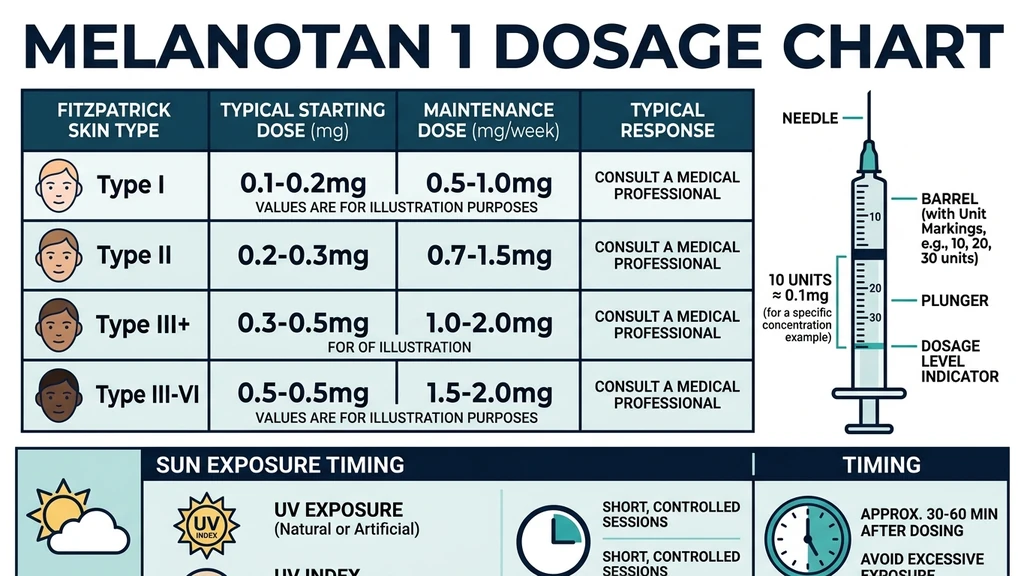
You have a 10 mg vial labeled MT-1 and every dosing guide you find is written for Melanotan 2. The numbers do not transfer. The standard research Melanotan 1 dosage is 0.25 mg daily for the first 3 to 5 days to assess tolerance, then 0.5 to 1 mg daily for a 10 to 14 day loading phase, followed by 0.5 to 1 mg two to three times weekly for maintenance. Melanotan 1 runs at roughly double the MT2 dose because it only activates the MC1R pigmentation receptor.
| Phase | Dose | Frequency | Duration |
|---|---|---|---|
| Tolerance start | 0.25 mg | Daily | Days 1 to 5 |
| Loading | 0.5 to 1 mg | Daily | Days 6 to 21 (varies by skin type) |
| Maintenance | 0.5 to 1 mg | 2 to 3x per week | Ongoing |
Melanotan 1 is the research name for the peptide sold pharmaceutically as afamelanotide (brand name Scenesse), an FDA-approved 16 mg implant for erythropoietic protoporphyria. The molecule induces tanning in humans when injected subcutaneously (Levine et al. 1991, PMID: 1658407), and it does so with a far quieter side-effect profile than Melanotan 2 dosing protocols produce.
If you are choosing between the two compounds rather than dosing one you already own, start with the Melanotan 1 vs Melanotan 2 comparison. Everything below assumes you are dosing MT1 specifically.
Get your custom peptide protocol:
- Tailored to your body and goals
- Precise dosing and cycle length
- Safe stacking combinations
- Backed by peer-reviewed studies
- Ready in under 2 minutes
What Melanotan 1 Is and Why Its Dosage Differs From MT2
Melanotan 1 is a linear synthetic analog of alpha-melanocyte-stimulating hormone (alpha-MSH), the natural signal that tells melanocytes to produce pigment. Chemists at the University of Arizona swapped two amino acids in the native hormone and produced a molecule with far greater potency and a much longer active life than alpha-MSH itself (Sawyer et al. 1980, PMID: 6777774).
The pharmaceutical version, afamelanotide, earned FDA approval in 2019 as Scenesse: a 16 mg implant placed under the skin every two months for erythropoietic protoporphyria, a disorder where sunlight causes burning pain. In its Phase III trials, patients on the implant tolerated dramatically more direct sun exposure without pain (Langendonk et al. 2015, PMID: 26132941). Gray-market MT1 vials are not Scenesse. They are unregulated research chemicals that share the same peptide sequence.
Think of the two melanotans like light switches. Melanotan 1 is a switch wired to one lamp. Melanotan 2 is the main breaker: flip it and every circuit in the house comes on at once. Literally: MT1 selectively activates MC1R, the receptor that controls skin pigmentation. MT2 also hits MC3R, MC4R, and MC5R, which is why it triggers libido spikes, appetite suppression, and heavy nausea that MT1 largely does not.
That selectivity is also why the doses differ. MT1 binds MC1R less aggressively than MT2 does, so research protocols run 0.5 to 1 mg daily where MT2 protocols run 0.25 to 0.5 mg. Copying numbers between the two compounds in either direction is the single most common mistake with these peptides.
Melanotan 1 Dosage Chart by Skin Type
Your Fitzpatrick skin type sets your loading dose, loading duration, and total cumulative need. Fair skin carries MC1R variants that respond weakly to melanocortin signaling, so it needs more peptide over more days.
| Fitzpatrick Type | Description | Loading Dose | Loading Duration | Total Load | Maintenance |
|---|---|---|---|---|---|
| Type I | Very fair, always burns | 0.5 to 1 mg/day | 3 to 4 weeks | 15 to 25 mg | 1 mg 2 to 3x/week |
| Type II | Fair, usually burns | 0.5 to 1 mg/day | 2 to 3 weeks | 10 to 20 mg | 0.5 to 1 mg 2x/week |
| Type III | Medium, sometimes burns | 0.5 mg/day | 10 to 14 days | 7 to 10 mg | 0.5 mg 2x/week |
| Type IV | Olive, rarely burns | 0.5 mg/day | 7 to 10 days | 5 to 7 mg | 0.5 mg 1 to 2x/week |
| Type V-VI | Dark to very dark | 0.25 to 0.5 mg/day | 5 to 7 days | Under 5 mg | 0.5 mg weekly |
Start every protocol at 0.25 mg daily for the first 3 to 5 days regardless of skin type. This confirms tolerance before you commit to the full loading dose. Flushing and mild queasiness, when they occur at all, show up in this window.
For context on how far community doses sit below clinical ones: trials in fair-skinned volunteers used 0.16 mg/kg daily, roughly 11 mg per day for a 70 kg adult, given in 10 day cycles. That regimen more than doubled epidermal melanin density and reduced UV-induced DNA damage in skin (Barnetson et al. 2006, PMID: 16763547). Research protocols at 0.5 to 1 mg trade speed for a gentler ride.
Doses above 1 mg per day add little extra pigmentation and mostly add flushing. If results stall, extend the loading duration or add controlled UV exposure rather than raising the dose. Cross-reference other compounds on the master peptide dosage chart.
Reconstitution Math for a 10 mg Vial
MT1 ships as freeze-dried powder. Add 2 mL of bacteriostatic water to a 10 mg vial and you get 5 mg/mL, the concentration every number below assumes. Use bacteriostatic water, not sterile water, because the vial will be punctured daily for weeks.
| Target Dose | Units at 5 mg/mL (2 mL added) | Units at 10 mg/mL (1 mL added) |
|---|---|---|
| 0.25 mg | 5 units | 2.5 units |
| 0.5 mg | 10 units | 5 units |
| 0.75 mg | 15 units | 7.5 units |
| 1 mg | 20 units | 10 units |
The 2 mL dilution is the better choice. At 5 mg/mL, every dose lands on a whole, easy-to-read syringe mark. At 10 mg/mL, a 0.25 mg dose is 2.5 units, a half-mark guess on most insulin syringes.
Mix it slowly. Run the water down the inside wall of the vial, never straight onto the powder, then roll the vial between your palms until clear. The full technique, including how to handle a vacuum-sealed vial, is in the peptide reconstitution guide.
Refrigerate the mixed vial at 2 to 8 degrees C and use it within 30 days; reconstituted peptide lifespan depends on cold storage from the first minute. Verify your own vial size and water volume with the reconstitution calculator, and convert any dose to syringe units with the peptide unit converter.
Timing and UV Exposure Protocol
Inject MT1 subcutaneously into the abdomen or outer thigh in the evening. Free peptide clears the blood quickly; afamelanotide's pharmacokinetics show a short plasma half-life, which is exactly why Scenesse uses a two-month implant instead of daily shots (Minder et al. 2017, PMID: 28063031). Daily injections during loading substitute for that slow release. Needle placement and angle are covered in the how to inject peptides guide.
UV matters more with MT1 than with MT2. MT1 raises melanin production at the cellular level, but visible color develops fastest when UV light triggers melanin distribution into the upper skin layers. Without any UV at all, MT1 tanning is slow and subtle.
The working protocol: 10 to 20 minutes of natural sun or a short tanning session, 2 to 3 times per week, starting around day 4 or 5 of loading. Stop well short of any pink. The goal is a trigger, never a burn.
Expect the sequence to run in this order: darkening of existing freckles and moles first (days 4 to 10), then a gradual overall warming of skin tone (weeks 2 to 4). Fair skin types sit at the slow end of every range. Track injection timing against your UV sessions with the half-life tracker.
Side Effects: Melanotan 1 vs Melanotan 2
MT1's receptor selectivity buys a genuinely milder experience. The MC4R-driven effects that define MT2, spontaneous erections and blunted appetite, are largely absent with MT1 because MT1 barely touches that receptor.
| Side Effect | Melanotan 1 | Melanotan 2 |
|---|---|---|
| Nausea | Occasional, mild (roughly 1 in 5 users) | 80 to 90% of users during loading |
| Facial flushing | Mild, brief | Common, more pronounced |
| Libido changes / erections | Minimal to none | Frequent, dose-dependent |
| Appetite suppression | Minimal | Moderate to strong |
| Mole and freckle darkening | Yes | Yes, typically stronger |
| New mole formation | Lower reported rate | Higher reported rate |
In the Scenesse clinical program, the most common adverse events across the 244-patient EPP population were implant-site reactions, nausea, and headache, with no treatment-related serious safety signal over the trial period (Langendonk et al. 2015, PMID: 26132941). That safety record belongs to pharmaceutical afamelanotide under medical supervision. It does not automatically transfer to an unregulated vial.
The honest caution: MT1 stimulates melanocytes, the same cells melanoma arises from. It darkens existing moles and can reveal new ones, which complicates the visual screening dermatologists rely on. Get a baseline full-body mole check before your first injection, photograph your moles monthly, and stop at any ABCDE change. The full risk framework is in the peptide safety guide, and the skin-level mechanism is covered in what peptides do for skin.
Common Melanotan 1 Dosing Mistakes
Mistake 1: Using MT2 numbers with an MT1 vial, or the reverse. The two compounds run at different doses. Draw 1 mg of MT2 because an MT1 chart said "1 mg daily" and you have injected four times the standard 0.25 mg MT2 starting dose: severe nausea, hours of flushing, and unwanted erections are the predictable result. Draw 0.25 mg of MT1 for three weeks because an MT2 chart said so and you get almost no color. Confirm which peptide is in your vial, then use only that compound's chart.
Mistake 2: Wrong water volume. Add 1 mL instead of 2 mL to a 10 mg vial and the concentration doubles to 10 mg/mL. Draw your usual 20 units expecting 1 mg and you inject 2 mg, twice the intended dose and past the point where extra peptide adds anything but flushing. Label the vial with its concentration the moment you mix it, and store it cold per the peptide storage guide.
Mistake 3: Treating MT1 as sunscreen. A developing tan from MT1 offers modest photoprotection, but a fair-skinned user who takes 45 unprotected minutes of midday sun in week one will burn exactly as they always do. The pigment is not there yet. Keep UV sessions to 10 to 20 minutes and keep sunscreen for anything longer.
Mistake 4: Skipping the mole baseline. Once every freckle darkens, you cannot tell which mole changed and which one simply pigmented. A 15 minute photo session before the first injection preserves that reference. Beginners should read getting started with peptides before their first draw.
Frequently Asked Questions
How much Melanotan 1 should I take per day?
Start at 0.25 mg daily for 3 to 5 days to confirm tolerance, then load at 0.5 to 1 mg daily for 10 to 14 days (longer for Fitzpatrick Type I-II skin). Maintain with 0.5 to 1 mg two to three times weekly. Compare compounds on the peptide dosage chart.
How many units is 0.5 mg of Melanotan 1?
At 5 mg/mL (a 10 mg vial mixed with 2 mL of bacteriostatic water), 0.5 mg is 10 units on a U-100 insulin syringe and 1 mg is 20 units. If you added 1 mL instead, halve those numbers. Check any combination with the peptide unit converter.
Is Melanotan 1 the same as afamelanotide and Scenesse?
Same peptide sequence, different products. Afamelanotide is the pharmaceutical name and Scenesse is the FDA-approved 16 mg implant for erythropoietic protoporphyria. Gray-market MT1 vials are unregulated research chemicals with no purity guarantee. The Melanotan 1 vs Melanotan 2 guide covers the naming in detail.
Does Melanotan 1 cause nausea like Melanotan 2?
Far less. Roughly 1 in 5 MT1 users report mild, brief queasiness, against 80 to 90% of MT2 users during loading. MT1 skips the MC4R activation that drives MT2's nausea, erections, and appetite loss. If you are running MT2 instead, use the Melanotan 2 dosage protocol.
Do I need UV exposure for Melanotan 1 to work?
Practically, yes. MT1 raises melanin production, but 10 to 20 minutes of UV two to three times weekly is what moves that pigment into visible skin layers. Without UV, results are slow and faint. Clinical trials paired the analog with controlled UV to double melanin density (PMID: 16763547). See what peptides do for skin.
How long does Melanotan 1 take to work?
Freckles and moles darken first, around days 4 to 10. Overall skin tone warms across weeks 2 to 4 of loading at 0.5 to 1 mg daily with regular brief UV sessions. Fitzpatrick Type I-II skin sits at the slow end and may need 3 to 4 weeks. Injection technique basics are in the how to inject peptides guide.
Is Melanotan 1 safer than Melanotan 2?
Its side-effect profile is milder and its pharmaceutical form has real trial data, but the melanoma question applies to both: each stimulates melanocytes, the cells melanoma arises from. A dermatologist baseline check and monthly mole photos are non-negotiable with either compound. Read the peptide safety guide before starting.
How do I mix a 10 mg vial of Melanotan 1?
Add 2 mL of bacteriostatic water down the inside wall of the vial for a 5 mg/mL concentration, then roll gently until clear. Refrigerate and use within 30 days. The reconstitution calculator handles any other vial size or water volume.
The Bottom Line
The Melanotan 1 dosage that works in research protocols is 0.25 mg daily for the first 3 to 5 days, 0.5 to 1 mg daily through a 10 to 21 day loading phase set by your Fitzpatrick skin type, and 0.5 to 1 mg two to three times weekly to maintain. At 5 mg/mL, that is 5 to 20 units on an insulin syringe.
MT1 trades MT2's speed for selectivity. One receptor, milder side effects, higher dose, and a stronger dependence on brief, controlled UV exposure. The melanoma caution stands for both compounds: baseline mole check first, monthly photos after.
Run your exact vial and water volume through the reconstitution calculator before your first draw, and keep the Melanotan 2 dosage protocol bookmarked if you switch compounds later. For more dosage guides, calculators, and peptide research breakdowns, explore PeptidesExplorer.
Related Articles
Melanotan 2 Dosage Chart by Skin Type
Melanotan 2 dosage: start 0.25 mg/day loading, then 0.5 mg 1-2x weekly. Full chart by Fitzpatrick skin type, nausea fixes, and nasal vs injection compared.
Kisspeptin Dosage: Every Human Study Dose Explained
Kisspeptin dosage from human trials: KP-10 at 0.01-3 mcg/kg, KP-54 at 3.2-12.8 nmol/kg. Doses for men and women, mcg conversions, and why they desensitize.
Ipamorelin Dosage: Solo Protocols, Timing & Unit Math
Ipamorelin dosage: 200-300 mcg subcutaneous, 1-3x daily, bedtime fasted. Charts by goal and weight, saturation dose, reconstitution units, safety data.
Epitalon Dosage: Khavinson Protocol, Cycles & Unit Math
Epitalon dosage: 5-10 mg/day subcutaneous for 10-20 days, 1-2 courses per year. Khavinson protocol, reconstitution units for 10-50 mg vials, evidence review.