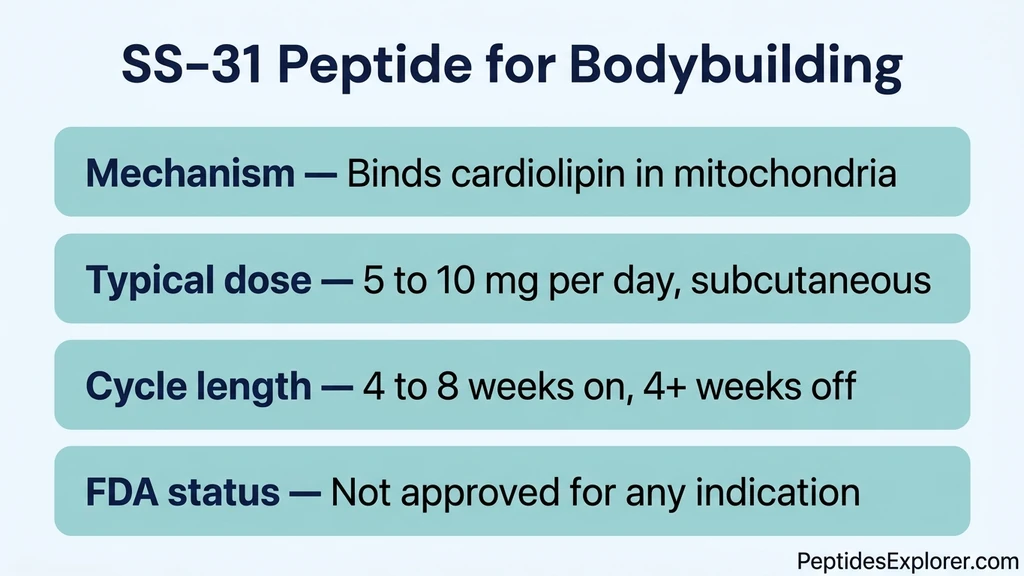
You heard about SS-31 on the Huberman Lab podcast last week and now you are standing in the kitchen with a tab open on a research vendor wondering if it belongs in your fridge next to the BPC-157. Here is the short answer: SS-31 will not build you new muscle. What it may do is recharge the tiny power plants inside your muscle cells so leg day stops wrecking you for three days, and so the volume you ran at 30 still works at 45. It is the "battery repair" peptide, not the "grow bigger" peptide.
| Quick Reference | SS-31 (Elamipretide) |
|---|---|
| What it is | A 4-amino-acid peptide engineered at Cornell to slip inside your cell's power plants |
| What it does | Protects the rubber gasket on the battery (cardiolipin), keeps your gas tank (ATP) full |
| What you feel | Better endurance, faster recovery, less between-set fatigue |
| Typical dose | 5 to 10 mg/day, subcutaneous, morning |
| Cycle length | 4 to 8 weeks on, 4+ weeks off |
| Cost | 150 to 300 USD per 50 mg vial |
| Legal status | Research chemical, not FDA-approved for humans |
| Best fit | Lifters 35+ who have already nailed sleep, food, and the basics |
SS-31 is not a swap for CJC-1295 and ipamorelin or 5-amino-1MQ. Those work on hormones and metabolism. SS-31 works on the engine itself. If your goal is putting on size, start with the peptides for bodybuilding guide and treat SS-31 as something you try later, after you have run the basics.
This is educational, not medical advice. SS-31 is a research peptide and is not approved for human use outside a clinical trial.
Get your custom peptide protocol:
- Tailored to your body and goals
- Precise dosing and cycle length
- Safe stacking combinations
- Backed by peer-reviewed studies
- Ready in under 2 minutes
What SS-31 Actually Is (And Why Your Lifting Buddy Keeps Texting You About It)
Picture the inside of your muscle cell as a workshop full of tiny batteries. Those batteries are mitochondria, and they make every drop of energy you use to push a barbell. SS-31 is a small peptide, just four amino acids long, that was designed at Weill Cornell to slip inside those batteries and protect them from wearing out (Szeto, 2006).
The technical sequence is D-Arg-2',6'-dimethylTyr-Lys-Phe-NH2. The plain version: it is small, water-friendly, and homes in on mitochondria with about 1,000 times more concentration than the rest of the cell. That targeting is what makes it different from a generic antioxidant pill.
You will see SS-31 sold under three names: SS-31 is the lab name, elamipretide is the clinical-trial name, and Bendavia was the drug-company brand. Same molecule. The drug company Stealth Biotherapeutics ran trials in heart failure and rare mitochondrial diseases. Some hit, some missed. As of 2026 it is not FDA-approved for anything.
So why are bodybuilders interested? Because lifters past 35 notice the same thing patients with mitochondrial disease feel in extreme form: the engine runs hotter and shorter. If SS-31 can patch the engine, it becomes a tool worth knowing about. For the muscle-building side of the picture, see CJC-1295 and ipamorelin benefits and peptides for recovery.
How It Works: Think of It as a Gasket That Keeps the Battery From Leaking
Inside every mitochondrion (the cell's battery), there is a thin inner wall holding everything in place. That wall is lined with a special fat called cardiolipin. Think of cardiolipin as the rubber gasket on a car battery. When the gasket is fresh, the battery makes clean power. When the gasket cracks with age and stress, the battery leaks acid, the voltage drops, and corrosion spreads.
In your cell, "leaking" means the battery starts spitting out reactive oxygen species (ROS), which is just chemistry-speak for rust. The rust eats more cardiolipin. Now the battery makes less ATP (the gas your muscles burn), and produces more rust at the same time. This is part of why training feels harder at 45 than at 25.
SS-31 works by binding directly to cardiolipin and shielding it from oxidation. In isolated mitochondria, SS-31 cuts hydrogen peroxide leakage by 30 to 50% and lifts ATP output by 20 to 40% (Birk et al., 2013). In aged mice, eight weeks of SS-31 brought their exercise capacity almost back to young-mouse levels (Siegel et al., 2013).
What that means for you under a barbell: your slow-twitch fibers and the oxidative parts of your fast-twitch fibers depend on these batteries to keep firing. If the batteries hold a charge longer, you get more reps before the burn, faster recovery between sets, and less wreckage the next morning. You will not look more jacked. You will train more, more often, with less rust building up.
How Lifters Actually Dose SS-31
No human trial has tested SS-31 for bodybuilding. Every protocol you see online is borrowed from heart-failure and mitochondrial-disease trials, then scaled down for someone who is healthy. Treat the numbers below as what people do, not what a doctor prescribes.
The standard research-use protocol: - Dose: 5 to 10 mg per day, under the skin - Timing: morning, empty stomach, same time daily - Cycle: 4 to 8 weeks on, at least 4 weeks off - Mixing: 2 mL bacteriostatic water into a 50 mg vial gives 25 mg/mL, so a 5 mg shot is 0.2 mL and a 10 mg shot is 0.4 mL
Published trials have used anywhere from 4 mg/day in Barth syndrome up to 40 mg/day intravenously for heart failure. The 5 to 10 mg sub-q range is on the conservative end. For the math, plug your vial into the peptide reconstitution calculator.
You inject into the soft tissue of your belly, two finger-widths from the navel, rotating sides each day. A 29- or 30-gauge insulin syringe is what most people use. If you have never given yourself a shot before, walk through how to inject peptides first.
Do not expect a thunderclap. Most users feel nothing the first week. The mitochondrial changes take 2 to 3 weeks to add up, and by week 3 or 4 you start noticing your last set has more left in it.
Once mixed, store the vial in the back of the fridge (2 to 8 degrees Celsius), wrapped to block light, and use within 28 days. Unmixed vials keep 24 months frozen. See how to store peptides.
Does It Actually Work? Here Is What the Evidence Says
The animal data is solid. SS-31 takes old, slow mice and makes them run almost like young mice in 8 weeks. The mechanism is clean and well understood. Isolated mitochondria respond predictably.
The human clinical data is mixed. A trial called EMBRACE missed its target. MMPOWER-3 missed its main goal but showed some smaller positive signals. The Barth syndrome trial (TAZPOWER) looked good enough that the company kept pushing. Side effects were mostly mild redness at the injection site.
Human data in trained lifters is essentially zero. A 2020 study in older sedentary adults showed SS-31 improved skeletal muscle mitochondrial function and exercise tolerance compared to placebo, but those people were not athletes (Roshanravan et al., 2020). Nobody has run a clean before-and-after study on lifters.
Forum reports skew positive, but the bias is obvious. People who drop $300 on a vial want to feel something. The mechanism argument is strong. The "this definitely works for lifters" argument is weak.
Honest take: if you are a 40-plus lifter with training, sleep, food, and core peptides like BPC-157 already locked in, SS-31 is a defensible experiment. If you are 28 and skipping breakfast, fix breakfast first. For a cellular-energy peptide with more user data, 5-amino-1MQ is better characterized.
Side Effects and Who Should Stay Away
Across roughly 1,500 trial participants, SS-31 has a clean safety record. The side effects you might run into:
- Injection site redness, itch, or small welts: the most common complaint, usually fades in a few hours
- Mild headache: occasional, mostly the first week
- Stomach upset: uncommon, more often at the higher IV doses used in heart-failure trials
- Brief dizziness right after a shot: rare, dose-dependent
- Slight bumps in liver enzymes: rare, reversible when you stop
No serious adverse events have been clearly tied to SS-31 in published trials. Long-term safety in healthy people is unknown because nobody has tracked them for years.
Stay away from SS-31 if you are: under 25, pregnant or breastfeeding, dealing with active cancer or known mitochondrial disease without specialist oversight, a tested athlete (assume banned under WADA S0), or on multiple psychiatric or cardiovascular drugs.
A note on research-grade quality: the SS-31 you buy online is not pharmacy-grade. Purity varies between vendors. Most of the risk comes from sloppy mixing, dirty bacteriostatic water, or warm storage, not the peptide itself. Read the peptide safety guide and are peptides legal before you order.
Rotate injection sites every day. Use a fresh syringe every shot. Wipe with 70% isopropyl alcohol. Never combine SS-31 in the same syringe with another peptide. Mixing wrecks your dose accuracy and makes it impossible to figure out which peptide caused a side effect.
Stacking SS-31 With Other Bodybuilding Peptides
SS-31 plays well with most other peptides because it works on a different system. It does not touch your testosterone, does not change your growth hormone pulses, and does not share receptors with the standard bodybuilding tools.
The "battery + growth" stack for lifters past 40: - SS-31: 5 to 10 mg subcutaneous, morning - CJC-1295 + ipamorelin: 100 mcg + 200 mcg, before bed - BPC-157: 250 mcg subcutaneous, post-workout - Run for 8 weeks on, 4 weeks off
CJC and ipamorelin pulse your growth hormone for hypertrophy. SS-31 keeps the cellular engine in good shape so the growth signal has somewhere to land. BPC-157 protects your tendons and connective tissue from the increased volume. Three layers, three problems. See CJC-1295 ipamorelin benefits and the peptide stacking guide.
The "battery + metabolism" stack: SS-31 5 mg in the morning, plus 5-amino-1MQ at 50 to 150 mg by mouth in the morning, for 6 to 8 weeks. 5-amino-1MQ raises NAD+, which is the fuel your batteries run on. SS-31 keeps the batteries themselves intact. The theory fits cleanly. The real-world overlap has not been studied. See 5-amino-1MQ dosage.
Do not stack SS-31 with MOTS-c at the same time of day. Both target mitochondria and the signaling overlap is uncharted. Skip high-dose NMN (above 1 g/day) for the first two weeks. Run anything new through the peptide stack calculator and check the peptide dosage chart for reference doses.
Run SS-31 solo for the first 2 weeks. If you get a side effect, you know exactly which peptide caused it.
Cost, Legality, and Whether It Is Worth Your Money
Cost. A 50 mg research vial runs 150 to 300 USD. At 5 to 10 mg per day, an 8-week cycle will cost you 600 to 1,200 USD all-in. That is 3 to 6 times what a BPC-157 or CJC/Ipa cycle costs, for a peptide with much less human performance data backing it.
Legality. In the US, SS-31 (elamipretide) is sold as a research chemical. Vendors label it "for research use only, not for human consumption." Buying it for your own use is not federally criminalized, but state laws and your professional license may matter more than federal rules. Read are peptides legal before you order.
For tested athletes. SS-31 is not on the WADA banned list by name, but the S0 category catches anything not approved for human therapeutic use. If you compete in a tested sport, treat SS-31 as banned.
Is it worth it? If you are under 35 and your sleep, food, and programming are not yet locked in, $1,000 is better spent on coaching, a smarter training block, or a DEXA scan and full blood panel. If you are 45, dialed in on the basics, and have already run cycles of BPC-157 and a growth secretagogue, SS-31 is a defensible experiment. If you are looking for a first peptide, this is not it. Start with the peptides for bodybuilding guide instead.
Frequently Asked Questions
Does SS-31 peptide build muscle?
No. SS-31 will not put new muscle on your frame. It does not raise testosterone, IGF-1, or growth hormone. It targets the mitochondria, the tiny power plants inside your muscle cells, which can support better endurance and faster recovery but does not directly grow tissue. For peptides that drive hypertrophy, see our CJC-1295 and ipamorelin benefits guide.
What is the typical SS-31 dosage for bodybuilding?
Most research users dose 5 to 10 mg per day under the skin, in the morning, for 4 to 8 week cycles with at least 4 weeks off in between. Mix a 50 mg vial with 2 mL of bacteriostatic water to get 25 mg per mL, then draw 0.2 mL for a 5 mg shot or 0.4 mL for 10 mg. No human bodybuilding trial has confirmed these numbers. Use the peptide reconstitution calculator to double-check the math.
Is SS-31 the same as elamipretide or Bendavia?
Yes, all three names refer to the same molecule: a 4-amino-acid peptide (D-Arg-dimethylTyr-Lys-Phe). SS-31 is the original lab name from Weill Cornell. Elamipretide is the clinical-trial name. Bendavia was Stealth Biotherapeutics' brand name. None of the three names is FDA-approved for any indication as of 2026. For broader context, see our peptide safety guide.
Is SS-31 safe?
Across roughly 1,500 trial participants, SS-31 was well tolerated. Mild redness at the injection site is the most common side effect. Headache, stomach upset, and small bumps in liver enzymes are less common. No serious side effects have been consistently linked to SS-31, but no one has tracked long-term use in healthy lifters, and research-grade purity varies between vendors. Read are peptides legal before ordering.
How long until SS-31 works?
Do not expect a same-day effect. Most users feel nothing the first week. The mitochondria need 2 to 3 weeks of daily dosing before the changes start adding up, and most reported benefits show up around week 3 or 4. If you want something that gives a faster recovery signal, see our peptides for recovery guide.
Can I stack SS-31 with CJC-1295 and ipamorelin?
Yes. The two stacks work on different systems: SS-31 protects the cell's batteries while CJC and ipamorelin pulse your growth hormone. There is no documented chemical clash, but never mix them in the same syringe. Inject SS-31 in the morning and CJC/Ipa before bed so the doses are 8+ hours apart. Run SS-31 alone for 2 weeks first so you can spot any side effects. See the peptide stacking guide.
How much does an SS-31 cycle cost?
A 50 mg research vial runs 150 to 300 USD. At 5 to 10 mg per day over an 8-week cycle, you are looking at 600 to 1,200 USD all-in. That is roughly 3 to 6 times what a BPC-157 or CJC/Ipa cycle costs, for a peptide with much thinner human performance data behind it. See our peptide dosage chart for cost comparisons across other peptides.
Is SS-31 legal?
In the US, SS-31 (elamipretide) is legal to buy from research vendors when it is labeled for research use only, not for human consumption. It is not FDA-approved, is not a controlled substance, and possession for personal use is not a federal crime. Selling it for human use will trigger FDA enforcement. If you compete in a tested sport, treat SS-31 as banned under WADA S0. See are peptides legal and how to inject peptides.
The Bottom Line
SS-31 is not the peptide to start a bodybuilding stack with. You will not look bigger in the mirror after a cycle. What you may notice is that the last few reps of a heavy set have something left in them, that leg day stops costing you three days of recovery, and that the volume you used to handle at 30 still works at 45.
If you are an experienced lifter past 35 who has already locked in training, sleep, food, and the core peptides, SS-31 is a defensible 4 to 8 week experiment at 5 to 10 mg daily under the skin. Plan for 600 to 1,200 dollars per cycle. Plan for subtle endurance and recovery wins, not body-comp changes. Plan for the fact that no human bodybuilding trial backs up your decision.
If you are younger, newer to lifting, or still getting your basics right, your money will move the needle further on coaching, a better-programmed block, and food. See peptides for bodybuilding and 5-amino-1MQ dosage for cheaper, better-studied starting points.
SS-31 is a research peptide, not a medicine. Talk to a qualified healthcare provider and read the peptide safety guide before you handle injectable products.
Related Articles: - Peptides for Bodybuilding - Peptides for Recovery - CJC-1295 and Ipamorelin Benefits - 5-Amino-1MQ Dosage - Peptide Stacking Guide - Peptide Safety Guide - How to Inject Peptides
Related Articles
Best Peptides for Men Over 50: Protocols
Top 8 peptides for men over 50 ranked by safety. Sermorelin, BPC-157, Tesamorelin protocols with adjusted dosing and blood work requirements.
PT-141 for Men: Dosage, Results & How It Works
PT-141 (bremelanotide) for men: 34% success in Viagra non-responders. Dosage, mechanism, clinical trial data, side effects, and comparison to PDE5 inhibitors.
GHK-Cu Nasal Spray: Dosage & Benefits
GHK-Cu nasal spray delivers copper peptide to the brain via the olfactory pathway. Dosage (625-1,250 mcg/day) and cognitive benefits from 2023 studies.
12 Nootropic Peptides Ranked (2026)
12 nootropic peptides ranked by evidence: Semax, Selank, Cerebrolysin, Dihexa, BPC-157. Mechanisms, dosages, and which ones actually work for focus and memory.