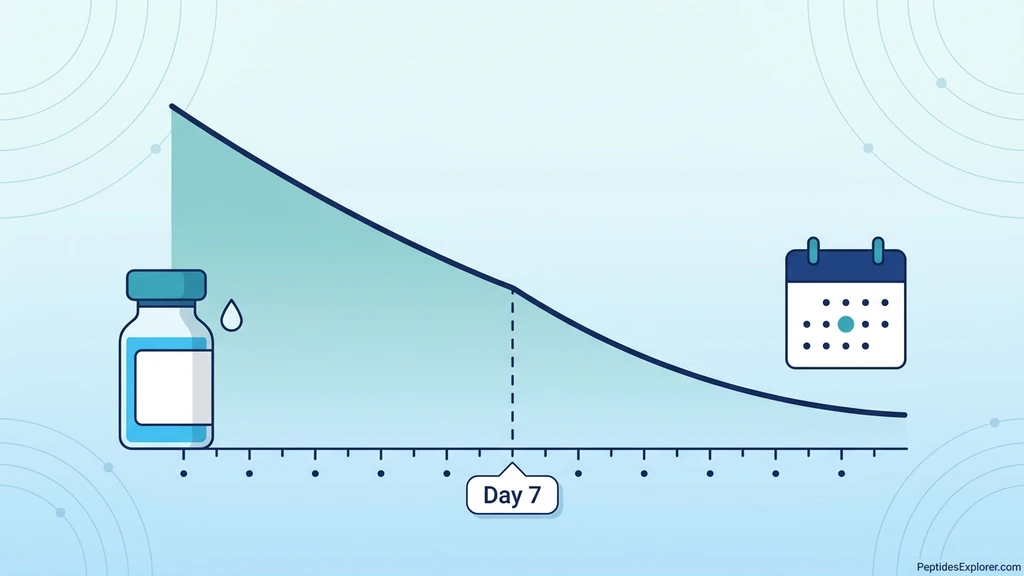
Your weekly cagrilintide dose went in on Friday, it is now Tuesday, and you want to know whether anything is left or whether a late dose will stack on top of it. Here is the answer: cagrilintide has a half-life of about 7 to 8 days, measured in the phase 1b trial that paired it with semaglutide. Half of a dose is still circulating a week later, blood levels reach steady state after 4 to 5 weekly injections, and the drug takes about 5 weeks to wash out after the last one.
| Question | Answer |
|---|---|
| Half-life | 7 to 8 days (phase 1b, Enebo 2021) |
| Why so long | A C20 fatty diacid hitches it to albumin; sequence changes stop it clumping |
| Native amylin for comparison | Minutes. Pramlintide, the first analogue, about 48 minutes |
| Time to steady state | 4 to 5 weekly doses; levels settle at about 2.1 times the first week |
| Washout after the last dose | Under 5% left at about 32 days; under 3% at 5 to 6 weeks |
| Matches semaglutide? | Yes. Semaglutide is about 1 week, which is why CagriSema fits one syringe |
| Regulatory status | Investigational; not FDA-approved for any use |
This page covers pharmacokinetics only. The compound itself is explained in what cagrilintide is, mixing in how to reconstitute cagrilintide, weekly amounts in the cagrilintide weight-loss dosage guide, the tirzepatide pairing in cagrilintide dosage with tirzepatide, and the fixed combination in CagriSema dosing. The profile lives at cagrilintide.
Get your custom peptide protocol:
- Tailored to your body and goals
- Precise dosing and cycle length
- Safe stacking combinations
- Backed by peer-reviewed studies
- Ready in under 2 minutes
Where the 7-to-8-Day Number Comes From
The half-life was measured in healthy-weight and overweight volunteers who received weekly subcutaneous cagrilintide alongside semaglutide 2.4 mg for 20 weeks. Cagrilintide's half-life came out at approximately 7 to 8 days, exposure rose in proportion to dose, and neither drug changed the other's blood levels (Enebo et al., Lancet, 2021, PMID 33894838). That single number is the basis for every weekly schedule that followed.
The phase 2 dose-ranging trial then ran once-weekly cagrilintide at 0.3 to 4.5 mg for 26 weeks in 706 participants. The 4.5 mg group lost 10.8% of body weight against 3.0% on placebo and 9.0% on daily liraglutide 3.0 mg, with no sign that the weekly interval left gaps in effect (Lau et al., Lancet, 2021, PMID 34798060). A drug whose levels halve every 7 to 8 days holds a smooth curve across a 7-day interval; that is what the trial design tested and confirmed.
This page uses 7.5 days as the working midpoint for every calculation below. If the true value for you sits at 7 or at 8 days, the numbers shift by a few percentage points, well inside the noise of injection technique and body weight.
Why Cagrilintide Lasts a Week When Amylin Lasts Minutes
Think of a harbour ferry. A swimmer crossing the water gets hauled out within minutes. A passenger who steps onto the ferry rides it for as long as the ferry circulates, protected and out of reach. Cagrilintide carries a hook that latches onto albumin, the body's largest circulating transport protein, and rides it instead of swimming.
Literally stated: native human amylin is a 37-amino-acid hormone co-secreted with insulin that slows gastric emptying, suppresses glucagon and signals satiety, and it is cleared from plasma within minutes, which is why pramlintide, the first clinical analogue, needs an injection before every meal (Hay et al., Pharmacol Rev, 2015, PMID 26071095). The design paper describes how the Novo Nordisk team solved both of amylin's problems at once. Amino acid substitutions removed its tendency to clump into fibrils, and a C20 fatty diacid attached through a linker gave it high albumin affinity, producing a stable, once-weekly amylin and calcitonin receptor agonist (Kruse et al., J Med Chem, 2021, PMID 34288673).
Albumin is too large to pass through the kidney filter, so a peptide bound to it is neither filtered nor exposed to the enzymes that chew up free amylin. Only the small unbound fraction is available to act on receptors and to be cleared, and it is replenished from the albumin pool as it goes. That reservoir is the half-life.
Steady State: Four to Five Weeks of Accumulation
With a 7.5-day half-life, 52% of a Friday dose is still present the following Friday when the next one goes in. Each week adds a full dose on top of what remains, and the pile grows until weekly clearance equals the weekly dose. That balance point is steady state, and for any drug it arrives after about 4 to 5 half-lives.
| Weekly dose number | Level, relative to the first dose | Share of final steady state |
|---|---|---|
| 1 | 1.00 | 48% |
| 2 | 1.52 | 73% |
| 3 | 1.80 | 86% |
| 4 | 1.94 | 93% |
| 5 | 2.02 | 96% |
| Steady state | 2.10 | 100% |
The accumulation ratio is 1 divided by (1 minus 0.52), which is about 2.1. Week 1 delivers roughly half the exposure that the same dose will deliver from week 5 onward. This is why the phase 2 trial escalated every 4 weeks and why early side effects are a poor guide to what a dose will feel like once it has filled up.
The practical consequence runs in both directions. A dose that feels mild in week 1 can turn nauseating in week 4 without any change on the syringe. The semaglutide side of this story is the same curve, which is why how long semaglutide stays in your system reads almost identically. You can plot both in the Peptide Half-Life Tracker.
Washout: How Long Cagrilintide Stays in Your System
Washout runs the same arithmetic backwards. The formula, shown once: remaining fraction = 0.5 raised to the power of (days since the last dose divided by 7.5). Everything in the table comes from that line.
| Days after the last dose | Share of the last dose remaining | Share of a steady-state peak remaining |
|---|---|---|
| 7 | 52% | 52% |
| 14 | 27% | 27% |
| 21 | 14% | 14% |
| 28 | 7.5% | 7.5% |
| 32 | 5.2% | 5.2% |
| 35 | 3.9% | 3.9% |
| 42 | 2.0% | 2.0% |
Two readings matter. If you stop at steady state, your blood level falls back to what a single first dose produced after about 8 days, because steady state is about 2.1 times that level and 7.5 times the base-2 logarithm of 2.1 is 8. Under 5% remains at about day 32, and the conventional five-half-life clearance point, around 3%, lands at day 37 or 38.
Appetite effects fade on the same clock, roughly in step with the level. Most people notice hunger returning in the second and third week after stopping, when the level has dropped to a quarter or less. The companion guides for the GLP-1 class, how long tirzepatide stays in your system and how long retatrutide stays in your system, follow the same template with shorter clocks of about 5 and 6 days.
Cagrilintide vs Semaglutide: Matched Clocks and the CagriSema Co-formulation
Semaglutide's half-life in humans is approximately 1 week. Like cagrilintide it is extensively bound to albumin, and it is cleared slowly by cleavage of the peptide backbone and beta-oxidation of its fatty acid side chain (Jensen et al., Eur J Pharm Sci, 2017, PMID 28323117). Two drugs with the same half-life rise, plateau and fall on the same schedule, and that is the whole reason they could be put in one weekly syringe.
| Compound | Class | Human half-life | Dosing interval | Source |
|---|---|---|---|---|
| Native amylin | Hormone | Minutes | Continuous, from the pancreas | Hay 2015, PMID 26071095 |
| Pramlintide | Amylin analogue | About 48 minutes | Before each meal | FDA label |
| Cagrilintide | Acylated amylin analogue | 7 to 8 days | Weekly | Enebo 2021, PMID 33894838 |
| Semaglutide | Acylated GLP-1 analogue | About 7 days | Weekly | Jensen 2017, PMID 28323117 |
| Tirzepatide | GIP/GLP-1 | About 5 days | Weekly | FDA label |
| Retatrutide | GIP/GLP-1/glucagon | About 6 days | Weekly | Urva 2022 |
The phase 1b trial that produced the half-life also showed no pharmacokinetic interaction between the two, and 4.5 mg cagrilintide with semaglutide 2.4 mg produced a 17.1% weight reduction at 20 weeks against 9.8% for semaglutide alone (Enebo et al., Lancet, 2021, PMID 33894838). In type 2 diabetes, 32 weeks of co-administered 2.4 mg of each lowered HbA1c by 2.2 percentage points and body weight by 15.6%, against 5.1% for semaglutide alone and 8.1% for cagrilintide alone (Frias et al., Lancet, 2023, PMID 37364590).
The phase 3 REDEFINE 1 trial then followed 3,417 adults without diabetes for 68 weeks: 20.4% weight loss on the combination against 14.9% on semaglutide, 11.8% on cagrilintide and 3.0% on placebo (Garvey et al., N Engl J Med, 2025, PMID 40544433). In REDEFINE 2, adults with type 2 diabetes lost 13.7% against 3.4% on placebo (Davies et al., N Engl J Med, 2025, PMID 40544432). A mismatched pair, say a 7-day peptide with a 5-day one, would drift out of phase inside a single week and could never share one titration ladder. The semaglutide profile covers the GLP-1 half of the molecule pair.
What the Half-Life Means for Missed Doses, Switching, and Side Effects
Missed dose. Cagrilintide has no prescribing label, so the rule is borrowed from semaglutide, which shares its half-life: if the next scheduled dose is more than 48 hours away, inject the missed one as soon as you remember and keep your usual day; if it is closer than that, skip it. A dose 3 days late means your level has slid to about 0.8 units against a normal trough of 1.1, roughly 25% lower, and your appetite will tell you. Never inject two doses to catch up.
Scenario 1, the catch-up double. You miss Friday, inject Tuesday, then inject Friday as usual. Friday's dose lands 3 days after Tuesday's, when 76% of it remains, and your level peaks near 2.3 units against a normal 2.1: a second rise 3 days after the first rather than 7, which is what the gut reacts to. Expect the nausea of a skipped titration step. Fix: after a late dose, the next one waits a full 7 days.
Scenario 2, the two-week restart. You travel for 16 days without the vial and resume at your full maintenance dose. Only 23% of the old level remains, your new peak is about 1.5 units rather than 2.1, so the pharmacology is forgiving. The lost tolerance is the problem: appetite and gastric emptying have partly reset over those two weeks. Fix: restart one step down for a week, as you would on the semaglutide titration schedule.
Switching. When you stop cagrilintide and start another agent, half the cagrilintide is still working a week later and a quarter after two weeks, so appetite suppression and slowed gastric emptying overlap. The switching logic in semaglutide to tirzepatide switching applies, with an extra 1 to 2 days of carry-over because cagrilintide runs slightly longer.
Side-effect duration. Pramlintide nausea lasts hours because the drug does. Cagrilintide nausea can last days because the level barely moves across the week; a new peak after an escalation step is still 91% of its height 1 day later and 76% at day 3. That is why users report a 3-to-5-day nausea wave after each increase. The coping tactics in how to relieve nausea from semaglutide transfer directly, and the retatrutide nausea guide explains the gastric-emptying mechanism they share.
Quantified Risks: GI Events, Hypoglycemia, and Investigational Status
Gastrointestinal events are the price of a long-acting amylin analogue. In the phase 2 trial, gastrointestinal disorders, mainly nausea, constipation and diarrhoea, were the most frequent adverse events across the cagrilintide groups, mostly mild to moderate (Lau et al., Lancet, 2021, PMID 34798060). In REDEFINE 1, gastrointestinal adverse events were reported by about 80% of participants on the combination against about 40% on placebo (Garvey et al., N Engl J Med, 2025, PMID 40544433). A long half-life means each of those events plays out over days rather than hours.
Hypoglycemia is the second risk, and it belongs to combinations. Amylin analogues on their own do not drive glucose below normal, but pramlintide carries a boxed warning for severe insulin-induced hypoglycemia because the two act together on post-meal glucose (Hay et al., Pharmacol Rev, 2015, PMID 26071095). The phase 2 diabetes trial of the cagrilintide and semaglutide combination was run in people on metformin, with or without an SGLT2 inhibitor, which kept insulin out of the picture (Frias et al., Lancet, 2023, PMID 37364590). Anyone pairing a weeks-long amylin analogue with insulin or a sulfonylurea faces a hypoglycemia risk that does not clear overnight.
Cagrilintide is an investigational compound. It is not FDA-approved on its own or inside CagriSema, it has no label, and every missed-dose and switching rule above is inferred from its pharmacokinetics or borrowed from semaglutide. Class-wide numbers are in GLP-1 side effects statistics, and interactions that stack on slowed gastric emptying in tirzepatide drug interactions.
Common Half-Life Mistakes
Judging a dose in week 1. Week 1 exposure is 48% of what that dose delivers at steady state. Fix: hold each dose 4 weeks before deciding it is too weak or too strong, which is the interval the phase 2 trial used.
Adding a dose on top of a regular one. An extra injection 3 days after a scheduled dose pushes the level about 23% above the steady-state peak. Fix: a late dose moves the whole schedule; the next one waits 7 days.
Expecting side effects to clear by morning. With 91% of a new peak still present after 24 hours, nausea from an escalation step runs for days. Fix: schedule increases before a light calendar and follow the same food and hydration rules as for semaglutide.
Confusing vial shelf life with body half-life. A reconstituted vial's 28 days in the fridge and the 7.5 days in your bloodstream come from different chemistry. The storage side is covered in how long reconstituted peptides last. For a peptide at the other extreme of the clock, compare MOTS-c half-life, where plasma clears in hours.
Frequently Asked Questions
What is the half-life of cagrilintide?
About 7 to 8 days. The phase 1b trial that gave weekly cagrilintide alongside semaglutide 2.4 mg for 20 weeks measured a half-life of approximately 7 to 8 days with dose-proportional exposure (PMID 33894838). That is what makes once-weekly injection work. The compound overview is on the cagrilintide profile.
How long does cagrilintide stay in your system after the last dose?
Using 7.5 days, 52% remains at 1 week, 27% at 2 weeks, 7.5% at 4 weeks and under 3% at about 5 and a half weeks. From steady state, the level drops to a single first-dose equivalent in about 8 days. Plot your own schedule in the Peptide Half-Life Tracker.
Why is the cagrilintide half-life so much longer than amylin?
Native amylin clears in minutes and pramlintide in about 48 minutes (PMID 26071095). Cagrilintide carries a C20 fatty diacid that binds albumin, which shields it from kidney filtration and enzymes, plus sequence changes that stop fibril formation (PMID 34288673). The same trick gives semaglutide its week-long half-life.
How long does cagrilintide take to reach steady state?
Four to five weekly doses, or about a month. Each week 52% of the previous dose remains, so levels build to about 2.1 times the first week: 73% of steady state at dose 2, 93% at dose 4, 96% at dose 5. The semaglutide curve in how long semaglutide stays in your system is nearly identical.
Is the cagrilintide half-life the same as semaglutide?
Close enough to share a syringe. Semaglutide is approximately 1 week (PMID 28323117) and cagrilintide 7 to 8 days (PMID 33894838), and co-administration changed neither drug exposure. That match is why CagriSema could be built as one weekly injection and reached 20.4% weight loss in REDEFINE 1 (PMID 40544433). The amylin half of the pair is profiled at cagrilintide.
What happens if I miss a dose of cagrilintide?
Cagrilintide has no label, so borrow the semaglutide rule it shares a half-life with: inject if the next scheduled dose is more than 48 hours away, otherwise skip, and never double. A 3-day-late dose leaves your level about 25% below normal. The same logic is laid out for a 5-day drug in best time to take tirzepatide.
Why does cagrilintide nausea last for days?
Because the drug level barely falls within a week: 91% of a new peak is still present after 1 day and 76% after 3. Gastrointestinal events hit about 80% of REDEFINE 1 participants on the combination versus 40% on placebo (PMID 40544433). Practical relief steps are in how to relieve nausea from semaglutide.
The Bottom Line
The cagrilintide half-life is about 7 to 8 days, measured in the phase 1b trial with semaglutide. Half a dose remains a week later, steady state arrives after 4 to 5 weekly injections at about 2.1 times the first-week level, and washout to under 5% takes about 32 days.
The principle: cagrilintide is a reservoir, and so is semaglutide. Matched half-lives let the two share one syringe and one titration ladder, and the same slow clock means missed doses barely dent the level, catch-up doubles overshoot it, and nausea from an increase lasts days rather than hours.
Cagrilintide is investigational and not FDA-approved for any use; every rule above comes from its pharmacology or from a borrowed semaglutide label. Model your own schedule in the Peptide Half-Life Tracker and find the rest of the cagrilintide cluster at PeptidesExplorer. Educational content, not medical advice.
Helpful Tools
Related Articles
MOTS-c Half-Life: How Long It Stays in Your System
MOTS-c half-life: no human PK study exists. Exercise-raised plasma MOTS-c clears within 4 hours, yet gene effects last days. Washout, detectability, drug tests.
How Long Does Retatrutide Stay in Your System?
Retatrutide stays in your system about 30 days after the last dose (6-day half-life): 45% left at day 7, 3% at day 30. Washout table, switching and surgery.
How to Reconstitute Cagrilintide (5 mg, 10 mg)
How to reconstitute cagrilintide: bacteriostatic water for 5 mg and 10 mg vials, mg to units on a U-100 syringe, fridge storage and the 28-day clock.
How Long Does Melanotan 2 Take to Work? MT2 Timeline
How long does melanotan 2 take to work: freckles darken by day 7, visible tan in 2 to 3 weeks, peak 1 to 3 weeks after the last dose. Plus MT2 half-life.