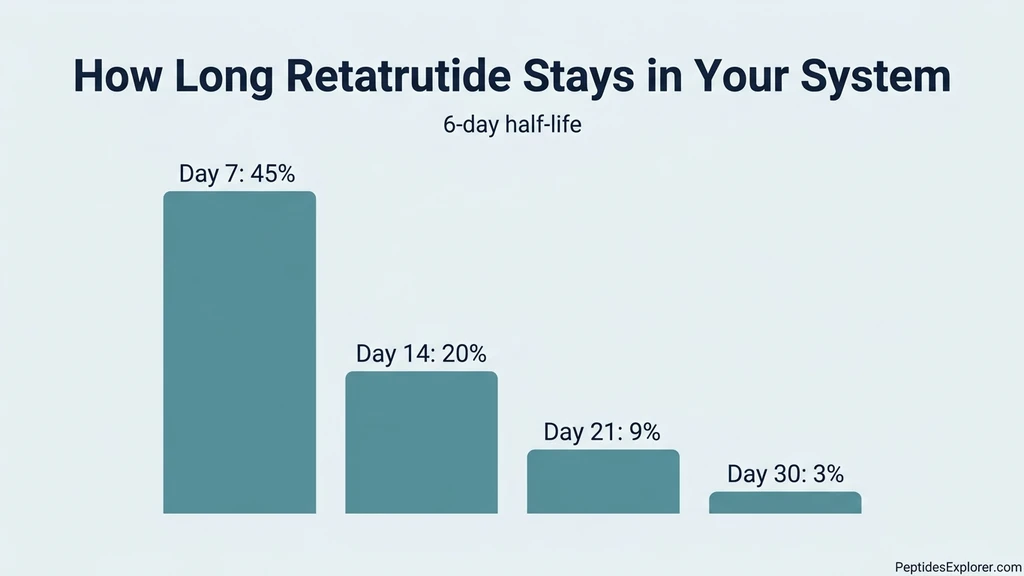
Your last injection was a week ago, the hunger is creeping back, and you need to know whether the drug is still in you. Here is the answer: retatrutide has a half-life of about 6 days, so roughly 45% of your last dose is still circulating at day 7, 20% at day 14, and about 3% at day 30. Plan on 30 days for it to be effectively out of your system, and about 6 weeks for the last trace.
| Time since last dose | Drug remaining | What you notice |
|---|---|---|
| Day 3 | 71% | Nothing changes yet |
| Day 7 | 45% | Appetite starts to return |
| Day 14 | 20% | Hunger near normal, nausea gone |
| Day 21 | 9% | Blood sugar drifting back to baseline |
| Day 30 | 3% | Effectively cleared |
| Day 42 | under 1% | Last trace gone, weight regain under way |
Those numbers describe the molecule in your blood, which is a different question from how long a vial lasts in the fridge; that lives in how long reconstituted peptides last and how to reconstitute retatrutide. How fast retatrutide starts working is covered in how long retatrutide takes to work, and which day and hour to inject in the best time to take retatrutide. This page covers one thing: how the drug leaves.
Get your custom peptide protocol:
- Tailored to your body and goals
- Precise dosing and cycle length
- Safe stacking combinations
- Backed by peer-reviewed studies
- Ready in under 2 minutes
The 6-Day Half-Life: What the Number Means
Think of a mug of coffee cooling on your desk. It loses heat fastest in the first minutes, then slower and slower as it creeps toward room temperature, because it sheds the same fraction of its remaining warmth in each interval. Retatrutide leaves your blood the same way: the same fraction of whatever is left disappears every 6 days, so the drop is steep in week one and a slow fade after that.
Literally stated: in the phase 1b multiple-ascending-dose trial, retatrutide's pharmacokinetics were dose proportional and its half-life was approximately 6 days (Urva et al., Lancet, 2022, PMID 36354040). Dose proportional means a 12 mg dose starts at three times the blood level of a 4 mg dose but falls at the same rate. The half-life does not change with the dose; only the starting height does.
That rate explains why a 72-hour late dose barely matters while a 14-day gap does. Six days is also the longest half-life of the three weekly incretins: tirzepatide's is about 5 days (Furihata et al., Diabetes Obes Metab, 2022, PMID 34647404) and semaglutide's is about 7 days according to its prescribing information. Run any of them through the peptide half-life tracker to see your own curve.
Retatrutide is an investigational compound. It has no FDA approval, no prescribing label, and no official washout guidance; every practical rule below is derived from its trial pharmacology or borrowed from the labels of tirzepatide and semaglutide, and this page says which is which.
Building Up: Steady State Takes 4 to 5 Weeks
Weekly dosing with a 6-day half-life means each injection lands on top of 45% of the previous one. The drug stacks until the amount you inject equals the amount you clear in a week. At that point your blood level sits about 1.8 times higher than it did after the first dose.
| Weekly dose number | Level vs final steady state |
|---|---|
| Dose 1 | 55% |
| Dose 2 | 80% |
| Dose 3 | 91% |
| Dose 4 | 96% |
| Dose 5 | 98% |
This is why the phase 2 obesity trial escalated every 4 weeks rather than every week: a dose has to reach its plateau before anyone can judge it, and gastrointestinal events in that trial were dose related and most frequent during escalation (Jastreboff et al., N Engl J Med, 2023, PMID 37366315). Jumping a step before week 4 means stacking a new dose on a plateau you never reached. The weekly volumes for each step are in the retatrutide dosage calculator, and the escalation-week side effect map in the retatrutide nausea guide.
The same arithmetic runs in reverse when you stop. Someone who quits after 16 weeks at steady state starts the washout from a level 1.8 times higher than a single dose, so in absolute terms they carry more drug on day 14 than a first-week user carried on day 7. The percentages in the washout table still apply; the starting height is just taller.
The Washout Curve After Your Last Dose
Pharmacology treats a drug as cleared after 5 half-lives, when about 3% remains. For retatrutide that is day 30. The table below assumes a user who has been dosing weekly long enough to reach steady state and gives the percentage of the level present on the day of the last injection.
| Day after last dose | Half-lives elapsed | Retatrutide remaining | Comparable point for tirzepatide | Comparable point for semaglutide |
|---|---|---|---|---|
| 0 | 0 | 100% | 100% | 100% |
| 3 | 0.5 | 71% | 66% | 74% |
| 7 | 1.2 | 45% | 38% | 50% |
| 14 | 2.3 | 20% | 14% | 25% |
| 21 | 3.5 | 9% | 5% | 13% |
| 30 | 5 | 3% | 2% | 5% |
| 42 | 7 | 0.8% | 0.3% | 1.6% |
Two things stand out. First, a one-week "break" removes barely half the drug, which is why skipping a single dose feels like a lower dose rather than a stop. Second, the tail is long: 9% at three weeks is still a pharmacologically active amount for a compound whose trial doses ranged from 1 mg to 12 mg.
Body weight, kidney function and liver function shift these numbers by hours, not weeks. Peptides of this class are broken down by proteolytic cleavage of the backbone and beta-oxidation of the fatty-acid side chain, a process that is not confined to any single organ; that is how semaglutide, the closest studied analogue, was shown to clear in humans (Jensen et al., Eur J Pharm Sci, 2017, PMID 28323117). The comparison columns are built from the 5-day and 7-day figures explained in how long tirzepatide stays in your system and how long semaglutide stays in your system.
What "Out of Your System" Means for Appetite, Blood Sugar and Weight
The molecule and its effects run on different clocks. Blood levels follow the table above; what you feel lags behind it in one direction and runs ahead of it in another.
Appetite and gut effects fade first. Retatrutide delays gastric emptying, and the delay is largest after the first dose and weakens with repeated dosing (Urva et al., Diabetes Obes Metab, 2023, PMID 37311727). Users report hunger returning between day 7 and day 14 after the last dose, while the level is dropping from 45% to 20%. Nausea and loose stools, if you had them, are usually gone inside that same window; the timeline for the latter is in how long retatrutide diarrhea lasts.
Blood sugar drifts back over weeks 2 to 4. In the phase 1b trial the glucose-lowering effect was measured at week 12 of continuous dosing and scaled with dose (Urva et al., Lancet, 2022, PMID 36354040). As the level crosses 20% and then 9%, fasting glucose climbs toward baseline. Anyone with type 2 diabetes who stops should have a plan with their prescriber for that window, because no insulin or metformin adjustment happens on its own.
Weight effect outlasts the drug. In the first-in-human study, a single dose reduced body weight for up to 43 days, which is 7 half-lives (Coskun et al., Cell Metab, 2022, PMID 35985340). The weight comes back after that, and retatrutide has no withdrawal data of its own, so the proxies are its cousins. One year after stopping tirzepatide, participants in SURMOUNT-4 regained 14% of body weight against a 5.5% further loss in those who continued (Aronne et al., JAMA, 2024, PMID 38078870). One year after stopping semaglutide, STEP 1 participants had regained two-thirds of what they lost (Wilding et al., Diabetes Obes Metab, 2022, PMID 35441470). Expect the retatrutide curve to look at least as steep, since its 24% weight loss at 48 weeks in phase 2 (Jastreboff et al., N Engl J Med, 2023, PMID 37366315) leaves more to regain. The head-to-head numbers are in retatrutide vs Zepbound.
Missed Doses and Switching to Tirzepatide or Semaglutide
The washout curve answers both the "I forgot" question and the "I am switching" question, because both come down to how much retatrutide is still there when the next drug goes in.
| Situation | Retatrutide still present | Rule |
|---|---|---|
| Dose 1 to 3 days late | 71% or more | Inject, then return to the normal day |
| Dose 4 to 7 days late | 45% to 65% | Skip it, resume on the normal day |
| Gap of 2 weeks | 20% | Restart one dose step lower for 1 to 2 weeks |
| Gap of 4 weeks or more | 3% or less | Restart from the beginning of the titration |
| Switching to tirzepatide | 45% on the day the next dose was due | Start tirzepatide on that day at a starting or mid dose, never the top dose |
| Switching to semaglutide | 45% on the day the next dose was due | Same rule; semaglutide's 7-day half-life stacks faster |
Scenario 1, the early switch. You take 12 mg of retatrutide on Friday, decide on Monday to move to tirzepatide, and inject 10 mg of it that evening. Monday is day 3, so 71% of a steady-state 12 mg exposure is still on board, and you have added a full-strength dual agonist on top. The combined incretin load for that week is roughly 1.7 times what your gut is trained for, which is the exposure of a skipped escalation step. Expect vomiting and a day in bed. Fix: wait until the day the next retatrutide dose was due, then start the new drug one or two steps below your target, using the tirzepatide dosage calculator for the units.
Scenario 2, the "it must be gone" restart. You stop for 10 days, assume the drug is out, and restart at your full 12 mg. On day 10 about 31% remains, and tolerance to nausea has partly unwound. You get a 12 mg peak on top of a third of a dose, with a gut that has forgotten the last step. Fix: one step down for one to two weeks, then climb back.
The reverse switch, with its overlap math and starting doses, is in switching from tirzepatide to retatrutide. The principle is identical in both directions: the molecule that is leaving still counts, and semaglutide at a 7-day half-life leaves even slower than retatrutide does.
Stopping Before Surgery, Pregnancy or a Night of Drinking
Surgery. The concern is delayed gastric emptying: food still in the stomach under anesthesia can be inhaled into the lungs. The 2024 multisociety guidance from the anesthesiology, gastroenterology and bariatric surgery societies moved away from blanket holding of GLP-1 receptor agonists and toward a 24-hour liquid diet before the procedure for patients at elevated risk of retained stomach contents, with holding reserved for case-by-case decisions (Kindel et al., Surg Obes Relat Dis, 2024, PMID 39482213). That guidance was written for approved drugs; retatrutide was not studied. Tell the anesthesia team the date of your last dose and the dose, because holding one weekly injection leaves 45% of the drug on board and holding two leaves 20%. A full washout for an elective procedure is 30 days.
Pregnancy. There are no human pregnancy data for retatrutide. The Wegovy label instructs stopping semaglutide at least 2 months before a planned pregnancy (FDA, Wegovy prescribing information, 2021, label PDF), and 2 months covers more than 9 retatrutide half-lives. Treat that as the floor. The class-level reasoning and the tirzepatide label language are in tirzepatide and pregnancy.
Alcohol. No interaction study exists for retatrutide and alcohol. The pharmacology is simple: as long as the drug is present, gastric emptying is slowed, alcohol sits in the stomach longer, and reduced food intake leaves less to buffer it. The gut effect weakens along the same curve as appetite, so a drink at day 14 lands on a very different stomach than a drink at day 3. The class-by-class rules are in can you drink alcohol on peptides.
Drug Tests and Lab Assays
Retatrutide does not appear on any standard drug screen. Employment panels of 5, 10 or 12 substances look for amphetamines, opioids, cannabinoids, cocaine, benzodiazepines and similar classes, using immunoassays that have no antibody for a 39-amino-acid incretin analogue. It cannot cause a false positive for any of them. The sport and employment detail is in do peptides show up on drug tests.
Detection in a laboratory is a different matter. The phase 1b trial quantified plasma retatrutide with a validated research assay through 12 weeks of dosing (Urva et al., Lancet, 2022, PMID 36354040), so a liquid chromatography mass spectrometry method built for the molecule can find it for as long as the washout curve says it is there, which is 4 to 6 weeks. No commercial clinical laboratory offers that test to patients as of October 2026.
What routine blood work does show is the drug's footprint. Fasting glucose, HbA1c, lipids and liver enzymes reflect retatrutide's effect until it has cleared. If a prescriber wants a true off-drug baseline, draw it at least 30 days after the last injection, and remember that HbA1c averages the previous 2 to 3 months regardless.
Common Mistakes With the Washout
Treating one skipped week as a reset. 45% of the drug is still present at day 7. Restarting at full dose is fine; restarting at a higher step because "the slate is clean" stacks on top of what is left. Fix: a 7-day gap changes nothing about the dose.
Switching drugs on the wrong day. Starting tirzepatide or semaglutide 2 or 3 days after the last retatrutide dose adds a full dose to a 70% residue. Fix: the first dose of the new drug goes in on the day the next retatrutide dose was due.
Expecting the weight to hold. The single-dose weight effect lasts to day 43, then the comparator data say the regain runs for a year. Fix: decide what replaces the drug before the last injection, not after the hunger returns.
Assuming the drug tests clean because it tests clean. It passes every employment panel and still shows up on a research assay for 6 weeks. Fix: the honest answer in any disclosure is the date of the last dose.
Frequently Asked Questions
How long does reta stay in your system?
About 30 days for practical purposes and 6 weeks for the last trace. Retatrutide has a half-life of roughly 6 days (PMID 36354040), so 45% remains at day 7, 20% at day 14, 9% at day 21 and 3% at day 30. The peptide half-life tracker plots the curve for your own dose and date.
What is the half-life of retatrutide?
Approximately 6 days, measured in the phase 1b multiple-ascending-dose trial, where pharmacokinetics were dose proportional (PMID 36354040). That is longer than tirzepatide at about 5 days and shorter than semaglutide at about 7. The pharmacology behind the once-weekly schedule is in the retatrutide profile.
How long does reta last in your body after you stop?
Appetite returns between day 7 and day 14, when the level falls from 45% to 20%. Blood sugar drifts back over weeks 2 to 4. The weight effect of even a single dose persisted to day 43 in the first-in-human study (PMID 35985340), after which regain begins. The build-up side of that curve is in how long retatrutide takes to work.
How long is the retatrutide washout before switching to tirzepatide?
Start the new drug on the day the next retatrutide dose would have been due, when 45% of it remains, and begin at a starting or mid dose rather than the top. Injecting 3 days after the last dose stacks on 71% residue and roughly 1.7 times the incretin load. The reverse direction is mapped in switching from tirzepatide to retatrutide.
Does retatrutide show up on a drug test?
No. Standard 5, 10 and 12-panel screens use immunoassays for amphetamines, opioids, cannabinoids and similar classes, none of which react with a peptide. A research-grade mass spectrometry assay can detect it for 4 to 6 weeks, but no clinical lab offers one. The sport and employment rules are in do peptides show up on drug tests.
How long before surgery should you stop retatrutide?
Holding one weekly dose leaves 45% of the drug, holding two leaves 20%, and a full washout is 30 days. The 2024 multisociety guidance favors a 24-hour liquid diet over blanket holding for at-risk patients (PMID 39482213), but it covers approved drugs only. Tell the anesthesia team your last dose and date. Tirzepatide's clearance timeline is in how long tirzepatide stays in your system.
How long does retatrutide take to reach steady state?
About 4 to 5 weeks of weekly dosing. Each injection lands on 45% of the previous one, so levels reach 80% of the plateau after 2 doses, 96% after 4, and 98% after 5, at a final level about 1.8 times a single dose. The phase 2 trial escalated every 4 weeks for that reason (PMID 37366315). Units per step are in the retatrutide dosage calculator.
The Bottom Line
Retatrutide stays in your system for about 30 days after the last dose, with 45% remaining at day 7, 20% at day 14, 9% at day 21 and 3% at day 30. The weight effect of a single dose lasts to day 43; after that the comparator trials say the regain runs for a year.
The principle: a 6-day half-life makes the drug a slowly draining reservoir, and the drug that is leaving still counts. Skipping a week removes half of it, switching drugs means stacking on what remains, and a true off-drug baseline needs a month.
Retatrutide is investigational and not FDA-approved, and none of its trials studied withdrawal; the switching, surgery and pregnancy rules here are borrowed from tirzepatide and semaglutide. Plot your own washout in the peptide half-life tracker and find the rest of the retatrutide cluster at PeptidesExplorer. Educational content, not medical advice.
Related Articles
MOTS-c Half-Life: How Long It Stays in Your System
MOTS-c half-life: no human PK study exists. Exercise-raised plasma MOTS-c clears within 4 hours, yet gene effects last days. Washout, detectability, drug tests.
Best Time to Take Retatrutide: Morning or Night?
Best time to take retatrutide: any hour, same weekday. Evening blunts nausea, morning suits diarrhea. Missed-dose rule, day switching, food, travel, alcohol.
Retatrutide Cost: 2026 Price Guide
Retatrutide cost in 2026: research vial pricing, projected prescription price, per-mg breakdown, and what drives the numbers. Why no insurance covers it yet.
Switching Tirzepatide to Retatrutide
Switching from tirzepatide to retatrutide: dose conversion logic, washout, titration restart, side effects to expect, and why a clean restart matters.