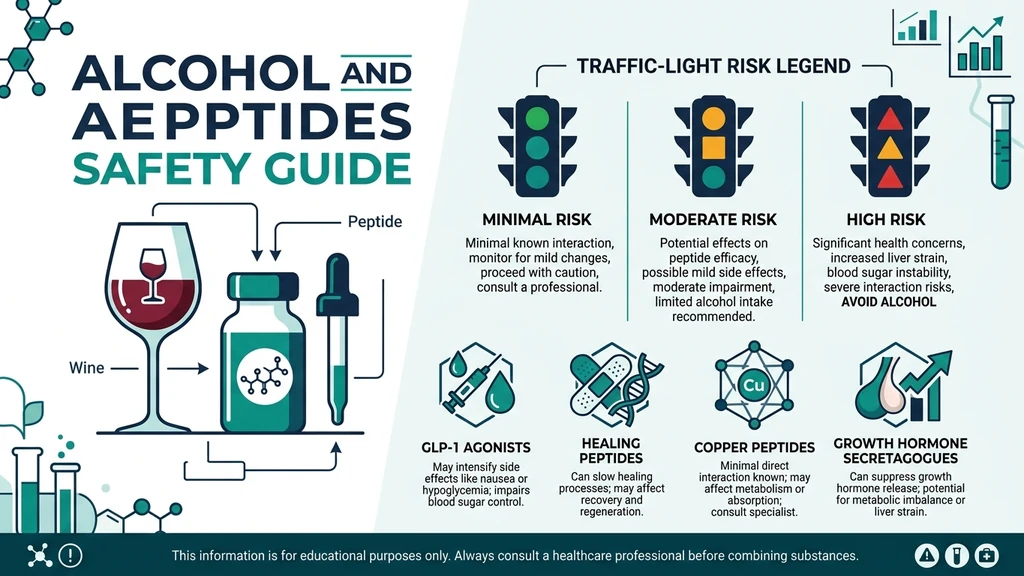
You are three weeks into a peptide protocol, a friend's birthday dinner is tonight, and you are staring at the wine list wondering if one glass undoes the whole thing. No peptide turns acutely toxic with alcohol the way metronidazole does, but "no contraindication" is not "no risk." Moderate drinking is low-risk with healing peptides like BPC-157, carries real metabolic risk with GLP-1s like semaglutide and tirzepatide, and directly cancels the benefit of growth hormone peptides like CJC-1295 by suppressing the nighttime GH pulse they exist to amplify. The answer changes by class, because peptides are not one drug.
| Peptide Class | Alcohol Interaction | Risk Level | Guidance |
|---|---|---|---|
| GLP-1s (semaglutide, tirzepatide, retatrutide) | Hypoglycemia, worse nausea and reflux, prolonged intoxication, stalled fat loss, possible pancreatitis stacking | Moderate to High | Eat first, limit drinks, skip if diabetic or fasting |
| Healing peptides (BPC-157, TB-500) | No direct peptide reaction; alcohol independently impairs healing; BPC-157 may protect liver and gut | Low (moderate) to Moderate (heavy) | Occasional moderate drinking fine; heavy drinking undercuts recovery |
| GH peptides (CJC-1295, ipamorelin, sermorelin, tesamorelin) | Suppresses nighttime GH pulse, fragments slow-wave sleep, cancels the injection's benefit | Moderate to High same-night | Do not drink the night you inject; space hours apart |
| Copper peptides (GHK-Cu) | Topical: negligible. Injectable plus heavy drinking: theoretical copper and liver interaction | Low (topical), theoretical (injectable) | Topical safe; moderate with injectable |
| Mitochondrial (MOTS-c) | No direct studies; alcohol mitochondrial and redox stress opposes the mechanism | Low to Moderate (mechanistic) | Moderation; heavy drinking works against the goal |
The rule of thumb runs through the whole table. The more a peptide works through metabolism, blood sugar, or sleep-driven hormone pulses, the more alcohol interferes. A topical skin peptide barely notices a glass of wine. A growth hormone secretagogue you inject at bedtime notices a great deal.
Get your custom peptide protocol:
- Tailored to your body and goals
- Precise dosing and cycle length
- Safe stacking combinations
- Backed by peer-reviewed studies
- Ready in under 2 minutes
The Short Answer by Peptide Class
None of the peptides covered here carries a hard alcohol contraindication. Metronidazole and disulfiram trigger violent reactions with even small amounts of ethanol. Peptides do not work that way, so a single drink will not put you in the emergency room.
The risk is quieter and slower. Alcohol either competes with the peptide's mechanism, amplifies its side effects, or wastes the benefit you paid for. A glass of wine with BPC-157 is a different decision than five drinks the same night you inject CJC-1295.
The sections below break each class apart so you can match your drink to your protocol. For a broader view of how these molecules behave, the peptide safety guide covers the foundations, and the peptide therapy side effects by class page maps what each group does on its own before alcohol enters the picture.
GLP-1 Peptides and Alcohol (Semaglutide, Tirzepatide, Retatrutide)
GLP-1 receptor agonists are the highest-stakes pairing with alcohol because they change how your body handles blood sugar, food, and the gut itself. Drinking on semaglutide or tirzepatide is usually tolerated in moderation with food, but four mechanisms make caution worthwhile.
Talk to your prescriber before drinking on a GLP-1 if you have diabetes, a pancreatitis history, or liver disease. Those three conditions move every risk below from theoretical to clinically real.
Hypoglycemia risk
Alcohol blocks hepatic gluconeogenesis. Metabolizing ethanol shifts the liver's NAD+/NADH redox ratio, which stalls the production of new glucose, so blood sugar can fall (Field et al., J Clin Invest, 1963; Kalaria, J Lab Precis Med review, PMID 1090474).
GLP-1s blunt appetite, so users often drink on a near-empty stomach with low glycogen reserves. That combination is exactly when alcohol-induced hypoglycemia hits hardest. Mechanistic detail on how alcohol impairs glucose control sits in the Biomolecules review on alcohol and glycemic control.
A quantified danger scenario
A semaglutide user skips dinner because appetite is suppressed, then has three drinks over an evening. Ethanol blocks the liver from making new glucose while glycogen stores are already low from minimal food intake.
Blood glucose can fall into the hypoglycemic range, bringing shakiness, sweating, confusion, and in extreme fasted cases the severe, prolonged hypoglycemia documented even in otherwise healthy people. The risk multiplies for anyone also taking insulin or a sulfonylurea for diabetes. The fix is simple: eat a real meal first, and never drink fasted on a GLP-1.
Worsened GI side effects and slowed gastric emptying
GLP-1s delay gastric emptying as a core part of how they work. Alcohol irritates the stomach lining on its own. Together they produce more nausea, reflux, and vomiting than either does alone.
Slowed emptying also means alcohol lingers in the stomach longer, which can prolong and heighten intoxication. A drink that would normally clear in an hour sits and absorbs more slowly. If GLP-1 nausea already troubles you, the how to relieve nausea from semaglutide guide covers management.
Pancreatitis signal
Heavy alcohol use is an independent, well-established cause of acute pancreatitis. GLP-1s carry a rare pancreatitis signal, though large meta-analyses do not support a class-wide risk, and FDA trial rates land around 0.32 to 0.39 percent (Cleveland Clinic review, ccjm.org/content/92/8/483).
The concern is stacking. A documented tirzepatide-associated pancreatitis case exists (PMC11743417), and layering heavy drinking on top of any pancreatitis risk factor is unwise. This is not a reason to panic over one glass of wine, but a reason for heavy drinkers on a GLP-1 to reconsider.
Stalled weight loss
Alcohol is roughly seven empty calories per gram, and the body prioritizes metabolizing ethanol over oxidizing fat. While your liver clears the alcohol, fat burning pauses.
On a GLP-1 run for weight loss, this is a common and frustrating reason the scale stalls despite perfect adherence. The drinks are not just calories, they actively interrupt the fat oxidation the peptide is meant to drive. The can you drink on tirzepatide page covers the fat-loss interruption in depth.
The craving paradox
Many GLP-1 users report wanting less alcohol, and the data backs it. A 2025 JAMA Psychiatry randomized controlled trial found once-weekly semaglutide reduced alcohol craving and heavy drinking days in adults with alcohol use disorder (Hendershot et al., JAMA Psychiatry, 2025, PMC11822619).
A Lancet eClinicalMedicine meta-analysis reached the same direction, with GLP-1 receptor agonists lowering alcohol consumption (eClinicalMedicine, 2025). GLP-1 receptors sit on brain reward pathways, which is the mechanism. For many people on these peptides, the question of whether to drink answers itself, because the desire fades. The full alcohol picture for this molecule lives on the drinking on semaglutide page.
Healing and Recovery Peptides and Alcohol (BPC-157, TB-500)
Healing peptides are the lowest-conflict pairing with alcohol, with one honest caveat. The peptide and the ethanol do not chemically fight each other, but heavy drinking still works against the goal you are running the peptide for.
Does alcohol blunt healing?
No human study shows alcohol chemically blocks BPC-157 or TB-500. State that plainly, because no one has run that trial.
What we do know is that alcohol independently impairs wound healing. It delays tensile strength gain, promotes inflammation, and impairs collagen synthesis in animal models, including Wistar rat skin wounds (PMC6081583) and intestinal anastomosis healing (PMC3425662). Heavy drinking works against recovery even if it never touches the peptide.
BPC-157's protective angle
Animal data suggests BPC-157 is hepatoprotective and gastroprotective, including against alcohol-induced gut and liver damage (Sikiric et al., review, PMC8275860). This is the reason the deeper analysis concludes moderate drinking is low-risk on this peptide.
The protective effect is genuine in rodent models but should not be read as license to drink heavily. The BPC-157 and alcohol six-study breakdown walks through every relevant study and where the evidence stops.
Practical guidance
Occasional moderate drinking is unlikely to derail healing on BPC-157 or TB-500. A glass of wine at dinner does not undo a recovery protocol.
Frequent heavy drinking is the problem. It undermines the exact tissue repair, collagen synthesis, and inflammation control you are paying for. The healing and recovery peptides overview covers how this class works and why a clean recovery window matters.
Growth Hormone Peptides and Alcohol (CJC-1295, Ipamorelin, Sermorelin, Tesamorelin)
This is the strongest "don't" in the article. Growth hormone secretagogues exist to amplify the pituitary's nighttime GH release, and alcohol directly suppresses that exact pulse.
Alcohol suppresses the GH pulse
These peptides work by boosting GH release during slow-wave sleep. Ethanol blocks it. At 0.8 g/kg, alcohol significantly inhibits nocturnal GH secretion, and around 1.0 g/kg it can almost completely abolish the nighttime pulse (Ekman et al., PMID 8675588; Prinz et al., PMID 7419664).
Drinking the same night you inject can cancel that night's GH benefit. The CJC-1295 and ipamorelin side effects page covers the stack itself, but on alcohol nights the math is simple: you suppress the response you injected for.
A quantified benefit wipeout
A user injects CJC-1295 and ipamorelin before bed for the slow-wave-sleep GH pulse, then drinks roughly 1.0 g/kg of ethanol, about five drinks over an evening for a 70 kg person.
Studies at that dose show nocturnal GH secretion can be nearly abolished. That night's injection delivers little to no GH benefit while still costing money and a needle stick. Chronic alcohol exposure also blunts GH in alcoholics, compounding the pattern over time (PMID 7118835). The fix is to inject on nights you are not drinking.
Sleep disruption compounds it
Alcohol fragments slow-wave sleep, the exact window the GH pulse depends on. So drinking attacks the response twice: once by suppressing GH directly, and again by degrading the deep sleep that drives it.
Even sermorelin and tesamorelin, milder than CJC-1295, lean on the same sleep-driven release. Space alcohol several hours from any bedtime GH injection, or better, keep injection nights dry.
Copper Peptides and Alcohol (GHK-Cu)
Topical GHK-Cu, the cosmetic serum form most people use, has negligible systemic interaction with alcohol. It works at the skin surface and barely enters circulation, so a glass of wine is irrelevant to your skincare routine. This is the lowest-risk pairing in the article.
Injectable GHK-Cu plus heavy drinking is a different and honestly low-confidence question. The liver is central to copper homeostasis through ceruloplasmin, and alcoholic liver disease disrupts copper regulation (PMC10344562). Copper dyshomeostasis and alcohol interact at the mechanistic level.
The evidence here is mechanistic, not a proven clinical interaction at supplement doses. Label it honestly as theoretical. Moderate drinking with injectable GHK-Cu is reasonable, but heavy chronic drinking that damages the liver is a separate problem. The GHK-Cu side effects page covers the peptide's own profile.
Mitochondrial and Metabolic Peptides and Alcohol (MOTS-c)
MOTS-c works through AMPK to improve mitochondrial function and insulin sensitivity (PMC9905433). Alcohol metabolism stresses mitochondria and shifts the NAD+/NADH balance, which conceptually opposes the pathway MOTS-c activates.
No direct MOTS-c plus alcohol studies exist. This is a mechanistic "works against the goal" note, not a documented interaction, and it should be read that way. The honest position is that we are reasoning from how each acts, not from data on the pair.
In practice, moderation is sensible and heavy drinking works against the metabolic improvements you are after. The MOTS-c side effects page covers what is actually established about this peptide.
General Harm-Reduction Rules for Drinking on Any Peptide
These rules apply across every class and cut most of the risk regardless of which peptide you run.
Never drink on an empty stomach, especially on a GLP-1, where the hypoglycemia risk concentrates in fasted users.
Separate alcohol from injection timing, particularly for GH peptides. Drink on non-injection nights, or keep alcohol several hours from a bedtime dose so the GH pulse has a clean window.
Hydrate. Alcohol plus GLP-1 GI effects, slowed emptying, nausea, occasional vomiting, raise dehydration risk faster than alcohol alone.
Watch for hypoglycemia symptoms if you are on a GLP-1: shakiness, sweating, confusion, sudden hunger. Treat with fast carbs and stop drinking.
Define moderation. US dietary guidelines set the baseline at up to one drink per day for women and two for men. On metabolic peptides, lower is better, and the cleaner your protocol, the faster your results.
Talk to a prescriber if you are on a GLP-1 with diabetes, liver disease, or a pancreatitis history before you make drinking a regular part of your protocol. The peptide interaction checker can flag stack-specific concerns.
Frequently Asked Questions
Can you drink alcohol on peptides?
Yes, no peptide has a hard alcohol contraindication, but risk varies by class. Healing peptides like BPC-157 are low-risk in moderation, GLP-1s raise hypoglycemia and GI risk, and growth hormone peptides have their nighttime benefit cancelled by drinking the same night. Match the drink to the protocol.
Is it safe to drink on GLP-1s like semaglutide or tirzepatide?
In moderation and with food, occasional drinking is generally tolerated, but alcohol can cause low blood sugar, worsen nausea, prolong intoxication, and stall weight loss. Diabetics and anyone with a pancreatitis or liver history should be especially cautious. The drinking on tirzepatide page covers the metabolic detail.
Does alcohol stop BPC-157 or TB-500 from working?
No human study shows alcohol chemically blocks these peptides. However, alcohol independently impairs wound healing, delaying collagen synthesis and tensile strength, so heavy drinking works against your recovery goal even though it does not react with the peptide. The BPC-157 and alcohol breakdown details the six relevant studies.
Can I drink the same night I inject CJC-1295 or ipamorelin?
It is the worst pairing on this list. Alcohol around 1.0 g/kg can nearly abolish the nighttime growth hormone pulse these peptides amplify, so you largely waste that night's injection. The CJC-1295 and ipamorelin side effects page covers the stack; on drinking nights, skip the injection.
How long should I wait between alcohol and a peptide injection?
For growth hormone peptides, drink on non-injection nights or keep alcohol several hours from your bedtime dose, since the GH pulse depends on undisturbed slow-wave sleep. For other classes, separating by a few hours and eating first removes most of the risk. The peptide safety guide covers timing principles.
Why do I crave less alcohol on semaglutide?
GLP-1 receptors sit on brain reward pathways. A 2025 JAMA Psychiatry randomized trial found semaglutide reduced alcohol craving and heavy drinking days in adults with alcohol use disorder, so reduced desire to drink is a real, documented effect. The drinking on semaglutide page covers this craving paradox in full.
Does drinking on peptides stall fat loss?
On GLP-1s, yes. Alcohol adds empty calories, roughly seven per gram, and the body burns ethanol before fat, pausing fat oxidation while it clears. This is a common reason the scale stalls despite staying on protocol. See why am I not losing weight on tirzepatide for the full stall checklist.
What is the safest way to drink while on a peptide protocol?
Eat before drinking, stay hydrated, keep within moderate limits, up to one drink a day for women and two for men, avoid drinking on growth hormone injection nights, and watch blood sugar if you are on a GLP-1 with diabetes. The peptide therapy side effects page covers what each class does on its own.
The Bottom Line
No peptide becomes acutely toxic with alcohol, but the safe answer depends on the class. Moderate drinking is low-risk with healing peptides like BPC-157, carries metabolic risk with GLP-1s through hypoglycemia and stalled fat loss, and cancels the night's benefit of growth hormone peptides by suppressing the GH pulse they amplify.
The principle that ties it together: the more a peptide works through blood sugar, metabolism, or sleep-driven hormone release, the more alcohol interferes. A topical copper peptide barely notices a drink. A bedtime GH secretagogue notices a great deal.
Match your drink to your protocol, eat first, keep alcohol off injection nights for GH peptides, and check with your prescriber if you are on a GLP-1 with diabetes or liver concerns. Learn more at peptidesexplorer.com.
This is educational content, not medical advice. Consult a healthcare provider before combining alcohol with any peptide protocol.
Related Articles: - BPC-157 and Alcohol - Can You Drink on Semaglutide - Can You Drink on Tirzepatide - Peptide Safety Guide - Peptide Therapy Side Effects - CJC-1295 and Ipamorelin Side Effects - GHK-Cu Side Effects - Peptides for Recovery
Helpful Tools
Related Articles
How Long Does Retatrutide Diarrhea Last? Timeline & Fixes
Retatrutide diarrhea lasts 3 to 5 days per wave, clusters after each dose increase, and fades by week 3 to 4 at a stable dose. Timeline, fixes and red flags.
Can Semaglutide Cause Kidney Stones?
Semaglutide has no proven link to kidney stones, and big cohort data leans protective. See the real risk factors and how to prevent stones on semaglutide.
Tirzepatide and Pregnancy: Safety & Risks
Tirzepatide is not recommended in pregnancy. Stopping window, the oral birth control interaction, breastfeeding, and what to do if you conceive on it.
MOTS-c Peptide Side Effects: Full Guide
MOTS-c peptide side effects explained: injection reactions, fatigue, GI issues, who should avoid it, dosing safety, and how to minimize risks. Evidence-based.