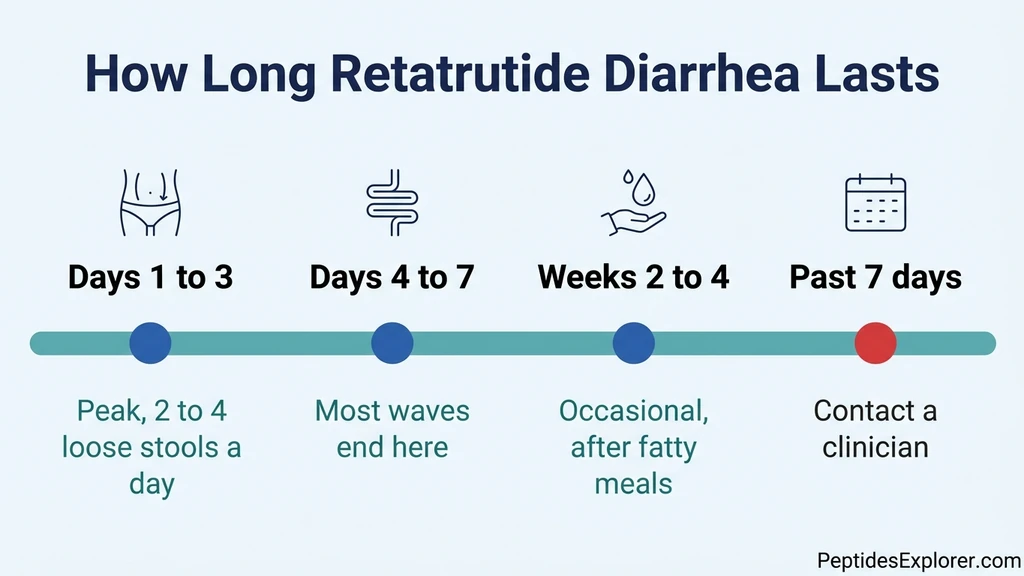
It is day two after your dose went up, and you have made four trips to the bathroom since breakfast. Here is the answer: retatrutide diarrhea usually lasts 3 to 5 days per wave, clusters in the first week after each dose increase, and fades to baseline by week 3 to 4 at a stable dose. Across a full escalation to 12 mg, that adds up to roughly 2 to 4 weeks of loose stools spread over 3 to 4 months.
| Phase | What to expect | Typical duration |
|---|---|---|
| Days 1 to 3 after a dose increase | Onset, 2 to 4 loose stools per day, morning and post-meal | Peak window |
| Days 4 to 7 | Frequency drops, urgency softens | Most waves end here |
| Weeks 2 to 4 at a stable dose | Occasional episodes after fatty or large meals | Intermittent, then gone |
| After each escalation | The clock resets, usually a shorter and milder wave | 3 to 7 days |
| Maintenance dose | Rare, food-triggered episodes | Should be over by week 4 |
| Past 7 days with no improvement | Outside the normal pattern | Contact a clinician |
Why the triple agonist loosens the gut in the first place is covered in the retatrutide diarrhea guide. This page covers the clock only: when it starts, when it stops, what moves the date, and when a long run stops being normal. Retatrutide is a research compound, not FDA-approved as of September 2026.
Get your custom peptide protocol:
- Tailored to your body and goals
- Precise dosing and cycle length
- Safe stacking combinations
- Backed by peer-reviewed studies
- Ready in under 2 minutes
One Wave per Dose Step: The Pattern Behind the Timeline
Think of each dose increase as a flight across time zones. Your body lands in a new hormonal setting, needs a few days to reset, then runs normally until the next flight. Diarrhea on retatrutide follows that jet-lag shape: a wave after every step up, then quiet.
The trial data confirms the wave is dose-driven. In the phase 2 obesity trial, gastrointestinal events were the most common adverse events, were dose-related, were mostly mild to moderate, and were partially mitigated by starting at 2 mg instead of 4 mg (Jastreboff et al., N Engl J Med, 2023, PMID 37366315).
Escalation speed sets the size of each wave. In the type 2 diabetes trial, mild-to-moderate GI events (nausea, diarrhea, vomiting, constipation) hit 35% of retatrutide participants overall, from 13% at 0.5 mg to 50% in the group escalated quickly to 8 mg, against 13% on placebo (Rosenstock et al., Lancet, 2023, PMID 37385280).
This is a class trait. Across 32 phase 3 GLP-1 receptor agonist trials, diarrhea was dose-dependent and more frequent with once-weekly agents than short-acting ones (Bettge et al., Diabetes Obes Metab, 2017, PMID 27860132). The same wave shape drives retatrutide nausea, which often peaks a day earlier.
Days 1 to 3: The Onset Window
Most users report the first loose stool within 24 to 72 hours of the first injection at a new dose. Stools run loose to watery, usually 2 to 4 per day, concentrated in the morning and within an hour of meals. Cramping is common; sharp or constant pain is not part of the pattern.
Fluid loss is the practical concern here. Drink to thirst plus a liter, aim for pale yellow urine, and add an electrolyte packet on any day with 3 or more watery stools.
Keep this window short by keeping the dose step small. A jump straight from 4 mg to 8 mg runs harder and longer than two smaller steps; the retatrutide dosage guide lays out the conservative ladder.
Days 4 to 7: The First Week
By day 4 or 5, stool count typically falls to 1 or 2 loose movements per day and the urgency softens. Most waves end here. If you were at 3 or more watery stools daily on day 2, expect near normal by day 6 or 7.
The first week is also where loperamide tempts people, and where it backfires. Retatrutide already slows the gut; a motility blocker on top can swing you into constipation that outlasts the diarrhea. Constipation sits on the same adverse-event list in the phase 2 data (Rosenstock et al., Lancet, 2023, PMID 37385280); the rates are in the retatrutide side effects overview.
If day 7 arrives with no improvement at all, the wave is running long. That is the first checkpoint in the red-flag table below.
Weeks 2 to 4: Settling at a Stable Dose
After the first week, diarrhea becomes intermittent and predictable. Episodes cluster after fatty meals, large portions, or alcohol, and resolve within a day. By week 3 or 4 at the same dose most users are back to their pre-retatrutide baseline.
The clearest time-course data comes from semaglutide, the closest well-characterized cousin. In the pooled STEP 1 to 3 trials, diarrhea was reported by 29.7% of semaglutide participants versus 15.9% on placebo, was transient, and occurred most often during or shortly after dose escalation. Only 4.3% stopped treatment because of GI events (Wharton et al., Diabetes Obes Metab, 2022, PMID 34514682). Retatrutide adds glucagon agonism, so its waves tend to be somewhat larger, but the shape is the same.
The stable-dose window is where fiber starts helping: psyllium, 1 teaspoon in a full glass of water, once daily from week 2. Semaglutide-specific patterns are in can semaglutide cause diarrhea and how long semaglutide side effects last.
After Each Dose Increase: Why the Clock Resets
Every escalation restarts the timeline, which is why total diarrhea burden depends more on how many steps you climb, and how fast, than on the final dose. The table shows typical user-reported windows for a conservative ladder with 4-week holds; these are not trial endpoints.
| Escalation step | Hold at this dose | Expected loose-stool window | Cumulative diarrhea days |
|---|---|---|---|
| 2 mg (start) | 4 weeks | 0 to 3 days, often none | 0 to 3 |
| 4 mg | 4 weeks | 3 to 5 days | 3 to 8 |
| 8 mg | 4 weeks | 4 to 7 days | 7 to 15 |
| 12 mg (maintenance) | Ongoing | 5 to 7 days, then tapering | 12 to 22 |
Each successive wave is usually milder than the last because the gut carries adaptation forward. The exception is a rushed step: the 8 mg fast-escalation group reported GI events at 50% against 35% across all retatrutide arms (Rosenstock et al., Lancet, 2023, PMID 37385280). Fast escalation compresses the waves until they overlap.
People arriving from another GLP-1 drug often skip steps because the first doses feel easy, and that shortcut produces the longest wave of the protocol; the switching from tirzepatide to retatrutide guide covers the safer crossover. Build your ladder with the retatrutide dosage calculator and hold each rung for the full 4 weeks.
When It Should Be Over
By week 4 at any stable dose, diarrhea should be gone or reduced to a rare, food-triggered episode. At a maintenance dose held 8 weeks or more, a bad week points to something you ate, an illness, or a missed and then doubled dose rather than the peptide.
Weight loss keeps going long after the GI wave stops. Phase 2 participants lost 22.8% at 8 mg and 24.2% at 12 mg over 48 weeks (Jastreboff et al., N Engl J Med, 2023, PMID 37366315), so diarrhea ending says nothing about efficacy. That clock is covered in how long retatrutide takes to work.
Persistence is unusual. Pooled across three randomized trials and 878 participants, overall adverse-event risk with retatrutide was not significantly different from placebo (relative risk 1.11) (Abdrabou Abouelmagd et al., Proc (Bayl Univ Med Cent), 2025, PMID 40291085). Diarrhea running past the window deserves a look for exactly that reason.
What Shortens a Wave
Slower titration. The single biggest lever. Starting at 2 mg rather than 4 mg partially mitigated GI events in the phase 2 obesity trial (Jastreboff et al., N Engl J Med, 2023, PMID 37366315). If a wave is still active on day 7, extend the hold at that dose to 6 weeks before stepping up.
Hydration and electrolytes. Target 2.5 to 3 liters of fluid on wave days, sipped rather than chugged. Any day with 3 or more watery stools gets an oral rehydration solution with sodium and potassium; plain water dilutes sodium further when losses are high.
Fat and portion size. Keep fat under 10 to 15 grams per meal during the onset window and split food into 5 or 6 small meals. Large, fatty meals are the usual trigger for the stable-dose episodes that drag a wave into week 2. Meal templates in what to eat on tirzepatide apply directly.
Fiber timing. Soluble fiber firms stool once the acute phase has passed. Start psyllium on day 3 or 4 of a wave, never on day 1, always with a full glass of water.
Loperamide, with caution. Over-the-counter loperamide (2 mg after a loose stool, label maximum 8 mg per day) can stop a wave that is wrecking a work day. Use it for 1 to 2 days at most, never with fever or blood, and expect an already-slowed gut to overshoot: 3 days at 8 mg often buys 4 or 5 days without a bowel movement.
Two Scenarios in Numbers
The stacked escalation. You move 4 mg to 8 mg to 12 mg on 2-week hops instead of 4-week holds. Three waves that should have been spaced across 12 weeks land inside 6, the third starting before the second has cleared: 2 to 3 continuous weeks of diarrhea instead of three separate 4-day waves. Fix: drop back one dose, hold 4 weeks, then climb.
The scale illusion. You weigh 90 kg. Over 3 days of diarrhea the scale drops 2.3 kg and you feel encouraged. A liter of water weighs 1 kg, and the 24.2% loss over 48 weeks in the phase 2 trial works out to roughly 0.5% of body weight per week, or about 0.45 kg for you (Jastreboff et al., N Engl J Med, 2023, PMID 37366315). Nearly 2 liters of that drop is fluid, and losing it in 3 days is the definition of clinically meaningful dehydration. Fix: replace 1 liter of electrolyte fluid per kilogram lost beyond your weekly trend, and stop reading wave-week weights as progress.
When It Is Not Normal
The signs below mean the diarrhea has left the normal pattern, and each one warrants a clinician rather than another day of waiting.
| Red flag | Why it matters | Action |
|---|---|---|
| No improvement after 7 consecutive days | Outside the 3 to 5 day wave | Hold the dose, contact prescriber |
| Blood in stool, or black tarry stool | Not a GLP-1 class effect | Same-day evaluation |
| Dark urine, dizziness on standing, under 4 urinations a day | Dehydration is established | Oral rehydration now; urgent care if no better in 12 hours |
| Cannot keep fluids down for 24 hours | Fluid deficit compounds fast | Urgent care |
| Over 3% of body weight lost in one week | Six times the trial trend of about 0.5% per week | Prescriber review of dose |
| Fever above 38.3 C (101 F) | Points to infection, not the peptide | Medical evaluation |
| Diarrhea returning at a stable dose with no food trigger | Adaptation should already have happened | Prescriber review |
Weeks of poor intake carry a second cost: rapid loss with low protein and iron intake is the setup for the shedding described in retatrutide hair loss. None of these signs means retatrutide must be abandoned. A dose reduction with a longer hold resolves most prolonged waves, and that decision belongs with whoever supervises your protocol.
Frequently Asked Questions
How long does retatrutide diarrhea last after a dose increase?
Typically 3 to 5 days, starting within 24 to 72 hours of the first injection at the new dose. Frequency drops by day 4 or 5, and most users are near baseline by day 7. A conservative ladder with 4-week holds, as in the retatrutide dosage guide, keeps each wave short.
Does the diarrhea come back with every dose increase?
Usually yes, and usually milder each time. Phase 2 data showed GI events were dose-related and partially mitigated by a lower 2 mg starting dose (PMID 37366315). The mechanism behind the repeat waves is explained in the retatrutide diarrhea guide; the timeline resets with each step.
Is diarrhea after the first reta injection normal?
Yes, within limits. A first-dose wave of 2 to 4 loose stools per day for 2 to 4 days is common at 2 to 4 mg. Diarrhea that is watery more than 6 times a day, bloody, or paired with fever is outside the pattern. Injection timing tips are in how to take retatrutide.
How long is too long for retatrutide diarrhea?
Seven consecutive days with no improvement is the checkpoint. Diarrhea should be fading by day 4 or 5 and gone by week 3 to 4 at a stable dose. Persistent loose stools at maintenance, dehydration signs, or blood mean it is time to hold the dose and read the retatrutide side effects overview before contacting a clinician.
Does retatrutide diarrhea last longer than tirzepatide or semaglutide diarrhea?
The wave shape is the same across the class. Semaglutide diarrhea was transient and clustered around escalation in the STEP trials (PMID 34514682). Retatrutide waves tend to run a day or two longer because of the added glucagon agonism. Compare with does tirzepatide cause diarrhea and can semaglutide cause diarrhea.
Will slower titration make the diarrhea stop sooner?
Slower titration shortens and softens each wave. Fast escalation to 8 mg produced GI events in 50% of participants versus 35% across all retatrutide groups in the phase 2 diabetes trial (PMID 37385280). Hold each dose 4 weeks, or 6 if a wave is still active on day 7, and map the ladder with the retatrutide dosage calculator.
Does the diarrhea stopping mean retatrutide has stopped working?
No. GI adaptation and weight loss run on separate clocks. Phase 2 participants kept losing weight through 48 weeks, reaching 24.2% at 12 mg (PMID 37366315), long after escalation-phase diarrhea had cleared. The efficacy timeline is covered in how long retatrutide takes to work.
The Bottom Line
Retatrutide diarrhea lasts 3 to 5 days per wave, clusters in the first week after each dose increase, and should be gone by week 3 to 4 at a stable dose. Past 7 days without improvement, with blood, or with dehydration signs, it has left the normal pattern.
The principle: the number of dose steps and the speed between them set the total burden, so the calendar is the treatment. Slow the ladder and each wave shrinks.
Plan your holds with the retatrutide dosage calculator and explore the full retatrutide cluster at PeptidesExplorer. Retatrutide is a research compound, not FDA-approved as of September 2026; this content is educational, not medical advice.
Helpful Tools
Related Articles
Alcohol on Tirzepatide: Risks
Alcohol and tirzepatide: no absolute contraindication, but risks include hypoglycemia, prolonged intoxication, and stalled weight loss.
Retatrutide Diarrhea: Rates, Causes & Management
Retatrutide diarrhea affects 16-34% of users by dose. Clinical trial rates, triple-agonist GI mechanism, comparison to semaglutide, and 7 evidence-based fixes.
Retatrutide Side Effects: Phase 3 Trial Data
Retatrutide side effects from 2 Phase 3 trials (1,200+ patients): nausea 26-43%, dysesthesia 4-21%, heart rate +6.7 bpm. Tirzepatide compared.
MOTS-c Peptide Side Effects: Full Guide
MOTS-c peptide side effects explained: injection reactions, fatigue, GI issues, who should avoid it, dosing safety, and how to minimize risks. Evidence-based.