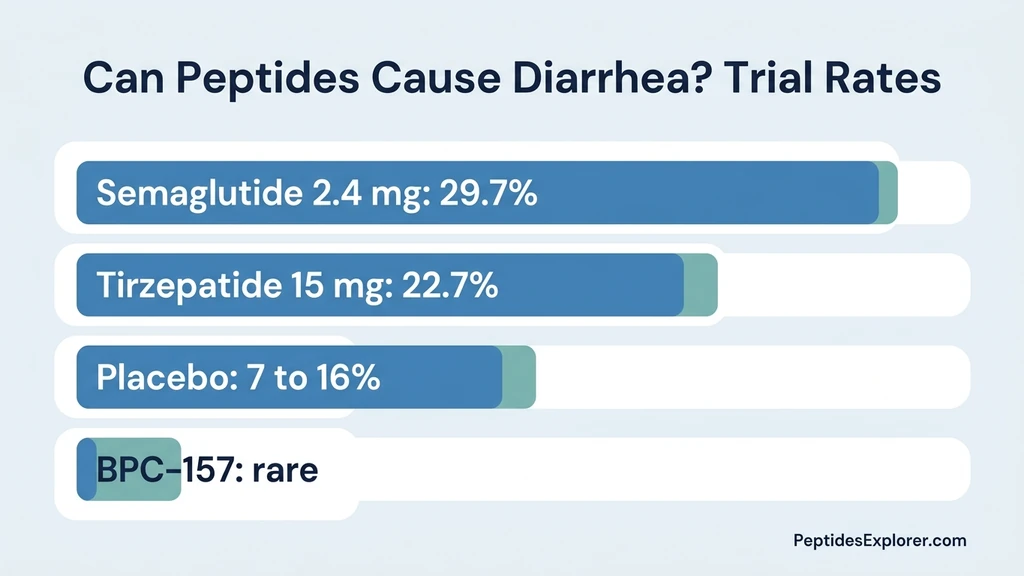
It is day four on a new vial, you have been to the bathroom three times before lunch, and you want to know whether the peptide did this. Here is the answer: yes, peptides can cause diarrhea, but the risk is concentrated almost entirely in the GLP-1 and amylin class. Semaglutide 2.4 mg produced diarrhea in 29.7% of trial participants versus 15.9% on placebo; tirzepatide reached 22.7% at 15 mg. Healing and growth-hormone peptides such as BPC-157, KPV, CJC-1295 and TB-500 cause it rarely, and when they do the culprit is often the water, the sweetener or a contaminated product rather than the peptide.
| Peptide | Diarrhea risk | Trial figure |
|---|---|---|
| Cagrilintide + semaglutide (CagriSema) | Very high | GI events 79.6% vs 39.9% placebo |
| Retatrutide | High | GI events 13% to 50% by dose, placebo 13% |
| Semaglutide 2.4 mg | High | Diarrhea 29.7% vs 15.9% |
| Tirzepatide 5 to 15 mg | High | Diarrhea 18.7% to 22.7% vs 7.3% |
| Cagrilintide alone | Moderate | GI events 41% to 63% vs 32% |
| Collagen peptide powders | Low to moderate | No trial rate; dose and sweetener dependent |
| BPC-157, KPV, MOTS-c, CJC-1295, ipamorelin, sermorelin, GHK-Cu, TB-500 | Rare | No trial signal |
This page ranks every peptide class by diarrhea risk and explains the mechanism behind each. The single-compound deep dives live elsewhere: can BPC-157 cause diarrhea for the gut-healing paradox, retatrutide diarrhea for the triple agonist, and can semaglutide cause diarrhea for the Wegovy-class detail.
Get your custom peptide protocol:
- Tailored to your body and goals
- Precise dosing and cycle length
- Safe stacking combinations
- Backed by peer-reviewed studies
- Ready in under 2 minutes
Diarrhea Risk by Peptide: The Ranked Table
Trial figures below measure different things, so the third column says exactly what each number counts.
| Rank | Peptide | Class | Figure | What it counts |
|---|---|---|---|---|
| 1 | Cagrilintide + semaglutide | Amylin + GLP-1 stack | 79.6% vs 39.9% placebo | Any GI event (Garvey et al., N Engl J Med, 2025, PMID 40544433) |
| 2 | Retatrutide | GIP/GLP-1/glucagon | 35% overall; 13% at 0.5 mg to 50% at 8 mg fast escalation; placebo 13% | Any GI event (Rosenstock et al., Lancet, 2023, PMID 37385280) |
| 3 | Semaglutide 2.4 mg | GLP-1 | 29.7% vs 15.9% placebo | Diarrhea specifically (Wharton et al., Diabetes Obes Metab, 2022, PMID 34514682) |
| 4 | Tirzepatide 5, 10, 15 mg | GIP/GLP-1 | 18.7%, 21.2%, 22.7% vs 7.3% placebo | Diarrhea specifically (Jastreboff et al., N Engl J Med, 2022, PMID 35658024) |
| 5 | Cagrilintide alone | Amylin analog | 41% to 63% vs 32% placebo; nausea 20% to 47% | Any GI event (Lau et al., Lancet, 2021, PMID 34798060) |
| 6 | Collagen peptide powders | Oral supplement | No trial rate | Osmotic, scales with scoop size and sweetener |
| 7 | BPC-157 | Gastric pentadecapeptide | No trial rate; 20 mg IV in 2 adults, no adverse effects | Oral capsules occasionally loosen stool for 3 to 5 days |
| 8 | KPV | Alpha-MSH fragment | No trial rate | Anti-inflammatory in colitis models |
| 9 | CJC-1295, ipamorelin, sermorelin | GH secretagogues | No serious adverse reactions in the CJC-1295 trial | GI effects not a reported signal |
| 10 | MOTS-c | Mitochondrial peptide | No human adverse-event dataset | Rare in user reports |
| 11 | GHK-Cu | Copper tripeptide | No trial rate | Topical or injected, never reaches the gut |
| 12 | TB-500 | Thymosin beta-4 fragment | No trial rate | Rare in user reports |
Across the GLP-1 class as a whole, nausea, vomiting, diarrhea and constipation occur in roughly 30% to 50% of patients, concentrated at initiation and dose escalation (Singhani et al., Nutr Clin Pract, 2026, PMID 42808923). Everything below rank 5 is a different world: the risk is real but small, and usually traceable to something other than the peptide sequence.
None of the compounds in this table except semaglutide and tirzepatide is FDA-approved for the uses described. Retatrutide and cagrilintide are investigational; the rest are research compounds.
Why GLP-1 Peptides Cause Diarrhea: Slow Stomach, Fast Gut
Think of a bakery with one slow oven and a fast packing line. The oven (your stomach) takes twice as long, so loaves sit and the smell makes you queasy. But whatever finally reaches the packing line arrives half-baked, and the line runs at full speed with no time to dry anything out. Nausea comes from the oven. Diarrhea comes from the line.
Literally stated: GLP-1 receptor agonists slow gastric emptying, which produces the fullness and nausea, while the diarrhea arises further down through altered intestinal motility and secretion. The nausea mechanism is well mapped; the diarrhea mechanism is less settled and is treated as a mix of transit changes and poorly digested, osmotically active food reaching the colon (Singhani et al., Nutr Clin Pract, 2026, PMID 42808923). The rest of the class picture, with per-drug numbers, is in GLP-1 side effects statistics.
Three practical consequences follow. First, fat makes it worse: a stomach that empties slowly on a fatty meal sends a greasy, unemulsified bolus downstream, and fatty loose stools on injection day are the classic result. Second, the timing is dose-linked. In the semaglutide STEP trials GI events were transient, mild to moderate in 98.1% of cases, and clustered during or shortly after dose escalation, with only 4.3% of participants stopping because of them (Wharton et al., Diabetes Obes Metab, 2022, PMID 34514682). Third, the stomach and the bowel can disagree: the same person can be constipated on week 2 and loose on week 5, which is why how long retatrutide diarrhea lasts is a timeline question rather than a yes-or-no one.
Retatrutide: The Glucagon Receptor Adds a Third Lever
Retatrutide hits GIP, GLP-1 and glucagon receptors at once, and the phase 2 obesity trial found GI events were the most common adverse events, dose-related, and partially mitigated by starting at 2 mg rather than 4 mg (Jastreboff et al., N Engl J Med, 2023, PMID 37366315). In the diabetes trial the spread was stark: 13% of the 0.5 mg group had GI events against 50% of the 8 mg fast-escalation group (Rosenstock et al., Lancet, 2023, PMID 37385280).
Scenario: skipping the 2 mg start. You begin at 4 mg because a forum said 2 mg "does nothing." Your odds of a GI event on that first dose roughly match the fast-escalation arm, around one in two, rather than the one in eight seen at the lowest dose. Fix: start where the trial started, hold 4 weeks, and run the units through the retatrutide dosage calculator.
Amylin Analogs and the Stacking Problem
Cagrilintide works on amylin receptors, slows gastric emptying by a second route, and on its own produced GI events in 41% to 63% of participants versus 32% on placebo, with nausea rather than diarrhea leading (Lau et al., Lancet, 2021, PMID 34798060). Stack it with semaglutide and the two mechanisms add: 79.6% of CagriSema participants had a GI event against 39.9% on placebo (Garvey et al., N Engl J Med, 2025, PMID 40544433).
Scenario: adding cagrilintide on top of a GLP-1 that already loosens you. Two gut-slowing mechanisms, started the same week, roughly double the chance of a GI event compared with either alone. Fix: stack only after the first compound is at a stable, tolerated dose, as laid out in cagrilintide dosage with tirzepatide, and check the pairing in the peptide interaction checker.
Peptides That Rarely Cause Diarrhea
Below the GLP-1 and amylin class, no peptide has a trial-measured diarrhea rate, and the honest statement is that rigorous human safety data for BPC-157, CJC-1295, GHK-Cu, ipamorelin, MOTS-c, sermorelin and TB-500 are scarce (Mendias et al., Sports Med, 2026, PMID 41966639). Absence of a signal is weaker than evidence of safety, and the table ranks accordingly.
BPC-157. A gastric-juice-derived peptide studied mainly for gut protection. The only human dosing report, an intravenous pilot, found no adverse effects at up to 20 mg in 2 healthy adults (Lee et al., Altern Ther Health Med, 2025, PMID 40131143). Two people is not a safety dataset. Oral capsules occasionally loosen stool for the first 3 to 5 days; injected BPC-157 almost never does.
KPV. This alpha-MSH tripeptide is taken up by the intestinal PepT1 transporter and reduced colitis in mouse models rather than causing it (Dalmasso et al., Gastroenterology, 2008, PMID 18061177). Diarrhea reports are rare and usually track a change in the oral product, not the peptide. Dosing is in the KPV dosage chart.
CJC-1295, ipamorelin, sermorelin. Growth-hormone secretagogues act on the pituitary, not the gut. The CJC-1295 trial in healthy adults reported no serious adverse reactions and described the compound as relatively well tolerated at 30 to 60 mcg/kg (Teichman et al., J Clin Endocrinol Metab, 2006, PMID 16352683); GI effects were not a reported signal. Flushing, water retention and injection-site reactions are the complaints that do show up, as the CJC-1295 dosage guide covers.
MOTS-c, GHK-Cu, TB-500. No human adverse-event dataset exists for any of the three. GHK-Cu is used topically or injected and never contacts the intestinal lining. MOTS-c and TB-500 user reports center on fatigue, headache and site reactions; see MOTS-c side effects and TB-500 side effects. If one of these gives you diarrhea, suspect the next section before the peptide.
Non-Peptide Causes: Water, Sweeteners, Carriers, Contamination
For anything outside the GLP-1 class, the realistic suspects are what came with the peptide.
| Suspect | How it causes loose stools | Tell-tale pattern |
|---|---|---|
| Sugar alcohols in flavored collagen or protein powders | Osmotic: unabsorbed sorbitol, xylitol or erythritol pull water into the bowel | Starts within hours of the scoop, stops on an unflavored batch |
| Large collagen doses (20 g+) | A big protein load plus sweetener, often on an empty stomach | Scales with scoop size, improves at 10 g with food |
| Non-sterile or expired reconstitution water | Bacterial growth in the vial; infection risk | Fever, site redness, or a vial older than its window |
| Oral capsule excipients | Bulking agents such as mannitol are themselves mild osmotic laxatives | Switching brands fixes it |
| Contaminated or mislabeled product | Endotoxin, wrong compound, or unknown filler | Sudden, severe, with vomiting or fever |
Sugar alcohols are the most common missed cause. They are poorly absorbed, and GI disturbances including osmotic diarrhea are a known dose-dependent effect of consuming them (Mäkinen, Int J Dent, 2016, PMID 27840639). A "peptide" diarrhea that appears only after flavored collagen or a sweetened electrolyte mix is almost always this.
Bacteriostatic water contains 0.9% benzyl alcohol as a preservative and causes no diarrhea when injected subcutaneously. The real water risk is the opposite one: tap water, store-bought distilled water, or a vial kept past its window grows bacteria, and the first sign may be an infection rather than a loose stool. Bacteriostatic water vs sterile water explains the difference, and how long reconstituted peptides last gives the discard dates.
How to Tell Which One It Is
Timing and pattern separate the causes faster than any test.
| Pattern | Most likely cause |
|---|---|
| Started 1 to 3 days after a dose increase on a GLP-1 or amylin peptide | The peptide, escalation-linked, expect 3 to 7 days |
| Worse on days you eat fatty or large meals | Slowed stomach plus fat load; diet fix first |
| Appears within hours of a flavored powder, absent on plain days | Sweetener or sugar alcohol |
| Peptide is a GH secretagogue, GHK-Cu or TB-500 and nothing else changed | Look at water, product, diet, stress |
| Sudden, watery, with fever or vomiting | Contamination or infection; stop and see a clinician |
| Persists past 7 days at a stable dose | Something other than adaptation |
Scenario: blaming ipamorelin. You start CJC-1295/ipamorelin and a chocolate collagen powder the same Monday and get loose stools by Wednesday. The secretagogue has no GI mechanism; the 15 g scoop of sweetened collagen does. Fix: drop the powder for 3 days before you touch the peptide dose.
Scenario: a 4-day run on tirzepatide at 10 mg. Four days of loose stools, half your usual food intake, no fever. That matches the 21.2% trial rate at that dose and the escalation window. Fix: hold the dose rather than climbing to 12.5 mg, eat low-fat, and check your other medications in tirzepatide drug interactions, since metformin and some antibiotics add their own loose stools. The units are in the tirzepatide dosage calculator.
Managing Peptide Diarrhea
The multidisciplinary consensus on GLP-1 GI events recommends slow escalation, smaller meals, less fat, and hydration as first-line steps (Gorgojo-Martínez et al., J Clin Med, 2022, PMID 36614945). In practice:
- 1.Hold the dose. Do not escalate while stools are loose. Give each GLP-1 step at least 4 weeks.
- 2.Cut fat on injection day. Keep meals under 15 g of fat and 300 calories for the first 48 hours after each dose.
- 3.Sip, do not gulp. 2 to 3 liters a day in small amounts; add an unsweetened electrolyte source if stools are watery.
- 4.Remove the sweeteners. Switch any flavored collagen, protein or electrolyte powder to an unflavored version for one week.
- 5.Audit the water and the vial. Bacteriostatic water, a vial inside its discard window, and a reputable source with a COA.
- 6.Use loperamide sparingly. It controls a bad day but masks the pattern you need to read.
- 7.Move the injection to the morning if nighttime urgency is the main problem; the timing logic in how to relieve nausea from semaglutide applies to diarrhea in reverse.
Discontinuation for GI events stayed under 5% in the semaglutide trials and under 7.1% at any tirzepatide dose (Jastreboff et al., N Engl J Med, 2022, PMID 35658024). Most people finish escalation without stopping. The broader rules for sourcing, storage and dose discipline are in the peptide safety guide.
Red Flags: When Diarrhea on Peptides Needs a Clinician
Stop the compound and get seen the same day if any of these appear:
- Six or more watery stools in 24 hours, or diarrhea lasting beyond 7 days at a stable dose
- Blood or black, tarry stool
- Fever of 38 °C (100.4 °F) or higher alongside the diarrhea
- Dark urine, dizziness on standing, a racing heart, or no urine for 8 hours
- Severe abdominal pain that does not ease after a bowel movement, which on a GLP-1 peptide needs pancreatitis and gallbladder causes excluded
- Vomiting that prevents you keeping fluids down for 12 hours
Nausea and diarrhea were the most common adverse events in the STEP 1 trial and were typically transient and mild to moderate (Wilding et al., N Engl J Med, 2021, PMID 33567185). The list above describes the minority that is neither. A dehydrated person on a drug that halves food intake can slide into electrolyte trouble inside two days, and no dose adjustment fixes that from home.
Frequently Asked Questions
Can peptides cause diarrhea?
Yes, mainly the GLP-1 and amylin class. Semaglutide 2.4 mg caused diarrhea in 29.7% of trial participants versus 15.9% on placebo, and tirzepatide reached 22.7% at 15 mg. Healing and growth-hormone peptides rarely do. The peptide safety guide covers how to separate peptide effects from water, sweetener and product problems.
Which peptides cause diarrhea the most?
Ranked by trial data: cagrilintide plus semaglutide (GI events in 79.6%), retatrutide (up to 50% at 8 mg fast escalation), semaglutide (diarrhea 29.7%), tirzepatide (18.7% to 22.7%), then cagrilintide alone. Each of these slows gastric emptying and alters gut transit. The retatrutide profile explains why the triple agonist sits near the top.
Why do peptides give you diarrhea?
GLP-1 peptides slow the stomach, which causes nausea, and change intestinal motility and secretion further down, which causes diarrhea, especially when fatty or large meals reach the bowel poorly digested. Class-wide, 30% to 50% of patients get some GI event during escalation. The numbers per drug are in GLP-1 side effects statistics.
How long does diarrhea on peptides last?
For GLP-1 peptides, 3 to 7 days after a dose increase is typical, and trial GI events were transient and clustered during escalation. Persisting past 7 days at a stable dose points to another cause. How long retatrutide diarrhea lasts gives the week-by-week timeline for the strongest compound in the class.
Can collagen peptides cause diarrhea?
Occasionally, and usually from the scoop rather than the collagen. Sugar alcohols such as sorbitol and erythritol in flavored powders are poorly absorbed and draw water into the bowel, and a 20 g dose on an empty stomach adds a protein load. Switch to unflavored, 10 g with food. GHK-Cu, by contrast, is a copper tripeptide that never reaches the gut.
Does bacteriostatic water cause diarrhea?
No. Its 0.9% benzyl alcohol preservative is injected subcutaneously and has no gut effect. The risk runs the other way: non-sterile water or a vial kept past its discard window grows bacteria, and infection, not diarrhea, is the usual first sign. Bacteriostatic water vs sterile water explains which to use for which peptide.
Do CJC-1295, ipamorelin or sermorelin cause diarrhea?
Rarely. These growth-hormone secretagogues act on the pituitary, and the CJC-1295 trial in healthy adults reported no serious adverse reactions and no GI signal. Flushing, water retention and site reactions are the real complaints. If diarrhea starts alongside them, check the peptide interaction checker for the other compound or supplement you started the same week.
When should you stop a peptide for diarrhea?
Stop and get seen the same day for 6 or more watery stools in 24 hours, blood in the stool, fever of 38 °C or higher, dizziness or dark urine, or severe abdominal pain. On a GLP-1 peptide the pain needs pancreatitis excluded. Trial discontinuation for GI events stayed under 7.1% at any tirzepatide dose, so most courses finish without stopping.
The Bottom Line
Peptides can cause diarrhea, and the risk sits almost entirely in the GLP-1 and amylin class: semaglutide 29.7%, tirzepatide up to 22.7%, retatrutide up to 50% at a fast escalation, and nearly 80% for any GI event when cagrilintide and semaglutide are stacked. Below that line, BPC-157, KPV, MOTS-c, the GH secretagogues, GHK-Cu and TB-500 carry no trial signal, and the water, the sweetener or the product is the better suspect.
The principle: a slowed stomach explains the nausea, a disturbed bowel explains the diarrhea, and both are dose-linked and escalation-linked. Hold the dose, cut the fat, drop the sweeteners, and give each step 4 weeks.
Only semaglutide and tirzepatide are FDA-approved for the uses described; retatrutide and cagrilintide are investigational and the rest are research compounds. Check every pairing in the peptide interaction checker and find the single-compound guides at PeptidesExplorer. Educational content, not medical advice.
Helpful Tools
Related Articles
How Long Does Retatrutide Diarrhea Last? Timeline
Retatrutide diarrhea lasts 3 to 5 days per wave, clusters after each dose increase, and fades by week 3 to 4 at a stable dose. Timeline, fixes and red flags.
How Long Does Retatrutide Nausea Last? Timeline
Retatrutide nausea peaks 24 to 48 hours after the shot, eases by day 3 to 4 and fades by week 2 to 4 at a stable dose. Hour-by-hour timeline, relief, red flags.
What Happens If You Use Expired Semaglutide?
Expired semaglutide usually means a weaker dose, not a dangerous one. Real risks by timeframe: 1 week, 1 month, 3 months past expiry and signs.
Alcohol on Tirzepatide: Risks
Alcohol and tirzepatide: no absolute contraindication, but risks include hypoglycemia, prolonged intoxication, and stalled weight loss.