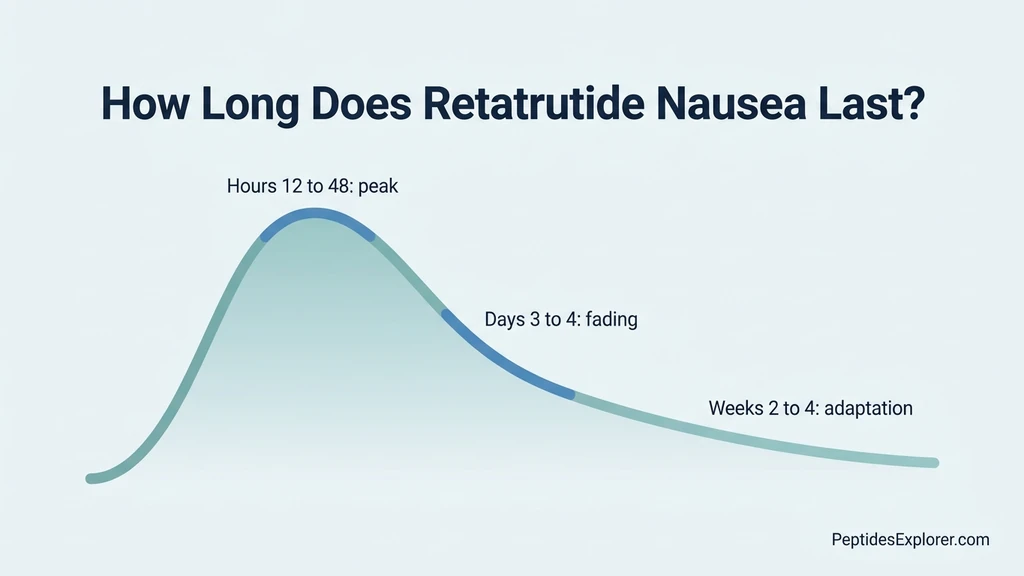
It is 2 AM on the second night after your dose went up, and you are lying on your side doing the math on how many hours this has left. Here is the answer: retatrutide nausea usually peaks 24 to 48 hours after the injection, eases by day 3 to 4, and fades to a background hum by week 2 to 4 at a stable dose. Every dose increase restarts the clock, usually with a shorter and milder wave than the one before.
| Phase | What to expect | Typical duration |
|---|---|---|
| Hours 0 to 12 | Little or nothing, appetite starts to drop | Quiet window |
| Hours 12 to 48 | Peak queasiness, worst after meals and at night | The wave |
| Days 3 to 4 | Nausea drops to short post-meal flickers | Fading |
| Days 5 to 7 | Mostly gone, next injection restarts a smaller wave | Tail |
| Weeks 2 to 4 at a stable dose | Occasional, meal-triggered, then absent | Adaptation |
| After each dose increase | A new wave, usually shorter than the last | 2 to 4 days |
| Vomiting past 24 hours, or no improvement by day 7 | Outside the normal pattern | Contact a clinician |
Why the triple agonist turns your stomach in the first place is covered in the retatrutide nausea guide, the loose-stool clock in how long retatrutide diarrhea lasts, and the morning-versus-night decision in the best time to take retatrutide. This page covers the nausea clock only: when it peaks, when it stops, what shortens it, and when a long run stops being normal. Retatrutide is a research compound, not FDA-approved as of October 2026.
Get your custom peptide protocol:
- Tailored to your body and goals
- Precise dosing and cycle length
- Safe stacking combinations
- Backed by peer-reviewed studies
- Ready in under 2 minutes
One Wave per Dose Step: The Shape of Retatrutide Nausea
Think of a thermostat that someone keeps nudging up. Each time the setting changes, the furnace runs hard for a day or two, the house overshoots, then the temperature settles. Retatrutide nausea follows that shape: a surge after every dose change, then a plateau your gut learns to live on.
The trial data confirms the surge is dose-driven. In the phase 2 obesity trial, gastrointestinal events were the most common adverse events, were dose-related, were mostly mild to moderate, and were partially mitigated by starting at 2 mg instead of 4 mg (Jastreboff et al., N Engl J Med, 2023, PMID 37366315). The same drug at the same final dose produced less nausea when the first rung was lower.
Speed matters as much as height. In the type 2 diabetes phase 2 trial, gastrointestinal events including nausea hit 35% of retatrutide participants overall, from 13% at 0.5 mg to 50% in the group escalated quickly to 8 mg, against 13% on placebo (Rosenstock et al., Lancet, 2023, PMID 37385280). The fast-escalation arm is the one that tells you what stacking waves feels like.
The pattern showed up from the first human doses. In the phase 1b multiple-ascending-dose study, 63% of participants reported a treatment-emergent adverse event, gastrointestinal disorders were the most frequent, and the half-life was approximately 6 days (Urva et al., Lancet, 2022, PMID 36354040). That half-life is why the wave lasts days rather than hours.
Hours 0 to 48: When Nausea Peaks After the Injection
The first few hours after a subcutaneous dose are usually quiet. Plasma levels climb through the first day, and most users report the first real queasiness somewhere between hour 12 and hour 24, with the peak landing on the second day at a new dose.
The mechanism sets the hourly pattern. Retatrutide delays gastric emptying (Urva et al., Diabetes Obes Metab, 2023, PMID 37311727), so food that would normally leave the stomach in 2 to 3 hours sits for longer. Nausea therefore spikes 30 to 90 minutes after eating and again at night, when a late dinner is still sitting there while you try to lie flat.
Nausea after eating during the peak window is the normal pattern, and a meal larger than a fist or heavier than about 15 grams of fat is the usual trigger. Nausea during sleep on night one or two tracks how full the stomach was at bedtime more than the clock.
Keep this window short by keeping the dose step small. A jump straight from 4 mg to 8 mg runs harder and longer than two smaller steps; the retatrutide dosage calculator maps the units for a conservative ladder.
Days 3 to 7: The Fade
By day 3 or 4 the constant background queasiness usually breaks into short flickers tied to meals, and by day 5 most people at a new dose can eat a normal small plate without thinking about it. The next injection on day 7 restarts a smaller wave, because the gut has already met this dose once.
The closest large time-course dataset comes from semaglutide. In the pooled STEP 1 to 3 trials, nausea was reported by 43.9% of participants on semaglutide 2.4 mg versus 16.1% on placebo, was 98.1% mild to moderate, transient, and occurred most often during or shortly after dose escalation; only 4.3% stopped for gastrointestinal reasons (Wharton et al., Diabetes Obes Metab, 2022, PMID 34514682). Retatrutide adds glucagon agonism and runs at higher weight-loss rates, so its waves tend to be somewhat larger, but the shape is the same.
If day 7 arrives and the nausea has not softened at all, the wave is running long; that is the first checkpoint in the red-flag table further down. The playbook in how to relieve nausea from semaglutide transfers almost unchanged.
Weeks 2 to 4: Adaptation at a Stable Dose
After the second injection at the same dose, nausea becomes intermittent and predictable: a fatty meal, a large portion, alcohol, or lying down too soon after dinner. By week 3 or 4 most users describe it as gone or as a faint reminder to stop eating sooner.
The adaptation has a physiological basis. A 2024 review of delayed gastric emptying with GLP-1 receptor agonists and tirzepatide lists tachyphylaxis with prolonged treatment among the class's key features: the slowing of the stomach weakens with sustained exposure (Jalleh et al., J Clin Endocrinol Metab, 2024, PMID 39418085).
Weight loss keeps going long after the nausea stops. Phase 2 participants lost 17.1% at 4 mg, 22.8% at 8 mg and 24.2% at 12 mg over 48 weeks (Jastreboff et al., N Engl J Med, 2023, PMID 37366315), so a quiet stomach says nothing about efficacy. That clock is covered in how long retatrutide takes to work.
After Each Dose Increase: Why the Clock Resets
Every escalation restarts the timeline, which is why total nausea burden depends more on how many steps you climb, and how fast, than on the final dose. The table shows typical user-reported windows for a conservative ladder with 4-week holds; these are not trial endpoints.
| Escalation step | Hold at this dose | Expected nausea window | Cumulative nausea days |
|---|---|---|---|
| 2 mg (start) | 4 weeks | 1 to 3 days, often mild | 1 to 3 |
| 4 mg | 4 weeks | 2 to 4 days | 3 to 7 |
| 8 mg | 4 weeks | 3 to 5 days | 6 to 12 |
| 12 mg (maintenance) | Ongoing | 3 to 5 days, then tapering | 9 to 17 |
Each successive wave is usually milder than the last because the gut carries tolerance forward. That tolerance is measurable: across approved incretin drugs, a longer escalation period with more dose steps was associated with more tolerance for nausea and vomiting (Nauck et al., Diabetes Obes Metab, 2026, PMID 41757397). Slow climbers end up tolerating higher doses.
People arriving from another weekly agonist often skip rungs because the first doses feel easy, and that shortcut produces the longest wave of the protocol; switching from tirzepatide to retatrutide covers the safer crossover. The microdosing approach to GLP-1 drugs splits the climb into more, shallower steps.
What Shortens a Wave
Evening injection. The peak falls between hour 12 and hour 48, so a 9 PM shot puts the worst of night one behind closed eyes and the worst of day two after a short, bland breakfast. This moves the wave; it does not shrink it.
Small, low-fat meals. During the peak window keep each meal to roughly 200 to 300 calories and under 15 grams of fat, 5 or 6 times a day. Rice, chicken, yogurt, toast and broth sit well on a slowed stomach; fried food and large portions turn a 2-day wave into a 4-day one. The templates in what to eat on tirzepatide apply directly.
Ginger. No trial has tested ginger in people on retatrutide. In pregnancy nausea, a meta-analysis of randomized trials found ginger reduced nausea compared with placebo without a signal of harm (Viljoen et al., Nutr J, 2014, PMID 24642205). Ginger tea or 250 mg capsules with meals are a low-risk addition for the first 3 days of a wave.
Fluids in sips. Target 2 to 2.5 liters a day, a few mouthfuls at a time. A stomach that empties slowly handles volume poorly, and dehydration makes nausea worse. Cold water, diluted electrolyte drinks and ice chips go down easier than a full glass.
Hold the dose step. If nausea is still active on day 7, the next rung waits: 6 weeks at the current dose instead of 4, then climb. Starting low and holding is the single lever with trial support (Jastreboff et al., N Engl J Med, 2023, PMID 37366315).
Pace the ladder. Take the smallest step your vial allows, hold 4 weeks, and schedule the next step on an empty week. An over-concentrated vial turns a planned 4 mg into a surprise 6 mg; how to reconstitute retatrutide walks through the math.
Skip alcohol for 48 hours. Alcohol sits in a stomach that is already emptying slowly and adds its own nausea. The class-wide rules are in can you drink alcohol on peptides.
Two Scenarios in Numbers
The midnight escalation on an empty stomach. You step from 4 mg to 8 mg, inject at midnight after skipping dinner, and wake at 3 AM queasy with nothing to settle it. By breakfast you cannot face food, which keeps the stomach empty and the nausea going; the wave stretches from 2 days to 4. Fix: escalation doses go in at 8 or 9 PM after a small early dinner, with crackers and water on the nightstand.
The stacked ladder. You move 4 mg to 8 mg to 12 mg on 2-week hops instead of 4-week holds. Three waves that should have been spaced across 12 weeks land inside 6, the pattern behind the 8 mg fast-escalation arm's 50% gastrointestinal events against 35% across all retatrutide groups (Rosenstock et al., Lancet, 2023, PMID 37385280). You get 2 to 3 continuous weeks of nausea instead of three separate 3-day waves. Fix: drop back one rung, hold 4 weeks, then climb.
When It Is Not Normal
The signs below mean the nausea has left the normal pattern, and each one warrants a clinician rather than another day of waiting.
| Red flag | Why it matters | Action |
|---|---|---|
| Vomiting that continues past 24 hours | Fluid loss compounds fast on a slowed gut | Hold the dose, urgent care if fluids will not stay down |
| No improvement at all by day 7 | Outside the 2 to 4 day wave | Hold the dose, contact prescriber |
| Dark urine, dizziness on standing, under 4 urinations a day | Dehydration is established | Oral rehydration now; urgent care if no better in 12 hours |
| Severe upper abdominal pain radiating to the back, with or without vomiting | The textbook presentation of pancreatitis | Same-day evaluation, do not inject again until cleared |
| Fever above 38.3 C (101 F) | Points to infection, not the peptide | Medical evaluation |
| Nausea returning at a stable dose with no food trigger | Adaptation should already have happened | Prescriber review, check the vial concentration |
| Over 3% of body weight lost in one week | Six times the trial trend of about 0.5% per week | Prescriber review of dose |
Pancreatitis deserves a word of proportion. A meta-analysis of 21 randomized semaglutide trials covering 34,721 patients found no increase in acute pancreatitis versus placebo (odds ratio 0.7) (Masson et al., Endocrinol Diabetes Nutr (Engl Ed), 2024, PMID 38555109). The event is rare, its pain pattern is distinct from the dull, meal-linked queasiness of a normal wave, and no equivalent long-term dataset exists for retatrutide.
Weeks of poor intake carry a second cost: rapid loss with low protein and iron intake is the setup for the shedding described in retatrutide hair loss. A dose reduction with a longer hold resolves most prolonged waves, and that decision belongs with whoever supervises your protocol.
Frequently Asked Questions
How long does nausea last after a retatrutide injection?
Most users feel it build from hour 12, peak between 24 and 48 hours, and fade by day 3 or 4. At a dose you have already taken, the wave is shorter, often 1 to 2 days. The drug has a half-life of about 6 days (PMID 36354040), which is why it lasts days rather than hours; pharmacology is in the retatrutide profile.
Does retatrutide nausea come back with every dose increase?
Usually yes, and usually milder each time. Phase 2 data showed gastrointestinal events were dose-related and partially mitigated by a 2 mg starting dose (PMID 37366315). Expect 2 to 4 days of nausea after each step, shrinking as tolerance builds. Map a 4-week-hold ladder with the retatrutide dosage calculator.
Why is reta nausea worse after eating, and how long does that last?
Retatrutide slows gastric emptying (PMID 37311727), so a meal sits for hours instead of 2 to 3. Nausea spikes 30 to 90 minutes after eating during the peak window and fades once the stomach adapts, typically by week 2 to 4 at a stable dose. Meals under 300 calories and 15 grams of fat, as in what to eat on tirzepatide, shorten it.
How do you handle retatrutide nausea during sleep?
Eat a small early dinner, finish 3 hours before bed, and sleep with your head raised on two pillows so a slow stomach is not lying flat. Keep crackers and cold water within reach for the 3 AM wake-up. Night nausea belongs to night one and two of a new dose and fades with the wave. The semaglutide version of this routine is in how to relieve nausea from semaglutide.
How long is too long for retatrutide nausea?
Seven days with no improvement is the checkpoint, and vomiting past 24 hours is an immediate one. A normal wave fades by day 3 or 4 and is gone by week 2 to 4 at a stable dose. Nausea that persists at maintenance with no food trigger points to the dose or the vial concentration; how to reconstitute retatrutide covers the math check.
Will slower titration make the nausea stop sooner?
Yes. Fast escalation to 8 mg produced gastrointestinal events in 50% of participants against 35% across all retatrutide groups (PMID 37385280), and across incretin drugs more steps over a longer period built more nausea tolerance (PMID 41757397). Hold each dose 4 weeks, 6 if a wave is still active on day 7. People crossing over should read switching from tirzepatide to retatrutide.
Does the nausea stopping mean retatrutide has stopped working?
No. Adaptation and weight loss run on separate clocks. Phase 2 participants kept losing weight through 48 weeks, reaching 24.2% at 12 mg (PMID 37366315), long after escalation-phase nausea had cleared. In the STEP trials, people with and without gastrointestinal events lost similar weight (PMID 34514682). The efficacy timeline is in how long retatrutide takes to work.
The Bottom Line
Retatrutide nausea peaks 24 to 48 hours after the injection, eases by day 3 to 4, and fades to an occasional meal-triggered flicker by week 2 to 4 at a stable dose. Each dose increase restarts a shorter, milder wave. Vomiting past 24 hours, dehydration signs, or no improvement by day 7 mean it has left the normal pattern.
The principle: the number of dose steps and the speed between them set the total burden, so the calendar is the treatment. Inject in the evening, eat small and low-fat for 3 days, sip fluids, and let an active wave finish before you climb.
Plan your holds with the retatrutide dosage calculator and explore the full retatrutide cluster at PeptidesExplorer. Retatrutide is a research compound, not FDA-approved as of October 2026; this content is educational, not medical advice.
Helpful Tools
Related Articles
How Long Does Retatrutide Diarrhea Last? Timeline
Retatrutide diarrhea lasts 3 to 5 days per wave, clusters after each dose increase, and fades by week 3 to 4 at a stable dose. Timeline, fixes and red flags.
Does Retatrutide Make You Poop More? What to Expect
Does retatrutide make you poop more? Usually yes in the first weeks of each dose. Trial GI rates, the day-by-day pattern after the shot, constipation, fixes.
Alcohol on Tirzepatide: Risks
Alcohol and tirzepatide: no absolute contraindication, but risks include hypoglycemia, prolonged intoxication, and stalled weight loss.
Can Peptides Cause Diarrhea? Which Ones Do and Why
Can peptides cause diarrhea? Yes, mostly the GLP-1 class: semaglutide 29.7%, tirzepatide up to 22.7% in trials. Ranked table, mechanisms and red flags.