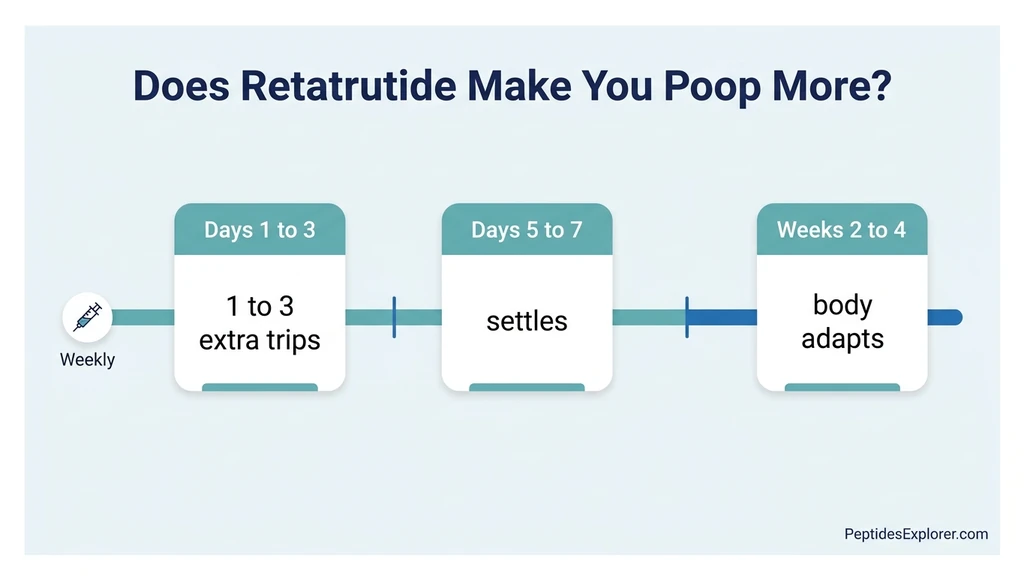
It is the morning after your second shot and you have already been to the bathroom twice before coffee. Here is the answer: yes, retatrutide makes most people poop more during the first 2 to 4 weeks at each new dose: softer stool, more trips, and a cluster of them in the 1 to 3 days after the weekly injection. For most users it settles into a new normal; for some it tips into watery stool, and for a smaller group it flips the other way into constipation.
| Question | Short answer |
|---|---|
| Does retatrutide make you poop more? | Usually yes, for 2 to 4 weeks after each dose step. Typical report: 1 to 3 extra trips a day, softer stool |
| When after the shot? | Days 1 to 3 after the weekly dose; most people settle by day 5 to 7 |
| Why? | A slowed stomach, more fat reaching the colon, a shifted diet, and less food going in |
| Normal shift or diarrhea? | Formed or soft stool up to 3 times a day is a shift; 3 or more watery stools a day is diarrhea |
| Can it make you go less? | Yes. Constipation hit 24% of semaglutide users in the STEP trials vs 11% on placebo |
| Best fixes | Start at 2 mg, hold each dose 4 weeks, keep fat under 15 g per meal, 25 to 30 g fiber, 2 to 3 liters of fluid |
| Red flags | Blood or black stool, fever, more than 7 days of watery stool, dizziness on standing |
This page covers the shift in frequency, urgency, consistency and timing, and what to do about it. Watery stool as a side effect in its own right is covered in does retatrutide cause diarrhea, its timeline in how long retatrutide diarrhea lasts, and the stomach side of the same week in the retatrutide nausea guide. Retatrutide is an investigational compound with no FDA approval for any use.
Get your custom peptide protocol:
- Tailored to your body and goals
- Precise dosing and cycle length
- Safe stacking combinations
- Backed by peer-reviewed studies
- Ready in under 2 minutes
How Often Bowel Habits Change on Retatrutide: The Trial Numbers
No retatrutide trial counted bathroom trips. What the trials did count was gastrointestinal adverse events, and the gut was the first place the drug showed up in every one of them.
| Trial | Population | Gastrointestinal finding | Source |
|---|---|---|---|
| Phase 1b, 12 weeks | 72 adults with type 2 diabetes | Adverse events in 63% on retatrutide vs 54% on placebo; GI disorders the most frequent | Urva et al., Lancet, 2022, PMID 36354040 |
| Phase 2, 36 weeks | 281 adults with type 2 diabetes | Mild to moderate GI events (nausea, diarrhoea, vomiting, constipation) in 35% on retatrutide vs 13% on placebo; 13% at 0.5 mg up to 50% at 8 mg with fast escalation | Rosenstock et al., Lancet, 2023, PMID 37385280 |
| Phase 2, 48 weeks | 338 adults with obesity | GI events the most common adverse events, dose-related, mostly mild to moderate, partially mitigated by a 2 mg rather than 4 mg starting dose | Jastreboff et al., N Engl J Med, 2023, PMID 37366315 |
The closest large dataset that breaks events down by type is semaglutide. Across the pooled STEP 1 to 3 trials, diarrhoea was reported by 29.7% on semaglutide 2.4 mg vs 15.9% on placebo, and constipation by 24.2% vs 11.1%, with most events arriving during or shortly after a dose increase (Wharton et al., Diabetes Obes Metab, 2022, PMID 34514682). Retatrutide inherits that class pattern, laid out in the GLP-1 side effect statistics, and adds a glucagon arm on top.
Why Retatrutide Changes How Often You Go
Think of a traffic light on a busy road. GLP-1 holds the light at red longer than usual, so cars stack up at the stomach. When it finally turns green, a whole platoon rolls into the small intestine at once instead of a steady trickle, and the road downstream has to clear a surge.
Literally stated: retatrutide delays gastric emptying (Urva et al., Diabetes Obes Metab, 2023, PMID 37311727), the shared GLP-1 receptor effect behind the fullness that drives how fast retatrutide works. The meal arrives in the intestine later and less processed, and the colon responds to the extra load of fluid and fat by moving.
More fat reaching the colon
Fat is the macronutrient that produces urgency. A slowed stomach means a fatty meal is handled less completely, and unabsorbed fat in the colon draws water and triggers contractions. Users describe it the same way: a greasy dinner on day 2 after the shot becomes an urgent trip at 6 AM on day 3.
Retatrutide also pulls on the glucagon receptor, the arm that raised energy expenditure and fat oxidation in the discovery work (Coskun et al., Cell Metab, 2022, PMID 35985340). Whether that arm adds to the bowel effect in humans has not been measured; what is measured is that GI events climbed with every dose step in both phase 2 trials.
Less food going in, and a different kind of food
The second shift is quieter. Appetite falls, meal volume falls, and the foods that disappear first are often the fibrous ones. A 2026 review of fiber during GLP-1 receptor agonist therapy describes exactly this: appetite suppression, smaller meals, slowed transit and constipation combine to cut fiber intake and the fermentable material reaching the colon (Yoon et al., Int J Mol Sci, 2026, PMID 42511630).
Less bulk can go either way: early on the shock to motility wins and you go more often; later, a small low-fiber diet in a slowed gut shrinks and hardens stool. The what to eat on tirzepatide guide covers the food side for the closest approved cousin, and most of it transfers.
The Weekly Rhythm: Day by Day After the Dose
No trial charted stool frequency by day of the week, so this timeline comes from pharmacology plus the pattern thousands of users report. Retatrutide's half-life is about 6 days (Urva et al., Lancet, 2022, PMID 36354040), so the blood level peaks in the first days after each injection and never fully drains before the next one.
| Day after injection | Typical bowel pattern | What to do |
|---|---|---|
| Day 0 (injection) | Usually unchanged | Small low-fat meal; nothing greasy tonight |
| Days 1 to 3 | Peak window: 1 to 3 extra trips, softer stool, morning urgency | Keep fat under 15 g per meal, stay near a bathroom in the morning |
| Days 4 to 5 | Frequency easing, stool firming | Rebuild fiber if you dropped it |
| Days 6 to 7 | Near your new baseline; some users swing toward constipation here | Water and fiber; do not skip meals |
| Each new dose step | The cycle restarts, usually milder than the step before | Hold the dose 4 weeks before climbing |
The peak window is why injection timing matters for bowel habits in a way it does not for weight loss: a Friday evening shot puts the first urgent morning on a Saturday. The trade-offs are mapped in best time to take retatrutide.
Each dose step resets the cycle, but the resets get smaller. Longer escalation schedules with more steps built measurable tolerance to incretin nausea and vomiting (Nauck et al., Diabetes Obes Metab, 2026, PMID 41757397), and the bowel follows the same curve.
What Counts as Normal, and Where the Line Is
Going more often is expected. The question is whether what comes out still looks like stool. Use consistency and count together.
| Pattern | Reading | Action |
|---|---|---|
| 1 to 3 trips a day, formed or soft (Bristol type 4 to 5), no urgency | Normal shift | Nothing; keep fat and fiber steady |
| 2 to 4 trips a day, soft and loose (Bristol 5 to 6), morning urgency on days 1 to 3 | Expected peak-window pattern | Low-fat meals, water, hold the dose |
| 3 or more watery stools a day (Bristol 7) | Diarrhea, a different problem | Rehydrate with electrolytes; follow the diarrhea rules |
| Fewer than 3 stools a week, hard, straining | The constipation flip | Fiber, fluid, movement; see the section below |
The STEP data give the proportions: 98.1% of GI events on semaglutide were mild to moderate and only 4.3% of users stopped the drug for gut reasons (Wharton et al., Diabetes Obes Metab, 2022, PMID 34514682). The extra trips are the expected, usually mild shift. Watery stool that goes on for days is the minority case, and it carries a dehydration risk the mild shift does not.
One practical marker: extra trips confined to the mornings of days 1 to 3 with formed stool are inside the normal pattern. Planning your day around bathroom access on day 5 means something else is adding to the load, and dietary fat is the first suspect.
The Constipation Flip: Why Some Users Go Less
Roughly one user in four on a weekly GLP-1 drug goes the other way. In the pooled STEP trials, constipation was reported by 24.2% on semaglutide vs 11.1% on placebo (Wharton et al., Diabetes Obes Metab, 2022, PMID 34514682), and the retatrutide phase 2 diabetes trial listed constipation among its GI events alongside nausea, diarrhoea and vomiting (Rosenstock et al., Lancet, 2023, PMID 37385280).
The mechanism is partly the drug and partly the diet. A GLP-1 analog studied in constipation-predominant IBS delayed gastric emptying but did not slow colonic transit, and at low doses it sped colonic transit at 48 hours (Camilleri et al., Am J Physiol Gastrointest Liver Physiol, 2012, PMID 22517769). The colon itself is not the brake. What hardens stool is a shrinking diet: less food, less fiber, less water, all arriving more slowly.
The flip usually shows up after week 4, once appetite has cut meal volume in half: hard pellets after three or more days, and a fullness that never clears. Rapid weight loss has other trailing effects, covered in retatrutide hair loss.
Managing It: Fiber, Water, Fat Per Meal, Dose Pacing
The expert consensus on GLP-1 gut effects sets separate rules for each symptom: how to reach the maintenance dose, what to do if events appear during escalation, and specific measures for diarrhoea and constipation (Gorgojo-Martínez et al., J Clin Med, 2022, PMID 36614945). Translated to a research-compound protocol, the levers are four.
- 1.Start at 2 mg and hold each step 4 weeks. The obesity trial's 2 mg start cut GI events compared with 4 mg (PMID 37366315). Work the step sizes out in the retatrutide dosage calculator.
- 2.Cap fat at 15 g per meal on days 0 to 3. Spread the day's fat across 4 to 5 small meals. Grilled chicken, rice, eggs, yogurt and cooked vegetables; no fried food or cream sauces in the peak window.
- 3.Build fiber to 25 to 30 g a day over a week. Psyllium has the strongest clinical support for normalizing stool in both directions (Yoon et al., Int J Mol Sci, 2026, PMID 42511630). One teaspoon in a glass of water daily, then two, adding about 5 g every two days; a jump from 10 g to 30 g in a day creates gas and more urgency.
- 4.Drink 2 to 3 liters of fluid, in sips. A slowed stomach handles a large glass poorly. Half a liter should carry electrolytes on days 1 to 3 if stool is loose.
Scenario 1, the skipped hold. You are at 8 mg, feel fine by day 10, and inject 12 mg the next week: a 50% jump after 10 days instead of 28. The fast-escalation arm of the diabetes trial had GI events in 50% of participants against 35% for the retatrutide groups overall (PMID 37385280). Expect the peak window to stretch from 3 days to a week. Fix: hold 8 mg for the full 4 weeks, then step.
Scenario 2, the day-2 dinner. You inject Friday evening, then eat a 900-calorie restaurant meal with 45 g of fat on Sunday: three times the per-meal cap in a stomach that empties slowly, and Monday morning becomes two urgent trips before 8 AM. Fix: on days 1 to 3, split that meal across lunch and dinner with the sauce on the side.
If you are switching from another weekly agonist, the bowel pattern carries over from your previous dose; switching from tirzepatide to retatrutide covers the overlap. An over-concentrated vial delivers more than the label says and shows up first in the gut; how to reconstitute retatrutide walks through the volumes.
Red Flags: When More Poop Becomes a Medical Problem
Most bowel changes on retatrutide need a diet adjustment and patience. A short list needs a clinician, and the list does not change because the compound is a research chemical.
Same-day medical evaluation if you see: blood in the stool, black or tar-like stool, fever above 38.3 C (101 F), severe abdominal pain that does not ease between bathroom trips, or signs of dehydration: no urine for 8 hours, a racing heart at rest, dizziness when you stand, confusion.
Contact a clinician within a few days if: watery stool lasts more than 7 consecutive days, loose stool is still present 4 weeks into a stable dose, constipation passes 5 days with no result from fiber and fluid, or you are losing more than 1.5 kg (3 lb) a week with no plan to.
In the obesity trial GI events were mostly mild to moderate and dose-related (Jastreboff et al., N Engl J Med, 2023, PMID 37366315), so a severe or persistent gut problem is outside the expected pattern and deserves a look. Dropping back one dose step, with the retatrutide dosage calculator for the units, is a legitimate move meanwhile. Retatrutide has no FDA approval and no prescribing label; the thresholds above borrow from the approved weekly agonists and general GI practice.
Frequently Asked Questions
Does retatrutide make you poop more?
Yes, for most users during the first 2 to 4 weeks at each dose step. The typical report is 1 to 3 extra trips a day with softer stool, clustered in days 1 to 3 after the weekly injection. GI events were the most common adverse events in the phase 2 trial (PMID 37366315). The retatrutide profile covers the mechanism.
Why does retatrutide make you poop so much the day after the shot?
Retatrutide delays gastric emptying (PMID 37311727), so a meal reaches the intestine later and in a larger, less processed load, and the colon clears it with extra contractions. Blood levels peak in the first days after each dose, with a half-life near 6 days (PMID 36354040). Timing options are in best time to take retatrutide.
How many times a day is normal on retatrutide?
Up to 3 formed or soft stools a day in the peak window is a normal shift. Three or more watery stools a day is diarrhea and needs electrolytes. In the pooled STEP semaglutide trials, 98.1% of GI events were mild to moderate (PMID 34514682). Class-wide rates are compared in the GLP-1 side effect statistics.
Does the extra pooping on retatrutide go away?
For most users, yes, within 2 to 4 weeks at a stable dose, and each new dose step brings a smaller wave than the one before. Longer escalation schedules with more steps built measurable tolerance to incretin GI effects (PMID 41757397). Plan 4-week holds with the retatrutide dosage calculator.
Can retatrutide cause constipation instead?
Yes. Constipation affected 24.2% of semaglutide users vs 11.1% on placebo in the STEP trials (PMID 34514682), and the retatrutide diabetes trial listed it among its GI events. The usual cause is a shrinking diet with less fiber and water, which the what to eat on tirzepatide guide addresses for the closest approved cousin.
What should you eat to stop pooping so much on retatrutide?
Keep fat under 15 g per meal on days 0 to 3 after the shot, split food across 4 to 5 small meals, and build fiber to 25 to 30 g a day with psyllium, adding 5 g every two days. Expert consensus puts diet first for GLP-1 gut effects (PMID 36614945). Meal ideas: what to eat on tirzepatide.
Does a higher retatrutide dose make you poop more?
Yes. GI events rose with every dose step in both phase 2 trials, from 13% at 0.5 mg to 50% at 8 mg with fast escalation in the diabetes trial (PMID 37385280). Escalation speed matters as much as the final dose. Step sizes are in how to reconstitute retatrutide and the reta peptide overview.
The Bottom Line
Retatrutide makes most people poop more for the first 2 to 4 weeks at each dose step: softer stool, 1 to 3 extra trips, concentrated in the 3 days after the weekly shot. A quarter of users on weekly GLP-1 drugs flip the other way into constipation once appetite cuts their fiber and fluid intake.
The principle: the drug slows the stomach and changes what you eat, and the colon reacts to both. Slow escalation from 2 mg with 4-week holds, fat under 15 g per meal in the peak window, 25 to 30 g of fiber and 2 to 3 liters of fluid cover almost every case. Blood, black stool, fever or more than 7 days of watery stool are outside the pattern and need a clinician.
Retatrutide is investigational and not FDA-approved, and no trial has measured stool frequency directly; the numbers here are trial GI event rates plus the pattern users report. Set your step sizes in the retatrutide dosage calculator and find the rest of the retatrutide cluster at PeptidesExplorer. Educational content, not medical advice.
Helpful Tools
Related Articles
How Long Does Retatrutide Nausea Last? Timeline
Retatrutide nausea peaks 24 to 48 hours after the shot, eases by day 3 to 4 and fades by week 2 to 4 at a stable dose. Hour-by-hour timeline, relief, red flags.
How Long Does Retatrutide Diarrhea Last? Timeline
Retatrutide diarrhea lasts 3 to 5 days per wave, clusters after each dose increase, and fades by week 3 to 4 at a stable dose. Timeline, fixes and red flags.
Alcohol on Tirzepatide: Risks
Alcohol and tirzepatide: no absolute contraindication, but risks include hypoglycemia, prolonged intoxication, and stalled weight loss.
Retatrutide Nausea: Rates, Timeline & Management
Retatrutide nausea affects 25-48% of users. Rates by dose, GLP-1 + glucagon mechanism, week-by-week timeline, and 8 management strategies.