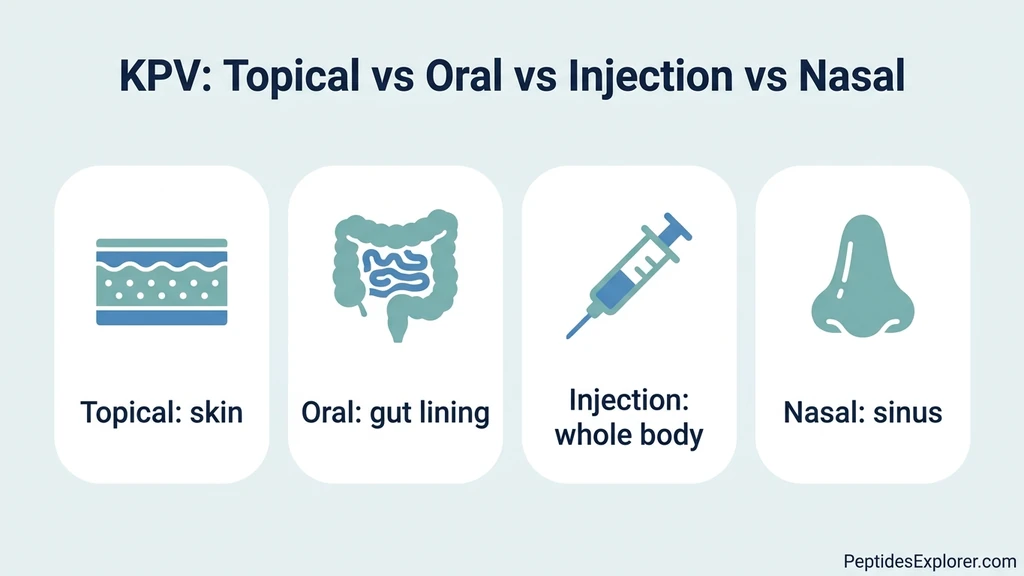
The same three amino acids are sitting in front of you as a cream, a capsule, a lyophilized vial and a nasal spray, and the vendor pages all promise the same thing. Here is the answer: the right KPV route is the one that puts the tripeptide in physical contact with the inflamed tissue. Topical for skin, oral for the gut, subcutaneous injection for inflammation you cannot reach from the outside, and nasal only when the sinuses themselves are the target. The gut route is the only one with animal efficacy data; the other three run on mechanism.
| Route | Reaches | Evidence tier | Pick it for |
|---|---|---|---|
| Topical cream or serum | Epidermis and upper dermis at the site | Keratinocyte cell data, alpha-MSH skin models | Eczema patches, psoriasis plaques, post-procedure redness |
| Oral capsule | Small-intestine and inflamed-colon lining via PepT1 | Mouse colitis studies, oral dosing | Colitis, Crohn's-type inflammation, leaky gut |
| Subcutaneous injection | Blood, then every tissue at low concentration | Mechanism only, no KPV injection trial | Joint, systemic or multi-site inflammation |
| Nasal spray | Nasal and sinus mucosa, partial systemic uptake | General nasal-delivery pharmacology, no KPV study | Chronic sinus irritation, needle-free systemic use |
KPV is the C-terminal fragment of alpha-MSH (Lys-Pro-Val), and it is not FDA-approved for any use by any route. How much to use on each route lives in the KPV dosage guide, and when in the day to take it in KPV morning or night. This page decides which route, nothing else.
Get your custom peptide protocol:
- Tailored to your body and goals
- Precise dosing and cycle length
- Safe stacking combinations
- Backed by peer-reviewed studies
- Ready in under 2 minutes
Why the Route Decides Everything for a Three-Amino-Acid Peptide
Think of KPV as a letter with no return address. Hand it to the person it is meant for and it gets read. Drop it in a public mailbox and most copies are shredded in sorting, and the one you needed may never reach the right door. The route is the hand-off, and for a peptide this small the hand-off matters more than the dose.
Literally stated: KPV works inside cells, where it blocks the NF-kappaB and MAP kinase inflammatory cascades at nanomolar concentrations (Dalmasso et al., Gastroenterology, 2008, PMID 18061177). It needs to be present at the inflamed cell, and each route delivers it to a different set of cells.
The molecule weighs about 342 daltons, under the 500-dalton ceiling dermatology uses as the rule of thumb for passive penetration through intact skin (Bos et al., Exp Dermatol, 2000, PMID 10839713). That number is why topical KPV is plausible at all, and why larger peptides such as GHK-Cu rely on carriers. What the fragment does and does not do is in KPV peptide benefits.
Oral KPV: The Only Route With Animal Efficacy Data
The gut is where KPV was characterized, and the oral route is the one you can defend with published studies rather than reasoning.
The intestinal lining carries a transporter called PepT1 whose day job is pulling dietary di- and tripeptides out of digested food. KPV is a tripeptide, so PepT1 pulls it into epithelial and immune cells directly. Mice given KPV in their drinking water had less DSS- and TNBS-induced colitis, with lower pro-inflammatory cytokine expression (Dalmasso et al., Gastroenterology, 2008, PMID 18061177). A second group confirmed it in two more colitis models: treated mice recovered earlier, regained more weight, and showed lower myeloperoxidase activity in colon tissue (Kannengiesser et al., Inflamm Bowel Dis, 2008, PMID 18092346).
PepT1 is expressed at low levels in a healthy colon and upregulated during inflammatory bowel disease, and in mice lacking PepT1 the protective effect of KPV against colitis-associated tumors disappeared (Viennois et al., Cell Mol Gastroenterol Hepatol, 2016, PMID 27458604). The transporter KPV depends on is densest exactly where the inflammation is. That is a strong reason to swallow KPV for gut disease, and no reason to swallow it for a skin plaque.
The weakness of plain oral KPV is survival through the stomach. When the peptide was packed into nanoparticles inside an alginate-chitosan hydrogel that collapses in the colon, it reduced colitis at a concentration 12,000-fold lower than free KPV in solution (Laroui et al., Gastroenterology, 2010, PMID 19909746). A later hyaluronic-acid nanoparticle version, also oral, targeted colonic epithelial cells and macrophages (Xiao et al., Mol Ther, 2017, PMID 28143741). This is the research version of an enteric coating; a vendor capsule labeled "enteric" is a different, untested product, and no human has been dosed with either in a trial. The parallel decision for a larger gut peptide is in BPC-157 oral vs injection.
Topical KPV: Direct Contact With Inflamed Skin
A cream puts the tripeptide where keratinocytes are, which is the one place outside the gut with cell-level KPV data.
Human keratinocytes respond to KPV across a concentration range from femtomolar to 100 nanomolar, through a calcium signal rather than the cyclic AMP pathway that alpha-MSH uses for pigmentation (Elliott et al., J Invest Dermatol, 2004, PMID 15102092). That separation is the whole appeal: the parent hormone alpha-MSH reduced irritant and allergic contact dermatitis in animal models, but its pigmentary effect limits its use, and KPV keeps the anti-inflammatory action without the tanning (Brzoska et al., Endocr Rev, 2008, PMID 18612139). Dermatology reviewers have proposed KPV and its derivative KdPT as candidates for cutaneous wounds and skin ulcers on the same basis (Böhm et al., Exp Dermatol, 2019, PMID 30661264).
What the skin literature lacks is a topical KPV trial in humans, or a penetration study of a KPV cream through human skin. The keratinocyte data are from cells in a dish; the dermatitis data are from alpha-MSH in mice. Topical KPV is a reasonable extrapolation with a measured mechanism, and that is the honest ceiling of the claim.
Formulation matters more here than for any other route. A thin water-based serum penetrates a plaque better than a heavy occlusive base. No peer-reviewed paper publishes a KPV cream strength, so any percentage on a label is the vendor's choice, not a studied one. Where topical KPV sits among the skin options is covered in peptides for eczema and peptides for psoriasis, with broader context in what peptides do for skin.
Injection and Nasal: Systemic Routes Without KPV-Specific Data
Subcutaneous injection and nasal spray both skip the gut. Both reach the blood. Neither has a KPV study behind it.
Subcutaneous injection places the tripeptide in the fat under the skin, from which it diffuses into capillaries and reaches every tissue at a low, even concentration. That is the right shape for inflammation with no surface you can reach: a joint, a tendon sheath, a diffuse autoimmune flare. It is the wrong shape for colitis, because a tripeptide in blood has to cross the vessel wall into the mucosa, while a swallowed one is carried straight into the epithelial cell by PepT1. The skill is generic: how to inject peptides covers needle and site, the peptide reconstitution calculator handles the water-to-powder math, and how long reconstituted peptides last sets the shelf limit.
Nasal spray absorbs through a highly vascular mucosa, eliminates first-pass metabolism, and is one of the few needle-free routes that can get peptides into circulation at all; its limits are mucociliary clearance, which sweeps a dose toward the throat within minutes, and absorption often too low to be useful without enhancers (Ulusoy et al., Eur Rev Med Pharmacol Sci, 2022, PMID 36524914). For KPV, no nasal pharmacokinetic or efficacy study exists. The route makes sense when the nasal and sinus lining is the target, since the spray lands on it, and is a weaker substitute for injection when the target is systemic. GHK-Cu nasal spray and the BPC-157 nasal spray guide describe what a spray delivers and what it loses.
Which Route for Which Condition: The Decision Table
Match the route to the tissue, then check the evidence column before you commit a month.
| Condition or goal | First-choice route | Why | Evidence behind the choice |
|---|---|---|---|
| Ulcerative colitis, Crohn's-type colon inflammation | Oral | PepT1 is upregulated in inflamed colon and carries KPV into the cell | Mouse colitis, oral KPV (PMID 18061177, 18092346) |
| Leaky gut, post-antibiotic gut irritation | Oral | Same transporter, same lining | Extrapolated from colitis models |
| Eczema patch, contact dermatitis | Topical | Direct keratinocyte contact; 342 Da passes intact skin | Keratinocyte cell data, alpha-MSH dermatitis models |
| Psoriasis plaque | Topical, serum base | Thick plaque blocks ointments; a thin vehicle penetrates better | Mechanism only |
| Post-procedure redness, minor wounds | Topical | Melanocortin peptides proposed for wound healing | Review-level proposal (PMID 30661264) |
| Joint or tendon inflammation | Subcutaneous injection | No surface to apply to; needs systemic distribution | No KPV data |
| Multi-site or autoimmune inflammation | Subcutaneous injection | Even systemic exposure | No KPV data |
| Chronic sinus or nasal irritation | Nasal | Spray lands on the target mucosa | General nasal pharmacology, no KPV data |
| Needle-averse systemic use | Nasal, with lowered expectations | Partial absorption, fast clearance | General nasal pharmacology |
| Gut plus skin at the same time | Oral plus topical | Two local routes, two targets | Each route's own evidence |
The last row is the most common real-world pairing: a capsule and a cream, each aimed at its own tissue, beats one injection trying to serve both. How KPV fits beside other anti-inflammatory compounds is in peptides for inflammation, and the logic of pairing routes in the peptide stacking guide.
Two Ways the Wrong Route Wastes a Month
Scenario 1: cream for colitis. You rub a KPV cream on your lower abdomen twice a day for 4 weeks hoping it reaches an inflamed colon. The peptide penetrates a few hundred micrometers of skin; the colon lining sits several centimeters deeper, behind muscle and peritoneum, and PepT1 on that lining never sees a molecule. Delivered dose to the target: effectively zero. Cost: 4 weeks and a tube. Fix: oral, where the drinking-water mouse data and the transporter both live.
Scenario 2: capsules for a psoriasis plaque. You swallow KPV daily for 6 weeks for a knee plaque. The transporter that absorbs KPV sits in the small intestine and the inflamed colon, and no study measures how much of a swallowed tripeptide ever reaches skin; the only skin-side data come from direct contact with keratinocytes. Six weeks pass with the plaque unchanged and the gut, which was fine, as the only tissue that got the peptide. Fix: a topical serum on the plaque itself.
Onset, Convenience, Cost and Combining Routes
Onset. Routes that put KPV in direct contact with the target act the same day at the cell level; what you can feel lags behind. Oral users commonly describe a gut change inside 2 to 4 weeks, topical users within 1 to 3 weeks on a patch, injectable users over a similar window. None of those windows comes from a trial; the mouse colitis studies report earlier recovery over days.
Convenience. Oral and topical are trivial: one capsule, one application. Nasal needs a spray bottle kept cold. Injection needs bacteriostatic water, a syringe, a swab, a refrigerator and a sterile routine; the peptide reconstitution calculator removes the arithmetic, not the routine.
Cost. Per milligram of peptide, the injectable vial is usually the cheapest form and the cream the most expensive, because the cream is mostly base. The useful comparison is cost per month at the tissue you care about, and there the local route (oral for gut, topical for skin) wins, since none of the dose is spent on tissues you were not treating.
Combining routes. A local route plus a systemic one is reasonable when two separate problems exist; two systemic routes (injection plus nasal) double the unknowns with no mechanism to justify it. No interaction data exist for any combination. KPV has never been tested in a human clinical trial by any route, and every onset and cost figure above is an estimate from use reports, not measurement.
Frequently Asked Questions
Can KPV be taken orally?
Yes, and oral is the best-supported KPV route. The gut transporter PepT1 carries the tripeptide straight into intestinal epithelial and immune cells, and KPV given in drinking water reduced colitis in mice (PMID 18061177). It suits gut inflammation specifically; the KPV profile lists the other targets it reaches poorly by mouth.
Does topical KPV actually absorb through the skin?
Plausibly. KPV weighs about 342 daltons, under the 500-dalton rule of thumb for passive penetration through intact skin (PMID 10839713), and human keratinocytes respond to it at femtomolar to 100 nanomolar concentrations (PMID 15102092). No human penetration study of a KPV cream has been published. Context on where it fits is in peptides for eczema.
Is KPV oral or injection better for gut inflammation?
Oral. Every KPV colitis study used oral dosing, and the transporter it depends on, PepT1, is upregulated in inflamed colon (PMID 27458604). An injection reaches the mucosa only from the blood side at low concentration, with no KPV data behind it. The same local-versus-systemic logic applies to BPC-157 oral vs injection.
When does injectable KPV make sense over oral or topical?
When the inflamed tissue has no surface you can reach: joints, tendon sheaths, or a multi-site autoimmune flare. Subcutaneous injection distributes the tripeptide evenly through the blood. No injectable KPV trial exists, so the choice rests on mechanism alone. Technique is generic; see how to inject peptides.
Does nasal KPV work?
No KPV nasal study exists. Nasal delivery skips first-pass metabolism and can carry peptides into circulation, but mucociliary clearance sweeps a dose away within minutes and absorption is often too low without enhancers (PMID 36524914). It is defensible for sinus-lining targets, weak as a systemic substitute. The GHK-Cu nasal spray page shows what sprays deliver.
Can you use oral and topical KPV at the same time?
Yes, and it is the most sensible combination when gut and skin inflammation coexist, because each route serves its own tissue with none of the dose wasted elsewhere. No interaction data exist for any KPV combination, so treat it as two separate local applications. The general rules for pairing peptides are in the peptide stacking guide.
Is an enteric-coated KPV capsule better than a plain one?
In research, colon-targeted delivery mattered enormously: KPV in nanoparticles inside an alginate-chitosan hydrogel worked at a concentration 12,000-fold lower than free KPV (PMID 19909746). A vendor "enteric" capsule is a different, untested product, so the research result does not transfer directly. How KPV ranks against other gut options is in peptides for inflammation.
Which KPV route works fastest?
The route in direct contact with the target: oral for gut, topical for skin. Cell-level effects begin the same day, and the mouse colitis studies showed earlier recovery over days (PMID 18092346). Felt changes lag by 1 to 4 weeks on any route, and no human trial has timed them. A reconstituted vial for injection also has a shelf limit; see how long reconstituted peptides last.
The Bottom Line
The route that puts KPV in contact with the inflamed tissue is the right one: oral for the gut, where PepT1 carries the tripeptide into the cell and the mouse colitis data live; topical for skin, where keratinocytes respond to it directly; subcutaneous injection for inflammation with no reachable surface; nasal only when the nasal lining itself is the target.
The principle is that a 342-dalton peptide acting inside cells at nanomolar concentrations does not need high blood levels, it needs the right doorstep. Pick the local route when one exists, and accept that injection and nasal use rest on mechanism rather than KPV-specific trials.
KPV is not FDA-approved for any indication and has not been tested in humans by any route; everything above is preclinical evidence and pharmacology, offered as education rather than medical advice. If you are reconstituting a vial, run the numbers in the peptide reconstitution calculator, and find the rest of the KPV cluster at PeptidesExplorer.
Helpful Tools
Related Articles
Retatrutide vs Semaglutide: Results, Risks, Cost
Retatrutide vs semaglutide (Ozempic, Wegovy): 24.2% vs 14.9% trial weight loss, side effects, heart rate, dosing cadence, cost, FDA status, and how to switch.
Ipamorelin vs Sermorelin: Mechanism, Safety, Cost
Ipamorelin vs sermorelin: ghrelin-receptor agonist vs GHRH analog, 2-hour vs 4-minute half-life, cortisol selectivity, FDA history, cost, and who picks which.
How Long Does KPV Take to Work? Timeline
How long does KPV take to work: gut symptoms in 1 to 2 weeks, skin in 2 to 4, systemic inflammation in 2 to 6. Half-life, onset by route, and when to stop.
Where to Inject KPV: Best Sites and Technique
Where to inject KPV: belly fat, outer thigh, arm or flank with a 29 to 31G insulin needle. Why the site barely matters, rotation grid and step-by-step.