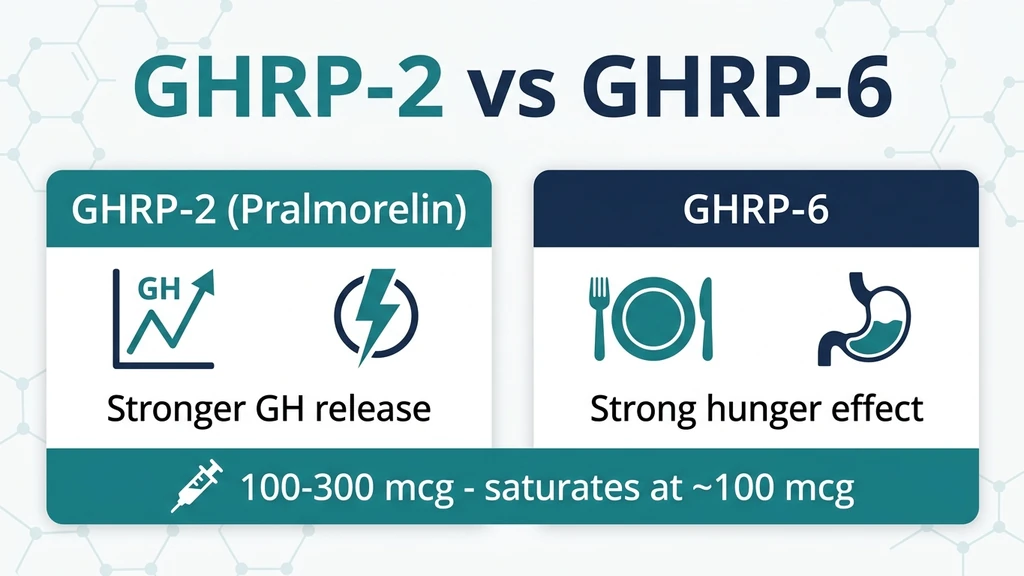
Two vials, six amino acids each, nearly identical names. Here is the difference that matters: GHRP-2 releases more growth hormone per microgram, while GHRP-6 produces the strongest hunger of any GH peptide. Both saturate the receptor around 100 mcg, and both stack with CJC-1295. Pick GHRP-2 for GH output with manageable appetite. Pick GHRP-6 when the appetite surge is the point.
| Quick Reference | GHRP-2 (Pralmorelin) | GHRP-6 |
|---|---|---|
| GH release per mcg | Highest of the classic GHRPs | Strong, slightly below GHRP-2 |
| Hunger effect | Moderate: +35.9% food intake in one human trial | Intense: hits 20-30 minutes after injection |
| Cortisol/prolactin | Mild rise, dose-dependent | Mild rise, dose-dependent |
| Saturation dose | ~100 mcg | ~100 mcg |
| Typical research protocol | 100-300 mcg, 1-3x daily | 100-300 mcg, 1-3x daily |
| Clinical pedigree | Approved GH-deficiency diagnostic in Japan | First GHRP tested in humans (1990) |
| Best fit | GH output, recomposition phases | Appetite stimulation, bulking phases |
GHRP-2's food intake figure comes from a controlled infusion study in healthy men (Laferrère et al., J Clin Endocrinol Metab, 2005).
Neither GHRP-2 nor GHRP-6 is FDA-approved. Both are research compounds in the United States. Nothing here is medical advice; consult a physician before considering any GH secretagogue.
Get your custom peptide protocol:
- Tailored to your body and goals
- Precise dosing and cycle length
- Safe stacking combinations
- Backed by peer-reviewed studies
- Ready in under 2 minutes
What GHRP-2 and GHRP-6 Actually Are
Both peptides are six-amino-acid agonists of the ghrelin receptor (GHS-R1a), the same receptor your stomach's hunger hormone activates. Think of that receptor as a doorbell wired to two rooms: the pituitary's GH room and the brain's appetite room. GHRP-6 rings both rooms at full volume. GHRP-2 rings the GH room louder and the appetite room softer.
That is the analogy. The literal version: both peptides trigger pulsatile GH release from the pituitary, and both stimulate appetite through ghrelin mimicry, but GHRP-2 delivers more GH per microgram while GHRP-6 delivers a stronger, faster hunger signal. Neither shuts down your natural production the way synthetic HGH does, because both work upstream of the pituitary.
GHRP-6: The Original
GHRP-6 is the historical starting point of this entire peptide class. Cyril Bowers demonstrated in 1990 that it stimulates GH release in normal men and acts synergistically with GHRH (Bowers et al., J Clin Endocrinol Metab, 1990). The receptor it activated was unknown at the time; hunting for it led researchers to discover ghrelin itself in 1999 (Bowers, Methods Enzymol, 2012).
Its defining trait in practice is hunger. Within 20-30 minutes of injection, most users report a strong, stomach-level urge to eat. For the full profile including benefits and protocols, see our GHRP-6 peptide guide.
GHRP-2: The Refined Successor
GHRP-2, known clinically as pralmorelin (KP-102), came out of the same Bowers research program with one goal: more GH per microgram (Bowers, Cell Mol Life Sci, 1998). It succeeded. GHRP-2 is generally considered the most potent GH releaser of the classic GHRPs, ahead of GHRP-6 and roughly comparable to hexarelin.
It also has the strongest clinical pedigree of the pair. Japan approved GHRP-2 as a diagnostic agent, where a single 100 mcg IV dose tests pituitary GH reserve in suspected adult GH deficiency (Chihara et al., Eur J Endocrinol, 2007).
Head-to-Head: The Four Differences That Matter
Strip away the marketing and four real differences separate these peptides.
| Factor | GHRP-2 | GHRP-6 | Edge |
|---|---|---|---|
| GH release per mcg | Highest of classic GHRPs | Strong but lower | GHRP-2 |
| Hunger intensity | Moderate | Intense, rapid onset | Depends on goal |
| Cortisol/prolactin at 100 mcg | Mild, transient rise | Mild, transient rise | Tie |
| Clinical validation | Approved diagnostic in Japan | Human data since 1990, no approval | GHRP-2 |
Potency. GHRP-2 wins on raw GH output. If the research goal is maximum GH pulse per injection, GHRP-2 is the stronger tool at the same microgram dose.
Hunger. This is the fork in the road. GHRP-6 produces intense, reliable hunger; GHRP-2 produces a milder version of the same effect. Milder does not mean absent: infused GHRP-2 increased food intake by 35.9% in healthy men, with every single subject eating more (Laferrère et al., J Clin Endocrinol Metab, 2005). If any appetite stimulation is unacceptable, ipamorelin is the cleaner choice.
Cortisol and prolactin. Both peptides nudge ACTH, cortisol, and prolactin upward. Arvat's team measured GHRP-2 head-on in humans: GH rose dramatically while prolactin, ACTH, and cortisol rose modestly and transiently (Arvat et al., Peptides, 1997). At 100 mcg doses these rises stay small; push to 300-600 mcg and they become measurable enough to matter for long protocols.
Use-case history. GHRP-2 carries a diagnostic approval in Japan and pediatric testing history. GHRP-6 carries 35 years of human research data but no approval anywhere.
Dosage Compared: Same Numbers, Different Reasons
The dosing math is nearly identical because both peptides saturate the ghrelin receptor around the same point. Roughly 100 mcg produces close to the maximum GH pulse; doses beyond ~300 mcg add side effects faster than GH.
| Protocol Element | GHRP-2 | GHRP-6 |
|---|---|---|
| Saturation dose | ~100 mcg | ~100 mcg |
| Common research dose | 100-300 mcg per injection | 100-300 mcg per injection |
| Frequency | 1-3x daily | 1-3x daily |
| Timing | Fasted: 30+ min before food | Fasted, or pre-meal to exploit hunger |
| Best injection windows | Post-workout, pre-bed | Pre-bed, or 30 min before a planned meal |
| Half-life | ~30 minutes | ~20-30 minutes |
Timing rules matter more than the microgram count. Carbohydrates and fats blunt the GH pulse, so inject on an empty stomach and wait at least 20-30 minutes before eating. The pre-bed injection rides your natural nocturnal GH pulse, which also supports sleep-related recovery.
The one strategic difference: GHRP-6 users often time injections 30 minutes before a scheduled meal, turning the hunger side effect into a feeding tool. GHRP-2 users generally dose for GH output alone. For vial math, use our peptide reconstitution calculator, and cross-check doses against the peptide dosage chart.
Which One Fits Your Goal
Match the peptide to the primary research goal, then let everything else follow.
Appetite and bulking phases: GHRP-6. If the limiting factor is eating enough, GHRP-6's hunger effect is a feature. Underweight subjects and hard gainers in research settings get a GH pulse plus a reliable appetite signal in one injection. Details in the GHRP-6 guide.
Maximum GH output and recomposition: GHRP-2. When the goal is the biggest GH pulse per injection with hunger as tolerable background noise, GHRP-2 wins on potency. During a fat-loss phase, its milder appetite effect is easier to work around than GHRP-6's.
No hunger, no cortisol, no prolactin: neither. Ipamorelin activates the same receptor with near-zero effect on appetite, cortisol, or prolactin, at the cost of a somewhat smaller GH pulse. Our MK-677 vs ipamorelin and tesamorelin vs ipamorelin comparisons map the cleaner alternatives.
Clinical-grade evidence: look elsewhere. Both GHRPs stalled before Phase III. Tesamorelin and sermorelin carry stronger regulatory footing; the CJC-1295 vs sermorelin comparison covers that tier.
Stacking With CJC-1295: Where Both Peptides Earn Their Keep
Neither GHRP is typically run alone. The reason is receptor synergy documented since 1990: a GHRP plus a GHRH analog releases more GH together than the sum of either alone (Bowers et al., J Clin Endocrinol Metab, 1990). The two signals hit the pituitary through different receptors at the same moment.
The standard research pairing is 100 mcg of either GHRP with 100 mcg of CJC-1295 without DAC, injected together 1-3x daily. The CJC-1295 dosage guide covers the GHRH side of the stack. The with-DAC version changes the logic entirely: its 6-8 day half-life creates a continuous GH bleed rather than pulses, explained in the CJC-1295 with DAC guide.
GHRP choice within the stack follows the same fork as before. GHRP-6 plus CJC-1295 suits mass phases where the hunger helps. GHRP-2 plus CJC-1295 suits recomposition goals, though many researchers gravitate toward the better-characterized CJC-1295 and ipamorelin pairing instead. Plan combined doses with the CJC-1295/ipamorelin dosage calculator.
Side Effects Compared: The Honest Ledger
Both peptides are well tolerated at saturation doses in published human studies, with no serious adverse events reported at 100 mcg. The differences show up in degree, and in what happens when doses climb.
| Side Effect | GHRP-2 | GHRP-6 |
|---|---|---|
| Hunger | Moderate (+35.9% intake measured) | Intense, 20-30 min post-injection |
| Cortisol rise | Mild, transient at ≤100 mcg | Mild, transient at ≤100 mcg |
| Prolactin rise | Mild, dose-dependent | Mild, dose-dependent |
| Water retention | Occasional | Occasional |
| Tingling/flushing | Occasional | Occasional |
| Blood glucose | Slight rise possible | Slight rise possible |
| Injection site redness | Common, resolves in hours | Common, resolves in hours |
Two scenarios show how dosing errors play out. First: a researcher doses 300 mcg of GHRP-6 at bedtime on an empty stomach, expecting sleep. The hunger lands 25 minutes later and either keeps them awake or sends them to the kitchen for 800 unplanned calories, undoing a cutting week in one snack. The fix is dosing GHRP-6 about 90 minutes before a planned meal and reserving pre-bed injections for GHRP-2.
Second: a researcher triples GHRP-2 to 600 mcg chasing a bigger pulse. GH output barely rises past the ~100 mcg saturation point, but prolactin and cortisol climb measurably at supraphysiological doses (Arvat et al., Peptides, 1997). Weeks of that pattern invite fluid retention and mood effects with no added benefit. The fix is staying at 100-150 mcg and adding a second daily injection instead of a bigger one.
Long-term GH-axis caveats apply to both: monitor IGF-1, watch fasting glucose, and avoid all GH secretagogues with any active malignancy. The peptide safety guide covers screening in detail.
Frequently Asked Questions
Which is stronger, GHRP-2 or GHRP-6?
GHRP-2 releases more growth hormone per microgram and is considered the most potent of the classic GHRPs. GHRP-6 sits slightly below it on GH output but produces much stronger hunger. Both saturate the ghrelin receptor around 100 mcg. Compare doses across compounds in our peptide dosage chart.
Does GHRP-2 cause hunger like GHRP-6?
Yes, but less intensely. A controlled trial found GHRP-2 infusion increased food intake by 35.9% in healthy men, with all 7 subjects eating more. GHRP-6 hunger is stronger and faster, typically hitting 20-30 minutes after injection. If zero appetite effect matters, see ipamorelin instead.
Can you take GHRP-2 and GHRP-6 together?
Stacking them adds little. Both compete for the same ghrelin receptor, which saturates around 100 mcg, so a second GHRP mostly duplicates the first. Real synergy comes from pairing one GHRP with a GHRH analog such as CJC-1295; our CJC-1295 dosage guide covers that combination.
What is the standard dose for GHRP-2 and GHRP-6?
Both follow the same template in research protocols: 100-300 mcg per injection, 1-3 times daily, on an empty stomach with food delayed 20-30 minutes. Doses beyond 300 mcg add cortisol and prolactin faster than GH. Work out vial concentrations with the peptide reconstitution calculator.
Do GHRP-2 and GHRP-6 raise cortisol and prolactin?
Both cause mild, transient rises in ACTH, cortisol, and prolactin. Human data on GHRP-2 shows these stay modest at 100 mcg doses and grow dose-dependently above that. Ipamorelin avoids the effect almost entirely, as covered in our MK-677 vs ipamorelin comparison.
Which works better with CJC-1295?
Either GHRP synergizes with CJC-1295, since GHRP and GHRH signals amplify each other at the pituitary. Choose GHRP-6 for bulking stacks where hunger helps and GHRP-2 for recomposition. The typical pairing is 100 mcg of each, dosed together; see CJC-1295 and ipamorelin benefits for the most popular variant.
Are GHRP-2 and GHRP-6 FDA approved?
No. Neither is FDA-approved in the United States; both are sold as research compounds. GHRP-2 (pralmorelin) is approved in Japan, though only as a 100 mcg diagnostic test for growth hormone deficiency, never as a therapy. Regulatory context for the whole class is in our peptide safety guide.
Is ipamorelin better than GHRP-2 or GHRP-6?
Ipamorelin trades a somewhat smaller GH pulse for near-zero hunger, cortisol, and prolactin effects, which is why it became the default GHRP in modern stacks. GHRP-2 still wins on raw potency and GHRP-6 on appetite stimulation. Our tesamorelin vs ipamorelin comparison shows where ipamorelin fits.
The Bottom Line
GHRP-2 and GHRP-6 press the same receptor with different fingerprints. GHRP-2 delivers the bigger GH pulse per microgram and a diagnostic approval in Japan. GHRP-6 delivers the strongest appetite signal in the peptide class, which is either its main flaw or its main feature depending on your goal.
Both saturate around 100 mcg, both dose at 100-300 mcg up to three times daily, and both work best paired with a GHRH analog like CJC-1295 rather than alone.
Start with the goal, then pick the tool. For the full GHRP-6 protocol, read our GHRP-6 peptide guide, and explore every dosage guide, comparison, and calculator at PeptidesExplorer.
Related Articles
CJC-1295 DAC vs No DAC: How to Choose
CJC-1295 DAC (6-8 day half-life, weekly injection) vs no DAC/Mod GRF 1-29 (30-min half-life, 2-3x daily). Compare dosing, GH patterns, and cost.
Ipamorelin vs Sermorelin: Mechanism, Safety, Cost
Ipamorelin vs sermorelin: ghrelin-receptor agonist vs GHRH analog, 2-hour vs 4-minute half-life, cortisol selectivity, FDA history, cost, and who picks which.
MK-677 vs Ipamorelin: Oral vs Injectable GH
MK-677 vs ipamorelin: oral ghrelin mimetic (24h half-life, 25-27% glucose rise) vs injectable selective GHRP. Trial data and cost.
BPC-157 vs BPC-159: Are They the Same?
BPC-157 vs BPC-159 compared: 15 vs 11 amino acids, 100+ studies vs near zero. Cognitive claims fact-checked and which one to choose.