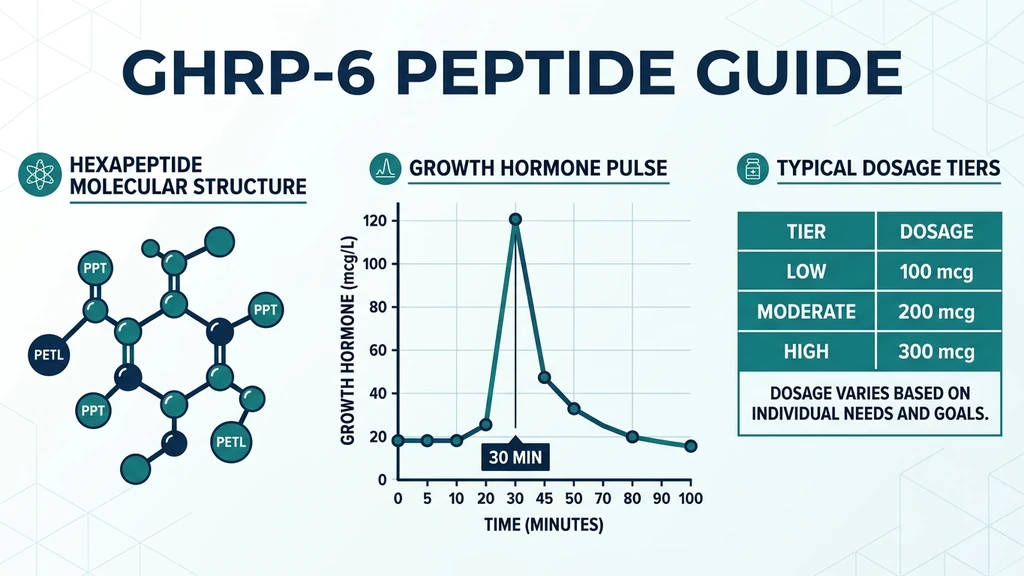
Twenty minutes after a GHRP-6 injection, your stomach growls like you skipped two meals. That hunger is the compound announcing itself. GHRP-6 is a six-amino-acid ghrelin mimetic that triggers a growth hormone pulse from the pituitary; research protocols use 100 to 300 mcg per injection, 1 to 3 times daily, and GH output saturates near 1 mcg per kg of body weight. It is a research compound, not an approved drug.
| Quick facts | GHRP-6 |
|---|---|
| What it is | First-generation growth hormone releasing peptide (hexapeptide, ghrelin mimetic) |
| Typical research dose | 100 to 300 mcg per injection, 1 to 3x daily |
| Saturation dose | ~1 mcg/kg (about 100 mcg for a 100 kg subject) |
| Half-life | Roughly 15 to 60 minutes; GH pulse peaks within 30 minutes |
| Signature effect | Strong hunger surge 15 to 20 minutes after injection |
| Status | Research use only, not FDA approved |
The dosing logic sits below, followed by how GHRP-6 compares with the rest of the GH peptide family in the peptide dosage chart cluster.
Get your custom peptide protocol:
- Tailored to your body and goals
- Precise dosing and cycle length
- Safe stacking combinations
- Backed by peer-reviewed studies
- Ready in under 2 minutes
GHRP-6 Dosage Chart
Research protocols center on 100 mcg per injection because that is where the dose-response curve flattens. In the original human work, GH release scaled with dose up to about 1 mcg/kg intravenously, and the foundational study documented strong GH pulses in normal men at exactly that threshold (Bowers et al., J Clin Endocrinol Metab, 1990, PMID 2108187).
| Research tier | Dose per injection | Frequency | Daily total |
|---|---|---|---|
| Conservative | 100 mcg | 1x daily (before bed) | 100 mcg |
| Standard | 100 mcg | 2 to 3x daily | 200 to 300 mcg |
| Aggressive | 200 to 300 mcg | 2 to 3x daily | 400 to 900 mcg |
| Saturation reference | ~1 mcg/kg | Per injection | Ceiling for GH response |
Timing decides how much of each dose converts to GH. Insulin and fatty acids blunt the pulse, so protocols inject on an empty stomach and hold food for 20 to 30 minutes afterward. The three classic windows are waking, post-training, and before bed, which ride the body's natural GH rhythm.
Doubling past saturation does not double output. A 100 kg subject injecting 300 mcg instead of 100 mcg gets a modestly taller GH pulse but roughly triple the hunger signal, plus measurable cortisol and prolactin elevation that the 100 mcg dose largely avoids. The extra 200 mcg mostly buys side effects.
A 5 mg vial reconstituted with 2.5 mL of bacteriostatic water yields 100 mcg per 5 units on an insulin syringe. Getting that arithmetic wrong is the most expensive mistake in the protocol, so run the numbers through the peptide reconstitution calculator and cross-check syringe markings with the peptide unit converter.
What GHRP-6 Is and How It Works
GHRP-6 is a synthetic chain of six amino acids (His-D-Trp-Ala-Trp-D-Phe-Lys-NH2) built in the 1980s by Cyril Bowers' group, years before anyone knew which receptor it hit. It reliably released growth hormone in humans, and the mystery of how drove a decade of research.
The answer came in two acts. In 1996, researchers cloned the receptor GHRP-6 activates, the growth hormone secretagogue receptor in the pituitary and hypothalamus (Howard et al., Science, 1996, PMID 8688086). In 1999, Kojima's team found the body's own key for that lock: ghrelin, the stomach hormone that drives hunger and GH release (Kojima et al., Nature, 1999, PMID 10604470).
Think of the pituitary as a house with two doorbells. GHRH analogs like CJC-1295 ring the front door, and ghrelin mimetics ring the back. GHRP-6 is literally a copy of the back-door key: it binds the same ghrelin receptor, which is why every injection arrives with an appetite surge that selective relatives like ipamorelin were later engineered to avoid.
The practical consequence: GHRP-6 triggers a sharp, short GH pulse rather than a sustained elevation. The pulse peaks within about 30 minutes and returns to baseline within a few hours, which mimics natural secretion instead of flatlining it the way exogenous HGH does.
GHRP-6 vs the Other GH Peptides
Every GH peptide in this family trades potency against side effects. GHRP-6 sits in the middle: stronger hunger than any of them, moderate GH release, mild cortisol and prolactin activity at higher doses.
| Peptide | Class | Typical research dose | Hunger | Cortisol/prolactin |
|---|---|---|---|---|
| GHRP-6 | Ghrelin mimetic | 100 to 300 mcg, 1 to 3x daily | Strong | Mild, dose-dependent |
| Ipamorelin | Ghrelin mimetic (selective) | 200 to 300 mcg, 1 to 3x daily | Minimal | None at research doses |
| Hexarelin | Ghrelin mimetic (potent) | 100 to 200 mcg, 1 to 2x daily | Moderate | Highest of the class |
| MK-677 | Oral ghrelin mimetic | 10 to 25 mg daily | Strong | Minimal |
| CJC-1295 / sermorelin / tesamorelin | GHRH analogs | Varies | None | None |
Within the ghrelin mimetics, the choice is a hunger question. Ipamorelin skips the appetite surge almost entirely, which is why it dominates modern stacks; the MK-677 vs ipamorelin comparison walks through the oral alternative. Hexarelin dosing buys more GH per mcg but desensitizes faster and pushes cortisol hardest.
The GHRH analogs are a different doorbell entirely. They cannot replace a GHRP, and a GHRP cannot replace them; the tesamorelin vs ipamorelin breakdown and the CJC-1295 vs sermorelin guide map that side of the family.
The Hunger Effect, Quantified
GHRP-6 hunger is not a vague appetite lift. It arrives 15 to 20 minutes after injection, feels like genuine stomach-empty hunger, and typically lasts 30 to 60 minutes. Subjects who inject 200 to 300 mcg report it as difficult to ignore.
The mechanism is direct receptor math. GHRP-6 activates the same receptor as ghrelin, and in controlled human research a ghrelin infusion increased food intake at a buffet meal by 28 percent (Wren et al., J Clin Endocrinol Metab, 2001, PMID 11739476). An injection of its mimetic pulls the same lever on demand.
Whether that is a bug or a feature depends on the research goal. In bulking and appetite-recovery contexts the hunger is the point: a pre-meal injection makes a 1,000-calorie meal feel easy. In fat-loss contexts it is disqualifying, which is why cutting-phase protocols swap in ipamorelin and accept a slightly weaker pulse.
One practical failure mode: injecting GHRP-6 before bed on a strict diet, then eating 500 unplanned calories at midnight because the hunger won. That single response erases the caloric edge the GH pulse provided. If the diet cannot absorb an appetite spike, this is the wrong peptide.
Stacking GHRP-6 with CJC-1295
The two-doorbell design is why stacking exists. Human data shows GHRP-6 needs endogenous GHRH tone to reach maximal GH stimulation (Pandya et al., J Clin Endocrinol Metab, 1998, PMID 9543138), and Bowers' original work found the combination acts synergistically: GHRP plus GHRH releases more GH than the sum of either alone (PMID 2108187).
The standard research pairing is 100 mcg GHRP-6 plus 100 mcg CJC-1295 without DAC in the same syringe, 1 to 3x daily on an empty stomach. The CJC-1295 dosage guide covers the GHRH side in detail, and the no-DAC guide explains why the short-acting version matches GHRP-6's pulse profile.
The DAC version changes the logic. Its multi-day half-life provides constant GHRH tone, so a once- or twice-weekly DAC injection with daily GHRP-6 shots is a lower-injection-count alternative. Same receptors, different rhythm.
Most of the published stack literature on this site covers CJC-1295 with ipamorelin because that combination skips the hunger; the benefits rundown applies almost unchanged to GHRP-6 apart from the appetite surge. Model the combined math with the CJC-1295/ipamorelin dosage calculator, substituting GHRP-6 on the GHRP side.
Side Effects and Safety
GHRP-6 has decades of small human studies with a mostly mild acute profile, and zero long-term safety trials. Both halves of that sentence matter.
The documented effects are dose-dependent. Hunger hits nearly everyone. Water retention, tingling or flushed skin, and injection-site redness are common in the first weeks. Above roughly 1 to 2 mcg/kg, cortisol and prolactin rise measurably; at 100 mcg those elevations are small and transient, which is another argument for staying at saturation rather than above it.
Two quantified scenarios worth internalizing. A subject running 300 mcg three times daily (900 mcg/day, roughly triple saturation for a 90 kg person) gains 2 to 3 kg of water weight in the first two weeks and elevates prolactin enough to blunt libido; dropping back to 100 mcg doses resolves both within days. A diabetic-leaning subject injecting before a carb-heavy meal compounds GH-induced insulin resistance, since GH is a counter-regulatory hormone that raises blood glucose for hours after each pulse.
Desensitization is the other ceiling. Continuous high-dose exposure downregulates the receptor within weeks, which is why protocols pulse doses rather than infuse and why 8 to 12 week cycles with breaks are standard. The side-effect patterns catalogued in the CJC-1295 and ipamorelin side effects guide overlap heavily, minus the hunger.
GHRP-6 is not FDA approved for any indication, and it is banned by WADA for competitive athletes. Anyone with a history of cancer should treat GH-axis peptides as off-limits, since GH and IGF-1 accelerate cell growth indiscriminately. A qualified physician and baseline bloodwork belong in any serious protocol.
Common GHRP-6 Mistakes
Four errors account for most failed GHRP-6 protocols. Each one is measurable, and each one has a simple fix.
Injecting after food. A dose taken 30 minutes after a meal lands on elevated insulin and fatty acids, which can cut the GH pulse by half or more. The subject pays for 100 mcg and absorbs the hormonal benefit of far less. Fix: inject fasted, then hold food for 20 to 30 minutes.
Chasing dose instead of frequency. One 300 mcg injection daily produces one saturated pulse plus surplus hunger and cortisol. Three 100 mcg injections produce three full pulses from the same 300 mcg of material. Frequency multiplies output; dose past saturation does not.
Reconstitution math errors. Adding 1 mL instead of 2.5 mL to a 5 mg vial makes each unit on the syringe worth 2.5x the intended dose, so a planned 100 mcg becomes 250 mcg. The result is a week of runaway appetite blamed on the peptide instead of the dilution. Fix: write the concentration on the vial and verify with the peptide reconstitution calculator.
Running it solo when the goal is maximal GH. GHRP-6 without GHRH tone leaves the documented synergy on the table (PMID 2108187). A matched 100 mcg of CJC-1295 without DAC roughly doubles the pulse for a few dollars more per dose.
A fifth, quieter mistake is skipping breaks. Receptor desensitization builds over continuous weeks of exposure, so the 8 to 12 week cycle with a 4 week gap is what keeps month three as productive as month one.
Frequently Asked Questions
What is the standard GHRP-6 dosage?
Research protocols use 100 mcg per injection, 1 to 3 times daily, on an empty stomach with food held for 20 to 30 minutes. GH release saturates near 1 mcg/kg, so larger doses mostly add hunger and cortisol. Context for the full family sits in the peptide dosage chart.
Why does GHRP-6 make you so hungry?
GHRP-6 activates the same receptor as ghrelin, the stomach hormone that signals hunger. In human research, ghrelin infusion raised food intake by 28 percent (PMID 11739476), and the mimetic pulls the same lever within 15 to 20 minutes. Ipamorelin hits the receptor without the appetite surge.
Is GHRP-6 better than ipamorelin?
Neither wins outright; they trade hunger for selectivity. GHRP-6 releases GH strongly but spikes appetite and nudges cortisol at higher doses, while ipamorelin stays clean at research doses with a slightly softer pulse. The MK-677 vs ipamorelin comparison maps the wider ghrelin-mimetic family.
Can you stack GHRP-6 with CJC-1295?
Yes, and the combination is synergistic: GHRP plus GHRH releases more GH than either alone (PMID 2108187). The standard research pairing is 100 mcg of each in one syringe, 1 to 3 times daily. The CJC-1295 dosage guide covers the GHRH half of the stack.
How long does GHRP-6 take to work?
The GH pulse peaks within 30 minutes of each injection, and hunger arrives even faster, at 15 to 20 minutes. Body-composition changes track the slower IGF-1 axis and typically need 8 to 12 weeks of consistent dosing. The CJC-1295 and ipamorelin benefits timeline follows the same arc.
What are the main GHRP-6 side effects?
Hunger, water retention, tingling or flushing, and injection-site redness lead the list, with cortisol and prolactin rising above roughly 1 to 2 mcg/kg per dose. Long-term human safety data does not exist. The CJC-1295 and ipamorelin side effects guide covers the overlapping GH-axis risks.
How do you reconstitute a 5 mg GHRP-6 vial?
Add 2.5 mL of bacteriostatic water to the 5 mg vial for a 2 mg/mL solution; 100 mcg is then 5 units on a U-100 insulin syringe. Inject the water slowly down the vial wall and swirl gently. Verify your own numbers with the peptide reconstitution calculator.
Is GHRP-6 stronger than hexarelin?
No. Hexarelin is the most potent GH releaser of the ghrelin-mimetic class per mcg, but it also produces the highest cortisol and prolactin response and desensitizes fastest. GHRP-6 trades a softer pulse for a friendlier hormone profile plus stronger hunger. The hexarelin dosage guide has the head-to-head numbers.
The Bottom Line
GHRP-6 delivers a sharp growth hormone pulse at 100 to 300 mcg per injection, 1 to 3 times daily, with GH output saturating near 1 mcg/kg and a hunger surge that defines the compound. Pair it with a GHRH analog like CJC-1295 when the goal is maximal synergistic release, or swap in ipamorelin when appetite is the enemy.
The rule that governs everything else: stay at saturation, inject fasted, and cycle with breaks. Doses above the ceiling buy cortisol and water weight, not growth hormone.
It remains a research compound with no approved use, so treat every protocol as experimental and involve a qualified physician. For the calculators, dosage charts, and peptide guides behind this one, keep exploring PeptidesExplorer.com.
Related Articles
Ipamorelin Dosage: Solo Protocols, Timing & Unit Math
Ipamorelin dosage: 200-300 mcg subcutaneous, 1-3x daily, bedtime fasted. Charts by goal and weight, saturation dose, reconstitution units, safety data.
Tesamorelin Peptide: Uses, Evidence, Risks
Tesamorelin peptide explained: a GHRH analogue FDA-approved as Egrifta for HIV lipodystrophy. What it does to visceral fat, IGF-1, and who should avoid it.
AOD 9604 Peptide: What the Evidence Shows
AOD 9604 peptide is a modified hGH fragment. Its 536-patient trial found no significant weight loss vs placebo. Mechanism, real evidence, FDA and WADA status.
CJC-1295 With DAC: Long-Acting GHRH Analog
CJC-1295 with DAC: 6-8 day half-life, 2-10x GH increase, 1-2 mg weekly. GH bleed effect, desensitization risk, and stacking protocols.