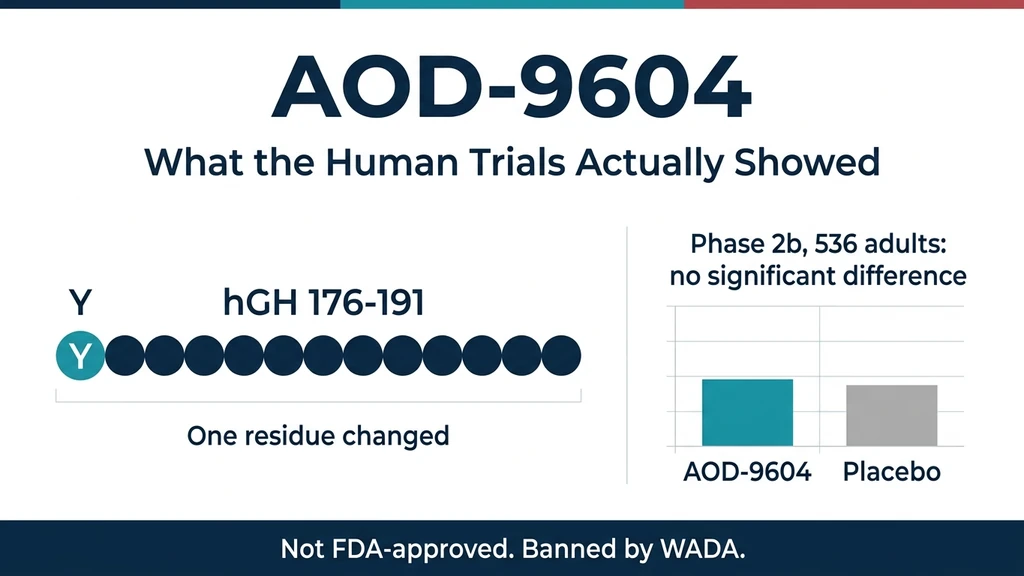
You are looking at a 5 mg vial labeled AOD 9604 and a vendor page promising it burns fat without touching your blood sugar. AOD 9604 is a 16 amino acid fragment of human growth hormone, engineered to keep hGH's fat releasing activity and drop everything else. It is not an approved drug, and its largest human trial, 536 adults over 24 weeks, found no statistically significant weight loss against placebo (Valentino et al., Clin Pharmacol Ther, 2010, PMID 20445536).
| Quick Reference | Details |
|---|---|
| What it is | Tyr-hGH(177-191), a 16 amino acid hGH C-terminal fragment |
| Developer | Metabolic Pharmaceuticals, Melbourne, Australia |
| Designed to do | Reproduce hGH lipolysis without IGF-1 or glucose effects |
| Best animal result | Over 50% less body weight gain in obese Zucker rats |
| Best human result | 2.6 kg loss vs 0.8 kg placebo, 12 weeks, oral 1 mg/day |
| Confirmatory trial | 536 adults, 24 weeks: no significant weight loss |
| Development status | Terminated 2007 |
| Routes tested in humans | Oral and intravenous only |
| FDA status | Not approved as a drug |
| WADA status | Prohibited at all times |
Two things are true at once. The safety record is genuinely clean: six randomized, double blind, placebo controlled trials found an adverse event profile indistinguishable from placebo, with no IGF-1 elevation and no antibody formation. The efficacy record is genuinely thin, and the trial that mattered missed.
This page covers what AOD 9604 is and what the evidence supports. For protocols and the side effect catalogue, see the AOD 9604 dosage and side effects guide. For what users report over 12 weeks, see AOD 9604 before and after. Educational content, not medical advice.
Get your custom peptide protocol:
- Tailored to your body and goals
- Precise dosing and cycle length
- Safe stacking combinations
- Backed by peer-reviewed studies
- Ready in under 2 minutes
What AOD 9604 Is, Down to the Amino Acid
Human growth hormone is a 191 residue protein. Its final sixteen residues, positions 176 through 191, read FLRIVQCRSVEGSCGF (UniProt P01241). AOD 9604 is that stretch with the phenylalanine at position 176 replaced by a tyrosine: YLRIVQCRSVEGSCGF. Anti-doping chemists write it as Tyr-hGH(177-191) (Cox et al., Drug Test Anal, 2015, PMID 25208511).
Take a house key and grind away every tooth except the one notch that lifts the garage door pin. The garage still opens. The front door, the back door, the shed: none of them move.
AOD 9604 is that filed down key. The fragment does not bind the growth hormone receptor, so IGF-1 does not rise, carbohydrate metabolism does not shift, and the tissue growth that follows full hGH therapy does not happen. Six randomized, double blind, placebo controlled trials confirmed the absent IGF-1 signal (Stier, Vos & Kenley, Journal of Endocrinology and Metabolism, 2013).
A key cut down to one notch is only useful when the thing you want is behind that one door. The human trials suggest the fat was not.
That single amino acid also separates AOD 9604 from the compound sold as HGH fragment 176-191, which carries the natural phenylalanine. They are different molecules with different evidence files, and vendors routinely treat the labels as interchangeable. AOD 9604 has six human trials behind it. The unmodified fragment has none. Anyone dosing either compound should read the HGH fragment dosage calculator inputs carefully, because the vial label frequently does not match the sequence inside.
What the Human Trials Actually Found
Metabolic Pharmaceuticals ran six human trials: two intravenous pilot studies, two oral pilot studies, and two oral efficacy trials in obese adults (Moré & Kenley, Journal of Endocrinology and Metabolism, 2014).
| Study | Participants | Route | Duration | Weight outcome |
|---|---|---|---|---|
| Phase 2a | ~300 obese adults | Oral | 12 weeks | 1 mg/day: 2.6 kg vs 0.8 kg placebo |
| Phase 2a, high dose arm | Same trial | Oral | 12 weeks | 10 mg/day: less weight loss than 1 mg/day |
| Phase 2b (OPTIONS) | 536 obese adults | Oral | 24 weeks | No statistically significant loss vs placebo |
| Four pilot studies | Small cohorts | 2 IV, 2 oral | Short | Safety and pharmacokinetics only |
The 12 week trial produced a 1.8 kg advantage over placebo at 1 mg per day. The same trial showed no dose response: participants on 10 mg per day lost less weight than participants on 1 mg per day (Valentino et al., Clin Pharmacol Ther, 2010). Development was terminated in 2007 after the 24 week trial in 536 subjects failed to produce significant weight loss.
The developers described the collapse plainly. "Effects of AOD9604 on weight loss were seen in initial trials but were not seen in the last study in which an intensive diet and exercise regime was incorporated" (Moré & Kenley, 2014). Put another way, once participants dieted and exercised, the drug added nothing measurable on top.
Not one of the six trials administered AOD 9604 subcutaneously. Every human dose on record went down the throat or into a vein. Daily subcutaneous injection, the route every vendor protocol recommends, has never been tested in a controlled human trial.
Two Ways AOD 9604 Costs You
Scenario one: paying for an effect the confirmatory trial could not find.
A standard research protocol runs 300 mcg per day for 12 weeks. That is 84 doses, 25,200 mcg, or 5.04 vials of 5 mg. At typical research-grade vendor pricing of $40 to $80 per vial, one cycle costs $202 to $403 before bacteriostatic water, syringes, and alcohol swabs. Run it twice a year and you have spent $404 to $806.
What you are buying is a 1.8 kg advantage that appeared once, in a 12 week oral trial, and then failed to reproduce in a trial nearly twice the size running twice as long. Semaglutide's pivotal trial produced 14.9% body weight loss over 68 weeks. AOD 9604's pivotal trial produced no significant difference from placebo. The fix is arithmetic: run the numbers in the peptide cost calculator against an intervention with a positive confirmatory trial before you spend anything.
The dose response failure is the sharper signal. A compound that works produces more effect at 10 mg than at 1 mg. AOD 9604 produced less. That pattern is what a drug looks like when the early result was noise.
Scenario two: reading "no IGF-1 effect" as "no risk."
The clean safety file describes pharmaceutical-grade tablets and supervised intravenous infusions given inside a clinical trial. It does not describe a lyophilized vial bought online, reconstituted on a kitchen counter, and injected daily for 12 weeks. Zero of the six trials tested that route.
The purity gap is documented. Belgian authorities seized unlabeled pharmaceutical preparations and needed mass spectrometry to establish that AOD 9604 was even in them (Vanhee et al., Drug Test Anal, 2014, PMID 24976118). Cox and colleagues note the peptide "was recently identified in confiscated vials in the USA."
For competitive athletes the downside is quantifiable. WADA prohibits growth hormone fragments at all times, in and out of competition, and the Prohibited List names AOD-9604 and hGH 176-191 explicitly. AOD 9604 does not disturb the standard WADA hGH isoform immunoassay (Orlovius et al., Drug Test Anal, 2013, PMID 24124033), so a normal growth hormone test proves nothing. Laboratories run a dedicated urine method with a 50 pg/mL limit of detection (Cox et al., Drug Test Anal, 2015). A tested athlete risks a multi-year sanction for a compound whose confirmatory trial found no benefit. Read do peptides show up on drug tests before you inject anything during a competitive season.
How to Spot a Mouse Effect That Never Reached Humans
AOD 9604 is a clean case study in a pattern that repeats across the peptide market. Five questions separate an animal finding from a human one, and every peptide page you read should answer all five.
- 1.Name the species. The lipolysis data comes from obese Zucker rats and ob/ob mice. Oral AOD 9604 at 500 mcg/kg for 19 days cut body weight gain by more than half, 15.8 g versus 35.6 g in controls (Ng et al., Horm Res, 2000, PMID 11146367). Rodents are not small humans.
- 1.Name the route. A drug that works orally in a mouse may fail subcutaneously in a person, and the reverse. Every AOD 9604 human dose was oral or intravenous. Every community protocol is subcutaneous. The evidence and the practice do not touch.
- 1.Look for dose response. More drug should produce more effect until it plateaus. In the 12 week trial, 10 mg per day underperformed 1 mg per day. A missing dose response usually means the effect was never there.
- 1.Ask whether the confirmatory trial replicated. Phase 2a found 1.8 kg over placebo in 300 people. Phase 2b found nothing in 536 people over twice the duration. The larger, longer trial is the one that counts.
- 1.Watch for safety language standing in for efficacy language. "Well tolerated," "no serious adverse events," and "indistinguishable from placebo" describe harm, not benefit. A sugar pill clears all three bars. When a vendor page leads with safety, check whether it ever states a weight loss number with a p-value attached.
Run those five questions against any compound before buying it. Our peptide safety guide applies the same filter across the categories.
Claim by Claim: Animal Evidence vs Human Evidence
Every claim on a typical AOD 9604 sales page traces back to one of these rows.
| Claim | Evidence in animals | Evidence in humans | Verdict |
|---|---|---|---|
| Stimulates lipolysis | Yes, obese Zucker rats and ob/ob mice (Ng 2000; Heffernan 2001) | Not measured as fat mass in any positive confirmatory trial | Animal only |
| Inhibits lipogenesis | Yes, isolated adipose tissue (Ng 2000) | Never tested | Animal only |
| Requires the beta-3 adrenergic receptor | Yes, beta-3 AR knockout mice were unresponsive (Heffernan, Endocrinology, 2001) | Never tested | Animal only |
| Produces weight loss | Over 50% reduction in body weight gain, oral 500 mcg/kg, 19 days | 2.6 kg vs 0.8 kg placebo at 12 weeks; nothing significant at 24 weeks in 536 adults | Failed to replicate |
| Does not raise IGF-1 | Not applicable | Confirmed across six RCTs (Stier 2013) | Supported |
| Does not impair glucose tolerance | Euglycemic clamp in rats showed no insulin resistance (Ng 2000) | No carbohydrate metabolism abnormality across six RCTs | Supported |
| Not immunogenic | Not applicable | No anti-AOD9604 antibodies detected (Stier 2013) | Supported for oral and IV |
| Repairs cartilage | Rabbit collagenase osteoarthritis model, 0.25 mg intra-articular weekly, better with hyaluronic acid (Kwon & Park, Ann Clin Lab Sci, 2015) | None | Animal only |
| Works by subcutaneous injection | Not the tested route | Zero controlled trials | Untested |
| Safe beyond six months | Not applicable | No human trial ran past 24 weeks | Unknown |
The pattern is consistent. Everything AOD 9604 is sold for rests on rodent and rabbit data. Everything AOD 9604 has proven in humans is a negative: it does not raise IGF-1, it does not wreck glucose tolerance, it does not provoke antibodies. Those are real findings. None of them is fat loss.
Regulatory Status: Approved, GRAS, and Banned Are Three Different Words
Not FDA approved. AOD 9604 has never been approved as a drug for any indication, in any country, by any route. Development stopped in 2007.
GRAS is not drug approval. In 2012 the developer self-affirmed Generally Recognized As Safe status for AOD 9604, "conditional on publication of pre-existing safety data, for its intended use in foods, drinks and dietary supplements" (Moré & Kenley, 2014). Self-affirmed GRAS means a company's own expert panel reached a safety conclusion. It is a food-ingredient designation covering things you swallow. It says nothing about efficacy, and nothing at all about injecting the compound under your skin.
Not compoundable in the United States. The FDA moved AOD 9604 into Category 2 of its interim 503A bulk drug substances list in 2023, citing immunogenicity, impurities, and limited human clinical data. On December 4, 2024, the Pharmacy Compounding Advisory Committee reviewed AOD-9604 free base and AOD-9604 acetate and voted against adding either to the 503A bulks list. Licensed compounding pharmacies cannot legally prepare it for patients.
Prohibited in sport at all times. The WADA Prohibited List, section S2.2, names "Growth Hormone fragments, e.g. AOD-9604 and hGH 176-191." Section S2 substances are banned in competition and out of competition, year round.
What remains is the research chemical channel, where vials are sold "for research use only" and are not manufactured, tested, or labeled as pharmaceuticals. For the wider legal picture see are peptides legal and our analysis of the FDA peptide crackdown.
Who AOD 9604 Is Actually For
Anyone treating clinical obesity has better options with orders-of-magnitude more evidence. Semaglutide produced 14.9% body weight loss over 68 weeks in a 1,961 patient trial. Tirzepatide produced 20.9% over 72 weeks. AOD 9604 produced no significant difference from placebo in 536 patients over 24 weeks. The gap is not close.
The rational case for AOD 9604 is narrow. Someone already lean, already dieting, already training, who wants a compound with an unusually clean endocrine profile and who accepts that the confirmatory human trial missed its endpoint. That is a bet on rodent data holding up in a route nobody tested. It is a defensible bet only if you can name it as one.
The most interesting unexplored branch is joints. Weekly intra-articular AOD 9604 improved cartilage scores in a rabbit osteoarthritis model, and the combination with hyaluronic acid outperformed either alone (Kwon & Park, Ann Clin Lab Sci, 2015, PMID 26275694). No human trial has tested this. Anyone reading that rabbit study as a treatment plan is repeating what the fat-loss market did in 2004. See peptides for joint pain for compounds with human data.
Newcomers to this category have no reason to begin with a compound whose own developer stopped funding it. Start somewhere with a positive trial and work outward.
Four Mistakes People Make With AOD 9604
Mistake 1: reading "well tolerated" as "works." Six trials found an adverse event profile indistinguishable from placebo. That sentence describes safety. The same six trials produced one 1.8 kg signal that a larger trial could not reproduce. Separate the two claims every time you read a vendor page.
Mistake 2: citing GRAS as FDA approval. GRAS was self-affirmed, conditional, and scoped to foods, drinks, and supplements. It is not a finding that the compound works, and it does not cover injection. A vendor calling AOD 9604 "FDA approved" is either confused or lying.
Mistake 3: assuming the 176-191 vial contains AOD 9604. Natural hGH 176-191 begins with phenylalanine. AOD 9604 begins with tyrosine. One amino acid, two molecules, two evidence files. The unmodified fragment has zero human trials.
Mistake 4: trusting a clean growth hormone test. AOD 9604 does not move the WADA hGH isoform immunoassay. Anti-doping laboratories screen for it with a separate urine assay that detects a stable metabolite down to 50 pg/mL. A normal GH panel is not evidence of anything.
For protocols, injection timing, and the full side effect table, the AOD 9604 dosage and side effects guide covers ground this page deliberately leaves alone.
Frequently Asked Questions
Does AOD 9604 actually work for weight loss?
The 24 week trial in 536 obese adults found no statistically significant weight loss versus placebo, and development stopped in 2007. An earlier 12 week trial showed 2.6 kg versus 0.8 kg on placebo at 1 mg daily, with no dose response. See AOD 9604 before and after for what that means in practice.
What is AOD 9604 made of?
Sixteen amino acids: YLRIVQCRSVEGSCGF. It reproduces the last sixteen residues of human growth hormone with tyrosine substituted for the natural phenylalanine at position 176. Chemists label it Tyr-hGH(177-191). That single swap distinguishes it from the compound sold as HGH fragment 176-191.
Is AOD 9604 FDA approved?
No. It has never been approved as a drug for any indication. It received self-affirmed GRAS status in 2012 as a food and supplement ingredient, which addresses safety when swallowed, not efficacy and not injection. For comparison with a growth-hormone-axis drug that did earn approval, see is tesamorelin FDA approved.
Is AOD 9604 banned by WADA?
Yes, at all times, in and out of competition. The Prohibited List names AOD-9604 explicitly under section S2.2, growth hormone fragments. Laboratories detect it in urine down to 50 pg/mL using a dedicated method, and a standard growth hormone test will not catch it. Details in do peptides show up on drug tests.
Why did the Phase 2b trial fail?
The 536 person, 24 week trial added an intensive diet and exercise program. Once participants were dieting and training, AOD 9604 added nothing measurable on top of placebo. The earlier positive result also lacked dose response, since 10 mg daily produced less weight loss than 1 mg daily. Our peptide safety guide explains how to read these signals.
Can AOD 9604 be stacked with semaglutide or tirzepatide?
The mechanisms do not overlap, and no controlled study has tested the combination. Given that AOD 9604 failed its own confirmatory trial, adding it to a GLP-1 agonist buys unproven benefit at real cost. Verify any combination with the peptide interaction checker before you plan a protocol.
How much does an AOD 9604 cycle cost?
At 300 mcg daily for 12 weeks you need 25,200 mcg, or roughly five 5 mg vials. At $40 to $80 per vial that is $202 to $403 per cycle, before bacteriostatic water and syringes. Compare against interventions with positive trials using how much peptides cost.
Where can you legally buy AOD 9604?
Nowhere, as a medicine. US compounding pharmacies cannot prepare it after the December 2024 advisory committee vote, and no approved product exists. Remaining supply is sold as a research chemical, outside pharmaceutical manufacturing standards. Read where to buy peptides in 2026 for what that channel actually involves.
The Bottom Line
AOD 9604 is a 16 amino acid fragment of human growth hormone, tyrosine at the front, designed to keep hGH's fat releasing activity and shed its effects on IGF-1 and blood glucose. The design worked. Six human trials confirm no IGF-1 elevation, no glucose disruption, no antibodies. The 536 patient, 24 week confirmatory trial found no statistically significant weight loss against placebo, and development ended in 2007.
Isolating one function of a hormone is a real achievement. Whether that isolated function does anything useful in a human body is a separate question, and for AOD 9604 the honest answer is that the trial designed to answer it came back negative.
Read the animal data as animal data. Ask which route was tested. Ask whether the bigger trial replicated the smaller one. Those three habits protect you across every compound on the market, not just this one.
Explore peptide profiles, dosage calculators, and evidence reviews at PeptidesExplorer.
This is educational content about a research compound. Consult a healthcare provider before using any peptide.
Related Articles
AOD-9604 Before and After: Results
AOD-9604 before and after results are modest: 2-3 kg fat loss over 12 weeks in clinical trials. Learn realistic timelines and dosing protocols.
Peptides for Bodybuilding (2026)
Best peptides for bodybuilding: BPC-157, TB-500, MK-677, CJC-1295/Ipamorelin, HGH Fragment 176-191. Dosages and stacking protocols.
HGH Fragment 176-191 Dosage: What Research Supports
HGH Fragment 176-191 dosage: 250-500 mcg/day subcutaneous, fasted, 8-12 week cycles. Unit math for 2 mg and 5 mg vials, rodent vs human evidence, safety.
GHRP-6 Peptide: Dosage Chart, Benefits & Hunger
GHRP-6 dosage chart (100 to 300 mcg tiers), how the ghrelin mimetic triggers GH release, the hunger effect, CJC-1295 stacking, and honest side effect data.