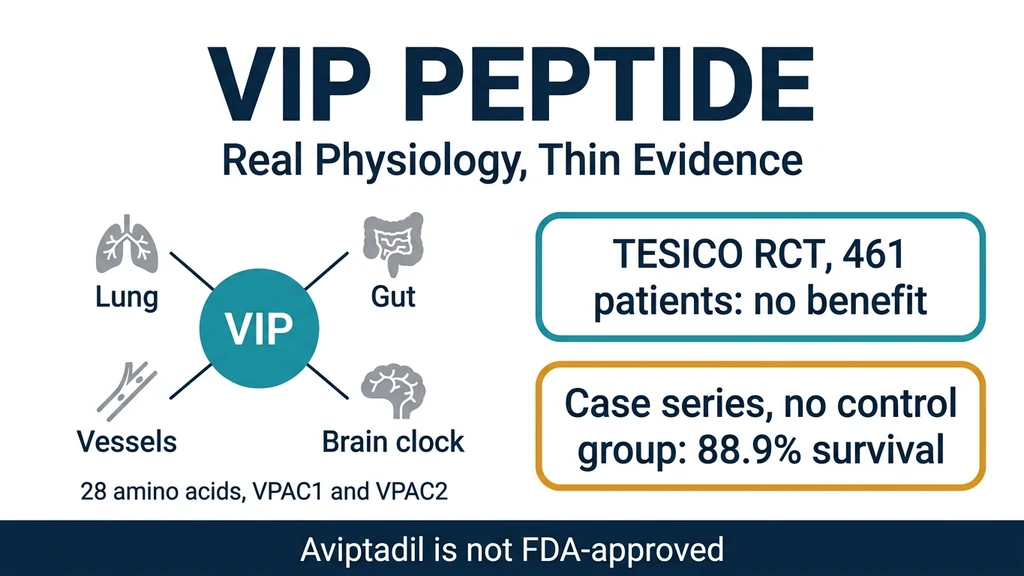
A clinic quoted you a few hundred dollars a month for a VIP nasal spray and told you it would fix mold illness. Here is the honest answer. VIP is vasoactive intestinal peptide, a 28-amino-acid signalling molecule your body already makes, with well-documented effects on blood vessels, airways, gut, and immune cells. The mold-illness protocol built around it has never been tested in a randomised controlled trial.
| Quick Reference | Details |
|---|---|
| What it is | Vasoactive intestinal peptide, 28 amino acids |
| Family | Secretin/glucagon superfamily |
| Receptors | VPAC1 and VPAC2 (class B GPCRs) |
| Endogenous roles | Vasodilation, bronchodilation, gut secretion, immune modulation, circadian signalling |
| Plasma half-life | Roughly 1 to 2 minutes |
| Synthetic version | Aviptadil |
| FDA approved? | No, for any indication |
| Best-known use | Intranasal "CIRS" protocol (unproven) |
| Largest RCT | TESICO, 461 patients, no benefit |
| Chronic excess | VIPoma: 6 to 8 L/day of watery stool |
Two separate things travel under the name "VIP peptide." One is real endogenous physiology with decades of solid research behind it. The other is a commercial intranasal protocol whose entire published evidence base is a handful of uncontrolled reports written by the person who invented the protocol. Every citation below is linked so you can check the gap yourself. Read our peptide safety guide alongside this.
Get your custom peptide protocol:
- Tailored to your body and goals
- Precise dosing and cycle length
- Safe stacking combinations
- Backed by peer-reviewed studies
- Ready in under 2 minutes
What VIP Actually Does in the Body
VIP was isolated from intestinal tissue and named for the first thing it was seen doing: dilating blood vessels. It is 28 amino acids long and belongs to the secretin/glucagon superfamily, which makes it a structural cousin of PACAP, secretin, and glucagon.
It signals through two class B G-protein-coupled receptors, VPAC1 and VPAC2, both of which bind VIP with high affinity and require the entire 28-residue peptide for full engagement (Couvineau & Laburthe, Br J Pharmacol, 2012). A third receptor, PAC1, binds VIP only weakly.
Those two receptors are scattered across very different tissues, which is why one peptide produces such an unrelated-looking list of effects. Airway smooth muscle relaxes. Intestinal epithelium secretes water and electrolytes. T cells shift toward a regulatory phenotype (Delgado & Ganea, Amino Acids, 2013). In the suprachiasmatic nucleus, VIP holds the clock neurons in phase with each other; mice lacking it lose behavioural rhythmicity (Aton et al., Nature Neuroscience, 2005).
One pharmacological fact governs everything downstream. Circulating VIP survives roughly one to two minutes before peptidases destroy it. Even inhaled synthetic VIP produced pulmonary vasodilation that was "modest and short-lived" (Leuchte et al., Eur Respir J, 2008). A molecule that disappears that fast was built for local paracrine signalling, not for circulating hormone duty. If you want to see how peptide half-lives shape dosing schedules, the peptide half-life tracker makes the arithmetic visible.
One Broadcast, Different Receivers
Picture a stadium PA system announcing "clear the concourse." The groundskeeper starts sweeping. Security walks the aisles. The kitchen crew locks the shutters. Same broadcast, three unrelated actions, because each crew is trained to hear that phrase differently.
VIP works the same way. It is one signal, released from nerve terminals and immune cells, and what happens next depends entirely on which receptor the receiving tissue carries and what that tissue is wired to do. VPAC1 predominates in the gut epithelium and liver. VPAC2 predominates in vascular and airway smooth muscle, pancreatic beta cells, and clock neurons.
Literally: VIP has no single effect. Its output is determined by VPAC1 and VPAC2 distribution across tissues, and both receptors couple to adenylate cyclase, raising intracellular cAMP in whatever cell they sit on. Relaxation in a muscle cell, secretion in a gut cell, suppression in a T cell.
That is the mechanism behind the sprawling benefit lists you see on peptide vendor pages. Vasodilation, bronchodilation, gut secretion, inflammation control, and sleep-wake timing are all real VIP biology. None of them are the same thing as a clinical benefit from a supplemented dose.
The CIRS Protocol: What Is Claimed, What Exists
Almost all consumer search interest in VIP traces to one source. Dr Ritchie Shoemaker built a treatment protocol for what he named Chronic Inflammatory Response Syndrome (CIRS), a multi-system illness he attributes to biotoxin exposure in water-damaged buildings. Intranasal VIP is the final step in that protocol.
The claim is specific. Compounded VIP nasal spray at 50 mcg per spray, four to eight sprays daily, is said to normalise MMP-9, TGF-beta-1, C4a, and VEGF, restore pituitary axis regulation, and even reverse grey matter atrophy on MRI.
The evidence for that claim is three publications: a 2013 paper in *Health*, a 2016 paper in *Medical Research Archives*, and a 2017 paper in *Internal Medicine Review*. Shoemaker is an author on all three. None is randomised. None has a placebo group. None appears in PubMed. Searching PubMed for Shoemaker plus vasoactive intestinal peptide returns two papers from the 1980s by a different author entirely.
The diagnostic category itself sits outside mainstream medicine. Allergy and immunology bodies recognise that indoor mold causes asthma exacerbation, allergic rhinitis, and hypersensitivity pneumonitis, and have found no support for a distinct multi-system biotoxin illness (Bush et al., J Allergy Clin Immunol, 2006). CIRS has no ICD code and no professional-society guideline.
None of that proves the protocol does nothing. It means the protocol has never been tested in a way that could tell the difference between the drug and the expectation of the drug. Compounded peptides also sit in a shifting regulatory zone; see are peptides legal for where nasal-spray compounding currently stands.
What the Controlled Trials Found
Synthetic VIP has a generic name, aviptadil, and it has been through real trials. Those trials are the closest thing to a clean read on whether supplementing VIP does anything.
COVID-19 respiratory failure. The TESICO trial randomised 461 patients with COVID-associated hypoxaemic respiratory failure to intravenous aviptadil or placebo, escalating from 600 to 1,800 pmol/kg over three days. The odds ratio for a better outcome at day 90 was 1.11 (95% CI 0.80 to 1.55, p = 0.54). Mortality was 38% on aviptadil versus 36% on placebo. The data and safety monitoring board stopped the aviptadil arm for futility (Brown et al., Lancet Respir Med, 2023).
A 2025 systematic review pooled the randomised evidence in ARDS and found a survival odds ratio of 1.01 (95% CI 0.72 to 1.42, p = 0.93). The seven uncontrolled case series in the same review reported 88.9% survival (Udupa et al., Indian J Crit Care Med, 2025). Hold those two numbers next to each other. The controlled data say nothing happened. The uncontrolled data look spectacular. Aviptadil has never been FDA approved for any indication.
Sarcoidosis. Twenty patients inhaled nebulised VIP for four weeks in an open-label phase II study. TNF-alpha production by bronchoalveolar cells fell significantly and regulatory T cells rose (Prasse et al., Am J Respir Crit Care Med, 2010). Real immunological movement, no control arm, no clinical outcome.
Pulmonary hypertension. Eight patients with primary pulmonary hypertension received inhaled VIP in an open-label study; mean pulmonary artery pressure fell and cardiac output rose (Petkov et al., J Clin Invest, 2003). A later acute study in 20 patients found the pulmonary vasodilation real but small and temporary (Leuchte et al., Eur Respir J, 2008). Two decades on, no approved VIP therapy for pulmonary hypertension exists.
The pattern repeats across every indication. Mechanism, yes. Surrogate markers, sometimes. Patient outcomes in a controlled trial, no.
Danger Scenario 1: What Chronic VIP Excess Actually Looks Like
Medicine already ran the experiment on sustained high VIP. It is called a VIPoma, a rare neuroendocrine tumour that secretes VIP without a brake. No competitor page discussing "VIP benefits" mentions it.
Normal fasting plasma VIP sits below about 70 pg/mL. A VIPoma is diagnosed above roughly 203 pg/mL, and the median value in confirmed cases is around 630 pg/mL, about nine times the upper limit of normal, with reported values running far higher (de Herder & Hofland, VIPoma, Endotext (NCBI Bookshelf)).
At those concentrations, VPAC1 receptors on the intestinal epithelium never stop firing. A healthy adult loses roughly 100 to 200 mL of water per day in stool. A severe VIPoma patient passes 6 to 8 litres, a 30- to 60-fold increase, and the diarrhoea continues through fasting. Potassium and bicarbonate leave with it, producing hypokalaemia and metabolic acidosis. Gastric acid secretion shuts down, giving achlorhydria. That triad is the syndrome. Roughly half of patients also develop hypercalcaemia, and 15% to 30% flush (Karele & Solis, Presse Med, 2024). Five-year survival is above 90% when the tumour is localised and about 60% once it has metastasised.
The honest reading: a 50 mcg intranasal spray does not reproduce a VIPoma. Circulating VIP clears in one to two minutes, and nasal absorption is a fraction of the dose. What VIPoma establishes is the direction of travel and the tissue that breaks first. Sustained VIP receptor agonism empties the gut, dumps potassium, and stops acid secretion. Anyone escalating VIP on their own, dosing eight sprays a day for months, or stacking it with other secretory agents should know which organ writes the first warning. New watery diarrhoea, muscle weakness, or cramping on a VIP protocol means stop the spray and call your doctor. The same logic applies to any peptide that acts on gut secretion and motility.
Danger Scenario 2: The Arithmetic of an Untested Protocol
The second harm is financial, and the numbers are easy to run. Compounded VIP nasal spray sells through telehealth and compounding pharmacies for roughly $189 to $439 per month. The Shoemaker protocol positions VIP as a final step used for months, and clinicians describe treatment windows beyond 12 weeks at more than six doses per day.
Take the low end. Twelve months at $189 is $2,268. Add the CIRS lab panel that gates entry to the protocol (C4a, TGF-beta-1, MMP-9, VEGF, MSH, VCS testing), typically several hundred to over a thousand dollars, largely uninsured. Add the prerequisite steps, binders, nasal antibiotics, remediation. A complete run past $4,000 is ordinary. At the $439 tier, twelve months alone is $5,268.
Now price the evidence you are buying. Zero randomised controlled trials. Zero placebo comparisons. Three uncontrolled reports, all co-authored by the protocol's originator, none indexed in PubMed. The one large placebo-controlled trial of synthetic VIP in humans enrolled 461 patients, found an odds ratio of 1.11 with a confidence interval crossing 1, and was halted for futility.
Contrast that with the "over 10,000 patients treated" figure cited in protocol marketing. Ten thousand uncontrolled treatments cannot answer the only question that matters, because there is no group of ten thousand who took the placebo. The 2025 ARDS review is a clean demonstration: case series showed 88.9% survival and the randomised data showed an odds ratio of 1.01. Same drug, opposite stories, and only one of them controlled for who gets better anyway.
Before committing, price the full course honestly with the peptide cost calculator, and compare against what peptide therapy costs across the field.
How to Audit Any Protocol Whose Evidence Is a Case Series
This skill generalises far beyond VIP. Peptide medicine is full of protocols whose citation list is a case series written by the person selling the protocol. Six questions expose them in about fifteen minutes.
1. Find the actual citation, not the claim. Vendor pages say "clinically proven" and link to nothing. Demand the author, journal, year. If the page cannot produce one, the audit is already over.
2. Search the citation in PubMed. Go to pubmed.ncbi.nlm.nih.gov and search the exact title. Indexing is not a guarantee of quality, but absence from PubMed means the journal cleared no indexing standard at all. All three VIP/CIRS papers fail here.
3. Ask what the control group did. A study without a control group cannot separate the drug from regression to the mean, from remediation of the mold exposure, from placebo response, or from time. Every uncontrolled series looks like a miracle. The aviptadil case series reported 88.9% survival and the randomised trials found no survival benefit at all.
4. Check who authored it against who profits. When the trial author, the diagnostic criteria author, the certifying body, and the treatment vendor are the same network, no independent party has ever tried to falsify the claim.
5. Look for a single independent replication. One outside group, no financial stake, same result. For intranasal VIP in CIRS, after roughly eighteen years, there is none.
6. Check the outcome measure. "Normalises C4a and TGF-beta-1" is a surrogate the protocol's author selected and interprets. "Fewer deaths at day 90" is an outcome nobody can spin. Surrogate improvement with no outcome data is where most peptide claims live.
Run those six on any peptide before you buy it. Run them on the vendor too; where to buy peptides in 2026 covers the sourcing side, and getting started with peptides covers the rest.
VIP Evidence Table: Claim by Claim
Every widely marketed VIP claim, the setting it was tested in, the strongest evidence that exists, and the verdict.
| Claim | Setting | Strongest evidence | Verdict |
|---|---|---|---|
| Corrects CIRS / mold illness | Intranasal, compounded | Uncontrolled case series, protocol originator, not PubMed-indexed | Unproven |
| Restores grey matter volume | Intranasal | Uncontrolled imaging series, same author, no control arm | Unproven |
| Treats chronic fatigue / SEID | Intranasal | No controlled data | Unproven |
| Improves survival in COVID ARDS | IV aviptadil | RCT, n=461, OR 1.11 (0.80 to 1.55), p=0.54, stopped for futility | No benefit |
| Improves survival in ARDS overall | IV aviptadil | Meta-analysis of 2 RCTs, survival OR 1.01 (0.72 to 1.42) | No benefit |
| Lowers pulmonary artery pressure | Inhaled | Open-label n=8; acute study n=20, effect small and short-lived | Weak signal, no approval |
| Dampens lung inflammation | Inhaled, sarcoidosis, 4 weeks | Open-label phase II, n=20, TNF-alpha fell, Tregs rose | Mechanistic only |
| Induces regulatory T cells | Human BAL cells + preclinical | Peer-reviewed, replicated | Established biology |
| Vasodilation and bronchodilation | Human and animal | Peer-reviewed, replicated | Established biology |
| Circadian pacemaker signalling | Mouse SCN | VIP-null mice lose rhythmicity | Established biology |
| Drives intestinal water secretion | Human, VIPoma | 6 to 8 L/day watery stool at pathological levels | Established, and the risk ceiling |
Read that table as two blocks. The bottom half is textbook physiology nobody disputes. The top half is what people are being sold. Very little travels from one block to the other, which is the ordinary fate of most endogenous signalling molecules when they are given as drugs. Compare with better-supported immune peptides such as thymosin alpha-1 and LL-37.
Common Mistakes With VIP Peptide
Mistake 1: Treating "your body already makes it" as a safety argument. Your body makes VIP at picomolar concentrations, in nerve terminals, for one to two minutes at a time. Insulin is also endogenous, and a wrong dose kills. Endogenous origin says nothing about the safety of an exogenous dose eight times a day for a year. The fix: judge a dose by trial data, not by provenance.
Mistake 2: Reading "10,000 patients treated safely" as evidence it works. Safety in an uncontrolled population and efficacy are different questions, and neither is answered without a comparison group. The 2025 ARDS review put the two side by side: 88.9% survival in case series, an odds ratio of 1.01 in the randomised data. The fix: ask for the control arm before you ask for the testimonial.
Mistake 3: Believing the aviptadil press releases and ignoring the trial. Company statements in 2021 described a 35% higher likelihood of recovery. The federally funded randomised trial that followed enrolled 461 patients and was stopped for futility, with mortality of 38% versus 36%. Serious adverse events by day 5 ran 63% on aviptadil against 56% on placebo, a difference that did not reach significance but pointed the wrong way. The fix: weigh the day-90 endpoint above the press release.
Mistake 4: Buying research-grade VIP powder and dosing it nasally. Unregulated powder carries no purity, sterility, or content assurance, and VIP is fragile enough that handling and storage errors silently destroy the peptide before it reaches you. Nasal delivery of a self-reconstituted peptide adds a mucosal infection route. The fix: if you pursue VIP at all, do it through a licensed prescriber and a compounding pharmacy, and read how to store peptides first. Check combinations with the peptide interaction checker.
Frequently Asked Questions
What is VIP peptide?
VIP is vasoactive intestinal peptide, a 28-amino-acid neuropeptide in the secretin/glucagon superfamily. It signals through the VPAC1 and VPAC2 receptors to dilate blood vessels, relax airways, drive intestinal water secretion, modulate immune cells, and synchronise circadian clock neurons. Its plasma half-life is roughly 1 to 2 minutes. See peptides for immune system.
What are the benefits of VIP peptide?
Documented biology includes vasodilation, bronchodilation, gut secretion, regulatory T-cell induction, and circadian signalling. Clinical benefit from supplementing VIP is another matter: the largest randomised trial, 461 patients, found no benefit. Treat the physiology as established and the therapeutic claims as unproven. Review our peptide safety guide.
What is the VIP peptide dosage used in protocols?
The published CIRS protocol describes compounded intranasal VIP at 50 mcg per spray, four to eight sprays daily, continued for months. Trials of intravenous aviptadil used 600 to 1,800 pmol/kg per day for three days. These are reported doses, not recommendations, and none is FDA approved. Price a full course with the peptide cost calculator.
What are VIP peptide side effects?
Reported effects include flushing, headache, low blood pressure, and diarrhoea, all predictable from vasodilation and gut secretion. In the TESICO trial, serious adverse events by day 5 occurred in 63% on aviptadil versus 56% on placebo. New watery diarrhoea or muscle weakness warrants stopping. See peptide therapy side effects.
Does VIP nasal spray treat mold illness or CIRS?
No controlled trial has tested it. The evidence consists of three uncontrolled reports co-authored by the protocol's originator, none indexed in PubMed, none with a placebo group. CIRS has no ICD code and no professional-society guideline. Compounded VIP nasal spray runs roughly $189 to $439 per month. See are peptides legal.
Is VIP peptide FDA approved?
No. Synthetic VIP (aviptadil) holds orphan drug and fast track designations for ARDS and pulmonary hypertension, which are procedural statuses, not approvals. The FDA has never approved VIP for any indication. Compounded nasal formulations are prescriber-directed and not FDA-evaluated. See the FDA peptide crackdown for current enforcement.
What happens if the body makes too much VIP?
A VIPoma, a VIP-secreting tumour, drives plasma VIP to a median around 630 pg/mL against a normal ceiling near 70 pg/mL. Patients pass 6 to 8 litres of watery stool daily against a normal 100 to 200 mL, with hypokalaemia and achlorhydria. That is the ceiling of VIP receptor agonism. See peptides for gut health.
Are there better-evidenced peptides for immune support?
Thymosin alpha-1 has been studied in hepatitis B, sepsis, and vaccine adjuvancy with human trial data behind it, and LL-37 is a well-characterised antimicrobial peptide. Neither is FDA approved for general immune support either, but both have more independent evidence than intranasal VIP. See thymosin alpha-1 benefits and LL-37 peptide benefits.
The Bottom Line
VIP peptide is vasoactive intestinal peptide, 28 amino acids acting on VPAC1 and VPAC2 receptors to dilate vessels, relax airways, move water across the gut wall, quiet immune cells, and keep the circadian clock in phase. That physiology is settled science. The intranasal protocol sold for mold illness rests on three uncontrolled papers by its own originator, and the only large placebo-controlled trial of synthetic VIP in humans, 461 patients, was stopped for futility.
A peptide can be biologically real and therapeutically unproven at the same time. VIPoma shows what sustained VIP receptor agonism does to a human being: 6 to 8 litres of watery stool a day, potassium stripped out, acid secretion gone. Know that outer boundary before you escalate anything.
If you are weighing a VIP protocol, run the six-question audit on it: find the citation, search PubMed, name the control group, check whether the author sells the treatment, look for one independent replication, and ask whether the outcome is a surrogate. Price the full course with the peptide cost calculator, read the peptide safety guide, and bring the trial data to a clinician who will read it with you. More evidence-first peptide guides at peptidesexplorer.com.
Helpful Tools
Related Articles
KPV Peptide Benefits: What the Evidence Shows
KPV peptide benefits ranked by evidence: strong preclinical colitis data, plausible skin effects, weak systemic claims. No registered human trial exists.
Peptides for Healing: What the Evidence Shows
Peptides for healing by tissue: tendon, bone, wound, gut, post-surgery. Which claims rest on human trials, which rest on rat studies, and what is unsafe.
Peptides for Psoriasis: The Evidence
Peptides for psoriasis: the honest evidence on KPV, GHK-Cu, BPC-157, and why LL-37 drives the disease rather than treating it. See a dermatologist.
Peptides for Eczema: What Helps?
Peptides for eczema: which ones support skin barrier repair and inflammation, the evidence behind GHK-Cu and KPV, safety cautions, and what they cannot replace.